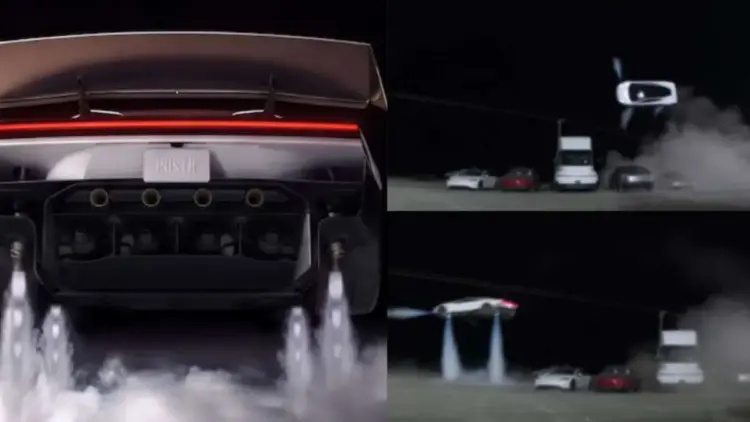
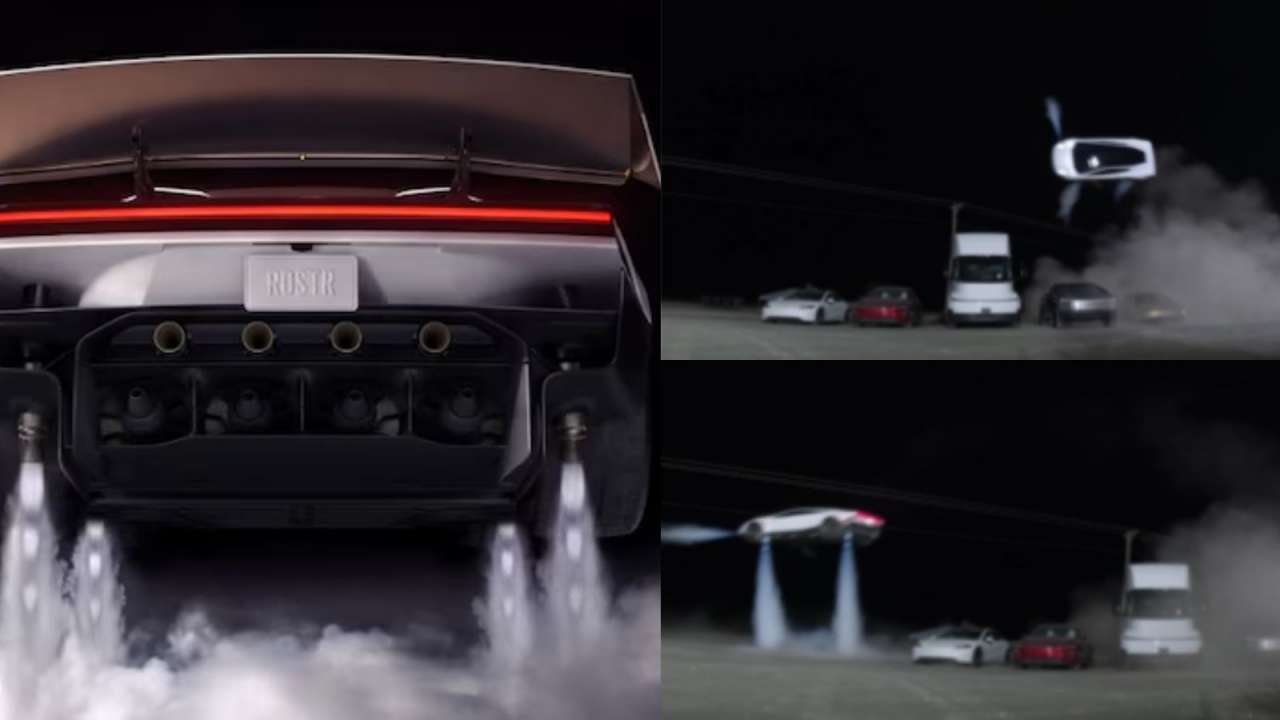
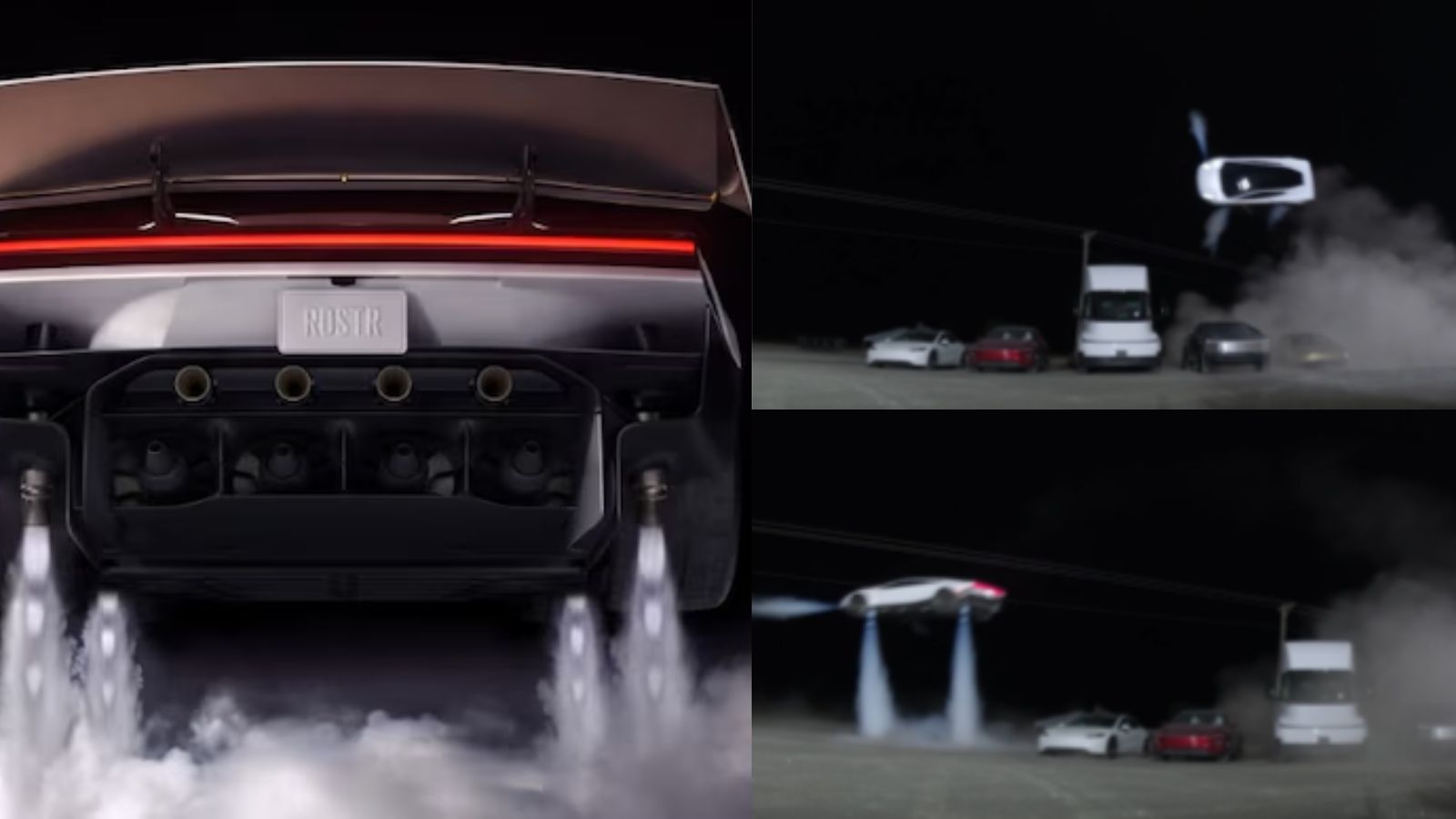
AUSTIN, TEXAS – October 16, 2026 – Tesla, the pioneering electric vehicle manufacturer, has once again shattered automotive conventions, unveiling a new iteration of its highly anticipated Roadster that promises to redefine the boundaries of speed, performance, and mobility. With claims of a mind-bending 0-100 km/h acceleration in just 0.81 seconds and the astonishing ability to perform aerial maneuvers like jumping and barrel rolls using an integrated system of ten rocket thrusters, the upcoming Roadster is poised to be more than just a car – it’s a statement about the future of transportation. Slated for a 2028 launch, this hypercar will be offered in three distinct variants: Performance, Thrust, and an exclusive, invite-only Rocket model, marking a significant leap forged in collaboration with Elon Musk’s aerospace venture, SpaceX.
The revelation, demonstrated at an event in Texas, showcased a prototype defying gravity, hinting at a future where road-legal vehicles blur the lines between asphalt and air. Tesla CEO Elon Musk’s ambitious vision, long a subject of speculation and anticipation, appears to be nearing fruition, promising a vehicle that could potentially outpace any supercar ever conceived. While the base Performance model retains an incredible electric powertrain, it is the mid-tier Thrust and the top-tier Rocket variants that truly push the envelope, integrating advanced propulsion systems derived from space exploration technology. The Rocket variant, in particular, is described as a single-seater marvel equipped with a complete flight system and ten thrusters, rechargeable via onboard compressors and compressed gas. This level of innovation not only promises unparalleled performance but also opens a Pandora’s Box of regulatory, safety, and ethical considerations that the automotive world has yet to fully grapple with.
A Legacy Reimagined: The Roadster’s Journey
The new Roadster isn’t just a standalone project; it’s the culmination of Tesla’s journey, dating back to its very inception. Its history is one of audacious vision, technological ambition, and persistent delays, building a narrative that has captivated both automotive enthusiasts and skeptics alike.
From Humble Beginnings: The First Generation (2008-2012)
The original Tesla Roadster holds a seminal place in automotive history. Launched in 2008, it wasn’t merely Tesla’s first production vehicle; it was the world’s first highway-legal, mass-produced all-electric car to use lithium-ion battery cells. Based on the chassis of the lightweight Lotus Elise, the first Roadster proved that electric vehicles could be exhilarating, desirable, and capable of long-distance travel, challenging the prevailing notion that EVs were golf carts or glorified appliances. It offered a range of over 300 kilometers and brisk acceleration, laying the groundwork for Tesla’s future success and proving the viability of high-performance electric cars. This initial success was critical in attracting investors, talent, and public attention, transforming Tesla from a startup into a serious contender in the automotive landscape. It was a halo car that cemented Tesla’s identity as an innovator, a disruptor, and a harbinger of the electric revolution.
)
The Grand Unveiling: Second Generation’s Debut (2017)
Fast forward to November 2017, when Elon Musk dramatically unveiled the second-generation Roadster at the Tesla Semi event. The presentation was a shocker, revealing a sleek, futuristic four-seater sports car with performance figures that seemed almost mythical at the time. Musk promised a 0-96 km/h (0-60 mph) sprint in 1.9 seconds, a quarter-mile in 8.8 seconds, and a top speed exceeding 400 km/h. Most astonishingly, he claimed a staggering 1,000-kilometer (620-mile) range on a single charge – a figure that remains unmatched by any production EV today.
During this initial reveal, Musk also teased the "SpaceX package," a conceptual upgrade that would add cold-gas thrusters to the car, enhancing acceleration and potentially enabling short hops. This early mention of rocket technology hinted at the radical direction the Roadster would eventually take, positioning it not just as a fast EV but as a vehicle pushing the boundaries of what’s physically possible for a road car. The initial price was set at $200,000 for the base model, with a "Founders Series" priced at $250,000, requiring a $50,000 deposit. The enthusiasm was palpable, with many viewing it as a clear signal of Tesla’s intent to dominate the high-performance segment.

A Decade of Delays and Anticipation (2017-Present)
Following its spectacular unveiling, the second-generation Roadster quickly became emblematic of Tesla’s ambitious promises and its challenges in bringing revolutionary products to market. Initial delivery was targeted for 2020, but the date slipped repeatedly. The reasons for these delays were multifaceted, including the intense production ramp-up of the Model 3, the development and launch of the Model Y, and more recently, the complexities of bringing the Cybertruck to production. Global supply chain disruptions, particularly during and after the pandemic, further exacerbated these issues.
Musk himself has been candid about the challenges, acknowledging that the Roadster was "not a priority" compared to the high-volume models critical for Tesla’s growth and profitability. He often cited the immense engineering hurdles in achieving the promised performance and range, especially with the integration of highly experimental technologies like the thruster system. Each delay, while frustrating for depositors, also served to heighten anticipation, creating a mystique around the car. It transformed from a mere supercar into an almost mythical object, a symbol of Tesla’s relentless pursuit of innovation, even if it meant pushing deadlines further and further into the future. The wait has been long, but the latest demonstration suggests that the engineering team has been hard at work behind the scenes.
)
The 2028 Horizon: A New Promise
The latest announcement, firmly setting the launch for 2028, places the new Roadster nearly a decade after its initial reveal. This revised timeline, while still distant, comes with the most concrete and astounding performance claims yet. It suggests that Tesla has not only resolved many of the technical challenges but has also significantly advanced the "SpaceX package" concept into a tangible, albeit highly exclusive, reality. The 2028 date allows for further refinement, regulatory navigation, and the establishment of production capabilities for such a technologically complex vehicle. It signifies a renewed commitment to delivering on the Roadster’s extraordinary potential, albeit on a much longer timeline than originally envisioned, but with capabilities far beyond initial promises.
Engineering the Extraordinary: Deep Dive into Roadster’s Technology
At the heart of the new Roadster’s audacious claims lies a blend of cutting-edge electric powertrain technology and aerospace engineering, a testament to the synergistic relationship between Tesla and SpaceX.
)
Unprecedented Acceleration: The 0.81-Second Marvel
The claim of 0-100 km/h in a staggering 0.81 seconds is not just fast; it’s a paradigm shift in automotive performance. To put this into perspective, the fastest production cars today typically achieve this feat in the 2-second range, with hypercars like the Rimac Nevera and Koenigsegg Jesko approaching 1.8-1.9 seconds. The Roadster’s stated acceleration is not merely an improvement; it’s a leap into an entirely new dimension of speed, possibly placing it in a league of its own, outperforming even purpose-built dragsters and specialized racing machines.
Achieving such acceleration requires an immense amount of power delivered instantaneously, coupled with an unprecedented level of traction management. While the exact power figures are yet to be disclosed, it’s safe to assume the Rocket variant will utilize multiple high-output electric motors, likely one per wheel, enabling precise torque vectoring. The critical factor, however, is not just power, but the ability to convert that power into forward motion without wheelspin. This is where the integrated thruster system and the fan-based suction technology become crucial, providing additional thrust and downforce to pin the car to the ground, maximizing grip beyond what conventional tires alone can offer. The physics involved are pushing the limits of current automotive engineering, requiring lightweight composite materials, advanced battery technology capable of extreme power discharge, and sophisticated control systems to manage the immense forces involved.
)
The Three Pillars: Performance, Thrust, and Rocket Variants
Tesla’s strategy for the new Roadster involves three distinct models, each offering a progressive level of technology and exclusivity, catering to different echelons of ultra-high-performance enthusiasts.
-
Performance Variant: This is the "entry-level" model, if such a term can be applied to a car of this caliber. Priced at an estimated $50,000 (though this figure needs re-verification as it seems remarkably low for a supercar, potentially indicating a deposit or an early-bird price that has since evolved), the Performance variant is still expected to be blisteringly fast, likely achieving acceleration figures that would humble most existing supercars. Crucially, as clarified in the latest information, this variant does not incorporate rocket thrusters. Its immense speed will be purely derived from its electric powertrain, advanced aerodynamics, and lightweight construction, making it a formidable electric hypercar in its own right, without the complexities of external propulsion.
)
-
Thrust Variant: Positioned as the mid-tier option, the Thrust variant introduces the first taste of aerospace-inspired technology. It incorporates "rear-facing boosters" designed to provide improved acceleration. While not a full flight system, these boosters likely provide supplementary thrust during launches, augmenting the electric motors’ output to achieve even faster sprint times. This variant requires a substantial USD 250,000 deposit, indicating its elevated status and limited availability. The exact nature of these "boosters" — whether compressed air, small chemical rockets, or another mechanism — remains to be fully detailed, but their purpose is clear: to push the car’s acceleration capabilities beyond conventional limits.
-
Rocket Variant: This is the undisputed pinnacle of the Roadster lineup and the centerpiece of Tesla’s audacious claims. The Rocket variant is equipped with a "complete flight system" and an array of ten thrusters strategically placed around the vehicle. Described as a single-seater, this invite-only model is where the true "flying car" aspirations materialize. The thruster system operates using compressed gas, which is recharged by onboard compressors, suggesting a self-contained and reusable propulsion mechanism. While "full flight" might imply sustained aerial travel, the demonstrations of "jumping and barrel rolling" suggest limited, controlled aerial maneuvers rather than prolonged aviation. This variant embodies the most radical aspects of the Roadster’s design, blending automotive engineering with principles typically reserved for spacecraft. The invite-only nature underscores its extreme exclusivity and Tesla’s likely intention to carefully curate its initial owners, perhaps involving them in feedback for future developments. Details regarding purchaser selection criteria and production numbers for this hyper-exclusive model are yet to be disclosed.
)
Beyond Thrusters: The Suction System and Downforce
Common across all three variants is an innovative fan-based suction system, a technology more commonly found in high-performance track cars or specialized racing prototypes. Tesla states this system can generate up to 2G of downforce. This immense force, created by actively sucking air from beneath the car to create a low-pressure zone, effectively glues the vehicle to the road. This significantly enhances grip, cornering speeds, and overall stability, particularly at high velocities. During the unveiling event, the car was showcased driving down a ramp, demonstrating the visible effect of this system, likely illustrating how it maximizes traction even in dynamic situations. This technology, combined with the electric powertrain’s instant torque, is crucial for handling the extreme forces generated by the car’s acceleration and potential aerial maneuvers. It is a fundamental component in ensuring that the Roadster remains controllable and stable, whether on the ground or briefly airborne.
The SpaceX DNA: Aerospace Influence
The collaboration between Tesla and SpaceX is not merely a branding exercise; it’s a fundamental integration of aerospace engineering principles into automotive design. The Rocket variant, in particular, showcases this synergy. The use of compressed gas thrusters, onboard compressors, and the intricate control systems required for precise aerial maneuvers are direct descendants of technologies developed for rockets and spacecraft. SpaceX’s expertise in propulsion, materials science (lightweight composites, high-strength alloys), and complex system integration has undoubtedly played a pivotal role in making the Roadster’s "flight system" a reality. This cross-pollination of industries represents a unique advantage for Tesla, allowing it to leverage advanced research and development from a field far beyond traditional automotive engineering, pushing the boundaries of what is considered possible for a road-legal vehicle.
)
Visionary Claims and Unanswered Questions
Elon Musk’s ambitious declarations have always been a hallmark of Tesla’s brand, but with the new Roadster, these claims reach unprecedented levels, simultaneously inspiring awe and raising critical questions.
Elon Musk’s Bold Declarations
Elon Musk has consistently positioned the new Roadster as a vehicle that will redefine expectations. His statements, often delivered with characteristic flair, emphasize the car’s revolutionary capabilities. The promise of "rocket thrusters" and a "flying car" has been a consistent theme, evolving from a vague concept to a demonstrated prototype. Musk’s assertion that the Roadster will "outpace any supercar" is a direct challenge to the established hierarchy of automotive performance, signaling a new era where electric propulsion, augmented by aerospace technology, will leave traditional internal combustion engines in the dust. These bold claims serve to maintain public excitement, attract top engineering talent, and reinforce Tesla’s image as a company unafraid to tackle seemingly impossible challenges. For Musk, the Roadster is not just a product; it is a statement about human ingenuity and the potential of technology to transcend current limitations.
)
Tesla’s Official Stance and Strategic Silence
Despite the dramatic demonstrations and Musk’s enthusiastic pronouncements, Tesla has maintained a strategic silence on many critical details surrounding the Rocket variant and its unprecedented capabilities. This includes:
- Purchaser Selection for Rocket Variant: The "invite-only" nature of the Rocket variant raises questions about how Tesla will select its exclusive clientele. Will it be based on previous Tesla ownership, influence, wealth, or a combination of factors? The lack of transparency here adds to the mystique but also creates uncertainty.
- Production Numbers: Tesla has not disclosed how many Rocket or even Thrust variants will be manufactured. Given the complexity and exclusivity, these numbers are expected to be extremely low, making them highly coveted collector’s items.
- Safety Protocols: A vehicle capable of jumping and barrel rolling on public roads (or even designated areas) presents significant safety concerns. Tesla has not detailed the safety mechanisms, fail-safes, or training required for drivers to operate such a vehicle safely for themselves, passengers, and bystanders.
- Road Regulations Compliance: This is perhaps the most significant unanswered question. How will a car that can perform aerial maneuvers comply with existing road traffic laws and regulations? Will there be specific zones or licenses required for these capabilities? The concept challenges the very definition of a "road-legal vehicle."
- Noise Levels and Environmental Impact: While electric, the thruster system, if it involves compressed gas expulsion, could generate considerable noise. The environmental impact of releasing compressed gas, even if benign, also warrants consideration.
- Definition of "Full Flight": The term "full flight system" is ambiguous. Does it imply sustained hovering, limited jumps, or short-distance aerial travel? The demonstrations so far suggest the latter, but clarity is needed.
- Durability and Maintenance: The long-term durability and maintenance requirements for a system involving rocket thrusters and complex flight controls in an automotive context are unknown.
Tesla’s typical approach involves revealing specifics closer to launch, often through software updates or detailed engineering blogs. This deliberate withholding of information allows the company to iterate on design, navigate regulatory landscapes, and build suspense. However, for a vehicle with such revolutionary capabilities, the need for transparency on safety, legality, and practicality will undoubtedly become paramount as the 2028 launch approaches.
)
The Road Ahead: Implications for Automotive and Beyond
The new Tesla Roadster, particularly its Rocket variant, is more than just a car; it’s a technological marvel that could trigger profound shifts across multiple industries and societal norms.
Reshaping the Supercar Landscape
The Roadster’s promised performance figures fundamentally challenge the established order of the supercar and hypercar market. For decades, the pinnacle of automotive engineering has been dominated by brands like Ferrari, Lamborghini, Bugatti, and Koenigsegg, synonymous with roaring internal combustion engines and exquisite craftsmanship. The Roadster, with its electric propulsion and aerospace enhancements, demonstrates that extreme performance is not only possible but perhaps even superior with alternative powertrains. This could accelerate the shift towards electrification in the ultra-luxury and performance segments, forcing traditional manufacturers to innovate even faster or risk being left behind. The competition will no longer be solely about horsepower and torque, but also about the integration of advanced software, AI, and entirely new propulsion methods. The Roadster is poised to become the new benchmark, forcing rivals to rethink their entire approach to hypercar design and engineering.
)
Regulatory Hurdles and Safety Concerns
The most significant implications of a road-legal car capable of aerial maneuvers lie in the realm of regulation and safety. Current automotive regulations are simply not equipped to handle vehicles that can "jump and barrel roll."
- Air Traffic Control and Certification: If the Rocket variant truly offers any form of flight, even momentary, it immediately enters the domain of aviation law. This would require certification from aviation authorities (like the FAA in the US or EASA in Europe), adherence to air traffic control protocols, and potentially a pilot’s license for the driver.
- Ground Vehicle Regulations: Even for simple "jumps," how do existing road laws (speed limits, lane discipline, pedestrian safety) apply? What are the liabilities in case of an accident involving a vehicle performing aerial stunts on or near public roads?
- Safety for Occupants and Bystanders: The forces involved in a 0.81-second acceleration and aerial maneuvers are immense. Ensuring the safety of the single occupant within the Rocket variant will require advanced restraint systems and structural integrity. More critically, the risk to bystanders and other road users from an airborne vehicle, however briefly, is a major concern. What if a thruster fails? What if a driver loses control during a jump? These are not trivial questions.
- Insurance Implications: Insuring a vehicle with such capabilities would be unprecedented, likely involving exorbitant premiums and complex liability clauses.
Governments and regulatory bodies worldwide will face the unprecedented task of creating entirely new frameworks to accommodate such vehicles, or severely restrict their use. This could lead to a dichotomy where the full capabilities are only permissible in controlled environments, effectively limiting the "flying car" to a track-day novelty rather than a truly transformative mode of transport.
)
The Practicality vs. Spectacle Debate
Ultimately, the Roadster, especially its Rocket variant, embodies a tension between practicality and spectacle. While its performance figures are undeniably revolutionary, its everyday utility for the average (or even affluent) driver remains questionable. Is it a practical vehicle for commuting or long-distance travel, or is it primarily a technological demonstration designed to showcase Tesla’s engineering prowess and generate hype?
The single-seater configuration of the Rocket variant further emphasizes its role as a specialized performance machine rather than a utilitarian vehicle. It is likely to appeal to an ultra-wealthy niche market of collectors, tech enthusiasts, and early adopters who prioritize cutting-edge technology and extreme performance above all else. However, its existence serves a crucial "halo car" effect for Tesla, elevating the brand’s image, attracting engineering talent, and inspiring confidence in its broader technological capabilities. It demonstrates what is possible, even if the direct application to mass-market vehicles is years, if not decades, away.
)
Manufacturing Realities and Production Challenges
Tesla’s history is replete with examples of ambitious production targets and subsequent delays, particularly with complex new models. The Roadster, with its integrated aerospace technology, represents an entirely new level of manufacturing complexity. Scaling production for the thruster system, ensuring the reliability of high-pressure gas components, and integrating advanced flight controls into an automotive assembly line will present formidable challenges. Supply chain issues for highly specialized components, quality control for precision aerospace parts, and the unique assembly processes required will likely test Tesla’s manufacturing capabilities to their limits, even for limited production runs. The 2028 timeline implicitly acknowledges these inherent difficulties.
India and Global Market Accessibility
The question "Will Elon Musk bring it to India?" is pertinent, reflecting the aspirations of a rapidly growing luxury car market. However, the Roadster’s global accessibility, let alone its presence in India, faces several hurdles:
)
- Price Point: With a base price likely exceeding $200,000 (and the Rocket variant far more), the Roadster will be an ultra-luxury item globally. In India, this would be compounded by high import duties (currently up to 100% for imported EVs over a certain value), pushing its price into the multi-crore rupee bracket, making it accessible only to a tiny fraction of the ultra-rich.
- Regulatory Environment: India’s regulatory framework, like many other countries, is not equipped for vehicles with aerial capabilities. Significant legislative changes and safety certifications would be required, a process that could take years.
- Infrastructure: While India’s EV charging infrastructure is growing, it is still nascent, particularly for high-power charging needed by performance EVs.
- Niche Market: The market for a single-seater, thruster-equipped hypercar in India would be extremely niche, making a strong business case for import challenging for Tesla.
While Tesla has expressed interest in the Indian market for its mass-market models, the Roadster’s specialized nature and regulatory complexities make its official launch in India a distant prospect, if it happens at all. It will likely remain a car for select global markets where regulatory frameworks are more permissive or explicitly adapted.
Beyond the Roadster: A Glimpse into the Future of Mobility
The Roadster, in its most extreme form, offers a tantalizing glimpse into a future where the lines between automotive and aerospace engineering blur. The technologies developed for its thruster system, advanced aerodynamics, and autonomous control could eventually trickle down into more mainstream applications. It could inspire innovations in vertical take-off and landing (VTOL) vehicles, personal air mobility, or even advanced safety systems for traditional cars. The Roadster embodies Elon Musk’s broader vision of pushing humanity towards a multi-planetary future, using terrestrial innovations as stepping stones. It signals a future where mobility is not just about getting from point A to point B faster, but about fundamentally reimagining how we interact with our environment and the very concept of transportation itself. The journey to 2028 will be closely watched, as the world awaits to see if Tesla can truly deliver on its most audacious promise yet.