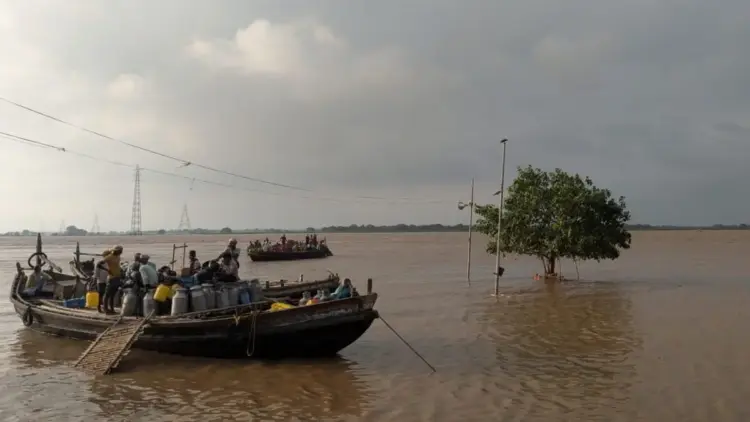
As the 30-year landmark agreement governing the sharing of the Ganga’s waters between India and Bangladesh approaches its expiration in December 2026, a dormant internal conflict within India has resurfaced with renewed intensity. Bihar, the middle-riparian state through which the Ganga flows for 445 kilometers, is demanding a fundamental seat at the negotiating table.
For decades, political leaders and hydrologists in Bihar have argued that the 1996 treaty—signed by then-Prime Minister H.D. Deve Gowda and Bangladesh Prime Minister Sheikh Hasina—disproportionately burdens the state while ignoring its evolving developmental and ecological needs. With the renewal deadline looming, the Bihar government, led by the Janata Dal (United), is asserting that any new agreement must move beyond a simple bilateral water-release model and toward a comprehensive, basin-wide management strategy that accounts for siltation, irrigation, and drinking water security.
Main Facts: The Architecture of the 1996 Treaty
The Ganga Water-Sharing Treaty was designed to resolve a decades-long dispute over the Farakka Barrage, located in West Bengal, roughly 18 kilometers from the Bangladesh border. The treaty focuses on the "lean season"—the period between January 1 and May 31—when river levels drop significantly.
Under the current framework, the distribution is determined by a specific sliding scale based on the water flow at the Farakka Barrage:

- Flow below 70,000 cusecs: India and Bangladesh each receive 50% of the water.
- Flow between 70,000 and 75,000 cusecs: Bangladesh is guaranteed a fixed 35,000 cusecs, with India receiving the remainder.
- Flow above 75,000 cusecs: India is guaranteed 40,000 cusecs (primarily to flush the Hooghly River for the Kolkata Port), and Bangladesh receives the rest.
A specific "emergency" clause stipulates that if the flow at Farakka falls below 50,000 cusecs during any ten-day period, the two national governments must enter immediate consultations to adjust allocations.
While the treaty brought diplomatic stability, Bihar’s leaders argue it was drafted with a "top-down" approach that treated Bihar merely as a conduit rather than a stakeholder with its own burgeoning population and agricultural requirements.
Chronology: A History of Discontent
The friction between Bihar’s state interests and India’s national diplomatic obligations has a long history, rooted in the very construction of the Farakka Barrage.
- 1961–1975: Construction of the Farakka Barrage. Its primary objective was to divert 40,000 cusecs of water into the Bhagirathi-Hooghly river system to desilt the Kolkata Port. Even during this phase, international experts like A.T. Ippen and C.F. Wicker warned that the diversion might not solve the port’s shoaling problems and could instead create upstream issues.
- 1994: The Second Bihar State Irrigation Commission report is prepared. It highlights that while Bihar holds only 16% of the Ganga’s catchment area, its tributaries provide a massive portion of the flow reaching Farakka during the lean season.
- December 1996: The Indo-Bangladesh Treaty is signed. Bihar’s political establishment immediately begins to flag concerns regarding the "minimum flow" requirements.
- 1997: The Bihar government officially demands that upstream states (like Uttar Pradesh and Uttarakhand) curb "indiscriminate use" of water so that the burden of supplying Bangladesh does not fall solely on Bihar’s tributaries.
- 2017: At the "Vision Ganga" program in New Delhi, Bihar’s leadership, including Nitish Kumar, intensifies the rhetoric, calling for a "silt management policy" and questioning the utility of the Farakka Barrage itself.
- August 2024: Sanjay Jha, a Rajya Sabha MP from the JDU, formally raises the issue during the Zero Hour, stating that renewing the treaty without addressing Bihar’s water security would be a "historical injustice."
Supporting Data: The Hydrological Burden
Bihar’s grievance is backed by complex hydrological data that suggests a mismatch between the state’s water contribution and its water rights.

The Catchment Paradox
According to the 1994 Irrigation Commission report, Bihar provides nearly half of the water that reaches the Farakka Barrage during the lean season. This water comes from major tributaries such as the Kosi, Gandak, Bagmati, and Sone. However, at the point where the Ganga enters Bihar from Uttar Pradesh (near Buxar), the flow is often shockingly low.
Data from the Bihar State Pollution Control Board indicates that during the peak lean period (February to April), the Ganga’s flow at Chausa in Buxar can drop to as low as 400 cusecs. By the time it reaches Kahalgaon in eastern Bihar, the flow increases to 1,600 cusecs due to internal tributaries. Yet, to fulfill the 1996 treaty, India must ensure tens of thousands of cusecs reach Farakka. Bihar argues it is "subsidizing" a national treaty with its own internal water resources.
The Siltation Crisis
Perhaps the most significant data point involves sediment. A four-volume study conducted by Professor Rajiv Sinha of IIT Kanpur for the Bihar government revealed that the Farakka Barrage acts as a massive "sediment trap."
The study estimated that the barrage triggers the siltation of approximately 156 million tonnes (MT) of sediment annually. This silt does not just stay at the barrage; it creates a "backwater effect" that causes sediment to settle hundreds of kilometers upstream in Bihar. This raises the riverbed, reduces the water-carrying capacity of the channel, and leads to catastrophic annual flooding even during moderate rainfall.

Agricultural and Industrial Demand
Bihar’s population has surged since 1996, and with it, the demand for water. The state government recently requested an allocation of 2,000 cusecs for drinking and industrial use during the lean period. However, reports suggest that the internal central committee reviewing the treaty renewal has recommended only 900 cusecs—less than half of the state’s demand.
Official Responses and Expert Perspectives
The debate over the treaty renewal features a sharp divide between political representatives and technical experts.
The Political Stance: "Bihar as a Stakeholder"
Sanjay Jha (JDU) has been the most vocal proponent of reform. "Adequate availability of Ganga water is essential for Bihar’s agriculture, drinking water supply, and industrial development," Jha argued in Parliament. The JDU’s position is that the treaty should not be a "bilateral release model" but an "inclusive basin-wide management approach."
The Expert Skepticism: "Evidence vs. Rhetoric"
Himanshu Thakkar, coordinator of the South Asia Network on Dams, Rivers and People (SANDRP), offers a different perspective. He argues that the Bihar government’s claim of being "pressured" by the treaty lacks empirical evidence. "Bihar possesses neither a dam nor any big storage facility where the state government could store Ganga water. Under these circumstances, the question of Bihar holding back or releasing water does not even arise," Thakkar noted. He suggests that Bihar’s problem is not the treaty, but its inability to manage the water it already has.

Similarly, Professor Rajiv Sinha of IIT Kanpur emphasizes that the issue is less about the volume of water and more about the management of silt. "The real issue is sediment. Sediment chokes the water channels, causing the water to spread across the surface. If this were removed, there would be no problem," Sinha stated. He advocates for a "silt management clause" to be added to the international treaty itself.
Implications: The Road to 2026
The renewal of the Ganga Water-Sharing Treaty is not merely a diplomatic formality; it is a test of India’s internal federalism and its environmental foresight.
1. Diplomatic Sensitivity
India’s relations with Bangladesh are a cornerstone of its "Neighborhood First" policy. Any attempt to significantly reduce water flow to Bangladesh could trigger diplomatic friction and provide an opening for other regional powers to exert influence. Therefore, the central government is unlikely to "annul" the treaty, as some local leaders have suggested.
2. The Shift to "Basin-Wide Management"
Experts agree that the 1996 model is outdated because it ignores the upstream states. If Bihar is expected to provide water for Bangladesh, then Uttar Pradesh and Uttarakhand must be held accountable for the water they divert before the river even reaches Bihar. This would require a "National Ganga Policy" that coordinates water usage across all riparian states before the final international commitment is made at Farakka.

3. Silt as a Shared Responsibility
If a silt management clause is included in the renewed treaty, it would force the central government to invest in large-scale dredging and sediment bypass technologies. This would not only alleviate Bihar’s flood woes but also improve the health of the delta in Bangladesh, creating a "win-win" ecological scenario.
4. Domestic Political Pressure
For the ruling JDU in Bihar, which is a key ally in the federal coalition government, the Ganga treaty is a potent domestic issue. As the 2025 Bihar Assembly elections approach, the demand for "justice for Bihar’s waters" will likely become a central campaign theme, putting pressure on the Center to grant concessions.
Conclusion
The Ganga is more than a river; it is a lifeline for 500 million people across two nations. As the 1996 treaty nears its end, the focus is shifting from the volume of water shared at a single barrage to the holistic health of the entire river system. Bihar’s demands—while politically charged—highlight a fundamental truth: a transboundary treaty cannot succeed if the regions providing the water are left to dry out or drown in silt. The 2026 renewal offers a rare opportunity to transition from "water sharing" to "river caring," ensuring that the interests of the state, the nation, and the neighbor are finally in equilibrium.