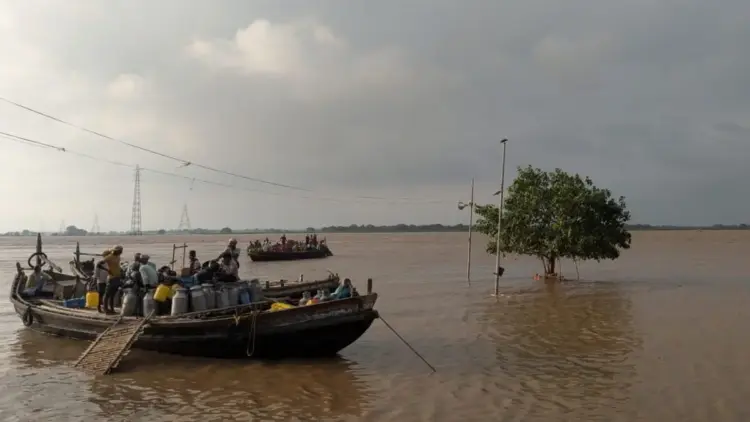
As the 30-year clock winds down on the historic Ganga Water-Sharing Treaty between India and Bangladesh, a familiar but intensifying storm is brewing in the Indian state of Bihar. Signed in December 1996, the treaty is due for renewal or revision by the end of 2026. However, political leaders and environmental experts in Bihar are increasingly vocal, demanding that the new agreement address the state’s long-neglected concerns regarding water security, siltation, and ecological health.
The treaty, while a landmark of South Asian diplomacy, has long been viewed through a different lens in Patna than in New Delhi or Dhaka. For Bihar, the Ganga is not just a transboundary waterway; it is the lifeblood of its agricultural economy and a source of perennial environmental crisis. As the central government prepares for high-level negotiations, Bihar is asserting its role as a primary stakeholder, insisting that the "national duty" of sharing water with Bangladesh must not come at the expense of the state’s own survival.
Main Facts: The Treaty and the Tension
The 1996 Ganga Water-Sharing Treaty was designed to resolve decades of dispute over the flow of the river during the "lean season"—the critical period from January to June when water levels drop significantly. The agreement focuses on the flow at the Farakka Barrage in West Bengal, just upstream from the Bangladesh border.
Under the current formula:

- If flow is below 70,000 cusecs: India and Bangladesh share the water equally (50-50).
- If flow is between 70,000 and 75,000 cusecs: Bangladesh is guaranteed 35,000 cusecs, with India receiving the remainder.
- If flow exceeds 75,000 cusecs: India receives a guaranteed 40,000 cusecs, and Bangladesh receives the rest.
The treaty also includes specific "guaranteed" flows for ten-day periods in April, the driest month. While this math provides a framework for international cooperation, Bihar argues that the formula is fundamentally flawed because it ignores the hydrological realities upstream.
The core of Bihar’s grievance lies in the perception that the state is forced to provide the lion’s share of the water that eventually flows to Bangladesh, via its numerous tributaries like the Kosi, Gandak, and Sone, while being restricted from utilizing that same water for its own developmental needs. Sanjay Jha, a Member of Parliament from Bihar’s ruling Janata Dal (United), recently brought this to the floor of the Rajya Sabha, warning that renewing the treaty in its current form would be a "disservice" to the people of Bihar.
Chronology: A History of Discontent (1961–2024)
The roots of the current tension date back long before the 1996 treaty.
- 1961–1975: Construction of the Farakka Barrage begins and concludes. The primary objective was to divert 40,000 cusecs of water into the Bhagirathi-Hooghly river system to flush out silt and keep the Port of Kolkata navigable.
- 1994: The second Bihar State Irrigation Commission report is published, highlighting that while Bihar holds only 16% of the Ganga’s catchment area, it contributes a disproportionately high amount of the river’s flow through its tributaries.
- 1996: Prime Ministers H.D. Deve Gowda (India) and Sheikh Hasina (Bangladesh) sign the 30-year treaty. Bihar’s leadership expresses immediate reservations, feeling the state was not adequately consulted.
- 1997: The Bihar government formally demands that upstream states (like Uttar Pradesh and Uttarakhand) share the burden of maintaining the Ganga’s flow, rather than Bihar bearing the responsibility alone.
- 2017: During the "Vision Ganga" program, then-Bihar Water Resources Minister Rajiv Ranjan Singh (now a Union Minister) points out a startling disparity: the Ganga enters Bihar with only ~14,000 cusecs but must leave the state at ~53,000 cusecs to meet treaty obligations.
- 2018: An IIT Kanpur study commissioned by Chief Minister Nitish Kumar confirms that the Farakka Barrage has caused massive siltation upstream, directly impacting Bihar’s topography.
- 2022: Bihar launches the Ganga Water Supply Scheme, a flagship project to provide treated Ganga water to the water-stressed towns of Gaya, Bodh Gaya, and Rajgir, but is limited by law to drawing water only during the monsoon months.
- 2024: As the treaty’s expiration nears, the JDU ramps up political pressure on the NDA-led central government to include "silt management" and "regional allocation" in the new agreement.
Supporting Data: The Hydrological Burden
Bihar’s claims are backed by a complex set of hydrological data that suggests a "middle-child" syndrome in river management. The state sits between the high-utilization upstream states (Uttarakhand, Uttar Pradesh) and the downstream treaty obligations at Farakka.

The Flow Disparity
According to the Bihar State Pollution Control Board, the Ganga’s flow at Chausa (Buxar), where it enters the state, can drop to as low as 400 cusecs during the peak lean period (February to April). By the time it reaches Kahalgaon in eastern Bihar, the flow increases to approximately 1,600 cusecs due to internal tributaries. However, to meet the treaty’s requirements at the Farakka Barrage, the state is effectively a conduit for water that it cannot touch.
The Siltation Crisis
The most damning data comes from the 2018 IIT Kanpur study led by Professor Rajiv Sinha. The study of the 580-kilometer stretch from Buxar to Farakka revealed that the Farakka Barrage acts as a "speed bump" for sediment.
- An estimated 156 million tonnes (MT) of sediment is trapped upstream of the barrage annually.
- This has caused the riverbed in Bihar to rise, leading to "braiding" (where the river breaks into multiple shallow channels) and increased flooding even during moderate rainfall.
- The rising riverbed reduces the "carrying capacity" of the Ganga, meaning the same volume of water that once stayed within the banks now spills over into villages and farmlands.
Water Demand vs. Allocation
Bihar’s population has surged since 1996, and with it, the demand for drinking water and industrial use. The state government has requested an allocation of 2,000 cusecs during the lean season for these purposes. However, reports suggest that an internal central committee has recommended only 900 cusecs, a figure Bihar leaders argue is insufficient for a state of 130 million people.
Official Responses: Political and Expert Perspectives
The response to Bihar’s demands is divided between political necessity and technical skepticism.

The Political Stance
The Janata Dal (United), a key ally in the current federal government, has made the treaty a centerpiece of its regional agenda. Sanjay Jha’s recent Rajya Sabha speech emphasized that "adequate availability of Ganga water is essential for Bihar’s agriculture, drinking water supply, and industrial development." The party’s strategy is to frame the treaty not just as a diplomatic agreement, but as a matter of "state rights" and "environmental justice."
The Expert Counter-View
However, some water experts argue that Bihar’s grievances may be misdirected. Himanshu Thakkar, coordinator of the South Asia Network on Dams, Rivers and People (SANDRP), suggests that the treaty itself does not "take" water from Bihar. "Bihar possesses neither a dam nor any big storage facility where the state government could store Ganga water. Under these circumstances, the question of Bihar holding back or releasing Ganga water does not even arise," Thakkar noted. He argues that the water would flow toward Farakka naturally regardless of the treaty, as Bihar lacks the infrastructure to divert it on a large scale.
Professor Rajiv Sinha of IIT Kanpur offers a middle ground. He agrees that while the treaty’s water-sharing math might not be the primary culprit, the physical presence of the Farakka Barrage is the real issue. "The real issue is sediment. Sediment chokes the water channels… there should be a clause on silt management in the Ganga Waters Sharing Treaty," Sinha told Mongabay-India.
Implications: A Basin-Wide Future?
The upcoming negotiations for the Ganga Water-Sharing Treaty carry significant implications for South Asian geopolitics and the domestic stability of India’s federal structure.

1. Diplomatic Sensitivity
India’s relationship with Bangladesh is currently in a state of flux following the recent political upheaval in Dhaka. The Ganga treaty is a cornerstone of bilateral relations. Any move by India to significantly reduce the water flow to Bangladesh to satisfy Bihar’s demands could trigger a diplomatic crisis and push Bangladesh closer to other regional powers.
2. The Shift to "Basin-Wide Management"
Experts like Sunil Kumar Chaudhary, a former professor at Tilka Manjhi Bhagalpur University, argue that the era of "bilateral release models" must end. The implication is that a new treaty should involve all basin states—including Uttarakhand, Uttar Pradesh, and West Bengal—to ensure that the burden of maintaining the river’s health and meeting international obligations is shared equitably.
3. Silt as a Security Issue
If silt management is not integrated into the new treaty, Bihar faces a future of permanent "man-made" floods. The implication for the central government is a rising bill for disaster relief and flood compensation in Bihar, which could eventually outweigh the costs of a comprehensive dredging and sediment-management strategy.
4. Climate Change Vulnerability
The Ganga is a glacier-fed river, making it highly sensitive to global warming. Future lean-season flows are predicted to become even more erratic. A treaty based on fixed cusec numbers from the 1990s may be unable to handle the "new normal" of climate change, necessitating a more flexible, data-driven approach to sharing.

Conclusion
As 2026 approaches, the Bihar government is no longer content to be a silent spectator to the Ganga Water-Sharing Treaty. By linking the international agreement to local issues of siltation, drinking water, and agricultural survival, Patna has effectively raised the stakes for New Delhi. The challenge for the Indian government will be to craft a "Ganga 2.0" agreement that maintains the delicate diplomatic balance with Bangladesh while addressing the legitimate hydrological and developmental anxieties of its own third-most-populous state. Whether the new treaty will expand to include silt management and basin-wide responsibility remains the billion-cusec question.