

In the sprawling urban expanse of Gurugram, where steel and glass often dominate the skyline, a quiet revolution is taking place along the edges of private properties. While most homeowners have retreated behind sterile brick walls and iron grills, a few remaining "living fences"—thick, vibrant boundaries of jasmine, roses, and hibiscus—serve as a poignant reminder of a greener past. These botanical barriers are more than just aesthetic choices; they are thriving ecosystems that support a myriad of life forms, from the common garden squirrel to the nesting bulbul.
However, as India’s urban landscapes succumb to rampant concrete growth, these green corridors are vanishing. In her seminal new book, The Living Fence, landscape architect Sonali Dahotre argues that reintroducing these "miniature Edens" is not merely a matter of gardening, but a critical ecological necessity. As climate change accelerates—bringing with it intensified heatwaves, flash floods, and biodiversity loss—the humble hedge may offer a sophisticated, low-tech solution to some of our most pressing environmental challenges.
Main Facts: Defining the Living Boundary
A "living fence" is fundamentally a row of plants grown along a property boundary to serve as a natural barrier. In her guide, Dahotre distinguishes between two primary forms: the hedge and the hedgerow. A hedge is typically composed of a single plant species, meticulously pruned and groomed to maintain a uniform, architectural appearance. In contrast, a hedgerow is a more diverse assembly of multiple species, allowed to grow into their natural forms, creating a wilder, more robust ecological niche.
The transition from green boundaries to stone and brick in India began in earnest during the early 1990s. As land prices skyrocketed and the socio-economic divide between neighborhoods widened, the "soft" boundaries of the past were replaced by "hard" security measures. While brick walls provide a sense of exclusion and security, they contribute to the "urban heat island" effect, reflecting heat back into the environment and preventing the natural percolation of rainwater.
![Reclaiming nature’s many delights through living fences [Book Review]](https://imgs.mongabay.com/wp-content/uploads/sites/30/2026/10/09171446/Carissa-scaled-e1791546473535-1200x800.jpg)
In contrast, a living fence offers a multi-functional service:
- Biodiversity Support: They provide food and shelter for birds, bees, butterflies, and small mammals.
- Climate Mitigation: They act as natural windbreakers, trap dust, and lower ambient temperatures through transpiration.
- Water Management: Unlike concrete, which encourages rapid runoff and flooding, living fences slow down rainwater, allowing it to seep into the groundwater.
- Socio-Economic Utility: In rural settings, these fences provide fuelwood, fodder, medicinal herbs, and even supplementary income.
Chronology: From Ancient Fortifications to Modern Shrinkage
The history of the living fence is as old as civilization itself. Dahotre traces the lineage of these green barriers through various eras, illustrating that humans have long recognized the defensive and utilitarian power of plants.
The Ancient World:
As early as 460 BCE, the Greek philosopher Democritus wrote of the cost-effectiveness of hedges grown from seeds of brambles and thorns. In his accounts of the Battle of Gaul in 57 BCE, Julius Caesar described the "fortified" hedges of the Nervii tribe. These were not merely garden borders but dense, impenetrable walls of bent trees and briars that were impossible to see through, let alone breach, serving as a sophisticated military defense.
The Indian Context:
While specific "hedgerow" terminology may be absent from ancient Sanskrit texts, Kautilya’s Arthashastra—the foundational Indian treatise on statecraft—mentions natural village boundaries consisting of rivers, mountains, forests, and specific trees like the Salmali (silk cotton tree) and Kshiravriksha (milky trees).
By the 18th century, living fences in India had reached a peak of strategic importance. The Maharaja of Mysore, Devaraja Wodeyar II, protected the Bengaluru Pettah with a massive defensive hedge of thorny vegetation, 73 meters wide, encircled by a deep ditch. Similarly, colonial records by Robert Orme describe the French territory of Pondicherry as being enclosed by a "hedge of large aloes and other thorny plants," which effectively repelled cavalry and hindered infantry movements.
![Reclaiming nature’s many delights through living fences [Book Review]](https://imgs.mongabay.com/wp-content/uploads/sites/30/2026/10/09172324/CALOTROPIS-768x512.jpg)
The Modern Decline:
The 20th century saw a global retreat of the hedgerow. Following World War II, European nations cleared vast tracts of hedgerows to create larger, industrial-scale arable fields to combat food shortages. In India, the 1990s marked a turning point where urbanization and the "walled villa" culture began to erase the traditional green boundaries that had defined middle-class neighborhoods for decades.
Supporting Data: The Ecological and Practical Impact
The ecological value of these spaces is backed by startling data. British ecologist Robert Wolton conducted a two-year study on a single hedgerow near his home, recording a staggering 2,070 species—ranging from insects and mammals to fungi and mosses—that either lived in or visited the hedge. This demonstrates that even a small strip of managed greenery can act as a "biodiversity hotspot."
In terms of disaster management, living fences serve as vital infrastructure. In the flood-prone Gangetic plains of Bihar, villagers have long utilized bamboo planted parallel to rivers. When floodwaters rise, these bamboo "fences" slow the velocity of the water, protecting homes from the full force of the current and trapping fertile silt.
Furthermore, Dahotre’s research emphasizes the carbon sequestration potential of these boundaries. By pulling CO2 from the atmosphere and storing it in biomass and the soil, living fences act as localized carbon sinks. In countries like England and Wales, the recognition of these benefits has led to the legal protection of hedgerows, a policy framework that Dahotre suggests Indian urban planners should consider.
Official Responses and Expert Recommendations
As a landscape architect, Dahotre’s work serves as both a manifesto and a practical manual. She argues that the modern preference for "raised planter beds" is a poor substitute for true living fences. Plants grown in raised beds are often disconnected from the earth’s natural water table and soil microbiome, whereas plants grown directly in the ground provide superior cooling and water filtration benefits.
![Reclaiming nature’s many delights through living fences [Book Review]](https://imgs.mongabay.com/wp-content/uploads/sites/30/2026/10/09171206/THE-LIVING-FENCE-COVER-scaled.jpg)
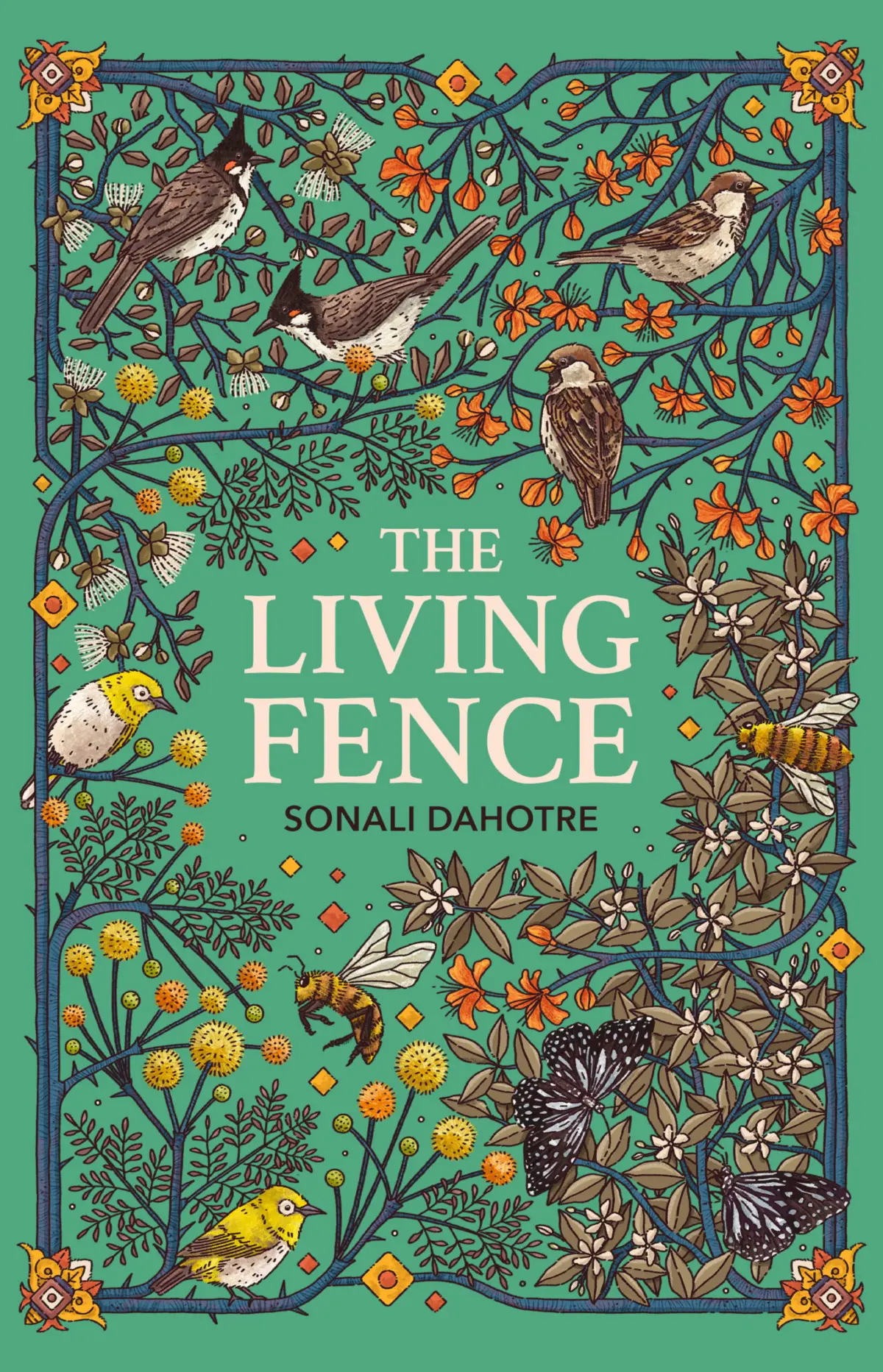
In The Living Fence, Dahotre provides a detailed directory of nearly 290 pages of plant species suitable for Indian climates. Key recommendations include:
- Rosa brunonii (Himalayan Musk Rose): A semi-evergreen climber that produces fragrant white flowers. It is ideal for creating soft arches and gateways while providing commercial value through its orange-red fruits.
- Bauhinia racemosa (Bidi Leaf Tree): Known for its iconic camel-foot shaped leaves, this hardy tree can be pruned into a dense physical barrier. It is a host plant for the Common Emigrant butterfly and holds significant cultural value in Maharashtra and Goa.
- Strategic Thorny Species: For rural security, plants like Opuntia and Euphorbia are recommended as they deter grazing livestock while doubling as green manure.
However, Dahotre also issues a professional warning against invasive species. While Lantana camara and Tecoma species are easy to grow and attract wildlife, their aggressive nature can lead to the "ecological destruction" of native habitats. Her recommendation is a move toward native flora that has evolved to thrive in local soil and rainfall conditions.
Implications: The Future of Urban Planning
The revival of the living fence has profound implications for the future of Indian cities. As "urban roads turn into open drains" during monsoon seasons—a phenomenon frequently highlighted in national media—the cumulative effect of thousands of living fences could act as a distributed "sponge," significantly reducing the volume and speed of urban runoff.
Furthermore, the psychological impact of these green spaces cannot be overstated. In an era of high-stress urban living, the presence of birdsong, the sight of butterflies, and the seasonal fragrance of jasmine provide a "sensory refuge" that concrete walls simply cannot offer.
The transition back to living boundaries will require a shift in both public policy and individual mindset. For homeowners, it means choosing the "soft" security of a thorny Bauhinia over the "hard" security of a barbed-wire wall. For municipal authorities, it involves recognizing hedgerows as essential "green infrastructure" rather than mere landscaping.
![Reclaiming nature’s many delights through living fences [Book Review]](https://imgs.mongabay.com/wp-content/uploads/sites/30/2026/10/09172439/Hedge-aloe-768x512.jpg)
Ultimately, Sonali Dahotre’s work suggests that we must stop viewing our properties as isolated fortresses and start seeing them as interconnected parts of a larger, living tapestry. By reclaiming the living fence, we do more than beautify our homes; we grant a "humble refuge" to the 8.7 million other organisms with whom we share the planet, ensuring that as our cities expand, nature is not left behind.
