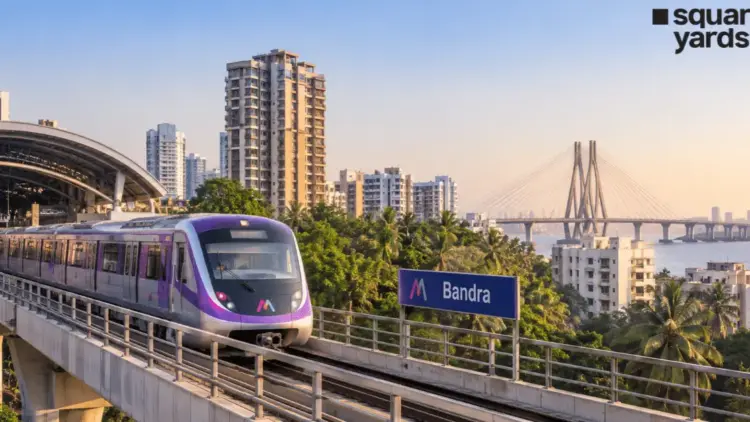
MUMBAI – The skyline of India’s financial capital is undergoing a dramatic transformation as the Mumbai Metropolitan Region Development Authority (MMRDA) accelerates work on Metro Line 2B. A critical component of the city’s ambitious master plan to overhaul public transit, Line 2B is now approaching a pivotal engineering milestone. With a targeted date of November 18, 2026, for the installation of the final three girders near the congested Juhu Circle, the project is moving steadily toward its goal of providing a seamless, high-capacity link between the western and eastern suburbs.
Spanning 23.64 kilometers, the elevated corridor is designed to act as a transverse artery, cutting through some of the city’s most densely populated residential zones and its most significant commercial hub, the Bandra-Kurla Complex (BKC). Once fully operational, the line will connect D N Nagar in Andheri West to Mandale in Mankhurd, effectively shrinking the psychological and physical distance between the two halves of the city.
Main Facts: The Anatomy of the Yellow Line 2B
Mumbai Metro Line 2B, often referred to as a key segment of the "Yellow Line," is being developed at an estimated cost of Rs 10,986 crore. Unlike several other lines that delve underground, Line 2B is entirely elevated, featuring 20 strategically placed stations.
The project’s backbone is its massive depot at Mandale, which spreads across 31.4 hectares. This facility is slated to be one of the largest metro depots in the region, equipped to handle the maintenance and stabling requirements of a high-frequency fleet. The corridor serves as an extension of Metro Line 2A (Dahisar to D N Nagar), creating a continuous loop that will eventually allow commuters to travel from the far reaches of the northwestern suburbs all the way to the eastern edge of the city.
The alignment is a masterclass in urban connectivity. It touches upon diverse micro-markets, including the upscale neighborhoods of Juhu and Santacruz, the corporate powerhouses of BKC, the industrial and residential pockets of Kurla, and the emerging residential hubs of Chembur and Mankhurd. By providing a dedicated right-of-way, the metro aims to decouple commuters from the notorious traffic congestion of the Santacruz-Chembur Link Road (SCLR) and the Western Express Highway.
Chronology: The Phased Roadmap to Completion
The realization of Line 2B is being executed through a phased approach, reflecting the complexity of building in a brownfield urban environment.
- The Operational Foundation: Currently, the sections between Mandale and Diamond Garden, along with the extension to Chembur, have seen the completion of major civil works, providing an initial footprint for the line in the eastern suburbs.
- The 2026 Milestone: The MMRDA has circled November 18, 2026, on its calendar. This date marks the deadline for the installation of the final three girders near Juhu Circle. This specific location is one of the most challenging segments of the route due to the high volume of traffic and the intricate network of existing utilities.
- The 2027 Opening: The next major operational leap is scheduled for March 31, 2027. This phase will open the 7.53-km stretch connecting Andheri West to Saraswat Nagar. This section is expected to see immediate high ridership, serving the "education and healthcare belt" of the western suburbs.
- Full Integration by 2028: The final piece of the puzzle—the Saraswat Nagar to Chembur section—is slated for completion in 2028. This will finalize the east-west link, connecting the Western Railway and Metro Line 1 with the Central and Harbour lines.
Supporting Data: Connectivity and Technical Specifications
To understand the scale of the project, one must look at the technical and geographic data that defines the corridor.
| Project Feature | Details |
|---|---|
| Total Length | 23.643 km |
| Total Stations | 20 (All Elevated) |
| Project Cost | Rs 10,986 Crore |
| Primary Depot | Mandale (31.4 Hectares) |
| Western Terminal | D N Nagar, Andheri West |
| Eastern Terminal | Mandale, Mankhurd |
| Key Interchanges | 6 (Including Metro Lines 1, 3, 4, and Railways) |
The route is meticulously planned to serve high-traffic nodes. Starting from D N Nagar, it moves through ESIC Nagar, Prem Nagar, Indira Nagar, Nanavati Hospital, Khira Nagar, and Saraswat Nagar. It then transitions into the heart of Bandra, serving National College and Bandra Metro, before entering the high-stakes commercial landscape of BKC. Within BKC, stations like the Income Tax Office, ILFS, and MTNL will cater to thousands of white-collar professionals. The line then crosses over to the east, hitting S G Barve Marg, Kurla East, and eventually terminating at Mandale via Chembur and Mankhurd.
Official Responses and Engineering Challenges
While the MMRDA has maintained a confident stance on the 2026 and 2027 deadlines, officials acknowledge the significant engineering hurdles involved. Constructing an elevated corridor over Juhu Circle and the busy intersections of Kurla requires surgical precision.
According to MMRDA sources, the "final three girders" at Juhu Circle represent more than just a construction task; they symbolize the closing of a gap in a highly congested corridor. To minimize public grievance, much of the heavy lifting and girder launching is scheduled during nighttime windows. The authority has also emphasized the use of advanced pre-cast technology to speed up the process and ensure structural integrity.
The MMRDA’s broader vision is "Multimodal Integration." Officials have frequently stated that Line 2B is not a standalone project but a "connective tissue." By ensuring that metro stations are within walking distance of railway stations and monorail stops, the authority aims to create a "15-minute city" dynamic where every major hub is accessible via rapid transit.
The Power of Interchanges: A Network Effect
The true value of Line 2B lies in its ability to talk to other transit systems. It is the "universal adapter" of Mumbai’s transport grid.
- D N Nagar: Connects with Metro Line 1 (Versova-Andheri-Ghatkopar), linking the new corridor to the existing east-west lifeline.
- BKC (Income Tax Office): Provides a crucial interchange with the underground Metro Line 3 (Aqua Line). This allows a commuter from Mankhurd or Chembur to reach Colaba or Cuffe Parade with a single change.
- Kurla East: Links to the Central Railway and the upcoming Metro Line 4 (Wadala-Kasarvadavali), opening up access to Thane and Central Mumbai.
- Chembur: Connects with the Harbour Line and the Mumbai Monorail, serving as a gateway for those traveling toward Navi Mumbai or the interior pockets of South-Central Mumbai.
Real Estate Implications: A Market in Flux
The "Metro Effect" is already palpable in the real estate sectors along the Line 2B alignment. The corridor passes through a spectrum of markets, from the ultra-premium Juhu to the redevelopment-heavy Chembur.
Western Suburbs: Premium Stability and Redevelopment
In Andheri West and Juhu, where property prices range from Rs 38,000 to Rs 80,000 per sq ft, the metro is acting as a catalyst for redevelopment. Older societies are now more attractive to developers like Lodha and Kalpataru because the improved FSI (Floor Space Index) near metro corridors allows for taller, more modern towers. For residents, the metro offers an escape from the gridlock of the SV Road and Link Road.
BKC and Bandra: The Commercial Magnet
BKC remains the jewel in the crown. With prices for luxury residential projects hovering between Rs 45,000 and Rs 65,000 per sq ft, the arrival of two metro lines (2B and 3) solidifies its position as India’s premier business district. This connectivity reduces the "commute penalty" for employees, making BKC an even more attractive destination for multinational corporations.
Eastern Suburbs: The Growth Frontier
The most significant percentage growth is expected in Kurla, Chembur, and Mankhurd.
- Kurla: With average prices between Rs 22,000 and Rs 32,000, Kurla is shedding its image as a purely industrial/wholesale hub.
- Chembur: Already a favorite for mid-to-high-end buyers (Rs 25,000 – Rs 45,000 per sq ft), the additional metro connectivity makes it a rival to the western suburbs in terms of accessibility.
- Mankhurd/Mandale: Currently the most affordable segment (Rs 18,000 – Rs 29,000), these areas are poised for gentrification as they become "30 minutes away" from BKC.
Conclusion: A New Era for Mumbai Mobility
Mumbai Metro Line 2B is more than just a series of piers and girders; it is a socio-economic bridge. For decades, Mumbai’s geography—a narrow peninsula—has dictated a north-south travel bias, leaving east-west commuters dependent on a handful of congested arterial roads.
As the MMRDA pushes toward the November 2026 milestone at Juhu Circle and the subsequent 2027 launch of the western section, the city stands on the threshold of a new era. By 2028, when the entire 23.64-km stretch is operational, the "Yellow Line" will not just move people; it will move the city’s economy, making the dream of a connected, efficient, and accessible Mumbai a tangible reality. The wait for a seamless east-west commute is nearing its end, promising a future where the city’s heart and its periphery are finally in sync.