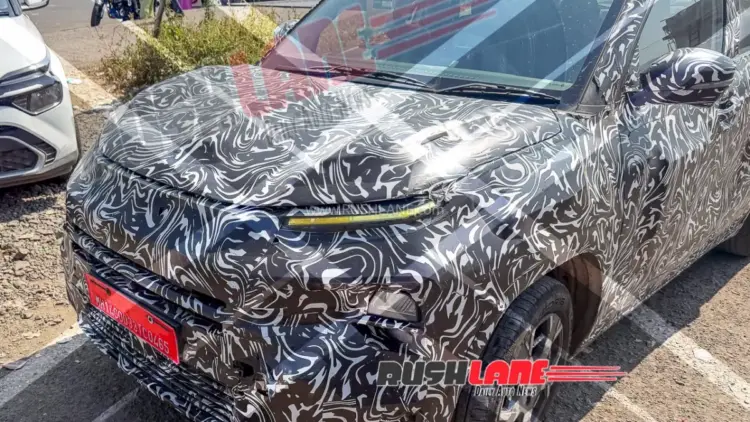
The Indian automotive landscape is currently witnessing a seismic shift toward diversified energy sources. While Electric Vehicles (EVs) have dominated the headlines for the past few years, a quieter but equally significant revolution is brewing in the form of internal combustion engines capable of running on high-ethanol blends. Leading this charge is Tata Motors, whose best-selling sub-compact SUV, the Punch, has recently been spotted in a heavily camouflaged avatar near Pune. This sighting has sent ripples through the industry, signaling that the production-ready version of the Tata Punch Flex-Fuel is likely entering its final stages of real-world validation.
Main Facts: The Pune Sighting and Technical Visuals
The recently surfaced spy shots reveal a test mule wrapped in a sophisticated black-and-white camouflage featuring a unique swirling graphic pattern. While Tata Motors frequently tests its upcoming models in the outskirts of Pune—close to its primary manufacturing and R&D facilities—this particular mule is of high interest because the Tata Punch facelift has already been commercially launched.
Design Cues and Identification
Despite the dense wrapping, several design elements confirm that the test vehicle is based on the latest facelifted iteration of the Punch. Observers noted the following features:
- Lighting Architecture: The vehicle retains the slim, high-mounted LED DRLs (Daytime Running Lights) and the separate, lower-positioned main headlamp housings characteristic of the new Tata design language seen on the Punch EV and the ICE facelift.
- Front Fascia: A broad lower grille is visible, designed to optimize airflow to the radiator—a crucial component for flex-fuel engines which may operate at different thermal profiles than standard petrol engines.
- Wheels and Stance: The prototype was seen sporting dark-finished alloy wheels, maintaining the rugged, mini-SUV stance that has made the Punch a household name in India.
- Rear Profile: The rear of the vehicle includes a prominent roof spoiler, a functional rear wiper, and partially exposed LED tail-lamp clusters.
Given that the cosmetic updates are already part of the current production model, industry experts have concluded that the camouflage is intended to hide internal mechanical changes. The most logical conclusion is the testing of the Flex-Fuel (E85/E100) powertrain, which Tata Motors has previously showcased as a concept.
Chronology: From Concept to Real-World Validation
The journey of the Tata Punch Flex-Fuel has been a calculated progression, aligning with the Indian government’s roadmap for ethanol blending.
-
January 2025: The Debut at Bharat Mobility Global Expo
Tata Motors first pulled the wraps off the Punch Flex-Fuel demonstrator at the inaugural Bharat Mobility Global Expo. This prototype was based on the pre-facelift model but served as a "proof of concept." It featured a modified version of the 1.2-litre Revotron engine, specifically engineered to handle the corrosive nature of ethanol and the different combustion requirements of higher blends. -
May 2026: Official Confirmation of Technological Readiness
In a significant update during the first half of 2026, Shailesh Chandra, Managing Director of Tata Motors Passenger Vehicles and Tata Passenger Electric Mobility, addressed the media regarding the company’s alternative fuel strategy. He confirmed that Tata Motors was "comfortable" with its technological readiness for higher ethanol blends. Chandra indicated that at least one flex-fuel product would be ready for market evaluation by late 2026 or early 2027.
-
November 2026: Recent Spy Shots
The sighting of the camouflaged facelifted model near Pune indicates that the transition from the "demonstrator" phase to the "production-validation" phase is complete. The vehicle is likely undergoing durability testing and ECU (Engine Control Unit) calibration to ensure seamless performance across varying ethanol percentages. -
February 2027: Potential Launch Window
With the next Bharat Mobility Global Expo scheduled for February 4–9, 2027, the industry anticipates that Tata Motors will use this high-profile platform to officially launch or showcase the final production version of the Punch Flex-Fuel.
Supporting Data: The Strategic Importance of the Punch
The decision to choose the Punch as the flagship for Tata’s flex-fuel ambitions is backed by robust sales data and market positioning.
The Sales Juggernaut
As of late 2026, the Tata Punch has secured its position as the number one selling car in the Tata Motors portfolio. It has consistently outperformed its siblings, the Nexon and the Tiago, due to its high safety rating (5-star GNCAP), compact footprint, and "SUV-lite" styling. By integrating flex-fuel technology into its most popular model, Tata ensures maximum market penetration and visibility for the new technology.
The Multi-Powertrain Strategy
Tata Motors has pioneered the "Power of Choice" strategy in India. The Punch is currently available in:
- Petrol: 1.2L Revotron engine.
- CNG: Featuring the innovative twin-cylinder technology that preserves boot space.
- Electric: Built on the acti.ev architecture with multiple range options.
Adding a Flex-Fuel variant makes the Punch one of the only vehicles in the world to offer four distinct powertrain options on a single platform. This diversification protects the brand against fluctuations in fuel prices and changes in government regulations.
Technical Modifications for Flex-Fuel
To make the 1.2-litre engine compatible with E85 (85% ethanol, 15% petrol), several engineering changes are required:

- Fuel System Upgrades: Ethanol is more corrosive than petrol; therefore, fuel lines, the fuel pump, and the fuel tank must be made of resistant materials.
- Engine Tuning: The ECU must be programmed with a fuel sensor that detects the ethanol-to-petrol ratio in real-time, adjusting ignition timing and fuel injection accordingly.
- Valvetrain Enhancements: Ethanol has a lower energy density but a higher octane rating. To maximize efficiency, reinforced valves and valve seats are often necessary to handle the different combustion temperatures.
Official Responses and Regulatory Context
The development of the Punch Flex-Fuel does not happen in a vacuum. It is a direct response to the aggressive push by the Government of India to reduce the national oil import bill and support the agricultural sector.
The Government’s Stance
Union Minister for Road Transport and Highways, Nitin Gadkari, has been a vocal proponent of "Green Fuel." The government has advanced the target for E20 (20% ethanol blending) to 2025 and is encouraging manufacturers to move toward E85 and E100 (pure ethanol) compatibility.
Competitive Landscape
Tata is not alone in this race.
- Maruti Suzuki: Already launched the WagonR Flex-Fuel, which is currently undergoing pilot testing and limited sales.
- Toyota: Has been a global leader in flex-fuel technology in markets like Brazil. Nitin Gadkari is slated to launch an E100-compatible Innova Hycross on November 25, 2026, further heating up the segment.
Shailesh Chandra’s previous statements emphasize that Tata Motors intends to be a leader, not just a participant, in this space. By ensuring their engines can handle "up to E100," they are future-proofing their internal combustion engine (ICE) lineup against future environmental mandates.
Implications: What This Means for the Consumer and the Environment
The introduction of a production-ready Tata Punch Flex-Fuel has far-reaching implications for various stakeholders.
1. Cost of Ownership
For the consumer, the primary draw of flex-fuel is the potential for lower running costs. Ethanol is generally cheaper to produce than petrol in India. Even though ethanol has a lower calorific value (leading to a slight drop in fuel efficiency), the lower price per liter could offset the mileage deficit, especially if the government provides tax incentives for flex-fuel vehicles.
2. Environmental Impact
Flex-fuel vehicles significantly reduce "well-to-wheel" carbon emissions. Since ethanol is derived from sugarcane and food grains, the CO2 emitted during combustion is partially offset by the CO2 absorbed by the plants during their growth. This makes the Punch Flex-Fuel a vital bridge for consumers who are not yet ready to switch to full electric but want a greener alternative to traditional petrol.

3. Rural Economy Support
A shift toward ethanol directly benefits Indian farmers. By creating a massive demand for ethanol, the automotive industry provides a stable secondary income stream for sugarcane and grain farmers, aligning with the national "Atmanirbhar Bharat" (Self-Reliant India) initiative.
4. Technological Leadership for Tata
By successfully launching a Flex-Fuel Punch, Tata Motors reinforces its image as an innovation-led company. It proves that the ALFA (Agile Light Flexible Advanced) architecture is versatile enough to accommodate cutting-edge green technologies, ensuring the platform remains relevant well into the 2030s.
Conclusion: The Road to February 2027
The sighting of the camouflaged Tata Punch near Pune is more than just a routine test run; it is a glimpse into the future of Indian motoring. As the automotive industry moves away from a "one-size-fits-all" fuel approach, Tata Motors is positioning the Punch to be the ultimate versatile vehicle.
With the Bharat Mobility Global Expo 2027 acting as the likely stage for its grand reveal, the Punch Flex-Fuel is poised to democratize sustainable technology for the masses. If Tata can manage to price it competitively while maintaining the Punch’s signature safety and style, they may very well have another market leader on their hands, further solidifying their dominance in the Indian SUV segment.