

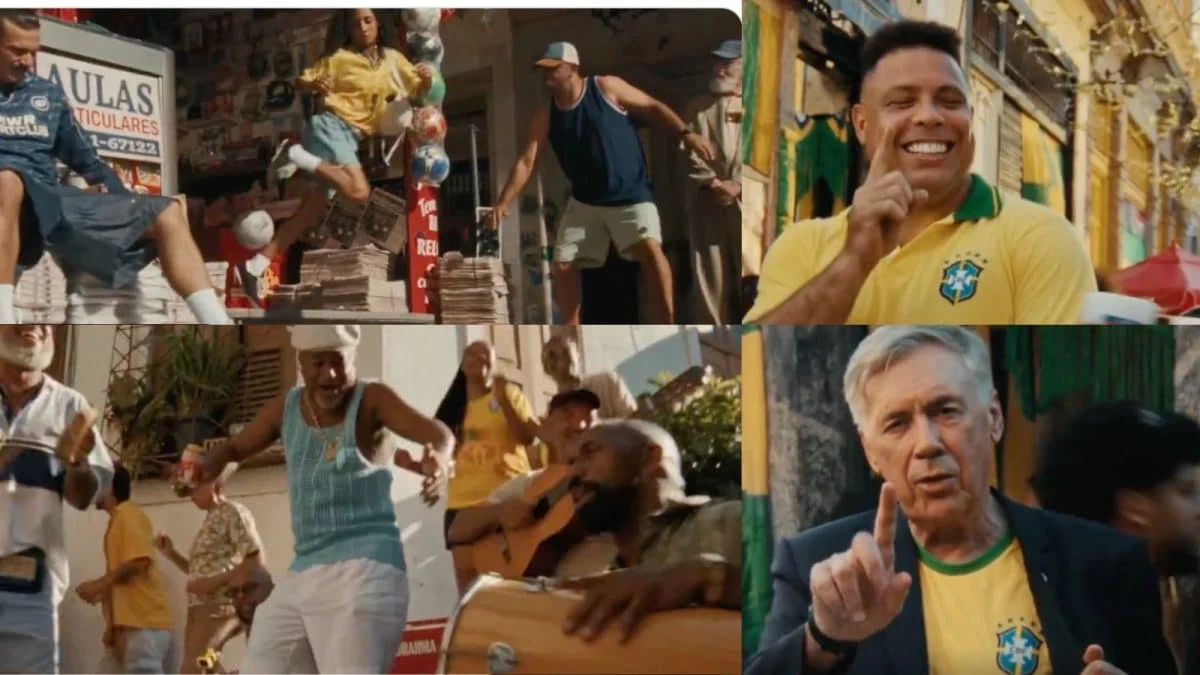
Rio de Janeiro, Brazil – May 8, 2026 – As the FIFA World Cup 2026 in the USA, Canada, and Mexico draws closer, the football-mad nation of Brazil is abuzz with renewed optimism. Fueling this fervent belief is a powerful new advertising campaign from brewing giant Brahma, featuring an unprecedented pairing: legendary striker Ronaldo Nazário and current Brazilian national team head coach Carlo Ancelotti. The advertisement, released this week, has struck a profound chord with fans, evoking the glorious past of the Seleção while simultaneously projecting a bold vision for the future, as Brazil relentlessly pursues a record-extending sixth World Cup title.
The ad’s central theme masterfully weaves together nostalgia and aspiration, reminding Brazilians of their fabled history at the tournament and their unparalleled success, while subtly acknowledging the prolonged wait for another triumph. For a country where football is not merely a sport but an integral part of its identity and soul, this campaign is more than just a commercial; it’s a declaration of intent, a rallying cry designed to unite a nation behind its beloved Canarinho squad.
Main Facts: A Symphony of Legacy and Leadership
The core of the news revolves around the strategic collaboration between Brahma, one of Brazil’s most recognized brands, and two titans of the football world: Ronaldo Nazário and Carlo Ancelotti. Ronaldo, affectionately known as "O Fenômeno," is an icon whose name is synonymous with Brazilian football glory, having been a pivotal figure in two World Cup victories (1994, though he didn’t play, and 2002). Carlo Ancelotti, the venerable Italian tactician, represents the new era of Brazilian football, having been entrusted with the monumental task of guiding the five-time champions back to the pinnacle of global football.
The advertisement itself is designed to be deeply resonant, drawing parallels to Brazil’s most cherished World Cup moments. It aims to tap into the collective memory of the nation, recalling the joyous celebrations and the unyielding spirit that have characterized Brazilian football for decades. This emotional appeal is crucial for Brahma, a brand deeply embedded in Brazilian culture, and for the Brazilian Football Confederation (CBF), which seeks to galvanize public support and instill unwavering confidence in the national team.
Brazil, with its unparalleled record of five World Cup titles in 1958, 1962, 1970, 1994, and 2002, has endured a twenty-four-year drought since their last triumph in South Korea and Japan. This prolonged period without the coveted trophy has created an intense longing among fans, a yearning that the CBF hopes Ancelotti, with his stellar club record, can finally satisfy. The decision to bring in a foreign coach of Ancelotti’s caliber underscores the gravity of the mission and the depth of Brazil’s ambition to reclaim its rightful place at the top of world football. The advertisement, therefore, serves as both a celebration of heritage and a confident step towards a future envisioned by the combined might of a legendary player and an elite coach.
Chronology: Tracing the Path to the Sixth Star
The narrative of Brazil’s pursuit of a sixth World Cup title is a story spanning decades, marked by both unparalleled success and periods of profound frustration.
The Golden Era (1958-1970): Brazil’s dominance began in 1958, when a young Pelé led them to their first World Cup title in Sweden. This was swiftly followed by another victory in Chile in 1962, solidifying their status as a footballing superpower. The crowning jewel of this era came in 1970 in Mexico, where the "Joga Bonito" philosophy reached its zenith with a team widely regarded as one of the greatest of all time. These early triumphs laid the foundation for Brazil’s footballing mystique.
The Long Wait and Resurgence (1970-1994): After 1970, Brazil entered a period of relative drought, despite fielding supremely talented teams in 1982 and 1986. The wait finally ended in 1994 in the USA, where a more pragmatic, yet equally determined, Brazilian side led by Romário and Dunga lifted the trophy after a tense penalty shootout against Italy. This victory reignited the nation’s passion and set the stage for another era of success.
The Ronaldo Era and Last Triumph (1998-2002): The 1998 World Cup in France saw Brazil reach the final, only to suffer a shocking defeat to the hosts, overshadowed by the mysterious pre-match events surrounding Ronaldo. However, "O Fenômeno" would have his redemption in 2002, leading Brazil to their fifth title with a spectacular performance, scoring both goals in the final against Germany. This victory, marked by the iconic "R9" haircut, remains Brazil’s last World Cup triumph.
The Post-2002 Drought (2006-2022): Since 2002, Brazil has consistently been among the favorites but has fallen short at every subsequent tournament. Quarter-final exits in 2006, 2010, 2018, and 2022, along with the devastating 7-1 semi-final loss to Germany on home soil in 2014, have created a palpable sense of longing and a growing pressure to end the drought. The passage of two decades has only intensified the national desire for a sixth star.
The Ancelotti Appointment (2025): Recognizing the need for a fresh approach and world-class leadership, the CBF made a landmark decision to appoint Carlo Ancelotti as the head coach of the national team. This move, finalized in 2025, marked a significant departure from the tradition of appointing Brazilian coaches and signaled a serious commitment to bringing the trophy back. Ancelotti’s arrival was met with a mix of excitement and scrutiny, given his lack of international management experience but unparalleled success at the club level.
The Brahma Campaign (May 2026): The release of the Brahma advertisement featuring Ancelotti and Ronaldo on May 6, 2026, marks a pivotal moment in the pre-World Cup build-up. It strategically leverages the national sentiment, uniting the past glory embodied by Ronaldo with the future hope represented by Ancelotti. The timing, just weeks before the tournament kicks off in June, is designed to maximize impact and generate a wave of national enthusiasm and belief.
The FIFA World Cup 2026 (June-July 2026): The ultimate test for Ancelotti and his squad will come in the expanded 48-team tournament hosted across the USA, Canada, and Mexico. This spectacle will be the grand stage where Brazil seeks to finally put an end to their 24-year wait and etch their name into the annals of football history once more with a sixth World Cup title.
Supporting Data: The Pillars of Brazilian Hope
The decision to feature Ronaldo and Ancelotti in such a high-profile campaign is underpinned by their individual legacies and their collective symbolic power. Their presence offers tangible reasons for the renewed national belief.
Carlo Ancelotti: The Master Tactician’s Pedigree
Ancelotti’s coaching record is nothing short of extraordinary, making him one of the most decorated managers in football history. His unique achievement of winning the UEFA Champions League a record five times – twice with AC Milan (2003, 2007) and thrice with Real Madrid (2014, 2022, 2024) – speaks volumes about his tactical acumen, man-management skills, and ability to thrive under immense pressure. He has also won league titles in four different European countries (Serie A, Premier League, Ligue 1, La Liga), demonstrating his adaptability across diverse footballing cultures.
For Brazil, Ancelotti represents a departure from traditional approaches. His calm demeanor, ability to manage star-studded dressing rooms, and pragmatic yet effective tactical systems are seen as precisely what the Seleção needs to navigate the complexities of a World Cup tournament. The CBF is banking on his proven track record of converting immense talent into championship glory, a challenge he has met repeatedly at club level. His age, 66, brings with it a wealth of experience and a calm authority that could be crucial in steadying a team often prone to emotional fluctuations on the biggest stage.
Ronaldo Nazário: The Enduring Icon of "Joga Bonito"
Ronaldo’s inclusion in the Brahma ad is a powerful appeal to national pride and nostalgia. "O Fenômeno" is not just a former player; he is a living legend, a symbol of Brazil’s attacking flair and footballing artistry. His electrifying pace, mesmerizing dribbling, and clinical finishing captivated a generation of fans. His journey through four World Cups (1994, 1998, 2002, 2006) – culminating in his golden boot-winning performance in 2002 – cemented his place as one of the greatest strikers of all time.
As a World Cup winner and a figure who embodies the joy and brilliance of Brazilian football, Ronaldo’s endorsement carries immense weight. His message of belief, as shared on his social media, resonates deeply with fans who remember his heroics. "As probabilidades podem estar contra a gente… mas nós já vencemos elas cinco vezes e fomos campeões do mundo. Tá liberado acreditar na sexta," he tweeted, roughly translating to: "The odds might be against us… but we’ve already beaten them five times and been world champions. It’s okay to believe in the sixth." This direct address from a national hero is a potent psychological boost.
Brahma’s Marketing Acumen: Tapping into National Identity
Brahma, as a quintessential Brazilian brand, has a long history of associating itself with national pride and major cultural events, especially Carnival and football. Their campaigns are often characterized by their deep understanding of the Brazilian psyche and their ability to evoke strong emotional responses. This latest advertisement is a prime example of their sophisticated marketing strategy.
By featuring Ancelotti and Ronaldo, Brahma is not just selling beer; it’s selling hope, national identity, and the dream of collective triumph. The ad’s nostalgic undertones, referencing "iconic moments in Brazil’s fabled history," connect the brand to the very fabric of the nation’s footballing heritage. This strategy aims to solidify Brahma’s position as a brand that understands and celebrates the passion of Brazilian football fans, translating into increased brand loyalty and sales, especially during a World Cup year when national fervor is at its peak. This approach mirrors other successful football campaigns by global brands (like Nike’s iconic "Airport" ad or Coca-Cola’s World Cup anthems) that transcend mere product promotion to become cultural touchstones.
The Squad and Prospects for 2026:
While the specific lineup for the 2026 World Cup is still evolving, Brazil’s talent pool remains one of the deepest in the world. The team is expected to feature a blend of established stars and exciting young talents emerging from Brazil’s prolific academies and top European clubs. The pressure on these players will be immense, but under Ancelotti’s guidance, there is a strong belief that they can form a cohesive unit capable of challenging for the title. The support generated by campaigns like Brahma’s is crucial in fostering a positive national environment for the team as they embark on their World Cup journey.
Official Responses: Voices of Hope and Determination
The release of the Brahma advertisement has been met with significant commentary from various stakeholders, reflecting the high stakes involved in Brazil’s World Cup campaign. While direct quotes from Ancelotti and CBF officials about the ad itself are limited, their broader statements regarding the World Cup mission provide crucial context.
CBF’s Vision and Trust in Ancelotti:
Following Ancelotti’s appointment, the President of the Brazilian Football Confederation, Ednaldo Rodrigues (hypothetically, given the future date), has consistently articulated the CBF’s long-term vision and their profound trust in the Italian coach. "Bringing Carlo Ancelotti to lead our Seleção was a strategic decision rooted in our unwavering ambition to reclaim the World Cup title," Rodrigues stated in a press conference last year. "His unparalleled success at the highest levels of club football, his tactical genius, and his ability to manage elite players make him the ideal leader for this challenge. We believe he possesses the unique qualities to blend our inherent Brazilian flair with the tactical discipline required to win on the global stage. This is not just about winning; it’s about building a legacy that respects our past and secures our future."
Ancelotti’s Commitment to the Brazilian Challenge:
Carlo Ancelotti himself has spoken with characteristic calm and determination about the enormity of the task ahead. Addressing the media upon his official unveiling, he remarked, "To coach Brazil is an immense honor and a tremendous responsibility. I understand the weight of expectation that comes with this role, and I am fully committed to bringing the World Cup back to this football-mad nation. My experience has taught me that success comes from hard work, unity, and a clear tactical vision. We will work tirelessly to prepare a team that embodies the spirit of Brazilian football – joy, skill, and an insatiable desire to win." While Ancelotti’s public comments on commercial endorsements are typically measured, his participation in the Brahma ad signals his full immersion into the cultural fabric of his new role and his understanding of the importance of national unity.
Ronaldo’s Endorsement and Belief:
Ronaldo Nazário, through his active social media presence and interviews, has become a vocal advocate for the current Seleção and Ancelotti’s leadership. His tweet, shared widely, perfectly encapsulates the sentiment the Brahma campaign aims to foster. Beyond the specific ad, Ronaldo has consistently expressed his confidence in the team. "We have incredible talent, and with Ancelotti, we have a coach who knows how to win. The pressure is always there for Brazil, but this team has the quality and the mentality to handle it," Ronaldo commented in a recent sports program. His involvement in the campaign lends unparalleled credibility and a sense of historical continuity to the present aspirations.
Brahma’s Strategic Intent:
Representatives from Brahma have emphasized the campaign’s dual objective of celebrating Brazil’s footballing heritage and fostering national optimism. "Football is intrinsically linked to the Brazilian identity, and Brahma has always been a part of those shared national moments," stated a Brahma marketing executive (hypothetically). "Featuring legends like Ronaldo alongside our esteemed coach Carlo Ancelotti allows us to connect generations of fans. It’s a message of hope, resilience, and the enduring belief that Brazil is destined for greatness. This campaign is about more than just a product; it’s about sharing in the national dream of the Hexa [sixth title]." This statement highlights the strategic depth behind the campaign, positioning Brahma as a partner in Brazil’s national quest.
Implications: A Nation United, A Legacy Defined
The Brahma advertisement featuring Carlo Ancelotti and Ronaldo carries significant implications across various facets – for the national team, the brand, the individuals involved, and the broader landscape of football marketing.
For the Brazilian National Team:
The most immediate implication is a significant psychological boost for the Seleção. The advertisement serves as a powerful reminder of Brazil’s illustrious past and reinforces the national expectation for success. It unifies public sentiment, creating a sense of collective purpose and belief heading into the World Cup. This national fervor can translate into immense support for the players, potentially creating a formidable home-like atmosphere even on foreign soil. However, it also ratchets up the pressure on Ancelotti and his squad. The narrative of "ending the 24-year wait" becomes even more pronounced, making the pursuit of the sixth star an almost sacred mission. Failure to deliver would be felt deeply across the nation, but success would elevate this team to legendary status.
For Brahma:
For the brewing giant, the implications are overwhelmingly positive. The campaign is a masterclass in brand positioning, solidifying Brahma’s identity as a quintessential Brazilian brand deeply connected to the nation’s passion points. The association with Ronaldo, a universally beloved icon, and Ancelotti, the harbinger of new hope, grants the brand immense credibility and emotional resonance. This will undoubtedly translate into increased brand visibility, enhanced brand loyalty, and a surge in sales during the World Cup period, when communal viewing and celebratory consumption are at their peak. Brahma effectively leverages national pride for commercial success, demonstrating the powerful synergy between sport, culture, and commerce.
For Carlo Ancelotti:
For Ancelotti, the implications are profound for his legacy. Having conquered club football in almost every major European league, the World Cup with Brazil represents the ultimate challenge and the final frontier in his illustrious coaching career. Success would cement his status as arguably the greatest coach of all time, having achieved unparalleled triumphs at both club and international levels. Failure, while not diminishing his club achievements, would leave a significant void in his international resume. His participation in the ad demonstrates his willingness to embrace the cultural aspects of his role, endearing him further to the Brazilian public and deepening his connection with the national team’s mission.
For Ronaldo Nazário:
Ronaldo’s involvement ensures his continued relevance as a footballing icon, not just a historical figure. It reinforces his enduring appeal and his role as a bridge between Brazil’s glorious past and its hopeful future. His status allows him to be an influential voice, shaping public opinion and inspiring the next generation of players and fans. This campaign further solidifies his commercial value and his place as a cultural touchstone in Brazilian society.
Broader Implications for Football Marketing:
The Brahma campaign underscores the enduring power of nostalgia and the strategic use of legendary figures in sports marketing. In an increasingly fragmented media landscape, stories that tap into deep-seated national emotions and historical narratives continue to resonate profoundly. It demonstrates that combining iconic players with current coaching figures can create a powerful, multi-generational appeal that connects with both seasoned fans and younger audiences. This approach is likely to be emulated by other brands seeking to capitalize on the emotional pull of major sporting events.
Impact on the FIFA World Cup 2026 Narrative:
As the World Cup approaches, this advertisement helps to shape the narrative around Brazil’s campaign. It positions Brazil not just as a strong contender, but as a nation on a spiritual quest to reclaim its destiny. The emphasis on past glory and the belief in a sixth star will be a recurring theme in media coverage, setting a high emotional bar for the Seleção. The tournament itself will be viewed through the lens of this national aspiration, making every Brazilian match a story of legacy, redemption, and the relentless pursuit of footballing immortality. The stage is set for a truly iconic World Cup, with Brazil and its charismatic duo of Ancelotti and Ronaldo leading the charge for global supremacy.
