

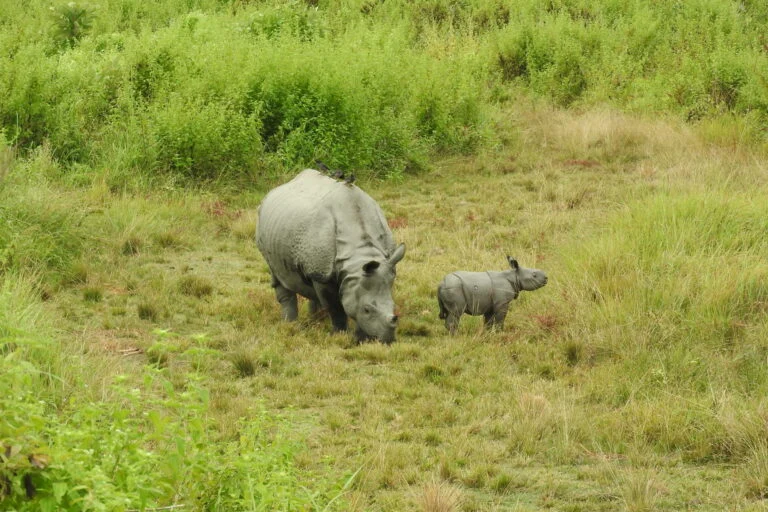
The recovery of the greater one-horned rhinoceros (Rhinoceros unicornis) in Assam’s Manas National Park (MNP) stands as one of the most ambitious and closely watched experiments in modern Asian conservation. Once entirely extirpated from the landscape during a period of intense civil unrest, the species has made a remarkable return through a combination of wild-to-wild translocation and the rehabilitation of orphaned calves.
A comprehensive new study, covering a decade of data from 2012 to 2021, provides a scientific "health check" on this reintroduced population. The findings offer a nuanced look at how these mega-herbivores are adapting, breeding, and carving out territories in a landscape that was once a graveyard for their ancestors. While the data confirms a successful re-establishment, it also highlights the delicate nature of wildlife restoration and the ongoing management required to prevent a second collapse.
Main Facts: The Scope of the Reintroduction
The restoration of the rhino in Manas was not a singular event but a multi-pronged strategy involving two primary pathways: the Indian Rhino Vision 2020 (IRV2020) and the Rhino Rehabilitation Programme.
The Two-Route Approach
- Wild-to-Wild Translocation: Between 2008 and 2021, 22 rhinos were captured from "donor" sites—specifically Kaziranga National Park and Pobitora Wildlife Sanctuary—and moved directly to Manas. These individuals were already habituated to the wild and possessed natural survival instincts.
- Rehabilitation and Release: In parallel, 20 rhinos were released into the park between 2006 and 2021 by the Centre for Wildlife Rehabilitation and Conservation (CWRC). These were largely calves orphaned by floods or poaching elsewhere, raised by humans, and gradually "rewilded" in Manas.
Key Study Findings
The recent study, led by wildlife biologist Deba Kumar Dutta and published in ResearchGate, meticulously tracked these individuals and their offspring (the F1 generation). The headline success is the recording of 35 rhino births within the park during the study period. Of these, 19 were born to translocated mothers, nine to rehabilitated mothers, and five to the first generation of rhinos actually born in Manas. This "generational turnover" is the ultimate benchmark for a successful reintroduction, signaling that the animals are not just surviving, but thriving.
Chronology: From Extirpation to Restoration
The history of rhinos in Manas is a story of tragedy followed by a slow, methodical recovery. To understand the significance of the current study, one must look at the timeline of the park’s decline and subsequent rebirth.
The Era of Loss (1980s – 2000s)
During the late 1980s and throughout the 1990s, Manas National Park was caught in the crossfire of ethno-political conflict in the Bodo heartland. The breakdown of administrative control led to a surge in poaching and timber felling. By the early 2000s, the park’s entire rhino population—estimated at roughly 100 individuals in the 1980s—had been completely wiped out. This led to Manas being placed on the UNESCO "World Heritage in Danger" list.

The Turning Point (2005 – 2008)
As peace returned to the region, the Bodoland Territorial Council and the Assam Forest Department, supported by NGOs like WWF-India and the International Rhino Foundation, launched IRV2020. The goal was to reach a population of 3,000 rhinos across seven protected areas in Assam. Manas was chosen as the primary site for re-establishment.
The Implementation Phase (2012 – 2021)
The study period captures the most critical phase of the project. It tracks the maturation of the initial "pioneer" rhinos and the birth of their calves. This decade saw a shift from simply keeping the animals alive to monitoring their reproductive health and social dynamics. By 2021, the population had stabilized enough to warrant a deeper analysis of their behavioral ecology, leading to the current findings.
Supporting Data: Breeding Metrics and Spatial Dynamics
The study provides granular data on how the origin of a rhino (wild-caught vs. rehabilitated) influences its behavior and reproductive success in the new environment.
Reproductive Indicators
The metrics for the F1 generation (rhinos born in Manas) are particularly encouraging. The study found that F1 females reached sexual maturity and had their first calf at an average age of 5.65 years. In contrast, rehabilitated rhinos calved much later, at an average of 9.2 years.
"Breeding and calving are among the most important indicators that reintroduced rhinoceroses have adapted well to their new environment," explains Deba Kumar Dutta. The fact that two calves were born less than 480 days after their mothers were moved suggests that the stress of translocation did not cause them to abort their pregnancies—a major win for the logistics team.
Spatial Use and Home Ranges
One of the most striking differences found in the data concerns how the rhinos use the 950-square-kilometer park:

- Translocated Rhinos: These wild-born individuals maintained massive home ranges, averaging 339 sq km. They utilized remote, undisturbed sectors of the park, displaying the wary, wide-ranging behavior of their ancestors.
- Rehabilitated Rhinos: These "human-imprinted" individuals stayed in much smaller areas, averaging only 52 sq km. They tended to cluster in the central, more managed parts of the park and occasionally wandered toward human settlements, likely due to their early-life habituation to people.
- F1 Generation: Interestingly, the rhinos born in Manas displayed an intermediate behavior, with an average range of 79 sq km. They often shared territory with their mothers but began to push further into the core areas of the park.
Seasonal Patterns
The data revealed a strong correlation between the monsoon and reproduction. Fourteen of the recorded births occurred between May and September. Unlike Kaziranga, which suffers from catastrophic flooding during the monsoon, Manas’s higher elevation and different drainage patterns make the rainy season a time of abundance. The peak availability of lush grass and water sources during these months creates the ideal nutritional window for nursing mothers.
Official Responses and Expert Analysis
The success in Manas has been met with cautious optimism by the global conservation community, though experts warn against declaring a final victory.
The "Metapopulation" Strategy
Yadvendradev Jhala, a senior scientist and former Dean of the Wildlife Institute of India, emphasizes that Manas cannot exist as an island. "The reintroduction has been remarkably successful but should not be viewed with complacency since it can easily be reversed," Jhala notes. He argues that the Manas rhinos must be managed as part of a metapopulation, which involves the periodic movement of individuals between Kaziranga, Pobitora, and Manas to ensure genetic diversity. Without this "genetic infusion," the small Manas population could suffer from inbreeding depression over time.
Addressing the Poaching Threat
Officials from the Assam Forest Department acknowledge that the study period was not without its setbacks. In the early years of the reintroduction, poaching claimed several adult males. This created an imbalance in the sex ratio and temporarily disrupted breeding cycles, explaining the "dip" in births recorded in 2016. However, the subsequent strengthening of the "Manas Tiger Force" and community-based anti-poaching initiatives has largely stabilized the situation, leading to the rebound in birth rates seen in 2020 and 2021.
Implications for Future Conservation
The findings from the 2012–2021 study have significant implications for how rhino reintroductions will be handled globally, from the Javan rhino in Indonesia to the black rhino in Africa.
1. The Value of Rehabilitation
The study proves that while rehabilitated, hand-reared rhinos may have smaller home ranges and later calving ages, they are still viable contributors to a new population. They act as a "buffer" and can successfully raise the next generation of truly wild (F1) rhinos.

2. Habitat Management
The study underscores the need for active grassland management. In Manas, the encroachment of invasive plant species like Chromolaena odorata and Mimosa invisa threatens the perennial grasslands that rhinos depend on. The success of the rhino population is directly tied to the forest department’s ability to control these weeds and maintain water holes.
3. The Need for Continued Translocation
Because the F1 generation is still relatively small, the study suggests that more "wild-to-wild" translocations are necessary to broaden the genetic pool. Relying solely on natural growth from a small founder population is risky.
Conclusion
The return of the greater one-horned rhino to Manas National Park is more than just a local success; it is a proof-of-concept for the "rewilding" of degraded landscapes. The 35 calves born during the study period are a testament to the resilience of the species and the effectiveness of the IRV2020 framework. However, as the study concludes, the survival of these "Manas Pioneers" depends on a relentless commitment to protection, habitat maintenance, and a scientifically-led management strategy that views the rhino not just as an individual, but as part of a larger, interconnected ecosystem.
