

Introduction: The Precarious Intersection of Finance and Climate
In the intricate web of India’s financial ecosystem, Microfinance Institutions (MFIs) have long served as the vital connective tissue between formal banking and the country’s most vulnerable populations. By providing small-ticket loans to low-income households—predominantly women and rural entrepreneurs—MFIs have been credited with driving financial inclusion and poverty alleviation. However, a new and formidable shadow is falling across this ₹3.81 trillion industry: the escalating threat of climate change.
A seminal policy brief released by the New Delhi-based Climate and Sustainability Initiative (CSI), titled “Micro Loans, Macro Shocks: How is Climate Risk Reshaping India’s Microfinance Industry,” warns that the very demographic MFIs serve is the one most exposed to climate-induced volatility. As extreme weather events—from record-breaking heatwaves to erratic monsoons—become the "new normal," the financial stability of millions of borrowers, and the institutions that support them, hangs in the balance.
Main Facts: A Portfolio Under Pressure
The CSI policy brief paints a sobering picture of the structural vulnerabilities inherent in the Indian microfinance sector. At the heart of the issue is the high concentration of credit in sectors that are directly dependent on stable weather patterns.
The ₹3.81 Trillion Exposure
The total microfinance portfolio in India stands at approximately ₹3.81 trillion. Of this staggering sum, the CSI report identifies that 60% is concentrated in agriculture and allied activities. This includes crop cultivation, agro-based enterprises, animal husbandry, and fisheries. Because these livelihoods are fundamentally "climate-sensitive," any deviation in temperature or rainfall directly impacts the borrower’s ability to generate income and, consequently, their ability to repay loans.
Sectoral Breakdown of Risk
The report categorizes the industry’s exposure into four primary segments:
- Agriculture and Allied Activities (60%): The highest risk category, encompassing farming and livestock.
- Non-Agro Activities (32%): Includes trading, transport, handicrafts, and small-scale businesses. While less direct than farming, these businesses often rely on the local agrarian economy for demand.
- Clean Energy and Water (4.4%): Loans specifically targeted at climate adaptation or basic utility needs.
- Housing and Non-Income Generating Activities (3.6%): Loans for domestic infrastructure.
The Vulnerability Trap
The "macro shock" mentioned in the report’s title refers to the systemic nature of climate risk. Unlike individual credit defaults caused by personal circumstances, climate events create "correlated risks." When a flood hits a district in Bihar or a drought strikes a region in Maharashtra, it doesn’t just affect one borrower; it affects the entire local economy simultaneously. This leads to a spike in Portfolio at Risk (PAR) for MFIs operating in those clusters, potentially threatening their solvency.
Chronology: From Weather Events to Financial Instability
The transition of a climate event into a financial crisis follows a predictable, yet devastating, timeline. To understand the gravity of the CSI findings, one must look at how these shocks have evolved from seasonal inconveniences into systemic financial hurdles.
Phase 1: The Immediate Income Shock
The cycle begins with a climate trigger—such as the heat stress witnessed across Northern India in early 2024 or the erratic monsoon patterns of the last decade. According to a 2025 report by Agri3 Fund, HSBC India, and MicroSave Consulting, these events have already begun to erode the economic foundation of rural India. Specifically, the report claims that India’s 120 million smallholder farmers have seen their farm incomes cut by 15% to 18% due to climate-induced disruptions.
Phase 2: The Liquidity Crunch
As income drops, the first casualty is the household’s disposable income. Low-income borrowers, who typically operate on thin margins, are forced to divert their limited savings toward immediate survival—food, water, and emergency repairs. This creates a liquidity crunch at the household level.
Phase 3: The Credit Cycle Disruption
Within three to six months of a major climate event, MFIs begin to see a rise in delayed payments. Because microfinance relies heavily on the "joint liability group" (JLG) model—where neighbors guarantee each other’s loans—the failure of one or two members due to a lost crop can cause the entire group’s repayment structure to collapse.
Phase 4: Long-term Portfolio Erosion
Over years of recurring droughts or floods, the resilience of these communities is worn down. Borrowers may fall into a debt trap, taking out new loans to pay off old ones, or may migrate to urban centers, leading to "ghost portfolios" where the borrowers are no longer traceable by MFI field officers.
Supporting Data: The Geography of Risk
The CSI policy brief provides a granular analysis of how climate risk is distributed across India’s diverse landscape. The findings suggest that the microfinance industry is most heavily invested in the regions that are the most geographically precarious.

Eastern India: The Eye of the Storm
The Eastern region—comprising Bihar, Odisha, Jharkhand, West Bengal, and the Andaman and Nicobar Islands—holds the highest portfolio exposure at 33%. Coincidentally, this region is ranked among the most climate-vulnerable in the country. It is a "high-concentration, high-risk" zone where frequent cyclones and perennial flooding in the Indo-Gangetic plain threaten nearly a third of the industry’s total assets.
The Northeast: Low Exposure, Extreme Risk
The Northeastern region represents only 3% of the national portfolio, yet it faces the most extreme environmental challenges. The CSI brief highlights that this area is highly vulnerable to landslides, flash floods, and extreme rainfall. While the financial impact on the national industry might be smaller in absolute terms, the "human cost" and the difficulty of maintaining financial services in these terrains are immense.
Central and Southern India: Moderate to High Risks
- Southern India (28% of portfolio): Shows moderate climate vulnerability. While better infrastructure and diversified economies provide some cushion, coastal regions remain at risk from rising sea levels and cyclones.
- Central India (18% of portfolio): Faces moderate to high vulnerability, particularly regarding heat stress and groundwater depletion, which affects its significant agricultural base.
Northern and Western India: The Relative Safe Havens
- Western India (11% of portfolio): Faces low to moderate risks, though parts of Gujarat and Rajasthan are increasingly prone to extreme heat and desertification.
- Northern India (7% of portfolio): Generally falls into the low-to-moderate category, with one notable exception: Jammu and Kashmir, which the report identifies as a high-vulnerability zone due to its fragile mountainous ecosystem.
Official Responses and Strategic Recommendations
The CSI policy brief does more than just diagnose the problem; it serves as a call to action for regulators, MFIs, and the government. The consensus among researchers at CSI, HSBC India, and Agri3 Fund is that the industry requires an urgent "climate-sensitive approach."
The Need for Climate-Resilient Credit
The brief suggests that MFIs must move beyond traditional credit scoring and begin integrating climate risk assessments into their lending models. This includes:
- Product Diversification: Developing loan products specifically for climate adaptation, such as drought-resistant seeds, solar-powered irrigation, and flood-resilient housing.
- Geographic De-risking: Encouraging MFIs to diversify their portfolios across different agro-climatic zones to avoid over-exposure to a single regional disaster.
Enhancing Insurance Linkages
One of the most critical "official" recommendations is the tightening of links between micro-credit and micro-insurance. Currently, many borrowers are uninsured against crop failure. The report advocates for "index-based insurance" that triggers automatic payouts based on weather data (e.g., if rainfall falls below a certain millimeter threshold), ensuring that borrowers can settle their MFI debts even if their harvests fail.
Regulatory Oversight
While the Reserve Bank of India (RBI) has begun emphasizing Green Finance, the CSI brief implies that more specific guidelines are needed for the microfinance sector. This could include "stress testing" MFI portfolios against various climate scenarios to ensure they have enough capital buffers to survive a major regional shock.
Implications: The Future of Financial Inclusion
The intersection of microfinance and climate change has profound implications for India’s broader economic goals. If left unaddressed, the climate crisis could undo thirty years of progress in rural development.
The Threat to Women’s Empowerment
Microfinance is a gendered industry; over 90% of MFI clients in India are women. When climate shocks hit, women often bear the brunt of the economic fallout, losing their hard-won financial independence. The CSI report suggests that the "macro shock" of climate change is also a "social shock" that could widen the gender gap in rural India.
Systemic Financial Risk
While an individual MFI might seem small, the sector as a whole is interconnected with the mainstream banking system. MFIs borrow heavily from commercial banks to fund their lending. A widespread default in the microfinance sector caused by a catastrophic monsoon season could lead to a spike in Non-Performing Assets (NPAs) for the larger banking sector, creating a contagion effect.
The Opportunity for "Green" Microfinance
On a more optimistic note, the crisis presents an opportunity. By pivoting toward "Green Microfinance," the industry can become a primary vehicle for climate adaptation. If the ₹3.81 trillion currently in circulation can be incentivized toward sustainable practices—such as organic farming, water conservation, and renewable energy—MFIs could transition from being victims of climate change to becoming the frontline of climate resilience.
Conclusion
The CSI policy brief, “Micro Loans, Macro Shocks,” serves as a definitive warning: the era of weather-blind lending is over. As the industry navigates the high-risk landscapes of Eastern India and the volatile agricultural heartlands, the ability to predict, price, and mitigate climate risk will determine the survival of the microfinance model. For India to achieve its goal of a resilient, inclusive economy, the "small loans" of the MFI sector must be protected from the "macro shocks" of a warming planet.
Credits & Sources:
- Policy Brief: "Micro Loans, Macro Shocks: How is Climate Risk Reshaping India’s Microfinance Industry" by Climate and Sustainability Initiative (CSI).
- Regional Data and Income Impact: 2025 Report by Agri3 Fund, HSBC India, and MicroSave Consulting.
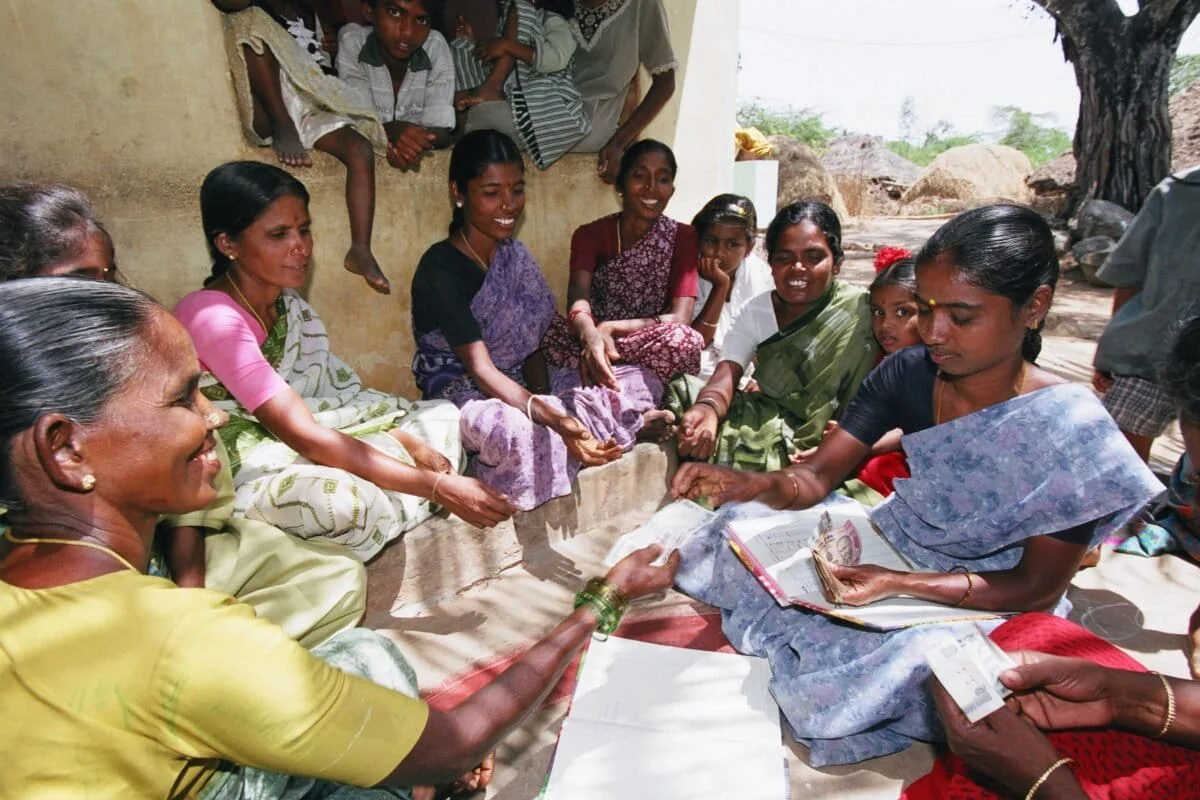
- Banner Image: Rural cooperative gathering (Marcel Crozet/ILO via Flickr).
