

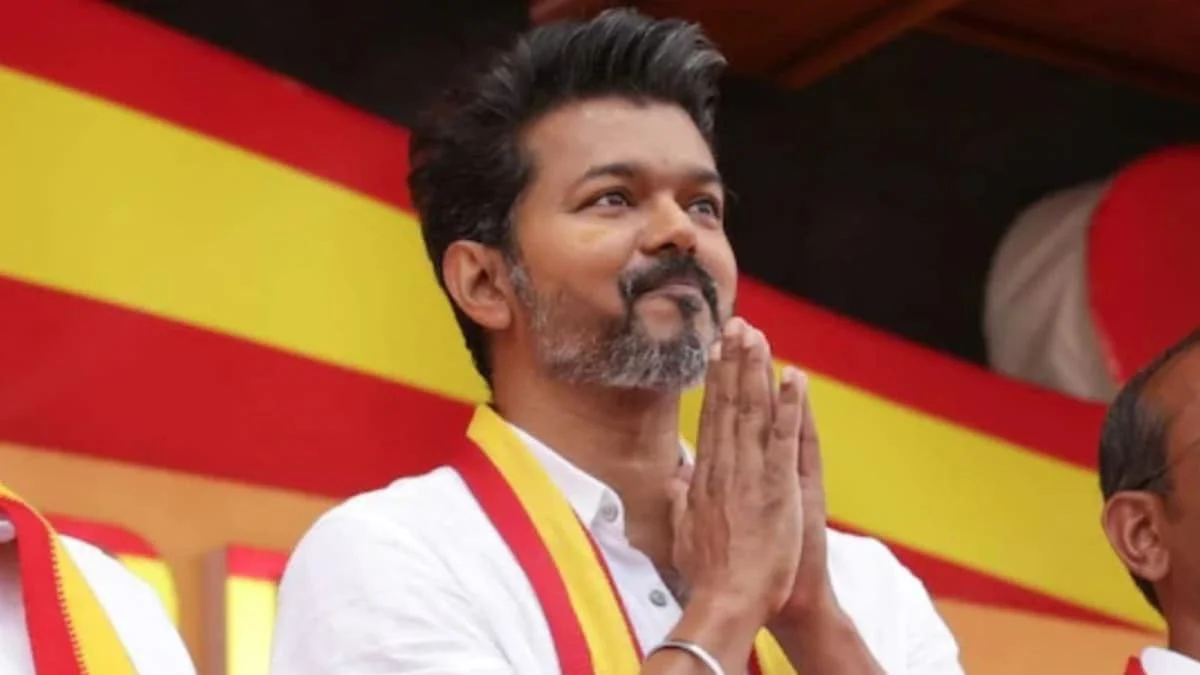
Chennai, Tamil Nadu – May 10, 2026 – History was rewritten today in Tamil Nadu as Chandrasekar Joseph Vijay, popularly known as ‘Thalapathy’ Vijay, took the oath of office as the state’s Chief Minister. The swearing-in ceremony, held amidst fervent cheers at Chennai’s iconic Jawaharlal Nehru Indoor Stadium, marked a monumental shift in the political landscape, bringing to an end nearly seven decades of a duopoly held by the Dravida Munnetra Kazhagam (DMK) and All India Anna Dravida Munnetra Kazhagam (AIADMK).
The 49-year-old actor-turned-politician, president of the newly formed Tamilaga Vettri Kazhagam (TVK), was administered the oath by Tamil Nadu Governor Rajendra Vishwanath Arlekar. His ascent to the top political office, supported by the Viduthalai Chiruthaigal Katchi (VCK) and the Indian Union Muslim League (IUML), signals a profound transformation in the state’s governance and political discourse. As the state ushers in this unprecedented era, public attention has also keenly turned to the financial disclosures of its new leader, whose election affidavit reveals a formidable net worth of Rs 624 crore.
A New Era Dawns in Tamil Nadu Politics
The inauguration of Joseph Vijay as Chief Minister is more than just a change in leadership; it represents a tectonic shift in the entrenched political dynamics of Tamil Nadu. For the first time since 1967, the reins of power will not be held by either of the two dominant Dravidian parties, DMK or AIADMK, which have interchangeably governed the state for generations. This historic moment culminates a journey that saw a beloved cinema icon transition into a formidable political force, capturing the aspirations of a populace yearning for change.
Vijay’s Tamilaga Vettri Kazhagam emerged as the single-largest party in the recent elections, securing 108 seats in the 234-member Assembly. The crucial support from the Viduthalai Chiruthaigal Katchi (VCK), a prominent Dalit political party, and the Indian Union Muslim League (IUML), solidified TVK’s position, pushing their total tally to a comfortable 120 seats, thereby forming a stable coalition government. The alliance, forged on a platform of anti-corruption, youth empowerment, and inclusive development, successfully resonated with a broad spectrum of voters disillusioned with traditional political narratives. The swearing-in ceremony itself was a spectacle, attended by political dignitaries, film personalities, and thousands of jubilant supporters, underscoring the widespread excitement and high expectations surrounding the new administration.
The Road to Power: A Chronology of TVK’s Ascent
Joseph Vijay’s journey from a celebrated superstar to the Chief Minister of Tamil Nadu has been meticulously charted over several years, culminating in today’s historic event. His foray into politics was not sudden but rather a carefully considered and gradually executed strategy, built upon years of public goodwill and social engagement.
Early Political Engagements and Public Service: While his formal entry into politics is recent, Vijay has long utilized his immense popularity for social causes. His fan clubs, initially focused on promoting his films, evolved into platforms for community service, engaging in activities such as blood donation drives, educational support for underprivileged students, and disaster relief operations. These initiatives, often carried out without overt political messaging, subtly laid the groundwork for his eventual political transition, building a reputation for social consciousness beyond his cinematic persona.
The Genesis of Tamilaga Vettri Kazhagam (TVK): The seeds of TVK were formally sown in late 2023, when Vijay announced his intention to enter active politics, citing a deep-seated desire to serve the people of Tamil Nadu and address systemic issues. The party was officially registered in early 2024, articulating a clear vision centered on clean governance, economic revival, and social justice. The name "Tamilaga Vettri Kazhagam," meaning "Tamil Nadu Victory Federation," itself conveyed a powerful message of regional pride and ambition. The party quickly gained traction, attracting a diverse membership base, including youth, first-time voters, and disillusioned members from established parties, all drawn to Vijay’s charismatic leadership and his promise of a new political culture.
The Electoral Battleground of 2026: The run-up to the 2026 Assembly elections was fiercely contested. TVK, despite being a nascent party, launched an aggressive and innovative campaign. Vijay crisscrossed the state, addressing massive rallies that mirrored the enthusiasm typically reserved for his film releases. His campaign focused on core issues affecting the common man: rising unemployment, agrarian distress, access to quality healthcare and education, and the pervasive issue of corruption. His speeches, delivered in his signature accessible style, resonated deeply, promising pragmatic solutions rather than ideological rhetoric.
The election witnessed a multi-cornered contest, with the incumbent DMK and the principal opposition AIADMK fighting to retain their traditional strongholds. TVK, however, managed to cut across caste and community lines, appealing to a broad electorate tired of the decades-old political narratives. The party’s manifesto, emphasizing transparency, technological integration in governance, and robust welfare schemes, further solidified its appeal. Exit polls began to hint at a significant upset, and as results trickled in, it became clear that TVK was poised to make history.
Forging a Coalition: While TVK emerged as the single-largest party, it fell short of a clear majority. This necessitated swift and strategic alliance-building. Negotiations with VCK leader Thol. Thirumavalavan and IUML’s K.M. Kader Mohideen proved successful. Both parties, recognizing the popular mandate for change and Vijay’s undeniable appeal, agreed to extend their support, ensuring the stability of the new government. This coalition, bringing together diverse political entities under TVK’s leadership, underscored Vijay’s ability to forge consensus and build bridges, a crucial skill for any Chief Minister.
The swearing-in ceremony on May 10, 2026, therefore, was not merely a formality but a celebration of a new political paradigm. It marked the culmination of a star’s evolution into a statesman, driven by a vision to redefine governance in Tamil Nadu.
Unpacking the Chief Minister’s Coffers: A Detailed Look at Joseph Vijay’s Declared Wealth
As Joseph Vijay assumes the mantle of Chief Minister, his financial transparency, detailed in his election affidavit filed in late March, offers a rare glimpse into the wealth accumulated by a superstar transitioning into public service. Declaring a net worth of Rs 624 crore, the affidavit meticulously outlines a diversified portfolio, heavily leaning towards conservative investments and substantial real estate holdings, with a notable aversion to volatile equity markets. His financial declaration also reveals zero liabilities, presenting an image of fiscal prudence and stability.
The Foundation of Fortune: Liquid Assets and Conservative Investments
Vijay’s movable assets, totaling approximately Rs 404 crore, form the lion’s share of his declared wealth, characterized by a distinctly risk-averse investment philosophy.
An Unprecedented Savings Account Balance: The most striking revelation within his liquid assets is the staggering balance of over Rs 213 crore held in a single Indian Overseas Bank (IOB) savings account located in Saligramam. This figure alone accounts for more than half of his total movable assets. Such a substantial sum residing in a regular savings account, rather than being deployed in higher-yield market-linked instruments, speaks volumes about his financial conservatism. It suggests a preference for immediate liquidity and capital preservation over aggressive growth, a strategy perhaps influenced by his public persona and the need for readily accessible funds for various ventures, or simply a deeply ingrained cautious approach to wealth management. This particular detail has sparked considerable discussion among financial analysts, many of whom point out the opportunity cost of keeping such a large amount in an instrument with relatively low returns, especially for an individual with such vast resources.
Strategic Fixed Deposits Across Multiple Banks: Complementing his savings account, Vijay has strategically diversified an additional Rs 100 crore across fixed deposits (FDs) in four different banks. This includes Rs 40 crore with Axis Bank, Rs 25 crore with Indian Overseas Bank, Rs 20 crore with HDFC Bank, and Rs 15 crore with the State Bank of India. This allocation across multiple institutions serves both to mitigate concentration risk and to benefit from varying interest rates. Together with his savings balance, the overwhelming bulk of his liquid wealth is thus locked into instruments offering guaranteed returns with no exposure to market fluctuations. This ultra-conservative approach stands in stark contrast to many high-net-worth individuals who typically allocate significant portions of their portfolios to equities, mutual funds, or alternative investments for higher potential growth. His reported total income of Rs 184.53 crore for FY 2024-25, largely stemming from his self-employment (acting, endorsements), rental income, and interest, underscores the significant cash flow he has generated.
Minimal Stock Market Exposure: In a further testament to his risk aversion, Vijay’s equity holdings are remarkably negligible. His declared investments in the stock market amount to less than Rs 20 lakh, representing a minuscule 0.04% of his total net worth. This includes shares in Jaya Nagar Property Pvt Ltd worth approximately Rs 19.69 lakh, Indian Overseas Bank shares valued at Rs 9,600, and Sun Paper Mill Ltd shares worth Rs 25,000. This minimal exposure suggests either a lack of interest or a deliberate choice to steer clear of the volatility inherent in equity markets, reinforcing the narrative that his wealth is built almost entirely on secure cash deposits, fixed income, and tangible property assets.
A Portfolio of Bricks and Mortar: Vijay’s Extensive Real Estate Holdings
Joseph Vijay’s immovable assets, valued at approximately Rs 220 crore, paint a picture of a shrewd investor in real estate, primarily concentrated in and around Chennai, a city known for its appreciating property values. His portfolio is well-diversified across residential, commercial, and agricultural properties, indicating a strategic approach to wealth preservation and generation through rental income.
Opulent Residential Properties: The affidavit lists ten residential properties across prime localities in Chennai, including Neelankarai, Saligramam, Mylapore, and Egmore, collectively valued at around Rs 115 crore. These locations are among the most sought-after in the city, known for their upscale communities, excellent infrastructure, and proximity to key urban centers. Owning multiple properties in such high-value areas not only reflects significant capital investment but also provides a steady stream of rental income, contributing to his overall financial stability.
Lucrative Commercial Properties: His commercial property holdings are equally substantial, valued at approximately Rs 82.8 crore. These properties are situated in strategic business hubs such as Parivakkam, Thyagaraya Nagar, Sholinganallur, and Koppur. Investments in commercial real estate typically offer higher rental yields and often appreciate robustly in growing urban economies. These assets likely serve as significant income generators, demonstrating a pragmatic approach to leveraging his wealth.
Diverse Land Holdings: Beyond built-up properties, Vijay also owns non-agricultural land in areas like Porur, Saligramam, and Neelankarai, valued at Rs 22 crore. Such land holdings offer potential for future development or significant capital appreciation. Additionally, he possesses agricultural land in Vattapatti village, Kodaikanal, valued at Rs 20 lakh. While a smaller component, this diversified land portfolio suggests a comprehensive approach to real estate investment, covering various asset classes and geographical locations. The declared income sources, including rental income from these properties, alongside self-employment and interest income, clearly indicate that these assets are actively generating returns, contributing significantly to his annual earnings.
The Lifestyle of a Superstar-Turned-Statesman: Vehicles, Valuables, and Family Finances
Even as he transitions to public service, Vijay’s affidavit details a lifestyle befitting a former superstar, balanced with a keen eye on family financial arrangements.
A Fleet of Luxury Vehicles: His vehicle collection reflects a taste for high-end automobiles. The fleet includes a 2024 Toyota Lexus 350 valued at Rs 3.01 crore, a 2024 BMW i7 worth Rs 2 crore, and a 2024 Toyota Vellfire at Rs 1.63 crore. These luxury cars are indicative of his previous profession and the associated affluence. Interestingly, the list also includes a 2020 BMW 530 (Rs 80.5 lakh), a more modest 2024 Maruti Swift (Rs 5.35 lakh), and a 2025 TVS XL Super bike (Rs 67,400). The inclusion of more common vehicles, alongside the super-luxury ones, could be seen as a strategic move to portray relatability to the common populace, or simply a reflection of diverse needs within his household.
Precious Jewellery and Family Loans: Vijay has declared 883 grams of gold and silver articles, valued at Rs 1.2 crore. Such holdings are common in Indian households, often serving as both investment and cultural assets. The affidavit also sheds light on internal family financial arrangements, listing 14 loans and advances extended to family members. These include a substantial Rs 12.6 crore to his spouse, Sangeetha Vijay, Rs 8.78 lakh to his son, Jason Sanjay, and Rs 4.6 lakh to his daughter, Divya Saasha. This practice, common among affluent families, allows for internal capital management and support, reflecting a structured approach to managing family wealth.
A Debt-Free Mandate: Financial Prudence and Public Trust
One of the most significant aspects of Vijay’s financial declaration is his absolute lack of liabilities. He has declared no outstanding dues to any bank or financial institution, presenting a clean slate financially. This zero-debt status is a powerful statement, especially for a public figure entering a high-profile political office. In a political landscape often scrutinised for financial impropriety, a debt-free personal balance sheet can bolster public trust and reinforce an image of integrity and responsible financial management.
Furthermore, his spouse, Sangeetha Vijay, has separately declared assets totaling Rs 15.76 crore. Her movable assets amount to Rs 15.51 crore, while immovable property stands at Rs 25 lakh. This separate declaration indicates a clear delineation of individual assets within the family, adhering to transparency norms for public office holders. The combined picture of Vijay’s and Sangeetha’s wealth underscores a family with significant financial independence and a conservative approach to wealth accumulation and management.
Reactions and Official Responses: The Political Landscape Shifts
The swearing-in of Joseph Vijay has sent ripples across Tamil Nadu and the national political arena, eliciting a range of reactions from political parties, the public, and allied partners. The consensus, however, is that this event marks an undeniable watershed moment.
Reactions from Rival Parties: The DMK and AIADMK, while acknowledging the democratic verdict, have expressed mixed sentiments. Senior DMK leaders, while extending formal congratulations to the new Chief Minister, have also vowed to play the role of a vigilant opposition. Sources within the DMK indicated that the party is undertaking a deep introspection into the causes of their defeat, particularly the erosion of youth votes and the anti-incumbency sentiment. Similarly, the AIADMK, now navigating its own internal challenges, acknowledged the historic nature of the shift but maintained that the "Dravidian ideology" would continue to be paramount in Tamil Nadu’s political narrative, irrespective of who holds power. They expressed skepticism about TVK’s long-term sustainability without the deep-rooted cadre base of traditional parties. Some analysts suggest that both traditional parties will now be forced to recalibrate their strategies, possibly focusing on grassroots rejuvenation and adapting to the new political realities.
Support from Coalition Partners: Leaders of the Viduthalai Chiruthaigal Katchi (VCK) and the Indian Union Muslim League (IUML) have voiced strong support and optimism for the new government. Thol. Thirumavalavan, VCK President, hailed the formation of the TVK-led government as a victory for social justice and inclusive politics. He reiterated VCK’s commitment to upholding the rights of marginalized communities and ensuring that the new administration works towards equitable development. K.M. Kader Mohideen of the IUML emphasized the importance of secular values and communal harmony, expressing confidence that Chief Minister Vijay would lead a government that respects and protects all communities in the state. Their statements underscored the collaborative spirit of the coalition and their shared objectives for Tamil Nadu’s progress.
Public Sentiment and Expectations: The public reaction has been largely jubilant, particularly among Vijay’s massive fan base and younger voters. There is a palpable sense of hope and expectation for a "cleaner" and more responsive government. Many citizens expressed relief at the breaking of the long-standing political monopoly, viewing Vijay as a fresh face untainted by previous allegations of corruption or dynastic politics. However, alongside the optimism, there are also cautious voices. Some political observers and senior citizens highlight the immense challenges ahead, particularly the need for an inexperienced party to quickly adapt to the complexities of state governance. The expectation is high for Vijay to translate his cinematic charisma and public goodwill into effective policy-making and efficient administration.
Governor’s Role: Governor Rajendra Vishwanath Arlekar, after administering the oath, offered his best wishes to Chief Minister Vijay and his cabinet. His role in facilitating a smooth transition of power has been widely noted, reinforcing the constitutional process amidst a significant political upheaval.
The reactions collectively underscore the magnitude of the change. While there is anticipation and hope for the new era, there is also an understanding that the TVK government faces the monumental task of delivering on its promises and consolidating its position in a historically competitive political landscape.
Implications for Tamil Nadu: The Road Ahead for the TVK Government
The ascension of Joseph Vijay and the Tamilaga Vettri Kazhagam government heralds a period of significant implications for Tamil Nadu, potentially reshaping its governance, political culture, and socio-economic trajectory. The challenges and opportunities facing the new administration are immense.
Governance and Policy Challenges
The TVK government steps into office with a mandate for change, but also with the daunting task of governing a complex and diverse state. One of the primary expectations is a marked departure from the perceived inefficiencies and corruption of previous administrations. Vijay’s campaign consistently promised "clean governance" and "people-centric policies." Translating these broad promises into actionable policies will be crucial.
Economic Revival: Tamil Nadu, while an industrially advanced state, faces challenges such as youth unemployment, agrarian distress, and regional disparities. The TVK government will be expected to unveil robust economic strategies to boost employment, support farmers, and attract new investments. This will require a delicate balance between industrial growth and environmental sustainability.
Social Justice and Welfare: Building on the legacy of Dravidian movements, the TVK will be under pressure to continue and enhance welfare schemes, particularly in education, healthcare, and social security. The VCK and IUML, as coalition partners, will play a critical role in ensuring that policies are inclusive and address the needs of marginalized communities. Issues of caste-based discrimination, gender equality, and religious harmony will require sensitive and effective policy interventions.
Administrative Efficacy: As a relatively new party, TVK lacks the deep administrative experience of the DMK or AIADMK. Chief Minister Vijay will need to quickly build a competent team of bureaucrats and advisors capable of implementing his vision. The challenge will be to streamline administrative processes, ensure transparency, and deliver services efficiently to the last mile. This will involve overcoming potential resistance from entrenched interests and fostering a culture of accountability within the government machinery.
The Future of Dravidian Politics
Vijay’s victory has undoubtedly shaken the foundations of Dravidian politics. For nearly seven decades, the DMK and AIADMK have defined the political narrative of Tamil Nadu, often with a focus on regional identity, language, and social justice.
A Reordering of Power Dynamics: The TVK’s success raises questions about whether this is a temporary disruption or a permanent reordering of the state’s political landscape. It forces both the DMK and AIADMK to re-evaluate their strategies, leadership, and public outreach. They will need to address why a significant portion of the electorate chose an outsider over their established legacies. This could lead to internal reforms, new alliances, or a more aggressive opposition stance from these traditional parties.
Erosion of Traditional Ideologies?: While TVK has adopted some tenets of Dravidian ideology, its primary focus has been on governance, anti-corruption, and development, rather than a strong ideological stance on language or federalism that defined earlier Dravidian movements. This shift might signal a move towards a more pragmatic, issue-based politics, potentially diluting the traditional ideological debates. However, the deep cultural and historical roots of Dravidianism mean that its influence will likely persist, adapting to the new political realities.
Space for New Entrants: TVK’s success could also open doors for other non-traditional political actors or regional parties seeking to challenge the established order. It demonstrates that with popular appeal and a clear message, it is possible to break through the entrenched two-party system.
The Symbolism of a Superstar’s Ascent
Joseph Vijay’s journey from a beloved film star to Chief Minister carries profound symbolism.
Hopes of the Youth: For millions of young voters and first-time electors, Vijay represents hope and a break from the past. His charismatic appeal, combined with his promise of a forward-looking government, has resonated deeply with a demographic eager for change and representation. His celebrity status brings an unparalleled level of public attention, which can be both an asset and a liability.
The Power of Charisma and Media: His victory underscores the continuing power of charisma and media influence in Indian politics, particularly in states with a strong cinematic tradition like Tamil Nadu. However, governing is vastly different from performing on screen. Vijay will need to prove his administrative acumen and policy expertise to maintain public trust.
Challenges of Transition: The transition from film to politics is often fraught with challenges. While his fan base provides an initial surge of support, governance requires sustained performance, complex decision-making, and the ability to navigate political intricacies. He will face intense scrutiny, and any missteps could be amplified due to his celebrity status.
Conclusion: A New Chapter in Tamil Nadu’s Political Saga
Today’s swearing-in of Chandrasekar Joseph Vijay as the Chief Minister of Tamil Nadu marks an indelible moment in the state’s political history. It signifies the end of a long-standing political era and the dawn of a new one, driven by a charismatic leader who successfully leveraged his immense public appeal to usher in an unprecedented change. With a robust financial standing, characterized by conservative investments and substantial real estate, Chief Minister Vijay embarks on his tenure with a clean slate, financially unencumbered and seemingly dedicated to public service.
The TVK government, supported by its coalition partners, faces the monumental task of fulfilling the high expectations of a populace yearning for transparent, efficient, and inclusive governance. The implications for Tamil Nadu are far-reaching, promising a re-evaluation of political strategies, a shift in ideological focus, and a test of whether a superstar’s popularity can translate into sustained, effective administration. As the state steps into this new chapter, all eyes will be on Chief Minister Vijay to see how he navigates the complex challenges and opportunities that lie ahead, shaping the future of Tamil Nadu for generations to come.
