

CHENNAI, India – The political landscape of Tamil Nadu, long defined by the formidable currents of Dravidian ideology, has been irrevocably reshaped. In a verdict that sent shockwaves across the nation, the Tamilaga Vettri Kazhagam (TVK), a party barely two years old, emerged as the single largest entity in the 2026 State Assembly elections. This unprecedented triumph, declared on May 4, 2026, by the Election Commission, brought to a dramatic close a 59-year streak of uninterrupted Dravidian political supremacy, heralding a new era for the southern state.
The architect of this seismic shift is none other than actor-turned-politician C. Joseph Vijay, whose meticulous, almost clinical, application of strategies reminiscent of the Bharatiya Janata Party’s (BJP) ascent under Prime Minister Narendra Modi and Home Minister Amit Shah, proved to be the decisive factor. This was no stroke of luck, but a testament to strategic architecture.
The Seismic Shift: 2026 Tamil Nadu Assembly Elections
The results of the 2026 Tamil Nadu Assembly elections, finalized on May 4, painted a picture of profound change. The TVK secured 108 seats, falling just 10 short of the 118-seat simple majority required to form a government independently. This outcome resulted in Tamil Nadu’s first hung assembly in decades, a clear indicator of a fragmented mandate but a resounding victory for the nascent party.
The impact on the established Dravidian heavyweights was immediate and devastating. The All India Anna Dravida Munnetra Kazhagam (AIADMK) not only failed to return to power but also lost its status as the official opposition, a position now occupied by the Dravida Munnetra Kazhagam (DMK). Even more astonishing was the personal defeat of outgoing Chief Minister M.K. Stalin, who lost the Kolathur seat he had won three times consecutively. Stalin promptly resigned on May 5, acknowledging the public’s clear desire for change.
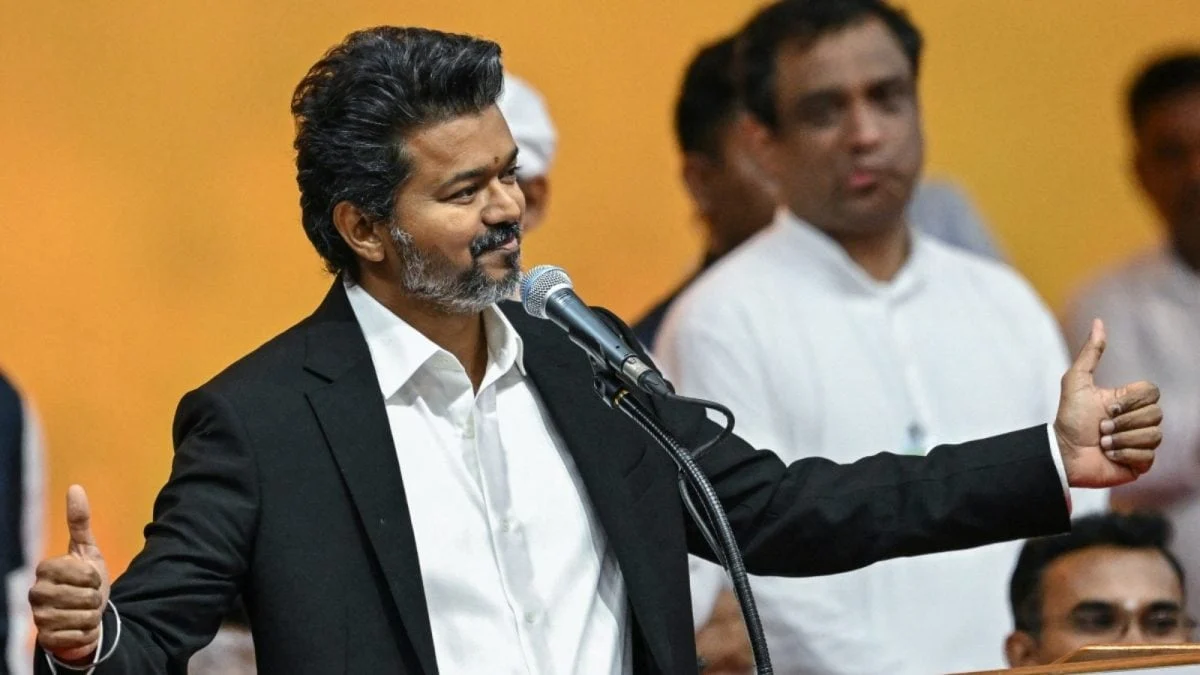
In stark contrast, TVK’s chief ministerial candidate, C. Joseph Vijay, demonstrated his widespread appeal by winning both the Perambur and Tiruchirappalli East constituencies he contested. His dual victories underscored the depth of his popular support and the effectiveness of his party’s ground game. Following a swift round of negotiations, the TVK, citing former Chief Minister K. Kamaraj of the Indian National Congress (INC) as one of its ideological icons, invited INC MLAs to form a coalition government. The INC, seizing the opportunity, left the DMK-led Secular Progressive Alliance and accepted TVK’s invitation, leading to the formation of a new government with Vijay at its helm. On May 10, 2026, C. Joseph Vijay took the oath as the newly elected Chief Minister of Tamil Nadu in Chennai, a moment captured in an AFP photo that circulated widely, symbolizing the dawn of a new political chapter.
A Blueprint for Victory: The BJP Playbook Adapted
Political analysts and commentators have been quick to dissect TVK’s improbable rise, with many pointing to a strikingly familiar strategic blueprint. The BJP’s meteoric growth under the Modi-Shah duo was characterized by the meticulous construction of a formidable party machine and an unparalleled booth-level management system. TVK, under Vijay’s leadership, replicated this model with remarkable precision, adapting it to the unique socio-cultural and political context of Tamil Nadu. This strategic borrowing, far from being a mere imitation, demonstrated a deep understanding of modern electoral mechanics and the art of political engineering.
I. Grassroots Fortification: Building a Party Machine
The foundation of any successful political movement lies in its ability to connect with voters at the most granular level. TVK understood this implicitly, embarking on an ambitious organizational overhaul that mirrored the BJP’s famed cadre-based structure.
The Booth-Level Architecture
In February 2025, a year before the decisive assembly elections, TVK launched a massive enrolment drive with an audacious target: to appoint over 70,000 booth agents across all 234 constituencies in Tamil Nadu. This move was not arbitrary; it was a direct echo of the BJP’s "panna pramukh" system, where a dedicated party worker is responsible for a single page of the voter list, typically comprising around 30 voters. TVK’s 70,000 booth agents represented a microscopic voter coverage architecture, designed for hyper-local engagement, voter identification, and mobilization on election day. Each agent was tasked with cultivating relationships, understanding local issues, and ensuring maximum turnout in their assigned micro-segment.
Parallel to this, the party restructured its internal hierarchy to ensure robust oversight and coordination. Ten Deputy General Secretaries, 10 Zonal In-Charges, and 5 Organisational Secretaries were appointed to oversee the vast network across all constituencies. These officials were responsible for orchestrating zone-wise booth committee meetings, dividing Tamil Nadu into strategic regions: South, North, Delta (East), and Kongu (West). All these efforts were directly overseen by Vijay himself, ensuring centralized command and consistent implementation of the party’s vision. The party also set an ambitious target of enrolling two crore members in the state, signaling its intent to build a broad-based popular movement. This extensive organizational scaffolding allowed TVK to reach every household, ensuring its message permeated even the remotest corners of the state.
From Fan Clubs to Cadre Network: The VMI Foundation
Perhaps the most ingenious adaptation of the BJP playbook was TVK’s transformation of Vijay’s extensive fan clubs into a dedicated political cadre. The BJP’s enduring success owes an enormous debt to the Rashtriya Swayamsevak Sangh (RSS), a pre-existing, decades-old ideological and cadre network with deep roots and embedded trust at the grassroots level. TVK found its equivalent in the Vijay Makkal Iyakkam (VMI) – Vijay’s People Movement.
Established in July 2009, VMI initially organized Vijay’s fan clubs, reportedly numbering around 85,000 across Tamil Nadu, under a welfare association. What began as a platform for cinematic admiration steadily evolved into a disciplined and structured network. Since the 1990s, these fan clubs had been actively engaged in social welfare activities: organizing blood donation camps, providing aid to the poor, and participating in disaster relief efforts during natural calamities. These initiatives were crucial; they built trust and accumulated significant social capital over two decades, transforming cinematic loyalty into community engagement. This very capital later became the robust foundation of a political base, a ready-made army of volunteers and activists.
The VMI’s political acumen was first tested in the 2011 elections when it supported the AIADMK-led alliance. After a period of relative non-involvement in mainstream politics, the organization decided to contest local body elections in Tamil Nadu in 2021. The results were a harbinger of things to come: VMI candidates won an impressive 115 out of the 169 seats they contested, demonstrating their organizational strength and grassroots appeal. These local victories provided invaluable experience and validated the effectiveness of their network. When TVK was officially formed, this extensive groundwork immediately translated into operational strength, allowing the party to enter the political arena with an unparalleled pre-existing grassroots presence, much like the BJP converting its ideological network into an electoral machine between 2012 and 2014.
II. Data, Strategy, and Narrative Control
Modern electoral campaigns are increasingly data-driven and strategically managed. TVK’s campaign was no exception, employing professional expertise to fine-tune its approach.
The Master Strategist: Prashant Kishor’s Intervention
The BJP famously leveraged the expertise of poll strategist Prashant Kishor in its 2014 Lok Sabha campaign and for several key state elections thereafter. TVK followed suit, bringing in Kishor to chart its course. Kishor held a series of intensive meetings with TVK’s top brass, crafting a comprehensive strategy for the fledgling party. He submitted a detailed SWOT (Strengths, Weaknesses, Opportunities, Threats) analysis report to the leadership, meticulously outlining the party’s current standing and identifying areas for improvement. This report, according to senior TVK leaders, was "a comprehensive document that provides a 360-degree view of the party’s current situation and offers suggestions on how to improve its prospects in the elections," providing a clear roadmap to increase its vote share, which Kishor estimated could be around 15% to 20%.
Kishor’s strategic counsel was pivotal, particularly his dismissal of the notion that TVK needed the AIADMK’s support. He affirmed the party’s capacity to contest independently, a bold stance that instilled confidence within the ranks. His unwavering conviction was publicly declared: "TVK has a high chance of winning Tamil Nadu elections in 2026," he stated, famously telling people to "keep this video and play it when the results come." This data-driven, professional approach replaced traditional gut-level political instinct, ensuring every move was calculated for maximum impact.
Digital Dominance: Winning the Algorithm War
The BJP’s 2014 campaign was widely hailed as India’s first social media election, demonstrating the power of digital outreach. TVK ran Tamil Nadu’s equivalent in 2026, recognizing that in the attention economy, digital presence was paramount. At the helm of TVK’s digital operations was C.T.R. Nirmal Kumar, a veteran of digital war rooms for both the BJP and the AIADMK. His specialized knowledge was instrumental in building an aggressive, algorithm-driven social media ecosystem designed to dominate online narratives.
Analysts widely cited TVK’s strong digital campaign as a major factor in Vijay’s success. The party meticulously crafted and disseminated a narrative portraying itself as a fresh, corruption-free alternative, directly contrasting with the perceived fatigue over decades of Dravidian tenures. Through targeted messaging, trend creation, and effective counter-narratives, TVK’s digital machinery ensured its message resonated with urban youth and first-time voters.
A prime example of this digital prowess was the party’s October 2024 Vikravandi conference, which drew an estimated 3 lakh turnout. Crucially, the event was live-streamed across every major digital platform, creating a mass-digital convergence that mirrored the reach of Modi’s mega rallies. TVK understood that in the attention economy, a single, well-executed, large-scale visible event, amplified digitally, could effectively rewrite an entire news cycle, capturing public imagination and media focus.
III. Strategic Acumen and Ideological Positioning
Beyond organization and digital warfare, TVK’s strategic decisions and ideological framing were key to its breakthrough.
The Art of Strategic Patience: Skipping the 2024 Lok Sabha Polls
One of the most underappreciated strategies employed by the BJP has been its discerning ability to choose its battles, knowing which elections to skip to preserve resources for winnable targets. Vijay adopted this principle with remarkable foresight. He made it unequivocally clear that TVK would not contest the 2024 Lok Sabha elections, opting instead to concentrate all its efforts on building grassroots support for the more crucial 2026 Assembly elections.
"Our goal is to contest the 2026 assembly elections and lead the fundamental political change that people need," Vijay declared. This strategic patience paid enormous dividends. By not contesting in 2024, TVK avoided the typical humiliation that often befalls nascent political outfits rushing into premature electoral battles without adequate groundwork. Kamal Haasan’s Makkal Needhi Maiam (MNM), which suffered significant defeats in its early electoral ventures, serves as a cautionary tale. TVK, by contrast, preserved its narrative of invincibility and utilized the time to meticulously complete its organizational build-out, consolidate its base, and refine its message. This approach clearly distinguished TVK from many new parties that prioritize immediate electoral presence over foundational strength.
Crafting a Hybrid Ideology: "Secular Social Justice"
The BJP built its electoral identity around a triangulated ideological product: strong nationalism, Hindutva cultural pride, and an anti-incumbency narrative against Congress dynastic rule. TVK engineered an almost structurally identical triangulation, carefully tailored for Tamil Nadu’s unique cultural and ideological context.
TVK unveiled its ideology as "secular social justice," a potent blend supporting secularism, egalitarianism, a two-language policy (in contrast to the BJP’s Hindi push), and democracy. Vijay strategically positioned his party as an "ideological opponent" to the BJP due to its right-wing politics, while simultaneously branding the DMK as a "political adversary" due to alleged corruption and dynastic politics.
TVK’s ideologue, Arokiasamy, was instrumental in engineering this hybrid ideology, which deftly fused traditional Dravidian principles with an assertive Tamil nationalism. This created a strategic pincer movement, allowing TVK to challenge both the DMK and the BJP simultaneously without being boxed into a singular ideological corner. This "textbook triangulation" enabled TVK to claim moral authority over the entire Tamil political spectrum, a feat no single Dravidian party could achieve, as each traditionally owned only one pole of the established political narrative.
The party’s ideological stance was further cemented through public resolutions. At its November 2024 conference, TVK passed 26 resolutions criticizing both central and state governments. At its first General Council meeting in March 2025, it passed 17 resolutions opposing central policies like the three-language formula and the Waqf Bill. These were not merely policy statements; they were identity-signaling events, each meticulously designed to generate media cycles and segment voters, mirroring how the BJP effectively used issues like the Ram Mandir, Article 370, and Triple Talaq as ideological beacons to rally its base.
The "Outsider vs. Dynasty" Narrative
A significant element of TVK’s success lay in its ability to harness the "outsider vs. dynasty" narrative, a potent weapon that the BJP successfully deployed against the Congress in 2014, casting Narendra Modi as the humble tea-seller from Gujarat against the entrenched Nehru-Gandhi establishment. Vijay skillfully played a similar card against the dominant political families in Tamil Nadu – the Stalin family in the DMK and the factionalized leadership of Palaniswami and Panneerselvam in the AIADMK.
Analysts reported that TVK managed to draw vote banks from both the DMK and AIADMK, attracting a diverse coalition of youth, women, urban populations, and first-time voters, irrespective of caste or religious affiliations. Vijay’s appeal transcended meticulous ideological adherence; it was driven more by a compelling promise of change and a break from the past. He presented himself as a fresh face, untainted by the perceived corruption and dynastic entrenchment that had plagued the Dravidian parties. This narrative resonated deeply with a populace yearning for a new direction, effectively positioning Vijay as the anti-establishment figure capable of ushering in a new era.
TVK’s inner circle, a meticulously assembled team, understood the intricate interplay of algorithms and Ambedkarite principles, social justice alongside precise booth management. This synthesis of fan-club loyalty, professional expertise, and a powerful anti-dynasty narrative effectively redefined the grammar of Tamil politics, making it accessible and appealing to a broad cross-section of society.
IV. The Unfolding of a New Political Landscape
The 2026 election results, while not a landslide, represented a monumental shift, revealing the successful culmination of TVK’s strategic architecture.
The Hung Assembly and Coalition Dynamics
TVK’s securing of 108 seats, though falling short of an outright majority, was a remarkable achievement for a first-time party contesting independently in 233 constituencies with zero incumbent advantage. The formation of a hung assembly presented a crucial test of political maneuvering, which TVK navigated deftly. Recognizing the need for coalition, TVK extended an invitation to the Indian National Congress (INC), a party with which it shared historical ideological commonalities, particularly in the legacy of former Chief Minister Kamaraj.
The INC, sensing an opportunity to re-establish its relevance in Tamil Nadu politics and break free from the shadow of the DMK, strategically decided to exit the DMK-led Secular Progressive Alliance. This move paved the way for a new alliance with TVK, leading to the formation of a coalition government. This demonstrated TVK’s flexibility and political acumen in forming alliances when necessary, ensuring stability despite a fragmented mandate.
The Power of Voter Mobilization: Record Turnout
The 2026 Tamil Nadu Assembly elections also recorded the highest voter turnout in the state’s history, reaching an unprecedented 85.1%, an increase of 12.41 percentage points from the previous election. This surging turnout is a critical indicator in electoral politics, as it typically benefits insurgent forces and signals a strong desire for change, rather than favoring incumbents. The massive mobilization efforts by TVK’s booth agents and the enthusiastic participation of Vijay’s fan base were instrumental in driving this record-breaking turnout, translating latent support into decisive votes.
Official Responses and Expert Analysis
Following the results, political critics and journalists unanimously acknowledged the multifaceted factors contributing to TVK’s success. The pervasive anti-incumbency sentiment against the DMK government, combined with Vijay’s unparalleled ability to mobilize his fan clubs into a unified political force, and TVK’s potent, corruption-free digital campaign, were repeatedly cited as major drivers. Comparisons to former actor-turned-Chief Ministers M.G. Ramachandran and J. Jayalalithaa were inevitable, though many noted that Vijay’s systematic approach set a new precedent.
Prashant Kishor, in particular, was lauded for his accurate prediction, with his pre-election statements proving prophetic. TVK leaders expressed satisfaction with the meticulously executed plan, crediting the grassroots work and strategic vision for their historic breakthrough.
Implications for Tamil Nadu and National Politics
The 2026 Tamil Nadu Assembly election results carry profound implications, not just for the state but potentially for the wider Indian political landscape.
End of an Era, Dawn of a New Chapter
TVK’s victory undeniably marks the end of an era – nearly six decades of uninterrupted Dravidian political dominance. This is a monumental shift for a state whose identity has been intricately woven with the narratives of self-respect, social justice, and regional autonomy championed by the Dravidian movement. The rise of TVK suggests a public appetite for new leadership and fresh political narratives, moving beyond the traditional binaries that have defined Tamil Nadu politics for generations. It signals a new chapter where established political dynasties and ideological strongholds are no longer impregnable.
A Transferable Template for Political Success
The deeper lesson emanating from TVK’s 2026 campaign is that the BJP’s template for political success was never solely about Hindutva or any specific ideology. Instead, it was about a universal "political technology" – a systematic methodology encompassing organizational discipline, meticulous narrative control, data-driven targeting, and the projection of a charismatic face framed as an agent of change. Vijay’s TVK has emphatically proven that this template is not ideologically exclusive; it is a transferable model that can be adapted to diverse cultural and ideological landscapes. This revelation could inspire similar movements across other states, potentially leading to a new wave of political outfits leveraging professional strategies over traditional patronage networks.
The Future of Tamil Nadu’s Political Spectrum
The advent of TVK and its successful formation of a government with the INC raises critical questions about the future of Tamil Nadu’s political spectrum. What will be the fate of the DMK and AIADMK, now relegated to the opposition benches? Will they be able to reinvent themselves and reclaim their lost ground, or will TVK solidify its position as the new dominant force? The alliance with the INC also suggests a potential realignment of political forces, challenging the long-standing regional party dominance. The coming years will witness intense political maneuvering as the new government navigates the complexities of governance, and the traditional Dravidian parties attempt to recalibrate their strategies in a dramatically altered landscape.
Conclusion
The Tamil Nadu Assembly elections of 2026 were not merely a contest of personalities or popular appeal. They were a meticulously engineered political project that borrowed the BJP’s proven playbook and masterfully adapted it for Tamil Nadu’s unique cultural and ideological fabric. From transforming fan clubs into a disciplined cadre army, akin to the RSS, to deploying advanced booth management systems mirroring the "panna pramukh" logic, TVK demonstrated a strategic prowess that belied its youth.
The involvement of poll strategists like Prashant Kishor underscored a shift towards data-driven warfare over traditional gut-level political instinct, complemented by aggressive, algorithm-driven digital campaigns that supplanted conventional street mobilization. Strategic patience, epitomized by skipping the 2024 Lok Sabha elections to consolidate for 2026, proved invaluable. Furthermore, TVK effectively weaponized an anti-dynasty narrative, positioning Vijay as a fresh alternative, while triangulating its ideology to challenge both ruling poles simultaneously.
The deeper lesson, as many observers now conclude, is that the BJP’s success model represents a transferable political technology. In Tamil Nadu in 2026, under the astute leadership of C. Joseph Vijay and the Tamilaga Vettri Kazhagam, this template worked, fundamentally reshaping the state’s political destiny and signaling a new chapter in India’s democratic narrative.
