

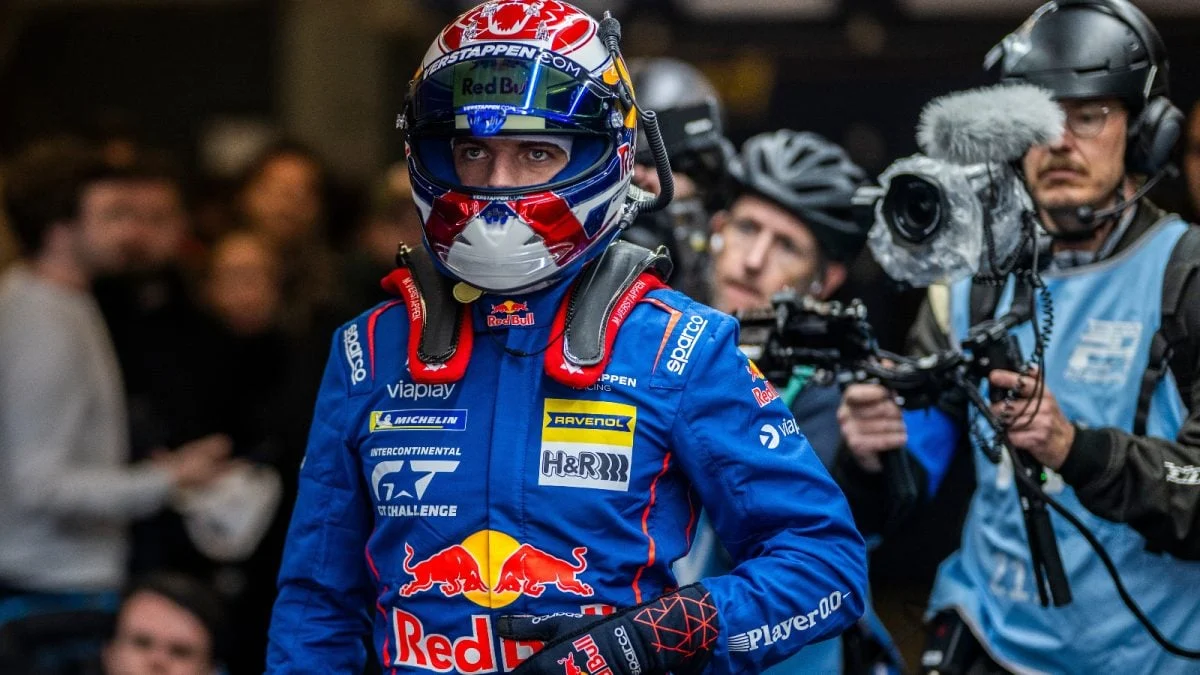
New Delhi, India – May 17, 2026 – Four-time Formula 1 World Champion Max Verstappen stands on the precipice of etching his name into motorsport history, far beyond the confines of grand prix racing. Currently competing in the legendary Nürburgring 24 Hours, one of the world’s most demanding endurance events, the 28-year-old Dutch sensation is not merely seeking another victory; he is pursuing a pair of unprecedented milestones that could redefine the scope of a modern racing icon’s achievements.
If Verstappen and his Mercedes-AMG GT3 team emerge victorious today, he will become the first Formula 1 World Champion to conquer the iconic endurance race after securing a world title. Adding another layer of extraordinary achievement, a win would also make him one of the few, if not the first, modern-era drivers to secure victories in machinery from three of motorsport’s most storied manufacturers: Red Bull (in Formula 1), Ferrari (in GT3 competition last year), and now, potentially, Mercedes. This audacious pursuit underscores a philosophy Verstappen articulated earlier this year: "I don’t need to be only an F1 driver, I can also do other things."
His participation in the Nürburgring 24 Hours is more than a diversion; it is a meticulously planned strategic move to expand his already formidable legacy, showcasing a versatility and ambition rarely seen in the hyper-specialized world of contemporary motorsport.
A Champion’s Uncharted Territory: The Green Hell Beckons
The Nürburgring Nordschleife, affectionately and ominously nicknamed "The Green Hell" by three-time F1 World Champion Jackie Stewart, represents the ultimate crucible for both driver and machine. Stretching over 25 kilometers (approximately 15.5 miles) through the Eifel forests, featuring more than 170 corners, drastic elevation changes, and notoriously unpredictable weather, the circuit demands absolute precision, unwavering focus, and profound respect. The 24-hour endurance race conducted on this legendary track is a brutal test of mechanical reliability, team strategy, and human endurance, pushing competitors to their absolute limits through day and night.
Verstappen, typically found dominating the world’s most advanced single-seater machines, now pilots a powerful Mercedes-AMG GT3 car, sharing driving duties with seasoned endurance specialists Daniel Juncadella, Jules Gounon, and Lucas Auer. This shift from the razor-edge performance of an F1 car to the robust, albeit highly sophisticated, demands of a GT3 machine in multi-class traffic highlights a remarkable adaptability. The challenge is immense: navigating slower cars, battling changeable conditions, enduring long stints behind the wheel, and relying implicitly on teamwork – all elements distinct from the solitary pursuit of an F1 Grand Prix win. For Verstappen, who has already scaled the pinnacle of F1, this foray into endurance racing is a clear signal of an unquenchable competitive fire, seeking new mountains to climb and new definitions of success.
The Quest for an Unprecedented Triple Crown of Manufacturers
Verstappen’s journey towards this unique manufacturer "triple crown" is a testament to his adaptability and raw driving talent. His dominance in Formula 1 with Red Bull Racing is well-documented, marked by four consecutive world championships (as of 2026) and a string of record-breaking victories. His synergy with the technically brilliant Red Bull machinery, meticulously engineered by figures like Adrian Newey, has become the benchmark of modern F1.
However, his ambition stretches beyond the open-wheel arena. Last year, Verstappen surprised many by competing in GT3 racing, where he achieved a significant victory driving a Ferrari 296 GT3. This wasn’t merely a casual appearance; it was a demonstration of his ability to extract maximum performance from a completely different type of race car, one with distinct aerodynamic characteristics, weight distribution, and driving dynamics compared to an F1 car. Winning with Ferrari, a manufacturer synonymous with F1 history and Red Bull’s traditional rival, was a potent statement about his pure racing instinct, unburdened by manufacturer allegiances in his quest for competition.
Now, at the Nürburgring 24 Hours, he has aligned himself with Mercedes-AMG. Should he taste victory here, it would complete an extraordinary triumvirate: wins with Red Bull (Formula 1), Ferrari (GT3), and Mercedes (GT3 endurance). In an era where top-tier drivers are typically tied to exclusive contracts within specific manufacturers or disciplines, achieving such a feat across three iconic brands—each with its own rich motorsport heritage and competitive rivalries—is virtually unheard of. It speaks volumes not just of his driving prowess, but also of his strategic independence and unwavering commitment to testing himself against the best, regardless of the badge on the bonnet. This achievement, if realized, would firmly place him in a unique pantheon of motorsport legends who transcended specific categories.
Chasing Nürburgring Immortality: A First for an F1 World Champion
Beyond the multi-manufacturer achievement, Verstappen’s primary objective at the Nürburgring is to make history as the first Formula 1 World Champion to win the 24-hour race after securing his world title. This is a crucial distinction that elevates the significance of his attempt.
While the Nürburgring 24 Hours has a storied history of attracting top talent, including numerous F1 drivers, the specific nature of Verstappen’s pursuit sets him apart. The late, great Niki Lauda, himself a three-time F1 World Champion, did win the Nürburgring 24 Hours in 1973. However, Lauda achieved that victory before he became an F1 World Champion. His Nürburgring triumph was a stepping stone in his burgeoning career, a testament to his raw talent that would later propel him to F1 glory.
Verstappen, on the other hand, arrives at the Nordschleife as a reigning, multi-time F1 World Champion, already at the zenith of his single-seater career. This changes the dynamic entirely. It’s not about proving his potential; it’s about expanding his domain, demonstrating that his skills are not merely F1-specific but universal. This is a challenge often avoided by contemporary F1 stars due to the inherent risks, the demands of F1 schedules, and the perception that such endeavors are "distractions." By tackling the Nürburgring, Verstappen is directly challenging this modern convention, asserting that a true champion’s hunger for competition knows no bounds or boundaries. His success would establish a new precedent, inspiring future generations of F1 drivers to look beyond their immediate discipline for competitive fulfillment.
Max Verstappen’s Unquenchable Thirst: Beyond the F1 Horizon
Verstappen’s motivations for embarking on this arduous journey into endurance racing are deeply personal and speak to the very essence of a competitor. His candid remarks earlier in the year provide a rare glimpse into the mindset of a champion who has seemingly achieved everything within his primary domain. "I’ve done this already for a while, achieved everything I want to achieve," Verstappen explained. "That’s why I want to explore other things and I don’t want to do them when I’m 40 years old. Now is the perfect age to do it."
These statements are profound. They articulate a desire to constantly evolve, to find new challenges that ignite the same passion and drive that propelled him to F1 superstardom. At 28, Verstappen is in his physical and mental prime, possessing the reflexes, stamina, and strategic acumen required for both F1 sprints and endurance marathons. He understands that opportunities to compete at this level, across different disciplines, are best seized when one is at their peak, rather than later in a career when physical capabilities may wane. This proactive approach to career diversification is a stark contrast to the traditional model where F1 champions often retire or transition into less demanding roles.
Verstappen’s ambition echoes that of other F1 legends who sought challenges beyond their primary discipline, most notably Fernando Alonso, who famously pursued the Triple Crown of Motorsport (Monaco Grand Prix, Le Mans 24 Hours, Indianapolis 500). While Verstappen has not explicitly stated such an overarching goal, his actions demonstrate a similar quest for versatility and comprehensive mastery. His engagement with endurance racing is not a sign of waning F1 commitment, but rather an expansion of his competitive canvas, driven by a pure, unadulterated love for racing in all its forms. This relentless pursuit of new benchmarks is what truly distinguishes him as a "driver’s driver."
Rigorous Preparation for the Ultimate Endurance Test
The Nürburgring 24 Hours is not a race one simply shows up for and expects to win, especially when transitioning from the highly specialized world of Formula 1. Verstappen’s commitment to this challenge is evident in his rigorous preparation. He has spent months acclimatizing himself to the unique demands of the Nordschleife, making multiple appearances at the circuit to familiarize himself with its treacherous curves, blind crests, and ever-changing conditions.
Earlier this year, he even participated in an NLS (Nürburgring Langstrecken-Serie) GT3 race at the venue, clinching a victory before his team was later disqualified due to a technical infringement related to tyre allocation. While the disqualification was a setback, the experience itself was invaluable. It provided critical track time, allowing him to understand the nuances of the Mercedes-AMG GT3 car in race conditions, to practice driver changes, and to integrate with his endurance teammates. This hands-on preparation is crucial for success on a circuit where local knowledge and experience can be as important as raw pace.
The Nordschleife is infamous for its narrow sections, unforgiving Armco barriers, and unpredictable Eifel weather, which can see sunshine, rain, and even hail on different parts of the track simultaneously. Mastering this circuit requires not just speed, but also immense patience, situational awareness to manage multi-class traffic, and the ability to adapt instantly to changing grip levels. Verstappen’s teammates – Daniel Juncadella, Jules Gounon, and Lucas Auer – bring a wealth of endurance racing experience, and their collective knowledge, combined with Verstappen’s unparalleled speed, forms a formidable lineup. The synergy within this quartet will be paramount, as successful endurance racing is as much about seamless teamwork as it is about individual brilliance.
The Broader Implications for Motorsport and Verstappen’s Legacy
Should Max Verstappen succeed in his audacious Nürburgring endeavor, the implications for his legacy and for motorsport as a whole would be far-reaching.
For Verstappen’s Legacy: A victory would cement his status as not just an F1 great, but a true all-around motorsport legend. It would demonstrate a breadth of talent and a competitive spirit that transcends the confines of a single discipline, placing him in the elite company of versatile racers like Jim Clark, Graham Hill, and Mario Andretti, who excelled across various categories. This multi-faceted success would elevate his standing beyond his contemporary F1 rivals, painting him as a pure racer driven by the challenge itself.
For F1 Drivers and the Sport: Verstappen’s pursuit could inspire a new generation of F1 drivers to look beyond the F1 bubble. For years, F1 teams have been reluctant to allow their star drivers to participate in other high-risk events, fearing injury or distraction. Verstappen, with his independent mindset, is challenging this paradigm. His success might encourage F1 teams to reconsider their stance, potentially leading to more crossover appearances and enriching the careers of drivers who seek diverse challenges.
For Endurance Racing: The involvement of an F1 superstar of Verstappen’s caliber undoubtedly brings increased global attention and prestige to the Nürburgring 24 Hours and endurance racing in general. This exposure can attract new fans, sponsors, and talent, further elevating the profile of these grueling but immensely rewarding disciplines. It highlights that endurance racing is not merely a niche category but a serious test of motorsport excellence.
The "Driver’s Driver" Aspect: Verstappen’s actions reinforce his image as a "driver’s driver" – someone whose ultimate motivation is the thrill of competition and the desire to prove himself against any challenge, in any car, on any track. This pure, unadulterated love for racing resonates deeply with fans and fellow competitors alike, solidifying his reputation as one of the most compelling figures in contemporary sport. His willingness to step outside his comfort zone underscores a relentless pursuit of perfection and a deep-seated belief that a true champion should be capable of excelling wherever they compete.
The Thrill of the Race: What to Expect
As the Nürburgring 24 Hours unfolds, the world watches with bated breath. The race is a symphony of speed, strategy, and survival. From the thunderous start, where hundreds of cars jostle for position, to the ethereal glow of headlights cutting through the Eifel night, every moment is fraught with drama. Drivers must contend with fatigue, the psychological pressure of sustained high-speed driving, and the ever-present threat of contact with competitors or the unforgiving barriers of the Nordschleife.
The Mercedes-AMG GT3, a robust and proven platform in endurance racing, provides Verstappen with a competitive machine. However, victory will hinge on flawless execution: precise pit stops, rapid driver changes, strategic tyre management, and the ability to avoid incidents in the dense traffic of multiple classes. The unpredictable weather, a constant feature of the Eifel region, could introduce further chaos, demanding lightning-fast decision-making from the pit wall and heroic driving from the cockpit. For Verstappen, the physical and mental demands of driving for hours on end, often in challenging conditions, will be a different kind of test from the high-intensity sprints of Formula 1.
Conclusion
Max Verstappen’s pursuit of victory at the Nürburgring 24 Hours is more than just another race; it is a profound statement about his ambition, his versatility, and his evolving legacy. As the sun sets and rises over the Eifel mountains, and the roar of engines echoes through "The Green Hell," Verstappen has the opportunity to achieve what no F1 World Champion before him has done: conquer this legendary endurance race after reaching the pinnacle of single-seater motorsport, while simultaneously achieving a unique triple crown across three of racing’s most iconic manufacturers.
His journey reminds us that true champions are not confined by categories or expectations; they are defined by their insatiable hunger for competition and their unwavering commitment to pushing the boundaries of what is possible. Whether he ultimately stands atop the podium or not, Max Verstappen’s audacious venture into the Nürburgring 24 Hours has already cemented his place as one of motorsport’s most intriguing and inspiring figures, constantly seeking new challenges and redefining the very essence of greatness.
