

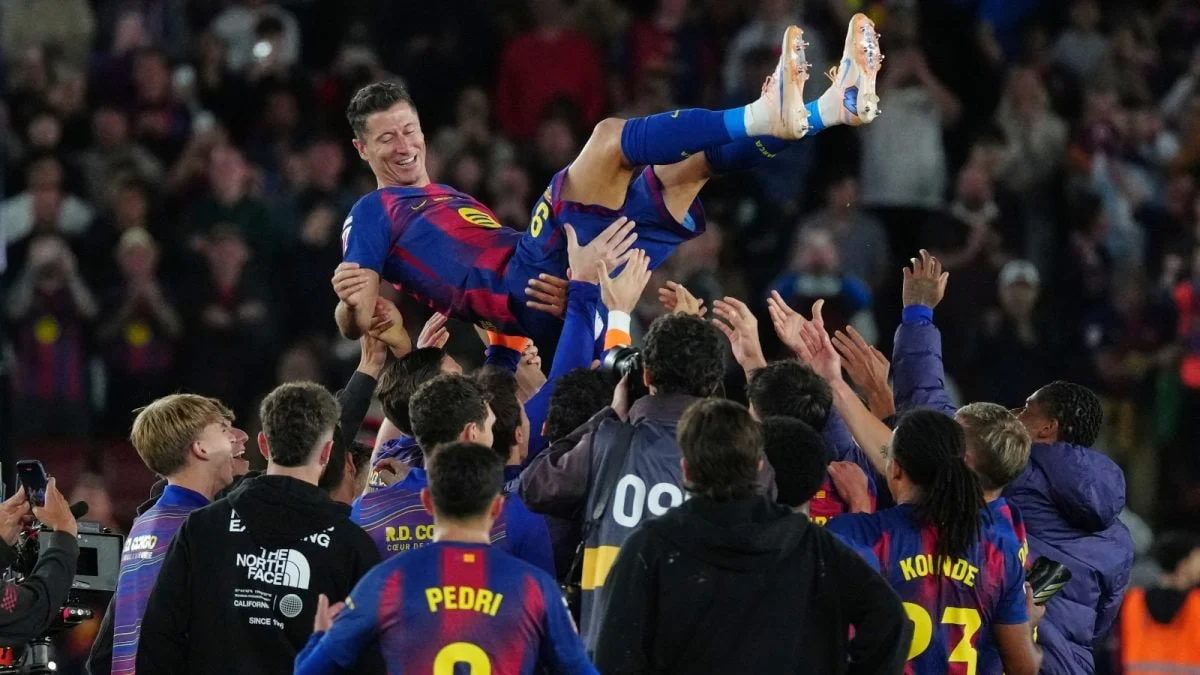
Barcelona, Spain – FC Barcelona has etched its name into the annals of La Liga history, completing an unprecedented perfect home season by winning all 19 of their league matches on home soil. This remarkable feat, culminating in a dominant 3-1 victory over Real Betis on Sunday night, not only cemented their status as the league champions but also marked a poignant farewell for club legend Robert Lewandowski at an emotionally charged Camp Nou. Under the astute guidance of manager Hansi Flick, the Blaugrana transformed their home grounds into an impenetrable fortress, setting a new benchmark for domestic dominance in the 38-game La Liga format.
The final home fixture, a celebratory affair after securing the league title, was a fitting display of the relentless form Barcelona had showcased throughout the season. Goals from the dazzling Raphinha and the ever-influential João Cancelo sealed the historic 19th consecutive home win, sending the jubilant supporters into raptures. Yet, beneath the celebrations, a bittersweet note resonated through the stadium as fans bid a heartfelt adieu to Robert Lewandowski, whose four illustrious seasons saw him lift three league titles and become a beloved figure in Catalonia. The evening was a testament to both unparalleled sporting achievement and the enduring emotional connection between a club, its players, and its devoted fanbase.
A Season of Unrivalled Home Dominance: The Chronology of a Fortress
The journey to this historic perfect home season began under a cloud of anticipation and expectation following a summer of strategic squad adjustments and the appointment of Hansi Flick. From the very first whistle of their opening home fixture against a determined Getafe side, which they dispatched with a convincing 3-0 victory, Barcelona signaled their intent. The early stages of the season saw them quickly establish a rhythm, with commanding wins over Valencia (a resounding 6-0 thrashing) and Elche (3-1) showcasing their attacking prowess and defensive solidity.
As the autumn leaves fell, the challenge intensified, but Barcelona’s home form remained unyielding. Critical encounters against formidable opponents like Real Sociedad (a hard-fought 2-1 victory) and Girona (another tight 2-1 win) tested their resolve. These matches, often decided by moments of individual brilliance or collective resilience, underscored the team’s ability to grind out results even when not at their free-flowing best. The atmosphere at their temporary homes, including the Estadi Olímpic Lluís Companys while the Camp Nou underwent its extensive renovation, proved no less intimidating for visiting teams. The faithful followed, creating a vibrant, hostile environment regardless of the venue.
The winter months brought a series of high-stakes clashes. Atlético Madrid, traditionally a difficult opponent, fell victim to Barcelona’s home dominance, succumbing 3-1 in a pulsating encounter that further solidified the team’s championship credentials. This period also saw them overcome Athletic Club (4-0) and Alavés (3-1) with impressive displays of attacking football, demonstrating a versatility in their approach – capable of both high-scoring spectacles and disciplined, tactical victories.
As the league campaign entered its decisive spring phase, the mounting pressure to maintain the perfect home record became a tangible narrative. Each home game was met with heightened anticipation, not just for the three points, but for the continuation of this extraordinary streak. Victories over Osasuna (2-0), Real Mallorca (3-0), and Sevilla (2-0) were not merely wins; they were affirmations of their unparalleled consistency. The squad, galvanized by Flick’s tactical discipline and the unwavering support of the Culer faithful, seemed to thrive on the pressure, turning every home game into a must-win event. The culmination against Real Betis was a celebration of this incredible journey, a final flourish that perfectly encapsulated a season of absolute home supremacy.
Unpacking the Numbers: A Statistical Breakdown of Unprecedented Dominance
Barcelona’s achievement of winning all 19 home matches in a 38-game La Liga season is not merely a record; it’s a statistical anomaly in modern football. To truly appreciate its magnitude, one must delve into the data that underpins this unparalleled dominance.
Across these 19 home victories, Barcelona scored a staggering 68 goals, averaging an impressive 3.58 goals per game. This attacking firepower was spread across the squad, with Robert Lewandowski leading the line for much of the season, but significant contributions also coming from the likes of Raphinha, João Félix, Ferran Torres, and rising stars from La Masia. The team’s offensive output was consistently high, reflecting Flick’s emphasis on relentless pressing and quick transitions.
Equally remarkable was their defensive record. Barcelona conceded a mere 7 goals in their 19 home league matches, boasting an incredible 12 clean sheets. This translates to an average of just 0.37 goals conceded per game, making their home defense virtually impenetrable. The partnership of Ronald Araujo and Andreas Christensen, often shielded by the midfield prowess of Frenkie de Jong and the emergent Gavi or Pedri, formed the backbone of this defensive solidity. Goalkeeper Marc-André ter Stegen enjoyed one of his finest seasons, making crucial saves at pivotal moments to preserve the perfect record.
The goal difference at home stood at an astounding +61, a testament to their ability to not only win but to overwhelmingly dominate opponents. This level of sustained performance distinguishes Flick’s Barcelona from previous formidable sides.
Historical Context:
Prior to this season, no team in the 20-club, 38-game La Liga format had ever achieved a perfect home record. The closest contenders in history include:
- Real Madrid (1985-86): Went unbeaten at home, but with several draws, showcasing an unbreakable fortress but not a flawless victory streak.
- Barcelona (1959-60): Managed an impressive 15 consecutive home wins, a record for its time, but in a different league structure with fewer teams and games.
The 2025-26 Barcelona squad thus stands alone, having navigated a full league calendar without dropping a single point in front of their home supporters. This accomplishment becomes even more impressive when considering the temporary nature of their primary home ground for parts of the season. The ability to adapt and maintain such high standards across different venues speaks volumes about the team’s mental fortitude and the coaching staff’s meticulous preparation.
While their league home form was flawless, the article notes that Barcelona did suffer two home defeats across all competitions, both coming in the UEFA Champions League against Paris Saint-Germain and Atlético Madrid. This distinction highlights the unique intensity and pressure of European football but also underscores the unparalleled consistency they maintained specifically within the domestic league framework. The focus, desire, and execution for La Liga home games were simply on another level.
Voices from the Camp Nou: Reactions and Tributes
The final whistle against Real Betis unleashed a torrent of emotions and reactions, from the dugout to the stands. Manager Hansi Flick, often reserved, allowed himself a rare moment of jubilation.
"This is an incredible achievement, truly historic," Flick stated in the post-match press conference, a proud smile gracing his face. "When I arrived, my aim was to instill a mentality of relentless pursuit, of making Camp Nou a place where opponents feared to tread. To achieve a perfect home season in my first year is beyond my wildest dreams, and it is a testament to the hard work, dedication, and quality of every single player, and the unwavering support of our fans. They truly are our 12th man."
Club President Joan Laporta echoed Flick’s sentiments, emphasizing the significance of the record for the club’s legacy. "This perfect home season is a symbol of our resurgence, a statement of intent for the future," Laporta commented. "It shows the world that FC Barcelona is back, and we are building something truly special here. To be the first club to achieve this in the modern La Liga era fills us with immense pride. It’s a reward for the fans who have stood by us through thick and thin, and a promise of more success to come."
The players themselves were quick to express their elation. Raphinha, whose goal contributed to the final victory, spoke of the team’s collective belief. "Every time we stepped onto our home pitch, we knew we had to win," he said. "It wasn’t just about points; it was about pride, about continuing this amazing run. The energy from the crowd was electrifying in every single game, pushing us when we needed it most." João Cancelo added, "This is what you play for – to make history. To be part of the first team to do this is something we will cherish forever."
However, the most poignant moments of the night belonged to Robert Lewandowski. Despite not finding the net in his final home outing, the Polish striker received a thunderous, prolonged ovation from the Camp Nou faithful when he was substituted. Fans held up banners, chanted his name, and gave him a guard of honor, recognizing his immense contribution to the club.
Addressing the crowd after the match, his voice filled with emotion, Lewandowski delivered a heartfelt message: "When I arrived in Barcelona, I knew that this club was big; however, thanks to your love, it has been incredible. Today I say goodbye to the stadium, but I will always carry Barcelona in my heart. Thank you for everything, Culers. It has been an honor." His words resonated deeply, acknowledging the bond he had forged with the supporters and solidifying his place as a revered figure in recent club history. The images of him waving to all corners of the stadium, a solitary figure soaking in the adoration, will undoubtedly become an iconic moment in Barcelona’s rich tapestry.
A Blueprint for the Future: Implications and Legacy
The perfect home season is more than just a statistic; it carries profound implications for FC Barcelona’s immediate future and long-term legacy.
Hansi Flick’s Early Legacy: For manager Hansi Flick, this achievement immediately cements his tactical prowess and leadership. In his inaugural season, he has not only delivered a league title but also instilled a winning mentality that transformed Barcelona’s home grounds into an impenetrable bastion. This record provides a strong foundation for his tenure, earning him significant goodwill and confidence from the board, players, and fans alike. It suggests a tactical system built on defensive solidity, disciplined pressing, and efficient attacking transitions – a blueprint that proved devastatingly effective at home.
Setting a New Standard: The 2025-26 squad has set an incredibly high benchmark for future Barcelona teams. Replicating a perfect home season will be an immense challenge, but the precedent has been established. This performance will undoubtedly raise expectations, not just for domestic competitions but also for their Champions League aspirations, where they will look to translate their home dominance onto the European stage.
The Void Left by Lewandowski: Robert Lewandowski’s departure, though anticipated, leaves a significant void in the attacking line. His experience, goal-scoring instinct, and leadership will be sorely missed. The club now faces the critical task of finding a suitable replacement who can maintain the prolific output and provide the focal point for Flick’s attacking schemes. This decision will be crucial in determining whether Barcelona can sustain their current level of success. Lewandowski’s legacy, however, is secured; he leaves as a three-time La Liga champion and a beloved striker who delivered consistent goals during a transitional period for the club.
Impact on Club Identity and Fan Engagement: This historic season reignites a sense of pride and optimism among the Culer faithful. The "fortress" mentality cultivated at home reinforces the unique identity of Camp Nou (and its temporary replacements) as a place where Barcelona are virtually unbeatable. This will likely translate into continued high attendance, increased merchandise sales, and renewed energy around the club, especially as the renovated Camp Nou approaches its full reopening. The emotional connection between the team and its supporters has been significantly strengthened by this shared, historic achievement.
La Liga’s Competitive Landscape: Barcelona’s flawless home record underscores their domestic supremacy in the 2025-26 season. While La Liga remains a highly competitive league, this level of home dominance by one team is rare and speaks volumes about Barcelona’s quality. It will undoubtedly challenge their rivals, particularly Real Madrid, to elevate their own performances and strategies in the seasons to come.
In conclusion, FC Barcelona’s perfect home season is a monumental achievement that transcends mere statistics. It is a testament to tactical genius, player dedication, and the enduring power of fan support. As Robert Lewandowski embarks on a new chapter, the Blaugrana stand at the precipice of a new era, armed with a historic record and a clear blueprint for continued success under Hansi Flick. The impenetrable fortress they built at home will serve as a powerful symbol of their ambition and a lasting legacy in the rich history of Spanish football.
