

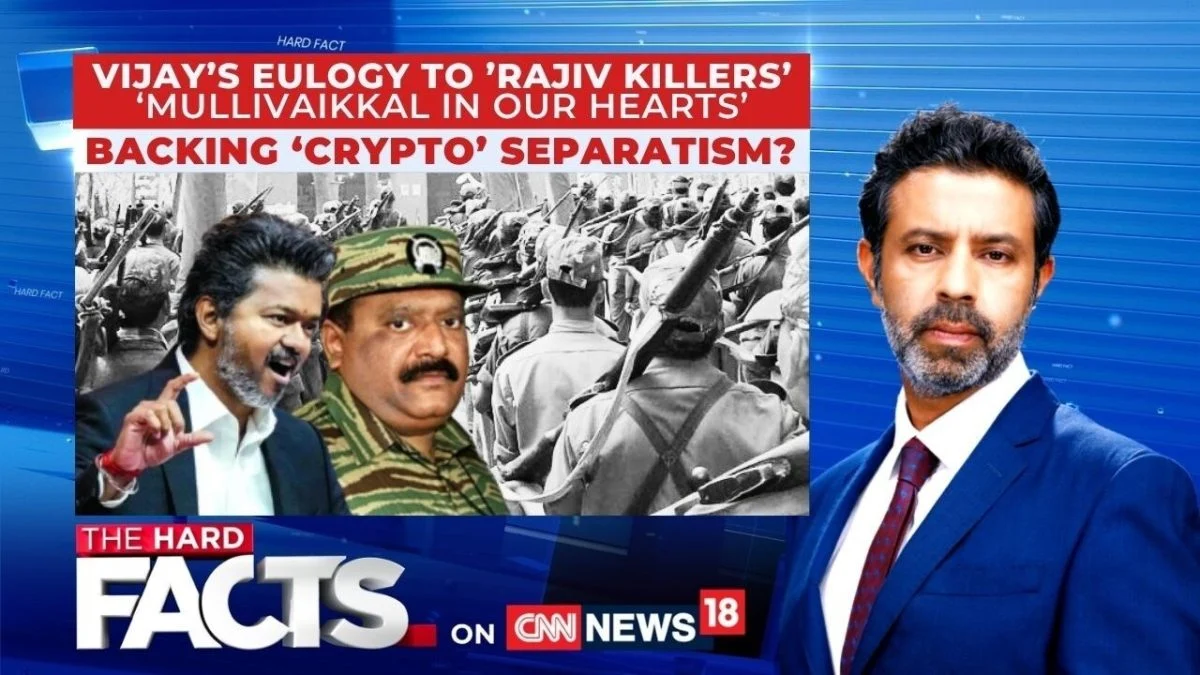
Chennai, India – May 19, 2026 – Tamil Nadu Chief Minister Vijay has found himself at the centre of a significant political storm following his impassioned remarks during the annual Mullivaikal Day commemoration. His statement, prominently featuring the phrase "Mullivaikal In Our Hearts," has been widely interpreted by critics as a romanticization of the Liberation Tigers of Tamil Eelam (LTTE) and its founder, Velupillai Prabhakaran, reigniting a contentious debate about national unity, historical remembrance, and the delicate balance of federal relations in India.
The controversy has swiftly escalated, with the Bharatiya Janata Party (BJP) and other political factions vehemently questioning the implications of the Chief Minister’s words. Accusations of "backing crypto separatism" have been hurled, forcing a national conversation about the boundaries of expressing solidarity with ethnic Tamil rights while navigating the sensitive legacy of a banned terrorist organization. The political temperature in Tamil Nadu and across India has soared, highlighting the enduring complexities of the Sri Lankan Tamil issue within Indian domestic politics.
Main Facts
On May 18, 2026, during the observance of Mullivaikal Day, Tamil Nadu Chief Minister Vijay delivered a speech that has since become a focal point of intense national scrutiny. The Chief Minister’s address included the evocative declaration, "Mullivaikal In Our Hearts," a phrase that resonated deeply with supporters but drew immediate condemnation from a segment of the political spectrum. This statement, intended to commemorate the victims of the final stages of the Sri Lankan Civil War, was perceived by critics as a thinly veiled endorsement or glorification of the LTTE, an organization banned in India for its role in the assassination of former Prime Minister Rajiv Gandhi and its violent separatist agenda.
The core accusation levelled against CM Vijay is that his remarks venture beyond humanitarian remembrance for Sri Lankan Tamils and instead veer into the dangerous territory of romanticizing a designated terrorist entity. Political opponents, most notably the BJP, have accused him of "backing crypto separatism," implying a subtle or covert support for secessionist ideologies under the guise of ethnic solidarity. This contention has ignited a heated political debate, challenging CM Vijay to clarify his stance and defend his government’s position on a matter fraught with historical pain, national security concerns, and deeply held sentiments within Tamil Nadu. The incident underscores the enduring tension between advocating for Tamil rights and meticulously avoiding any symbolism that could be construed as supporting separatist movements.
Chronology of Events Leading to the Controversy
The roots of the current controversy extend deep into the history of the Sri Lankan Civil War and its profound impact on Tamil Nadu. Understanding the context of Mullivaikal Day and the political landscape surrounding it is crucial to grasping the gravity of CM Vijay’s remarks.
Historical Context of Mullivaikal:
Mullivaikal Day, observed annually on May 18th, commemorates the tragic culmination of the Sri Lankan Civil War in 2009. It marks the day when the Sri Lankan military declared victory over the Liberation Tigers of Tamil Eelam (LTTE) in Mullivaikkal, a small coastal village in the Mullaitivu district. The final weeks and days of the conflict were characterized by intense fighting, widespread allegations of human rights abuses, and a devastating loss of civilian life. Estimates from various sources, including the United Nations, suggest tens of thousands of Tamil civilians perished in the "No-Fire Zones," caught between the advancing Sri Lankan army and the retreating LTTE. For Tamils globally, particularly in Tamil Nadu, Mullivaikal represents a painful scar, a symbol of immense suffering, unresolved justice, and the perceived genocide of their ethnic brethren. The LTTE, founded by Velupillai Prabhakaran, waged a brutal three-decade-long war for an independent Tamil state, Tamil Eelam, in Sri Lanka. It was designated a terrorist organization by India, the United States, the European Union, and several other countries, primarily due to its use of suicide bombings, child soldiers, and its direct involvement in the 1991 assassination of former Indian Prime Minister Rajiv Gandhi.
Previous Commemorations in Tamil Nadu:
For years, Mullivaikal Day has been observed in Tamil Nadu with varying degrees of political and public participation. While official state-level commemorations have historically focused on humanitarian remembrance, offering prayers for the victims and calling for international investigations into alleged war crimes, certain fringe groups and ultra-nationalist Tamil outfits have used the occasion to openly glorify the LTTE and its leadership. Mainstream political parties in Tamil Nadu have generally walked a tightrope, expressing solidarity with the Sri Lankan Tamil cause and advocating for their rights and rehabilitation, without explicitly endorsing the LTTE or its violent methods. The discourse has often revolved around demands for self-determination, justice, and accountability for the atrocities committed during the war, carefully differentiating these demands from calls for a separate state supported by an armed group.
CM Vijay’s Rise and Political Stance:
Chief Minister Vijay, a prominent figure in Tamil Nadu politics, has cultivated a strong image as a champion of Tamil rights and cultural identity. While his party’s specific stance on the LTTE has historically been nuanced, he has consistently advocated for the welfare and justice of Sri Lankan Tamils. His political narrative often intertwines with strong regional sentiments, emphasizing the unique cultural and linguistic heritage of Tamil Nadu. In recent years, his rhetoric has increasingly focused on what he perceives as a historical injustice against Tamils, both within India and abroad. His supporters view him as a fearless leader unafraid to speak truth to power, while critics often accuse him of leveraging ethno-nationalist sentiments for political gain. His rise has coincided with a period of heightened regional assertiveness in Tamil Nadu, making his statements on sensitive issues like Mullivaikal even more impactful.
The Specific Speech on May 18, 2026:
The controversial remarks were made during a state-sponsored or widely publicized Mullivaikal remembrance ceremony held in Chennai. CM Vijay, addressing a large gathering, delivered an emotionally charged speech. While details of the full speech are being parsed, the phrase "Mullivaikal In Our Hearts" quickly became the most quoted and debated line. Beyond this specific utterance, reports suggest that CM Vijay’s speech also touched upon the "unfulfilled aspirations" of Tamils, the "sacrifices made for their dignity," and the "need for global powers to acknowledge their plight." He reportedly called for renewed international efforts to ensure justice and autonomy for Sri Lankan Tamils, without explicitly naming the LTTE or its founder. However, in the context of Mullivaikal Day, and given the LTTE’s historical association with the struggle for Tamil Eelam, the emotive language and the phrase "Mullivaikal In Our Hearts" were immediately seized upon by critics as a symbolic embrace of the very movement that led to the tragic events. Initial reactions on social media were swift, dividing opinion sharply between those who saw it as a powerful expression of solidarity and those who condemned it as dangerous and irresponsible.
Supporting Data and Historical Context
The current political firestorm surrounding Chief Minister Vijay’s Mullivaikal Day remarks cannot be fully appreciated without a deeper dive into the historical realities of the Sri Lankan Civil War, the LTTE’s legacy, and the concept of "crypto separatism."
The Mullivaikal Massacre: A Deep Wound:
The final phase of the Sri Lankan Civil War in 2009, culminating in the events at Mullivaikal, remains a deeply contested and painful chapter. As the Sri Lankan armed forces cornered the LTTE into a small coastal strip, hundreds of thousands of Tamil civilians were trapped in designated "No-Fire Zones." Human rights organizations and the United Nations have documented extensive allegations of war crimes and crimes against humanity committed by both sides. The UN Panel of Experts on Accountability in Sri Lanka, in its 2011 report, found credible allegations that both the Sri Lankan military and the LTTE committed serious violations of international humanitarian law and international human rights law. The report estimated that "tens of thousands" of civilians may have been killed in the final months of the conflict. The Sri Lankan government, while acknowledging civilian casualties, has consistently denied systematic war crimes, attributing deaths to collateral damage. For the global Tamil diaspora and particularly for the population of Tamil Nadu, Mullivaikal symbolizes an unaddressed genocide and a profound failure of the international community to protect civilians. This narrative of victimhood and injustice is central to the emotional resonance of phrases like "Mullivaikal In Our Hearts."
LTTE’s Legacy in India: A Complex Relationship:
The Liberation Tigers of Tamil Eelam, while enjoying some sympathy among certain segments of Tamil Nadu’s population for its stated aim of protecting Sri Lankan Tamils, is officially a banned terrorist organization in India. This proscription stems primarily from its direct involvement in the assassination of former Indian Prime Minister Rajiv Gandhi in 1991, an act that sent shockwaves across the nation and fundamentally altered India’s foreign policy towards Sri Lanka. The memory of this heinous act ensures that any perceived glorification or sympathetic portrayal of the LTTE, or its leadership, triggers a strong negative reaction from mainstream Indian political parties and the general public, particularly the Congress party.
The complexities arise from the distinction between supporting the human rights and political aspirations of Sri Lankan Tamils, and endorsing the violent, separatist ideology of the LTTE. For many in Tamil Nadu, expressing solidarity with their ethnic brethren across the Palk Strait is a deeply ingrained sentiment, rooted in shared language, culture, and historical ties. However, this solidarity often clashes with India’s national security interests and its commitment to a united Sri Lanka. Political leaders in Tamil Nadu have historically navigated this delicate balance, often advocating for humanitarian aid, rehabilitation, and a political solution for Tamils within a united Sri Lanka, while condemning the LTTE’s terrorism. CM Vijay’s recent remarks are seen by critics as having blurred this carefully maintained distinction, reigniting old wounds and challenging national consensus.
"Crypto Separatism" Explained:
The accusation of "crypto separatism" is a potent and politically charged label. In this context, it refers to the subtle, indirect, or covert promotion of secessionist ideas or support for movements aiming to break away from a sovereign state, often masked under the guise of advocating for human rights, cultural identity, or humanitarian concerns. Critics argue that by invoking "Mullivaikal" in such an emotive way, without explicitly condemning the LTTE’s methods or its status as a banned organization, CM Vijay provides tacit encouragement to elements that might still harbor separatist aspirations, either for Sri Lankan Tamils or, more alarmingly for some, for Tamil Nadu itself.
India has a long and often turbulent history with separatist movements, from Kashmir to the Northeast, and has consistently maintained a firm stance against any ideology that threatens its territorial integrity. Therefore, any political rhetoric that even remotely hints at separatism is viewed with extreme caution by the central government and nationalist parties like the BJP. The term "crypto separatism" highlights the fear that seemingly innocuous expressions of ethnic pride or historical remembrance can be co-opted or interpreted as a legitimization of secessionist narratives, thereby undermining national unity and sovereignty. The accusation forces political leaders to be meticulously precise in their language when addressing sensitive historical events involving armed non-state actors.
Official Responses and Political Fallout
The aftermath of Chief Minister Vijay’s Mullivaikal Day address has seen a rapid escalation of political rhetoric, with various parties and leaders weighing in, further deepening the controversy. The official responses highlight the sharp ideological divides and the sensitivity surrounding issues of national unity and historical memory.
BJP’s Denunciation:
The Bharatiya Janata Party (BJP) has been at the forefront of the criticism, launching a scathing attack on CM Vijay and his government. State BJP President K. Annamalai was among the first to condemn the remarks, stating, "Chief Minister Vijay’s eulogy to ‘Rajiv Killers’ on Mullivaikal Day is an insult to every Indian and a betrayal of the nation’s integrity. To say ‘Mullivaikal In Our Hearts’ without unequivocally condemning the LTTE, a banned terrorist organization responsible for the assassination of our former Prime Minister, is nothing short of promoting crypto separatism." National BJP spokespersons echoed these sentiments, with one senior leader commenting, "This is not just about Tamil rights; this is about national security. No leader, especially a Chief Minister, can be allowed to romanticize or lend implicit support to an organization that shed Indian blood. We demand a full clarification and an unconditional apology." The BJP has called for the Election Commission to take note, accusing CM Vijay of violating his oath of office by seemingly endorsing a proscribed group. They have also highlighted the timing, suggesting it’s a calculated move to consolidate a specific vote bank ahead of upcoming local elections.
Responses from Other Political Parties:
The controversy has also seen varied reactions from other political entities.
- AIADMK (Opposition in Tamil Nadu): The principal opposition party in Tamil Nadu, the All India Anna Dravida Munnetra Kazhagam (AIADMK), while historically having its own nuanced stance on Sri Lankan Tamil issues, has cautiously distanced itself from CM Vijay’s more provocative statements. While not directly aligning with the BJP’s harsh condemnation, a spokesperson for the AIADMK remarked, "While we empathize with the suffering of our Tamil brethren in Sri Lanka, it is crucial for all leaders to maintain the sanctity of national unity and respect for institutions. Any statement that blurs the lines between humanitarian support and support for a banned organization is regrettable." This stance indicates a desire to avoid being seen as anti-Tamil, while also not wanting to be associated with potentially separatist sentiments.
- Congress Party (National Opposition): As the party of the assassinated former Prime Minister Rajiv Gandhi, the Indian National Congress has expressed profound dismay. A senior Congress leader, speaking to the press, stated, "The assassination of Rajiv Gandhi by the LTTE is a wound that India carries to this day. Any attempt to glorify or even implicitly support the perpetrators, or the organization they represented, is deeply offensive and unacceptable. We urge CM Vijay to remember his constitutional duties and the sacrifice of our leader." This response from Congress is particularly significant given its historical connection to the tragedy.
- CM Vijay’s Party’s Defense: In response to the growing chorus of criticism, Chief Minister Vijay’s party has mounted a robust defense. Party spokespersons have clarified that the CM’s remarks were purely a humanitarian expression of solidarity with the victims of the Mullivaikal tragedy and the larger Sri Lankan Tamil community. "The Chief Minister’s words were taken out of context," stated a senior party official. "He was remembering the innocent lives lost, the immense suffering, and the ongoing struggle for justice and dignity for Tamils. To twist this into an endorsement of separatism or terrorism is malicious and politically motivated. We condemn the attempts by the BJP to communalize and politicize a humanitarian issue." The party emphasized that CM Vijay has always stood for the unity and integrity of India, while also advocating for the rights of Tamils globally through peaceful and democratic means. They argue that "Mullivaikal In Our Hearts" is a cry for justice and remembrance, not a call for renewed violence or separatism.
- CM Vijay’s Clarification: While not issuing a full apology, CM Vijay himself released a brief statement through his office, reiterating that his speech was intended to "mourn the loss of innocent lives at Mullivaikal and to stand in unwavering solidarity with the Sri Lankan Tamil people in their pursuit of justice and equality." He added that his government "categorically condemns all forms of terrorism and violence, and is committed to upholding the sovereignty and integrity of India." This clarification, however, has done little to placate his critics, who demand a more explicit denouncement of the LTTE.
Central Government’s Stance:
While the central government has not issued an immediate direct statement from the Prime Minister’s Office, sources within the Ministry of Home Affairs have indicated that the matter is being "closely monitored." Given the BJP’s strong criticism, it is implicit that the central government views such statements with concern, particularly regarding their potential impact on national security and India’s sensitive diplomatic relations with Sri Lanka. Any perceived support for proscribed organizations from a state head would naturally draw the attention of New Delhi.
Sri Lankan Government’s Reaction (Hypothetical):
Though not explicitly reported, it is highly probable that the Sri Lankan government would view CM Vijay’s remarks with unease. Colombo has consistently been wary of any statements from Indian politicians that could be interpreted as interference in its internal affairs or as a revival of pro-LTTE sentiments in Tamil Nadu. Such statements risk complicating the delicate post-war reconciliation process and could potentially strain bilateral relations between India and Sri Lanka, especially if they are perceived as legitimizing the narrative of the Tamil separatist movement.
Implications and Future Outlook
The controversy sparked by Chief Minister Vijay’s Mullivaikal Day remarks carries significant implications, not only for the domestic political landscape but also for India’s federal structure and its international relations. The incident has laid bare the enduring sensitivities surrounding historical conflicts, ethnic identities, and national security.
Impact on Federal Relations:
The immediate and most visible implication is the potential for increased friction between the Tamil Nadu state government and the BJP-led central government. The central government, often vigilant about state leaders’ pronouncements on issues touching national security and foreign policy, may view CM Vijay’s statements as an overstep or a challenge to its authority. This could manifest in heightened political tensions, leading to a more confrontational relationship between Chennai and New Delhi. Such strained relations could potentially impact central funding for state projects, slow down approvals, or even lead to political maneuvering by the Centre to undermine the state government, particularly if the BJP perceives a substantial political gain in isolating CM Vijay. The debate over state autonomy versus national unity is likely to resurface with renewed vigor.
International Relations (India-Sri Lanka):
India maintains a delicate and complex foreign policy towards Sri Lanka, balancing strategic interests, regional stability, and the humanitarian concerns of the Tamil population. For decades, India has advocated for a political solution within a united Sri Lanka, urging Colombo to implement the 13th Amendment to its constitution, which envisages devolution of powers to the provinces. CM Vijay’s remarks, particularly if interpreted internationally as tacit support for a banned terrorist organization, could complicate India’s diplomatic efforts. Sri Lanka might view such statements as an unwelcome interference in its internal affairs and a potential threat to its sovereignty. This could strain the bilateral relationship, potentially affecting trade, security cooperation, and India’s standing as a neutral facilitator for reconciliation in Sri Lanka. It also risks being exploited by other regional powers seeking to gain influence in Sri Lanka.
Domestic Political Landscape in Tamil Nadu:
Within Tamil Nadu, the controversy is likely to further polarize the political discourse. For CM Vijay and his party, the remarks could consolidate his base among ardent Tamil nationalists and those who feel strongly about the plight of Sri Lankan Tamils. His supporters might view him as a courageous voice standing up for their ethnic identity against central pressures. However, the accusations of separatism and disrespect for Rajiv Gandhi’s memory could alienate moderate voters and those concerned about national unity. This could affect his party’s performance in future elections, potentially leading to a re-evaluation of its strategy. The AIADMK and other opposition parties will likely use this incident to question CM Vijay’s judgment and commitment to national integrity, adding another layer to the already competitive state politics.
Precedent and Free Speech vs. National Security:
The incident also raises a broader debate about the limits of free speech for political leaders, especially when discussing sensitive historical events involving banned groups. Where does expressing solidarity with an ethnic group end, and the appearance of supporting a terrorist organization begin? This delicate line is often blurred in emotionally charged discussions. The controversy could set a precedent for how political leaders, particularly at the state level, are expected to frame their discourse on issues with historical links to terrorism or separatism. It highlights the constant tension between protecting fundamental rights like freedom of expression and safeguarding national security and territorial integrity. The need for leaders to be precise and responsible in their language, especially when dealing with such potent symbols, becomes paramount.
Call for Clarity and Dialogue:
Ultimately, the controversy underscores the critical need for greater clarity and open dialogue. Political leaders, particularly those in positions of power, must articulate their positions with precision, ensuring that their humanitarian concerns are not misinterpreted as endorsements of violence or separatism. There is a strong argument to be made for addressing the genuine grievances and suffering of the Sri Lankan Tamil population, advocating for their rights and justice through peaceful, democratic, and internationally recognized channels. However, this must be done without inadvertently fueling extremist narratives or undermining national unity. The path forward will require careful statesmanship, a commitment to national interest, and a nuanced understanding of historical complexities from all stakeholders involved. The lasting impact of CM Vijay’s remarks will likely be felt for months, if not years, to come, shaping political discourse and policy decisions across India.
