

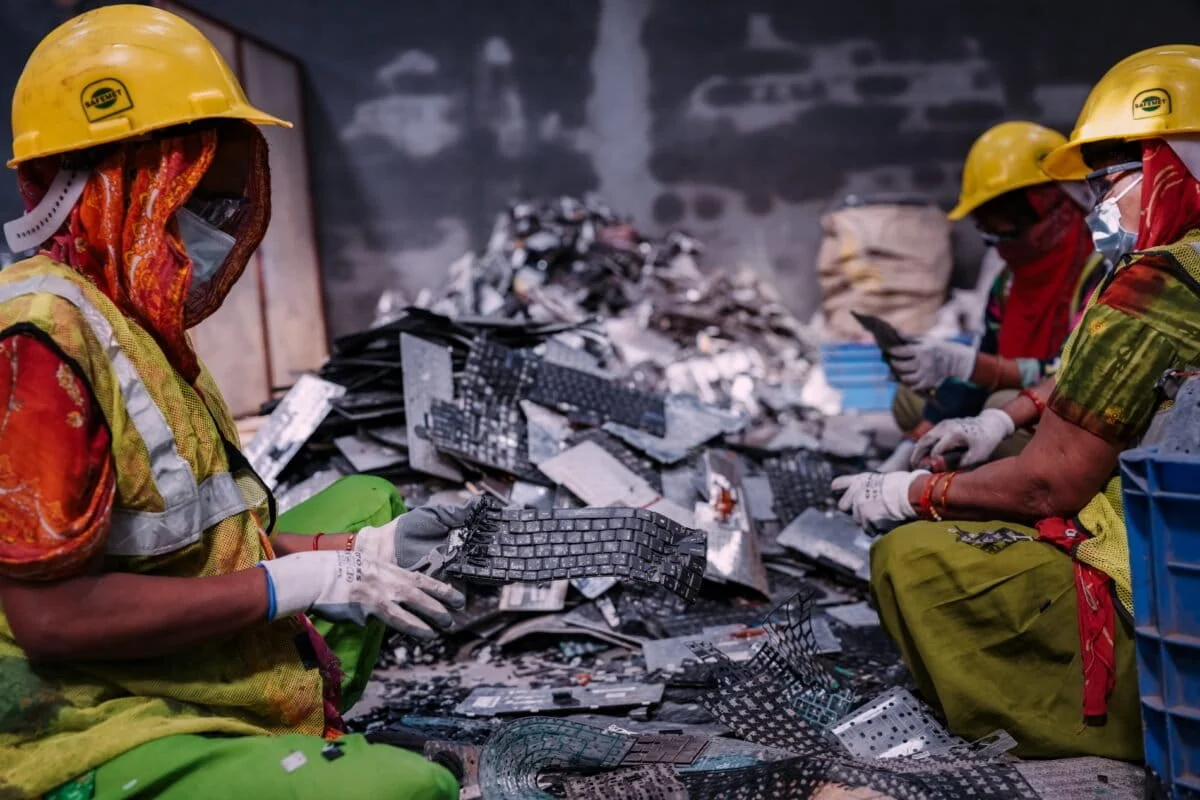
In the bustling streets of Pune, Maharashtra, Shambhu Yadav begins his day long before the city’s tech professionals power up their laptops. Having migrated from Meerut, Uttar Pradesh, in search of a livelihood, Yadav found himself absorbed into an invisible yet indispensable workforce: the informal waste collectors, known locally as kabadiwalas. Without formal training or protective gear, Yadav handles the discarded remnants of India’s digital revolution.
Yadav is a single unit in a massive, decentralized machine. He collects, segregates, and sells trash to larger dealers, earning between ₹100 and ₹500 a day. Despite his meager personal earnings, he is a vital cog in a lucrative industry valued at approximately ₹1.3 trillion (USD 13.5 billion). As India’s consumption of electronics skyrockets, men like Yadav have transitioned from collecting paper and plastic to handling high-risk electronic waste (e-waste)—a shift that offers higher profit margins but poses grave risks to human health and the environment.
Main Facts: The Dual Reality of India’s E-Waste Crisis
India currently stands as the world’s third-largest producer of e-waste, trailing only China and the United States. The country generates a staggering 1.4 million tonnes of electronic waste annually, though some independent estimates suggest the figure could be as high as 3.2 million tonnes.
The e-waste landscape in India is defined by a sharp dichotomy:

- The Formal Sector: Comprising registered producers, recyclers, and refurbishers governed by the Central Pollution Control Board (CPCB). Currently, there are 7,226 registered producers and 295 official recyclers.
- The Informal Sector: An expansive network of hundreds of thousands of waste pickers and scrap dealers who process 90-95% of the country’s e-waste.
While the formal sector has the legal mandate to recycle, it lacks the logistical reach to collect waste from households and small businesses. Conversely, the informal sector possesses the reach but lacks the technology to process waste safely. This creates a "leakage" where hazardous materials like lead, mercury, and cadmium are released during crude dismantling processes, while valuable "critical minerals" are lost due to inefficient extraction methods.
Chronology: From Scrap Metal to Digital Debris
The evolution of India’s waste management system reflects the country’s rapid economic liberalization and subsequent technological boom.
- Early 2000s: The IT revolution in cities like Bengaluru and Hyderabad leads to a surge in discarded hardware. E-waste begins to enter the traditional "kabadi" stream. Informal clusters, such as Seelampur in Delhi and Padarayanpura in Bengaluru, emerge as global hubs for primitive e-waste dismantling.
- 2011: The Indian government introduces the first E-Waste (Management and Handling) Rules, marking the first attempt to separate electronic waste from general municipal solid waste.
- 2016: The rules are overhauled to include Extended Producer Responsibility (EPR). This mandates that electronics manufacturers are responsible for the end-of-life disposal of their products.
- 2022: The Ministry of Environment, Forest and Climate Change notifies the E-Waste (Management) Rules, 2022. These rules introduce a market-based transition with e-waste recycling certificates and more stringent targets for producers.
- Present Day: Despite these legislative milestones, the gap between policy and practice remains wide. Workers like Sharvan in Bengaluru continue to manually strip copper from wires—a practice he describes as "mining for gold"—because the formal system remains inaccessible to the grassroots collector.
Supporting Data: The Capacity Gap and the Cash Economy
The primary hurdle to formalization is a massive disparity in processing capacity. According to the Ministry of Electronics and Information Technology (MeitY), the formal sector currently processes only 5% to 10% of the total e-waste produced in India.
The Producer-Recycler Imbalance
The CPCB registers over 7,000 producers who manufacture or import electronics. However, there are only 295 authorized recyclers and 53 refurbishers nationwide. This bottleneck forces producers to rely on Producer Responsibility Organizations (PROs) to bridge the gap, but even then, the waste often originates from the informal sector.

The Economics of Anonymity
The informal sector thrives on cash transactions and operational anonymity. Pranshu Singhal, founder of the PRO Karo Sambhav, notes that grassroots collectors avoid digital transactions to bypass the Goods and Services Tax (GST) trail and banking costs. In the informal market, copper shards can sell for ₹1,000–₹1,200 per kilogram. For a worker earning ₹500 a day, the immediate liquidity of the cash-based "kabadi" system is far more attractive than the delayed payments and bureaucratic hurdles of the formal sector.
The Value of "Urban Mining"
E-waste is not merely trash; it is a repository of precious metals. Estimates suggest that India’s annual e-waste contains critical minerals and precious metals—including gold, silver, lithium, and cobalt—worth approximately $4.9 billion (₹470 billion). When processed informally, these minerals are often lost or contaminated.
Official Responses: Strategies for Integration
Recognizing that the informal sector cannot be bypassed, the Indian government and various NGOs have begun exploring "hybrid" models of waste management.
The Role of NGOs and Social Enterprises
Organizations like Chintan (Delhi) and SWaCH (Pune) are pioneering the integration of waste pickers into the formal value chain. Chintan has trained a cohort of 400 waste pickers to act as "aggregators." These individuals collect e-waste safely and sell it to formal recyclers. Bharati Chaturvedi, founder of Chintan, reports that this integration has increased the income of participating waste pickers by at least 7%.

In Pune, the SWaCH cooperative works in tandem with the municipal corporation. More than 4,000 waste pickers have been granted the formal right to collect dry waste, which is then diverted to recyclers authorized by the Maharashtra Pollution Control Board (MPCB). Amogh Bhongale of SWaCH emphasizes that these drives ensure e-waste is diverted from landfills into a regulated "circular economy."
Government Missions and Skilling
The Indian government recently launched a Critical Mineral Mission with an outlay of ₹650 crore. The mission aims to incentivize the extraction of rare earth minerals from e-waste. To succeed, experts argue that the government must provide state-backed identities and minimum wage schemes for informal workers. Rohan Massey of Saahas Zero Waste suggests that treating these collectors as "entrepreneurs" rather than unskilled laborers is the key to bringing them into the formal fold.
Implications: Health, Environment, and Economic Security
The failure to fully formalize the e-waste sector has profound implications for India’s future.
1. Public Health and Environmental Hazards
Informal recycling often involves "acid bathing" circuit boards to extract gold or burning wires to reach copper. These methods release toxic fumes and heavy metals into the soil and groundwater. For workers like Shambhu Yadav and Sharvan, the long-term health consequences include respiratory issues, skin diseases, and neurological damage. Without formalization, these workers remain outside the reach of occupational health standards.

2. Strategic Resource Security
As the world shifts toward green energy, minerals like lithium and cobalt have become strategic assets. India is currently dependent on imports for these minerals, which are essential for Electric Vehicle (EV) batteries. By failing to efficiently recycle e-waste, India is effectively throwing away the raw materials needed for its own energy transition. "Urban mining" through formal e-waste channels could provide a domestic buffer against global supply chain shocks.
3. The Need for "Traceability"
For the Extended Producer Responsibility (EPR) framework to be effective, there must be full traceability from the consumer to the recycler. Current rules exclude the informal collector from the "paper trail." Experts argue that the EPR rules should be amended to recognize informal collectors as legitimate "collection agents." This would allow them to earn a legal commission from producers while ensuring that the waste they collect reaches authorized facilities.
4. Economic Formalization
The transition from a cash-based waste economy to a digital, GST-compliant one is a significant hurdle. However, the success of models like Karo Sambhav and Chintan proves that when offered better rates—such as the ₹65 per kilogram Rahim Mandal receives through Chintan versus the ₹40 he received in the open market—informal workers are willing to transition.
Conclusion
India’s e-waste management is at a crossroads. The informal sector, led by individuals like Shambhu Yadav, provides a service that the state and private corporations currently cannot replicate. However, this service comes at a high cost to human health and the environment.

The path forward lies not in the eradication of the kabadiwala, but in their elevation. By providing legal recognition, safety training, and financial incentives, India can transform its "shadow recyclers" into the frontline of a sophisticated, multi-billion-dollar circular economy. Unlocking the $4.9 billion trapped in the country’s e-waste requires more than just technology; it requires a social contract that values the worker as much as the mineral.
