

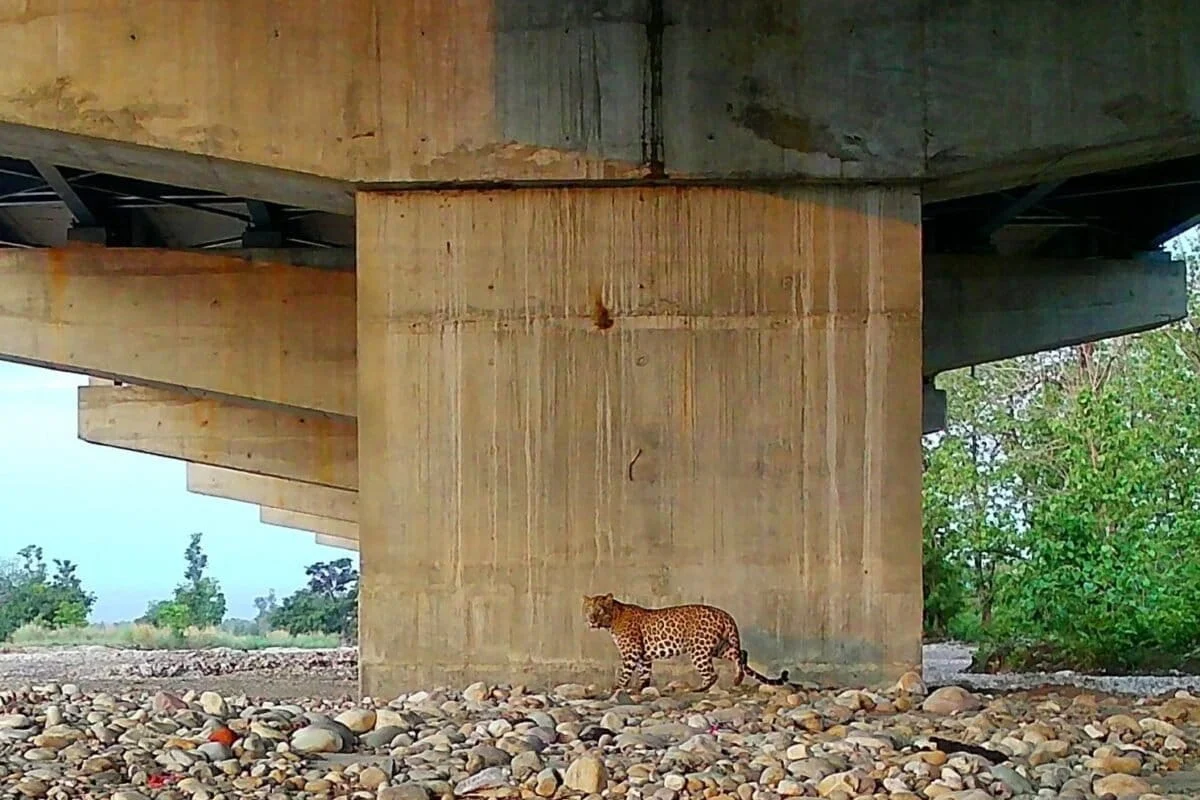
The Delhi-Dehradun Economic Corridor, a 200-kilometer marvel of modern engineering, was designed to do more than just slash travel time between India’s capital and the foothills of the Himalayas. Built with an unprecedented focus on "linear infrastructure ecology," the expressway features one of the country’s most ambitious attempts to mitigate habitat fragmentation. According to a landmark report by the Wildlife Institute of India (WII), there is now early, empirical evidence that these efforts are bearing fruit.
Camera traps and acoustic sensors have documented a wide array of species—from the majestic Asian elephant to the elusive rusty-spotted cat—navigating the underpasses designed to keep them safe from the high-speed traffic above. However, while the early data is encouraging, researchers and conservationists warn that the presence of animals does not yet equate to long-term ecological success. Noise pollution, human interference, and the uneven distribution of wildlife use remain significant hurdles in the quest to reconnect the fragmented Shivalik landscape.
Main Facts: A Corridor for Two Worlds
The Delhi-Dehradun Economic Corridor became fully operational in 2025, though its official inauguration took place in April 2026. At the heart of its environmental mitigation strategy is a 20-kilometer stretch passing through a high-biodiversity zone in the Terai landscape. This region is a vital corridor for megafauna, including tigers and elephants, and serves as a sanctuary for sensitive species like the great hornbill and king cobra.
To prevent the expressway from becoming a lethal barrier, engineers and biologists collaborated to design a 10.97-kilometer section comprised of elevated flyovers and specialized underpasses. These structures serve three primary purposes:
- Reducing Animal Mortality: Preventing "roadkill" incidents on a high-speed expressway.
- Mitigating Human-Animal Conflict: Keeping wildlife away from vehicles and nearby human settlements.
- Preventing Population Isolation: Ensuring that genetic exchange continues by allowing animals to move between the Rajaji Tiger Reserve, the Doon Valley, and adjoining forest divisions.
The WII study, released in February 2026, utilized a sophisticated array of 150 camera traps and 29 AudioMoth acoustic recorders. Over a 40-day monitoring period in mid-2025, the team captured over 111,000 images, of which more than 40,000 documented 18 different wild species successfully utilizing the underpasses.
Chronology: From Legal Battles to Biological Proof
The journey toward the Delhi-Dehradun Economic Corridor’s wildlife mitigation measures has been marked by legal scrutiny and evolving scientific understanding.

- January 2021: The Uttarakhand High Court intervened in a public interest litigation, staying a state notification that sought to de-notify the Shivalik Elephant Reserve. The court observed that the reserve was essential for the survival of migratory elephants and that any irreversible loss to the habitat would be a catastrophe for the environment.
- 2022: A preliminary technical report by the WII and the Uttarakhand Forest Department evaluated newly commissioned underpasses at Motichur and Teen Pani. These sites, located on the NH-72 corridor, provided an early "proof of concept," showing that while animals would use the structures, human presence was a major deterrent.
- May – June 2025: Following the completion of the Ganeshpur-Asarori stretch of the new Delhi-Dehradun Economic Corridor, WII researchers conducted intensive monitoring. This 40-day window provided the primary data for the current assessment of species adaptation.
- February 2026: The WII officially released its report, "Landscape Reconnected," providing the first comprehensive post-construction evidence of wildlife use on the new expressway.
- April 2026: The corridor was officially inaugurated, marking its full transition from a construction project to a functioning piece of national infrastructure.
Supporting Data: Species Adaptation and the Impact of Noise
The WII study divided the monitored corridor into three distinct ecological zones: a riverbed, a hilly section, and a sal forest stretch. The data revealed a fascinating hierarchy of how different species adapted to the new concrete structures.
Species Frequency and Adaptation Rates
The camera traps recorded a diverse "guest list" of wildlife. The most frequent visitors were golden jackals, followed by nilgai (blue bull), sambar deer, Indian hare, and spotted deer (chital).
The speed of adaptation was particularly noteworthy:
- Immediate Users (Within 5 Days): Nilgai, elephants, golden jackals, hares, sambar, and spotted deer were documented using the underpasses almost immediately after monitoring began.
- Delayed Users: More cautious species, including leopards, the rare rusty-spotted cat, and the grey mongoose, only appeared later in the sampling period, suggesting a longer "settling-in" phase for predators and smaller, more secretive mammals.
The Elephant in the Room
Elephants, the flagship species of the Shivalik landscape, were recorded using the underpasses 60 times during the 40-day study. However, the data showed that elephants did not use the 11-kilometer stretch uniformly. Instead, they clustered at specific points, indicating that certain "micro-corridors" within the structure are preferred over others.
The Acoustic Barrier
Perhaps the most significant finding of the 2026 report involves the impact of sound. Using AudioMoth recorders, researchers found that anthropogenic noise—primarily the roar of high-speed traffic—consistently drowned out biological sounds throughout the stretch.
The study found a clear correlation between noise levels and species detection:

- Sensitive Species: Sambar, spotted deer, and Asian elephants were predominantly detected in the quieter sections of the underpasses.
- Tolerant Species: Golden jackals, nilgai, and wild boars appeared less affected by the racket, frequently appearing in noisier sections closer to the road’s exit points.
Furthermore, the study documented a temporal shift. Large predators like leopards and mega-herbivores like elephants strictly avoided the underpasses during peak human activity. They were almost exclusively recorded at dusk, dawn, and during the night, when vehicular and human disturbance was at its lowest.
Official Responses and Expert Opinions
The reaction to the WII report has been a mix of cautious optimism and sharp critique regarding the broader planning of such "mega-projects."
The Conservationist Perspective:
Upasana Ganguli of the Wildlife Trust of India (WTI) emphasized that the early numbers are just the beginning of a much longer story. "Early evidence of wildlife use is encouraging, but it should be seen as a starting point rather than proof of long-term success," Ganguli stated. She noted that true success would be measured by whether elephant herds—including mothers and calves—continue to use these paths across all seasons and over several years.
The Legal and Planning Critique:
Abhijay Negi, the lawyer who represented petitioners in the 2021 High Court case, offered a more skeptical view. While acknowledging that "nature does have resilience," Negi pointed out a fundamental disconnect between engineering and ecology.
"There is a massive gap between planning and actual corridor use," Negi remarked. He argued that many of these studies were conducted with the primary goal of facilitating a "mega infrastructure project" with political weight, rather than being driven purely by conservation needs. He cautioned that while the underpasses align with some known routes, they do not capture all the traditional paths elephants have used for generations.
The Researchers’ Recommendations:
The WII authors have called for immediate "noise-abatement measures." These include the installation of advanced sound barriers in major crossing sections to make the underpasses more palatable for noise-sensitive species. They also echoed the recommendations of the 2022 report: restricting human activity beneath the flyovers, allowing natural vegetation to regenerate to provide cover for animals, and maintaining long-term monitoring.

Implications: A Model for the Future?
The findings from the Delhi-Dehradun Economic Corridor have far-reaching implications for how India, and the world, approaches the "Green Infrastructure" movement.
1. The Necessity of Post-Construction Audits
The WII report proves that building a wildlife crossing is not a "set it and forget it" solution. The discovery that animals avoid noisy or human-heavy sections of the underpasses suggests that the design of the structure itself is only half the battle; the management of the environment underneath and around the structure is equally vital.
2. Fragmentation vs. Connectivity
The Shivalik-Rajaji landscape remains under immense pressure. While the 11 kilometers of underpasses mitigate the impact of the expressway, the surrounding areas continue to see increased settlement and secondary road development. Experts warn that these underpasses could become "bridges to nowhere" if the forest patches they connect are not also protected from encroachment.
3. Balancing Development and Ecology
The Delhi-Dehradun project serves as a high-profile test case for the Indian government’s "Gati Shakti" (Power of Speed) initiative. If the corridor can successfully demonstrate that high-speed economic growth can coexist with the movement of tigers and elephants, it will provide a blueprint for future projects. However, if the use of these corridors declines due to noise or human disturbance, it will serve as a cautionary tale about the limits of engineering in the face of biological needs.
Conclusion
The 40,444 images of wildlife captured beneath the Delhi-Dehradun Economic Corridor are a testament to the resilience of the natural world. They show that, given a chance, nature will attempt to reclaim its ancestral paths. Yet, as the hum of tires continues unabated above, the challenge remains to ensure that these concrete tunnels remain true sanctuaries of passage, rather than mere shadows of the corridors that once were. The coming years of monitoring will determine if this project is a true bridge to the future of conservation or merely a temporary bypass in the face of inevitable fragmentation.
