Munich, Germany – May 29, 2026 – Indian shooting has once again etched its name in the annals of international sport, delivering a spectacular 1-2 finish in the Women’s 10m Air Pistol event at the ISSF World Cup in Munich. In a gripping final that mirrored their previous encounter at the same venue last year, veteran Suruchi Singh Phogat clinched her fifth career ISSF World Cup gold medal, while the prodigious 21-year-old Esha Singh secured a well-deserved silver, completing a remarkable double medal haul at the prestigious competition.
The dual triumph underscores India’s growing prowess in pistol shooting, setting a formidable tone for a crucial Olympic cycle that includes the upcoming Asian Games and the highly anticipated Doha World Championships, where crucial quotas for the Los Angeles 2028 Olympics will be on offer. Esha Singh’s performance, in particular, has captivated the shooting world, as she achieved the rare feat of medaling in both the 25m Pistol and 10m Air Pistol events, having previously set a new 25m world record earlier in the week en route to a gold medal.
A Resounding Victory in Munich
The ISSF World Cup series represents the pinnacle of annual competitive shooting, drawing elite athletes from across the globe to test their mettle and fine-tune their skills. The Munich leg, held at the historic Olympic Shooting Range, carries particular weight given its tradition and the caliber of competition it attracts. This year, the Indian contingent arrived with high expectations, and their pistol shooters delivered beyond measure.
The women’s 10m Air Pistol final was a showcase of precision, mental fortitude, and strategic shooting. For Suruchi Singh Phogat, this victory marks a significant milestone – her fifth ISSF World Cup title. Her experience and unwavering focus were evident as she navigated a highly competitive field, ultimately standing atop the podium. Phogat’s consistent performance throughout the year has solidified her status as a leading figure in Indian shooting, a crucial asset as the nation eyes greater glory on the international stage.
Esha Singh’s silver medal, hot on the heels of her 25m Pistol gold and world record, cemented her reputation as one of the sport’s most versatile and exciting talents. To excel in two distinct pistol disciplines, demanding different techniques, rhythms, and mental approaches, is an extraordinary achievement. Her ability to transition seamlessly and maintain a championship-level performance across events speaks volumes about her dedication and natural aptitude. This rare double medal performance at a World Cup signals a potential paradigm shift in how multi-event shooters are viewed and developed within the Indian system.
The Road to the Final: A Test of Nerves and Precision
The path to the medal rounds in an ISSF World Cup is fraught with challenges, beginning with the qualification stage where even a slight lapse in concentration can mean the difference between advancing and early elimination. The Women’s 10m Air Pistol qualification saw a fiercely contested field, with shooters from powerhouse nations vying for one of the coveted eight spots in the final.
Both Suruchi Phogat and Esha Singh demonstrated immense resilience during the qualification round. They each posted identical scores of 578, a testament to their consistent skill. However, it was Phogat who edged out Singh for the eighth position based on a higher number of inner tens – a critical tie-breaking criterion in precision shooting. Despite the close call, Esha Singh also secured her place, ensuring two Indian flags would fly in the final.
Their qualification was particularly impressive given the caliber of competitors they overcame. Among those who failed to make the cut were some of the world’s most decorated shooters, including Paris Olympics 25m champion Yang Jinn, 10m Air Pistol champion Oh Ye-jin of Korea, and the formidable world number one, Qianxun Yao of China. To outmaneuver such an elite lineup in the qualification stage alone speaks volumes about the form and competitive edge of the Indian duo. Another Indian shooter, Muskan, competing in the non-medal category, finished a commendable sixth, further highlighting the depth of talent within the national squad.
The eight-shooter final promised an electrifying contest, featuring a constellation of international stars. The lineup included Tokyo Olympian and world junior mixed team champion Choo Gaeun, 25m Pistol World Junior silver medallist Mirslova Mincheva of Bulgaria, Granada World Cup champion Shen Yiyao of China, 25m Pistol Asian Champion Nguyen Thuy Trang of Vietnam, and the highly experienced London Olympics silver medallist and three-time Olympian Celine Goberville of France, alongside Zhang Qi of China. Each competitor brought their unique blend of experience and skill, setting the stage for a truly nail-biting showdown.
The Battle Unfolds: Series by Series
The final commenced with palpable tension, as each shooter aimed to establish an early lead. France’s Celine Goberville, a seasoned Olympian, quickly asserted herself, grabbing the early advantage with a strong first series score of 51.6 points. Close on her heels was Choo Gaeun of Korea, just 0.1 points behind, signaling her intent. Esha Singh started solidly with a first series of 51.5, positioning herself in third place, while Zhang Qi occupied the fourth spot. Suruchi Phogat, known for her ability to build momentum, found herself in fifth place with 49.4 points, a relatively modest start but far from insurmountable.
As the competition progressed into the second series, Phogat began her ascent, shooting a confident 51.5 points to climb to the fourth position. Gaeun maintained her lead, closely followed by Goberville, while Singh held steady in fourth. Mincheva moved into fifth, as Chang dropped to sixth, and Thuy and Yiyao rounded out the field in seventh and eighth, respectively. The scores remained incredibly tight, with mere decimal points separating the contenders, amplifying the pressure with every shot fired.
The final then transitioned into the elimination stages, a format designed to heighten drama, where one shooter exits after a two-shot series. This is where mental fortitude truly comes to the fore. Phogat, with her characteristic calm, steadily worked her way up the leaderboard. Esha Singh experienced a brief dip, momentarily dropping to fifth, but showcased her remarkable resilience by quickly regrouping and fighting her way back into the top four. The intensity ratcheted up as Mirslova Mincheva was the first to be eliminated, finishing in fourth place.
The pressure continued to mount, and Choo Gaeun, who had held a strong position for much of the final, faltered with some uncharacteristically low nines, leading to her elimination in third place. This left an all-Indian final showdown: Suruchi Singh Phogat versus Esha Singh. The atmosphere was electric, a testament to the depth of Indian talent in the sport.
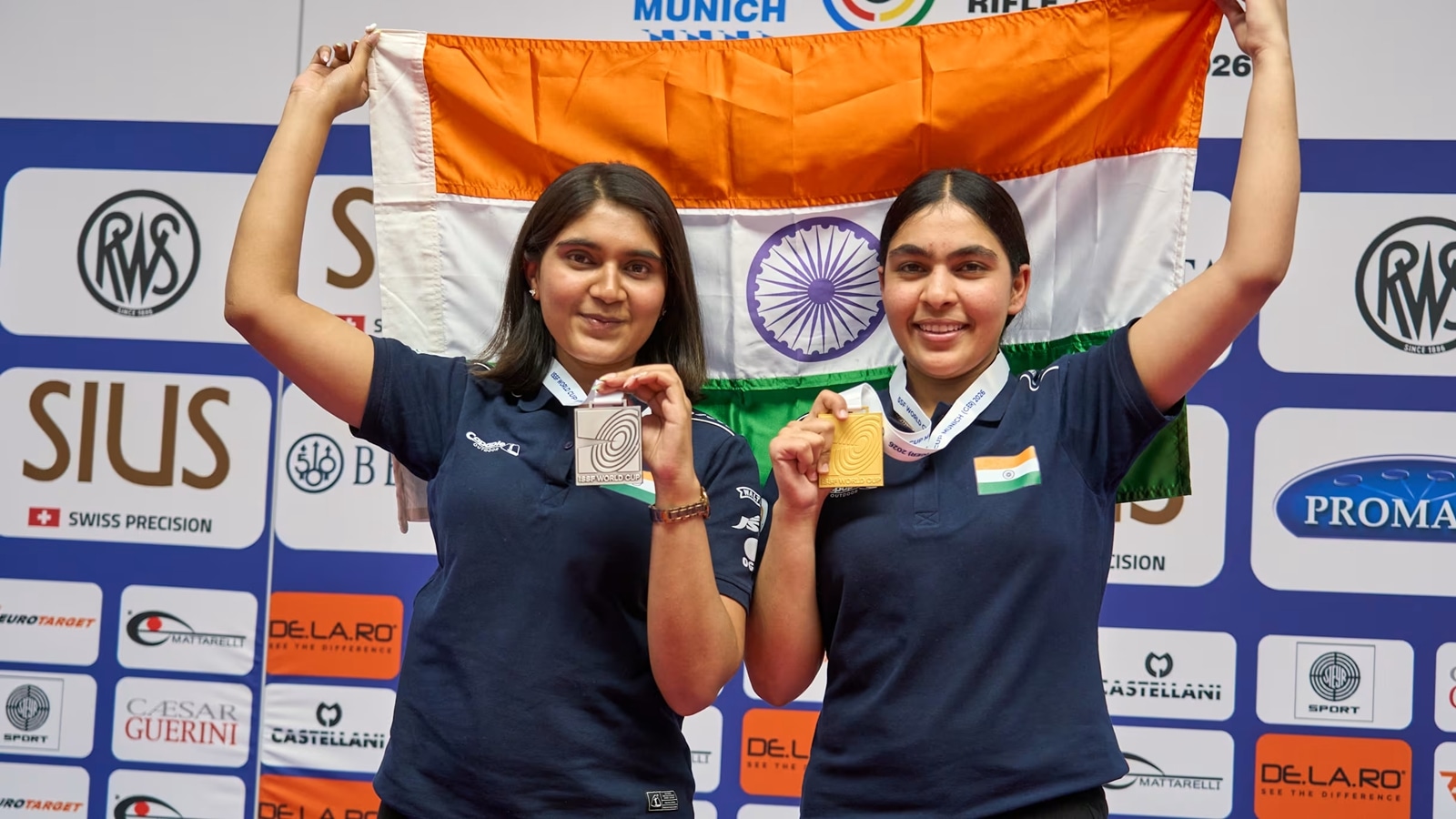
With a 1.2-point lead over Esha, Phogat demonstrated nerves of steel in the last elimination series. She fired impressive shots of 10.2 and 10.3, maintaining her composure under immense pressure. Esha Singh, not one to back down, responded with strong shots of 10.1 and 10.7, pushing her senior counterpart to the very limit. However, Phogat’s earlier advantage proved decisive, and she ultimately secured the gold medal with a lead of 0.9 points, a margin that underscored the razor-thin difference between victory and silver at this elite level. Throughout the elimination series, Phogat’s consistency was highlighted by eight shots of 10.2 or more, while Esha also displayed remarkable precision with six such shots, showcasing the high level of execution from both Indian athletes.
Voices from the Podium and the Coaching Bench
The euphoria of victory and the satisfaction of a hard-fought battle were evident in the post-match reactions. Suruchi Singh Phogat, reflecting on her fifth World Cup title, expressed her relief and optimism for the critical year ahead. "This is my first World Cup title of the year, and the start has been good for me," she told ISSF TV, her voice steady and confident. "I did not face any pressure (to compete against Esha for the gold). The start was not good, but after that, I got the flow and settled down. I just followed my technique, and it went well." Phogat’s comments highlight her reliance on a disciplined approach and her ability to recover from a slow start, a hallmark of seasoned champions. She also emphasized the broader implications of her win: "It is a very important year with Asian Games and Olympic quota matches too. I hope I will be able to win a medal in the Asian Games and then in the Olympics too." Her aspirations clearly extend beyond individual glory, aligning with national ambitions for global sporting excellence.
The National High Performance Manager, Raunak Pandit, offered crucial insights into the performance of both shooters, underlining the strategic significance of their achievement. Speaking with The Indian Express, Pandit lauded their methodical approach: "I am impressed by how both Suruchi and Esha built their match. Esha had a decent start but then faltered a bit but then made a comeback. Suruchi had a moderate start and then shot consistently to pull things back." His analysis underscored the mental toughness required to navigate the ebbs and flows of a high-stakes final. "It was not an easy cake walk for both of them," Pandit continued, acknowledging the formidable international competition. He also touched upon the healthy internal rivalry within the Indian team: "It’s good to see the competition among the Indian shooters and such things always propels each shooter." This internal competition, rather than being a hindrance, is viewed as a catalyst for individual improvement and collective success.
Esha Singh’s Remarkable Versatility and Resilience
Esha Singh’s performance in Munich stands out not just for her silver medal in 10m Air Pistol but for the sheer versatility she displayed throughout the week. Her earlier gold medal in the 25m Pistol event, where she outshot the likes of Paris Olympics champion Yang Jinn and set a new world record, was a phenomenal achievement in itself. To then pivot to the 10m Air Pistol, a discipline demanding a different rhythm, trigger control, and focus, and secure another medal, is a testament to her exceptional talent and mental strength.
Raunak Pandit elaborated on the unique challenges Esha faced in achieving this double. "The 25m pistol final was a high scoring final and it was a big emotional high for Esha," he explained. "To forget that and start from scratch in the 10m air pistol event with a clear mind is not that easy." The transition between events, especially after such a significant victory, requires a rapid mental reset and physical recovery. "Our main focus was on her recovery and it was yesterday that she trained in 10m after training for 25m earlier for four days," Pandit revealed, highlighting the meticulous planning behind her performance. "She did struggle in qualification due to that but then she bounced back in the final." This insight provides a deeper appreciation for Esha’s resilience and the support system enabling her success.
At just 21 years old, Esha Singh has already accumulated an impressive list of accolades. This latest silver marks her third ISSF World Cup medal in the 10m Air Pistol, following her title win at the Ningbo World Cup last year. Her consistent presence on international podiums positions her as a pivotal figure in India’s shooting future, a young athlete who consistently delivers under pressure across multiple disciplines. Her ability to bounce back from adversity, as demonstrated by her recovery in the 10m final, showcases a maturity beyond her years and marks her as a true champion in the making.
Implications for Indian Shooting: A Golden Era Beckons
The 1-2 finish at the Munich World Cup carries profound implications for Indian shooting, signaling a vibrant and promising future for the sport in the nation. This dual victory, especially against a field comprising some of the world’s most formidable shooters, is a powerful statement about India’s growing bench strength and the efficacy of its coaching and training programs.
Firstly, these medals significantly boost India’s prospects for the upcoming Doha World Championships, which are crucial for securing Olympic quotas. Performances like these not only earn valuable ranking points but also instill immense confidence in the athletes and the national federation regarding their potential to secure multiple berths for the Los Angeles 2028 Olympics. Each medal won, each world record broken, adds to the momentum that could translate into a substantial contingent for future global events.
Secondly, the competitive spirit within the Indian team, as noted by Raunak Pandit, is a healthy indicator of sustainable success. When athletes like Phogat and Singh push each other to excel, it elevates the overall standard of the team. This internal rivalry fosters a culture of continuous improvement, where each shooter strives to outdo the other, ultimately benefiting the entire squad. Such a dynamic is essential for developing a deep pool of talent capable of consistently challenging for top honors internationally.
Finally, the consistency demonstrated by Indian shooters at various World Cups and international events suggests that these are not isolated triumphs but part of a sustained upward trajectory. The infrastructure, coaching expertise, and athlete dedication are converging to create a golden era for Indian shooting. The ability to produce multiple medalists in the same event, year after year, speaks to a robust system that identifies, nurtures, and hones world-class talent.
The Road Ahead: Asian Games and Paris/LA Olympics
With the Munich World Cup concluded, the focus for Suruchi Singh Phogat, Esha Singh, and the entire Indian shooting contingent now shifts to the critical challenges ahead. The immediate priority will be the Doha World Championships, a pivotal event in the Olympic qualification calendar. Securing Olympic quotas at Doha would be a massive relief, allowing athletes to concentrate solely on their preparation without the added pressure of qualification.
Following Doha, the Asian Games represent another significant platform for India to assert its dominance on the continental stage. A strong performance there would not only add to the medal tally but also serve as a crucial test of readiness for the global spectacle of the Olympics. Both Phogat and Singh, along with their teammates, will be aiming to replicate their World Cup success and bring home a rich haul of medals from the Asian Games.
Looking further ahead, the ultimate goal remains the Los Angeles 2028 Olympics. The performances in Munich are a clear indication that India possesses the talent, temperament, and strategic depth to contend for multiple medals at the pinnacle of international sport. The continued development of young talents like Esha Singh, combined with the seasoned experience of athletes like Suruchi Singh Phogat, positions India as a formidable force in the global shooting arena, poised to make a significant impact in the years to come. The double podium finish in Munich is not just a victory; it is a powerful statement of intent from Indian shooting on its ambitious journey towards Olympic glory.