

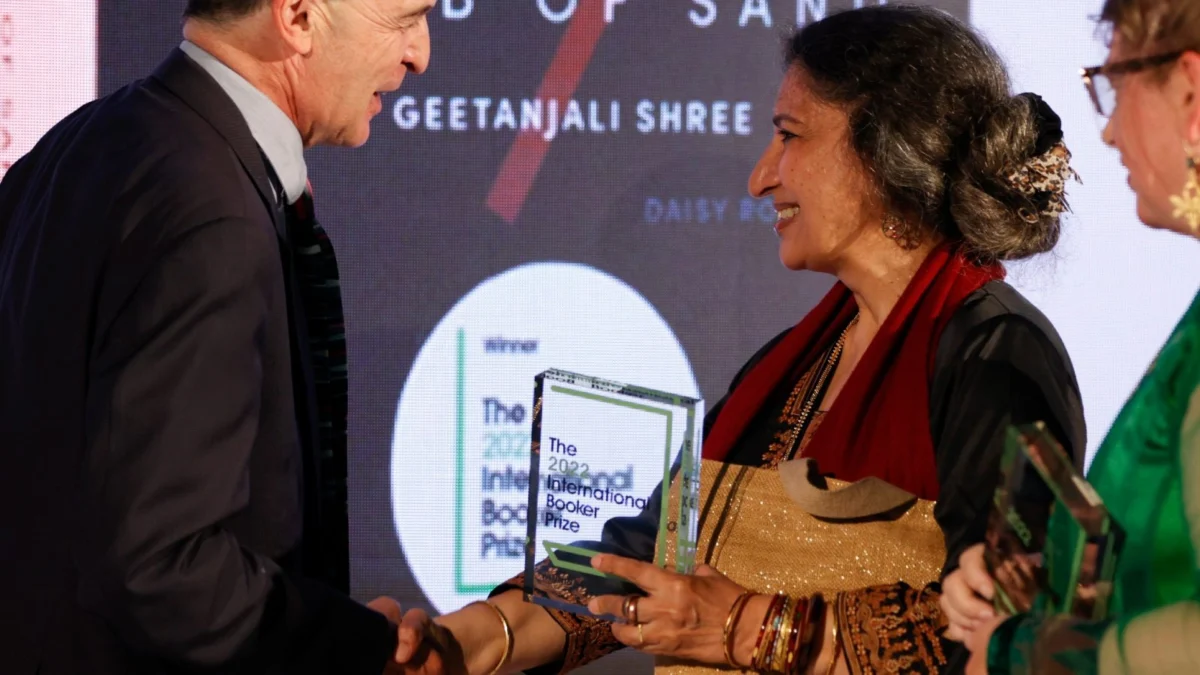
In a moment that has been described as a "tectonic shift" for South Asian literature, Delhi-based author Geetanjali Shree has been awarded the 2022 International Booker Prize for her novel Tomb of Sand. Originally published in Hindi as Ret Samadhi, the work was translated into English by Daisy Rockwell. This victory marks the first time a book written in an Indian language has won the prestigious award, signaling a new era for the global recognition of "Bhasha" (regional language) literature from the subcontinent.
The announcement, made during a glittering ceremony in London on May 26, 2022, saw Shree and Rockwell share the £50,000 prize money equally. The win is not merely a personal triumph for the author and translator but a historic breakthrough for Hindi, a language spoken by hundreds of millions but historically underrepresented in the global literary canon.
Main Facts: A Historic Triumph for Hindi Letters
The International Booker Prize is awarded annually for a single book, translated into English and published in the UK or Ireland. It aims to encourage more publishing and reading of quality fiction from all over the world. Until this year, while Indian authors writing in English—such as Arundhati Roy, Salman Rushdie, and Aravind Adiga—have famously won the "original" Booker Prize, the International Booker had remained elusive for works translated from Indian languages.
Tomb of Sand triumphed over a formidable shortlist of five other titles, including works by Nobel laureate Olga Tokarczuk and esteemed writers like Claudia Piñeiro and Mieko Kawakami. The judging panel, chaired by translator Frank Wynne, described the novel as an "extraordinary" achievement that manages to be "utterly original" while remaining deeply rooted in the specificities of Indian life and history.
The novel is published in the UK by Tilted Axis Press, a small independent publisher founded by translator Deborah Smith (who won the prize in 2016 for Han Kang’s The Vegetarian). The choice of a small press further highlights the role of independent publishing in bringing diverse voices to the forefront of the English-speaking world.
Chronology: From ‘Ret Samadhi’ to Global Acclaim
The journey of Tomb of Sand began in 2018 when it was published in Hindi as Ret Samadhi by Rajkamal Prakashan. Geetanjali Shree, already a respected figure in Hindi literature with several novels and short story collections to her name, had crafted a narrative that was structurally experimental and linguistically playful.
The timeline of its ascent to the International Booker is as follows:
- 2018: Ret Samadhi is published in India. It receives critical acclaim within the Hindi literary circuit for its unique prose style and its treatment of aging and the Partition.
- 2021: Daisy Rockwell, a US-based translator and artist known for her work on Upendranath Ashk and Bhisham Sahni, completes the English translation. Tilted Axis Press releases the book in the UK under the title Tomb of Sand.
- March 2022: The Booker Prize Foundation announces the longlist of 13 books. Tomb of Sand is included, making it the first Hindi novel to ever reach this stage.
- April 2022: The book makes the final shortlist of six. Literary critics begin to take serious notice, praising the "polyphonic" nature of the prose.
- May 26, 2022: At the ceremony in London, Geetanjali Shree and Daisy Rockwell are declared the winners.
Supporting Data and Context: The Narrative and the Craft
To understand the significance of the win, one must look at the complexity of the book itself. Tomb of Sand is a sprawling, 700-page novel that defies easy categorization.
The Plot
The story follows an 80-year-old woman, referred to as "Ma," who sinks into a deep depression following the death of her husband. She eventually emerges from her bed with a renewed, almost rebellious lease on life. Much to the consternation of her bohemian daughter, Ma insists on traveling to Pakistan to confront the unresolved ghosts of her past—specifically the trauma of the 1947 Partition of India.
Themes of Borders and Identity
The novel explores the concept of "borders" in every sense: the physical borders between nations (India and Pakistan), the borders between genders, the borders between life and death, and the borders between different languages. Shree uses the metaphor of sand—constantly shifting, impossible to contain—to represent the fluidity of these boundaries.
The Challenge of Translation
Daisy Rockwell’s translation has been hailed as a feat of linguistic gymnastics. The original Hindi is noted for its wordplay, puns, and rhythmic cadence, which many thought would be "untranslatable." Rockwell managed to capture the spirit of Shree’s "dhun" (melody) while creating a version that resonates with English readers. The translation process involved a close collaboration between the two, ensuring that the cultural nuances of North Indian life were preserved without being "exoticized" for a Western audience.
Official Responses: Voices from the Literary Community
The reaction to the win has been overwhelmingly positive, with leaders, writers, and critics hailing it as a watershed moment.
In her acceptance speech, Geetanjali Shree expressed her disbelief and humility:
"I never dreamt of the Booker. I never thought I could. What a huge recognition. I’m amazed, delighted, honored, and humbled. Behind me and this book lies a rich and flourishing literary tradition in Hindi, and in other South Asian languages. World literature will be the richer for knowing some of the best writers in these languages."
She also addressed the importance of linguistic diversity, stating, "Only a narrow self and mind would want a shrunken monolingual existence."
Daisy Rockwell, reflecting on the art of translation, noted:
"Tomb of Sand is a book about borders—borders between religions, nations, and genders. It is a book that refuses to stay in its place. To translate it was to engage in a constant dance with Geetanjali’s incredible imagination."
Frank Wynne, chair of the judges, praised the book’s vitality:
"This is a luminous novel of India and partition, but one whose spellbinding brio and fierce compassion weaves youth and age, male and female, family and nation into a kaleidoscopic whole."
On social media, the literary world erupted in celebration. Bengali writer Arunava Sinha tweeted, "Yessss! A first win for a Hindi novel, an Indian novel, a South Asian novel. Congratulations!" The Booker Prizes’ official channels also highlighted the work as a bridge between cultures.
Implications: A New Dawn for Indian Bhasha Literature
The victory of Tomb of Sand is expected to have far-reaching implications for the publishing industry and the perception of Indian literature globally.
1. Increased Visibility for Regional Languages
For decades, the global publishing market has focused almost exclusively on Indian Writing in English (IWE). This win forces a reconsideration of the vast literary output in languages like Hindi, Bengali, Tamil, Malayalam, and Marathi. It proves that stories rooted in specific regional contexts have universal appeal.
2. The "Translation Effect"
There is likely to be a "Booker effect" on the translation market. Publishers in the UK and US may now be more willing to commission translations from Indian languages, which were previously seen as "commercially risky." Similarly, Indian publishers may invest more in high-quality English translations of their backlists.
3. Boosting the Morale of Bhasha Writers
Geetanjali Shree’s win is a validation for writers who choose to write in their mother tongues despite the global dominance of English. It asserts that one does not need to write in English to reach a global stage; rather, the world will come to the language if the work is powerful enough.
4. Redefining the "Partition Novel"
The Partition of 1947 is a recurring theme in South Asian literature, often treated with somber realism. Tomb of Sand offers a new way of looking at this historical trauma—through the lens of magical realism, humor, and the perspective of an elderly woman. It expands the boundaries of how history can be told.
5. Institutional Support
The win has already prompted calls for better institutional support for translators in India. While India has a rich tradition of internal translation between regional languages (e.g., Hindi to Bengali), the infrastructure for exporting these works to the international market through English or other European languages remains underdeveloped.
Conclusion
Geetanjali Shree’s Tomb of Sand is more than just a prize-winning novel; it is a cultural manifesto. It celebrates the "messiness" of life and the beauty of a language that refuses to be contained. By winning the International Booker Prize, Shree and Rockwell have not only brought glory to Hindi literature but have also reminded the world that the most profound stories are often found in the places where borders—be they geographical or linguistic—begin to blur.
As the literary community continues to celebrate this milestone, the hope is that Tomb of Sand will serve as the first of many bridges connecting the diverse, vibrant world of Indian Bhasha literature to the global stage.
