

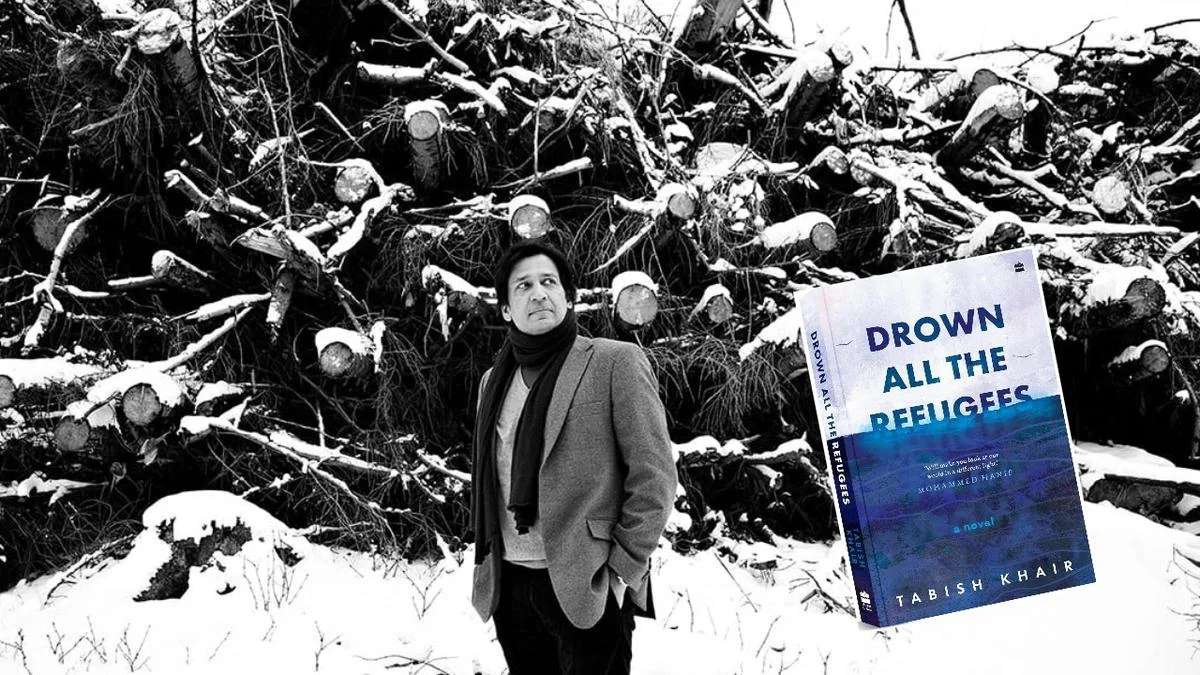
In an era defined by mass displacement and the erosion of the individual under the weight of global capital, author and academic Tabish Khair has emerged as a vital voice in contemporary world literature. His latest novel, Drown All the Refugees (HarperCollins), marks a significant and haunting addition to a body of work that has consistently sought to map the intersections of identity, religion, and the shifting borders of the modern state. By employing a title that functions as a jarring provocation, Khair invites readers into a narrative that explores the literal and metaphorical "drowning" of those whom the world has chosen to forget.
Main Facts: The Premise of ‘Drown All the Refugees’
The central inquiry of Drown All the Refugees is a psychological and existential one: How do individuals navigate a splintering of the self? Khair posits that in the face of modern trauma—whether it be the loss of a homeland or the dehumanization inherent in the refugee experience—the human psyche undergoes a fragmentation, a separation of "shadow and substance."
Set against a backdrop that mirrors the escalating humanitarian crises of the mid-2020s, the novel utilizes the occult as a narrative framework. For Khair, the supernatural is not a flight from reality but a necessary tool for the rational mind to process horrors that are essentially "beyond words." By engaging with the occult, the novel provides a vocabulary for the unspeakable, allowing the protagonist to confront the visceral reality of suffering that traditional political or legal discourse often sanitizes.
The novel is structured as a direct address from the narrator to another writer, one who belongs to a "language or culture that matters" in the global hierarchy. This framing device highlights the power imbalances inherent in storytelling and the global literary market, questioning who is allowed to speak and whose stories are deemed worthy of preservation.

A Literary Evolution: The Chronology of Tabish Khair’s Oeuvre
To understand Drown All the Refugees, one must view it as the culmination of a decade-long thematic evolution. Khair, an Indian-born author based in Denmark, has long been preoccupied with the "transnational" experience, but his focus has shifted significantly over time.
1. The Global West Phase (2012–2016)
In works such as How to Fight Islamic Terror from the Missionary Position (2012) and Jihadi Jane (2016), Khair explored the experiences of Muslims living in the Global West. These novels focused on the "fused experiences" of racism, indoctrination, and the pervasive shadow of Islamophobia. During this period, his writing was characterized by a sharp, often satirical critique of Western liberal perceptions and the radicalization of the marginalized.
2. The Return to the Subcontinent (2018–2023)
With Night of Happiness (2018) and Namaste Trump (2023), Khair brought his lens closer to home, focusing on the changing socio-political landscape of India. Night of Happiness, in particular, began his experimentation with the occult and the psychological thriller, using a ghost-story framework to explore the trauma of communal violence and the precariousness of memory in a rapidly modernizing society.
3. The Metaphysical and Global Humanitarian Phase (Present)
Drown All the Refugees represents a synthesis of these two periods. It combines the global concerns of his early work—displacement, international law, and the refugee crisis—with the metaphysical and psychological depth of his later Indian-centric novels. It marks a shift from specific geopolitical critiques to a broader, more existential exploration of what it means to be a "human" in a world that increasingly values humans as commodities or statistics.

Supporting Data: The Reality of Global Displacement
The provocation of Khair’s title is grounded in a grim statistical reality. During his discussions regarding the novel, Khair points to the widening gap between the legal definition of a "refugee" and the actual experience of displacement.
According to current humanitarian estimates cited in the context of the novel’s release:
- Refugee Populations: There are approximately 41 million people worldwide who meet the official international legal criteria for refugee status—those who have crossed a national border to flee conflict or persecution.
- Internally Displaced Persons (IDPs): At least 83 million people are internally displaced. These individuals have fled their homes for the same reasons as refugees but have not crossed an international border.
- The Legal Gap: Under current international law, IDPs often lack the same protections and "right to refuge" afforded to official refugees. This creates a class of "invisible" sufferers who are, for all intents and purposes, displaced but legally nonexistent in the eyes of the global community.
Khair uses the example of Gaza as the most blatant modern instance of this failure. He argues that the world has overlooked the most fundamental human right: "the right to live safely wherever you already are." When this right is stripped away, the act of fleeing becomes a desperate attempt to reclaim a humanity that the law is often too slow, or too biased, to recognize.
Official Responses and Philosophical Foundations
The novel’s title, Drown All the Refugees, has sparked significant debate within literary and human rights circles. Khair defends the title as a "tool" of literary tradition. He argues that literature should not draw back from provocation if it enables a deeper incursion into reality.

The "Money Nexus" and the Individual
Khair’s philosophical framework draws heavily on the work of Raymond Williams, particularly the concept that the word "individual" shares a root with "indivisible." Khair notes that in the medieval period, the individual was seen as indivisible from their society. However, the dominance of capital—what 19th-century thinkers called the "money nexus"—has severed these ties.
In Khair’s view, modern capitalism does not just separate neighbors; it enters the biological family, fragmenting the most intimate of human connections. This "fragmentation of the self" is the core tragedy of the modern refugee, who is stripped of their social context and reduced to a singular, isolated unit of suffering.
The "Sensible Distance"
A key concept Khair introduces in his dialogue is that of "sensible distance." He argues that for a society to function, there must be a distance that allows for difference without requiring total identification or absolute sameness. He uses "sensible" in the dual sense of being "rational" and "sensate" (touching, feeling). This distance is what allows "me to be me, and you to be you," creating a space for empathy that does not rely on the erasure of the other’s unique identity.
Implications: Reshaping the "Minds That Matter"
The most profound implication of Khair’s work lies in his critique of literature as a commodity. He acknowledges that the publishing industry is embedded in a hierarchical power structure where certain languages and cultures are deemed to "matter" more than others.

However, Khair offers a hopeful counter-narrative:
- Language vs. Reality: He argues that language is essential but never sufficient. It can never fully exhaust or capture reality.
- The Power of Gaps: True literature, according to Khair, exists in the "gaps, silence, noise, and contradictions" of language. It is in these spaces that readers and writers can find the room to question and subvert hierarchical power.
- Restoration as Possibility: While the novel depicts a world of fragmentation, it ends with a "bit of hope." Khair suggests that restoration—of the self and of the community—remains a human possibility, provided we start small, through personal lines of connection: talking, touching, and understanding across differences.
Conclusion
Drown All the Refugees is more than a novel about a crisis; it is a meditation on the state of the human soul in the 21st century. By forcing the reader to confront a title that echoes the most xenophobic rhetoric of our time, Tabish Khair demands a reckoning. He asks us to look past the statistics and the legal definitions to see the "shadow and substance" of the people behind the labels. In doing so, he reaffirms the role of the writer not just as a storyteller, but as a witness to the "unspeakable" and a guardian of the gaps where the truth resides.
Tabish Khair’s ‘Drown All the Refugees’ is published by HarperCollins and is available at major bookstores.
