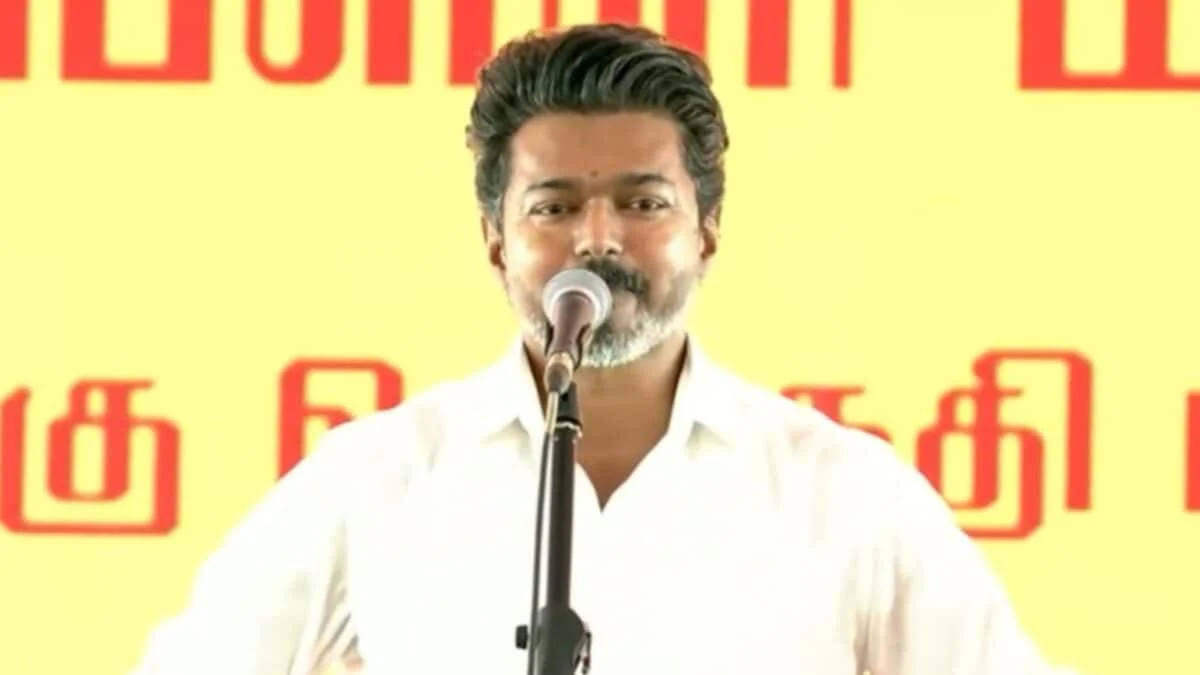
Tiruchirappalli, India, June 1, 2026 – In a highly anticipated and symbolically charged address, Tamil Nadu Chief Minister C. Joseph Vijay, leader of the nascent Tamilaga Vettri Kazhagam (TVK), held his first major public thanksgiving rally in Tiruchirappalli on Monday. The event, mere weeks after his historic assumption of office, served as both a celebration of his party’s unprecedented electoral victory and a fiery retort to his political adversaries. With a confident demeanour and a direct message, CM Vijay challenged his critics to "keep it coming," asserting that constructive feedback would only strengthen his government’s resolve to deliver on its promises.
The rally, attended by an enthusiastic crowd that filled the sprawling grounds, marked a pivotal moment for the TVK and its charismatic leader. It underscored the seismic shift in Tamil Nadu’s political landscape, which for decades has been dominated by the Dravida Munnetra Kazhagam (DMK) and the All India Anna Dravida Munnetra Kazhagam (AIADMK). Vijay’s address was not just a victory speech; it was a declaration of intent, signaling a new, perhaps more confrontational, style of governance and political engagement in the southern state.
The Inaugural Rally: A Statement of Intent
Chief Minister Vijay, a former cinematic superstar whose transition to full-time politics culminated in a stunning electoral triumph, used the Tiruchirappalli platform to articulate his vision for Tamil Nadu and to squarely address the immediate challenges posed by a vocal opposition. The rally was carefully orchestrated to convey a message of strength, gratitude, and unwavering commitment to the electorate who had placed their faith in an unconventional political entity.
"It has not even been a few weeks since we came to power," CM Vijay declared, his voice resonating across the vast gathering. "Those who said they would remain silent for six months could not remain silent even for six days. They began complaining within half an hour of us assuming office." This pointed remark, widely understood to be directed at the DMK, highlighted the intensity of the political rivalry that has rapidly defined the post-election period. The Chief Minister framed his government’s arrival as a definitive rejection by the people of the "two parties that alternated in power and deceived them for years," a narrative that resonated deeply with a segment of the electorate yearning for change.
He further sought to redefine his role, stating, "You have chosen Vijay your elder brother, your younger brother not as the Chief Minister, but as your chief servant who has come to work sincerely for you." This carefully crafted imagery aimed to foster a direct, personal connection with the populace, positioning him as an accessible and dedicated public servant rather than a distant political figure. The acknowledgment, "We could have done better, but I thank you for the support you have extended to TVK," demonstrated a pragmatic humility, while his confident assertion that criticism would "help us in performing better" showcased a proactive approach to governance, transforming potential weaknesses into opportunities for improvement.
A Calculated Choice of Venue
The selection of Tiruchirappalli for this inaugural public gathering was far from arbitrary. Located centrally in Tamil Nadu, Tiruchirappalli, often referred to as Trichy, holds significant strategic and historical importance. It is a major educational and industrial hub, and a key transportation nexus, making it an ideal location to reach a broad cross-section of the state’s population. Furthermore, Vijay himself had contested and won the Trichy East assembly seat in the recent elections, alongside Perambur in Chennai, though he subsequently vacated the Trichy East constituency. His declaration that "the people of the constituency will always be very close to him" was a reaffirmation of his bond with the region, even as he leads the state from Chennai. This choice of venue strategically reinforced the TVK’s statewide appeal and its commitment to regional representation, moving beyond the traditional concentration of power in the capital.
The Genesis of a Political Force: TVK’s Ascent
Vijay’s entry into the political arena had been a subject of intense speculation for years, mirroring the paths of other successful actor-turned-politicians in Tamil Nadu, most notably the late M.G. Ramachandran (MGR) and J. Jayalalithaa. However, unlike many who test the waters tentatively, Vijay made a decisive break from his film career, announcing the formation of the Tamilaga Vettri Kazhagam (TVK) with a clear mandate to contest all 234 assembly seats. This audacious move was met with a mix of excitement from his massive fan base and skepticism from seasoned political observers who doubted his ability to dismantle the entrenched Dravidian political structures.
From Silver Screen to Secretariat: Vijay’s Political Journey
For decades, C. Joseph Vijay, known simply as ‘Vijay’ or ‘Thalapathy’ (Commander) to his legions of fans, dominated the Tamil film industry. His films often carried subtle, and at times overt, political messages, touching upon themes of social justice, corruption, and the plight of the common man. These cinematic narratives inadvertently laid the groundwork for his political aspirations, building a formidable fan club network that transcended mere cinematic appreciation, transforming into a potent grassroots organization. This network, initially geared towards fan welfare activities and film promotions, swiftly adapted to political activism, forming the backbone of the TVK’s organizational structure. His public appearances often drew unprecedented crowds, signaling a popular appeal that extended far beyond the box office.
The Formation of Tamilaga Vettri Kazhagam
The TVK was founded on the promise of clean governance, an end to corruption, and a focus on the welfare of all sections of society, particularly the youth and marginalized communities. Vijay articulated a vision for a "caste-free" and "corruption-free" Tamil Nadu, directly addressing the perceived failures of successive DMK and AIADMK governments. His campaign focused on issues such as education, healthcare, employment generation, and public safety, carefully positioning himself as an alternative to the established political order rather than an extension of it. The party’s emblem and flag, while distinct, subtly evoked a sense of continuity with popular figures from Tamil Nadu’s political history, allowing his supporters to draw parallels that resonated emotionally.
A Mandate for Change: The 2026 Electoral Earthquake
The 2026 assembly elections will undoubtedly be etched in Tamil Nadu’s political history as a watershed moment. The TVK’s performance defied pre-election predictions and stunned political pundits, demonstrating a profound desire for change among the electorate.
Shattering the Status Quo: TVK’s Historic Win
The Tamilaga Vettri Kazhagam secured a remarkable 108 out of the total 234 assembly seats, a clear majority that allowed Vijay to form the government independently. This victory was not merely a win but a profound disruption of the traditional two-party dominance. For the first time in decades, a party outside the DMK-AIADMK binary had ascended to power with such a convincing mandate. The TVK’s success was attributed to several factors: Vijay’s immense personal popularity, a well-executed grassroots campaign leveraging his fan base, a compelling narrative of change and clean governance, and widespread voter fatigue with the perceived corruption and dynastic politics of the established parties.
The magnitude of this achievement was underscored by Vijay’s own reference to late Chief Minister M.G. Ramachandran. "They said that even late CM MG Ramachandran did not secure this much vote share in his very first election," Vijay noted, implicitly acknowledging the historic nature of his win while quickly adding, "I am not comparing myself to MGR. MGR. is MGR., but I am your Vijay, who has come to work in the path shown by MGR., Anna, and Periyar." This careful navigation of MGR’s towering legacy demonstrated political astuteness, drawing inspiration from past icons without directly claiming equivalence, thereby appealing to diverse segments of the electorate.
The Electorate’s Verdict on Traditional Powers
The TVK’s victory came at the direct expense of the DMK and AIADMK, both of whom saw significant reductions in their seat counts. The DMK, which had been the primary opposition, faced a particularly harsh verdict, prompting Vijay to repeatedly highlight their "poor performance" as a reflection of "people’s dissatisfaction with ‘family politics,’ drug menace and crimes against women." These issues, amplified during the election campaign, struck a chord with voters who felt that traditional governance had failed to adequately address pressing social concerns.
Vijay also dismissed allegations of "horse-trading" and accused the DMK and AIADMK of forming an "unusual coalition" in an attempt to prevent the TVK from coming to power. This narrative portrayed the established parties as desperate to cling to power, further solidifying the TVK’s image as an independent force fighting against a corrupt establishment. The "historic voter turnout" that Vijay praised was indeed a testament to the electorate’s engagement and their active participation in ushering in this new political era.
Direct Confrontation: CM Vijay’s Scathing Critique of Opposition
The Tiruchirappalli rally was a platform for CM Vijay to directly confront his political opponents, particularly the DMK, whose swift criticism of his nascent administration clearly rankled the new Chief Minister.
The ‘Six Days’ Barb: A Swift Rebuttal to DMK
Vijay’s pointed jibe about the DMK failing to maintain silence for even "six days" after promising "six months" was a powerful rhetorical device. It exposed what he perceived as hypocrisy and an inability to accept the democratic mandate. By highlighting the immediacy of the opposition’s complaints, Vijay sought to portray them as obstructionist and out of touch with the public’s will. This tactic also served to rally his own party members and supporters, reinforcing their belief in the righteousness of their cause and the legitimacy of their victory. He framed the DMK’s quick condemnation as an attempt to delegitimize his government even before it had a chance to fully settle in, a strategy he vowed to counter with transparent and effective governance.
Rejecting ‘Family Politics’ and Social Ills
Beyond the immediate political sparring, Vijay used his address to reiterate his core ideological commitments. His promise of "corruption-free governance under the TVK and an end to all caste-based politics" was a direct appeal to the aspirations of a generation disillusioned with the traditional political narratives. The emphasis on ending "family politics," the "drug menace," and "crimes against women" resonated deeply in a state that has grappled with these issues. The drug menace, in particular, has been a growing concern, with its devastating impact on youth and public health. Similarly, the issue of crimes against women remains a sensitive topic, often brought to the forefront of political discourse. By directly linking the DMK’s "poor performance" to these societal ills, Vijay effectively positioned the TVK as the party of moral rectitude and social responsibility.
Embracing Criticism for Progressive Governance
Perhaps the most unconventional aspect of Vijay’s speech was his open invitation for continued criticism. "Keep it coming," he challenged his rivals, arguing that it would "help us in performing better." This stance, a departure from the typical defensive posture of new governments, suggests a strategic approach to opposition. By welcoming criticism, Vijay attempts to disarm his detractors, portraying himself as a leader committed to continuous improvement rather than one afraid of scrutiny. This also allows him to frame any future policy adjustments as responses to constructive feedback, rather than capitulations to political pressure. It sets a precedent for a more transparent and responsive administration, aiming to foster a dialogue that can potentially transcend partisan divides for the greater good of the state.
Symbolism and Substance: The CM’s Unconventional Persona
Beyond his words, CM Vijay’s public persona and choices of attire have also become subjects of public and media scrutiny, revealing a deliberate strategy to communicate his vision.
Beyond the Traditional Attire: A Message of Transparency
One of the more unexpected talking points emerging from his public appearances was his choice to wear a suit, a departure from the traditional white shirt and dhoti or safari suit typically favored by Tamil Nadu’s political leaders. Addressing these questions directly, Vijay explained, "Are we not allowed to wear a coat and suit? Is it meant only for people in positions of authority? There is nothing like that. I am not wearing many colours. It is just black and white, like all our hearts. The choice of these colours is to show that I will remain transparent and simple in everything, just like black and white."
This explanation was a shrewd move, transforming a fashion choice into a powerful metaphor for his governance philosophy. Black and white, universally associated with clarity, honesty, and simplicity, became symbolic of his promise for transparent and uncorrupt rule. It also subtly challenged the established sartorial codes of Tamil Nadu politics, signaling a break from the past and an embrace of a modern, perhaps more global, image for the state’s leadership, without alienating the local populace. This choice aims to convey that he is a leader who is not bound by outdated conventions but is focused on substantive change.
Echoes of Leadership: MGR, Anna, Periyar and the ‘Chief Servant’
Vijay’s careful invocation of MGR, Anna, and Periyar—towering figures in Tamil Nadu’s political and social reform history—demonstrates his awareness of the historical lineage he is stepping into. While asserting his distinct identity ("I am your Vijay"), he strategically aligns himself with the principles and paths laid out by these stalwarts. MGR’s populist appeal and welfare schemes, Anna’s Dravidian ideology and linguistic pride, and Periyar’s radical social justice movement form the bedrock of modern Tamil Nadu politics. By claiming to follow their "path," Vijay seeks to legitimize his nascent movement within the state’s dominant political discourse, assuring continuity of core values while simultaneously presenting himself as a fresh face. His self-designation as "chief servant" further emphasizes a commitment to public service, echoing the populist leadership styles that have historically resonated with the masses in Tamil Nadu.
The Shifting Sands of Tamil Nadu’s Political Landscape
The TVK’s victory and CM Vijay’s assertive address in Tiruchirappalli signify more than just a change in government; they herald a fundamental reordering of Tamil Nadu’s political dynamics.
The Challenge of Sustaining Momentum
For the TVK, the immediate challenge lies in translating electoral success into effective governance. The honeymoon period for any new government is typically short, and the intense scrutiny from both the public and a wounded opposition means Vijay’s administration must deliver tangible results quickly. Fulfilling ambitious promises of corruption-free governance, tackling social ills, and fostering economic growth will require robust policy frameworks, efficient implementation, and a disciplined party apparatus. The defection of several opposition AIADMK functionaries and legislators to the ruling TVK, while bolstering the party’s legislative strength, also presents a challenge of integrating diverse political elements and managing internal expectations. Sustaining the momentum generated by the election win and the public rally will be crucial for the TVK’s long-term political viability.
An Existential Crisis for the Dravidian Majors
For the DMK and AIADMK, the 2026 elections represent an existential crisis. Having alternated in power for decades, their collective failure to prevent the rise of a third force demands a profound introspection. The criticism of "family politics" and "corruption" suggests that their traditional narratives and leadership models may no longer resonate with a significant portion of the electorate, particularly the youth. Both parties face the daunting task of reinventing themselves, addressing internal dissent, and formulating new strategies to regain public trust. The coming years will determine if they can adapt to this new political reality or if the TVK’s ascent marks the beginning of their decline into secondary roles. The loss of legislators to the TVK further weakens their immediate standing and underscores the need for internal reforms.
Implications for Governance and Public Policy
The TVK’s agenda, centered on clean governance, social justice, and economic development, promises a shift in policy priorities. The focus on issues like the drug menace and crimes against women could lead to more stringent enforcement and social programs. The emphasis on ending caste-based politics, if effectively implemented, could foster greater social cohesion and equality. However, translating these broad promises into concrete, impactful policies will require careful planning and execution. The new government will need to navigate complex administrative challenges, budgetary constraints, and the expectations of a highly engaged electorate.
A New Era of Political Engagement
CM Vijay’s open invitation for criticism and his unconventional public persona signal a potential shift towards a more transparent and perhaps less dogmatic political culture in Tamil Nadu. This approach, if consistently maintained, could foster a more dynamic and responsive political environment where public feedback plays a more direct role in governance. The 2026 elections and the subsequent actions of the TVK government under Chief Minister Vijay will undoubtedly shape the future trajectory of Tamil Nadu, ushering in an era of renewed political competition and, potentially, transformative change. The eyes of the nation, and indeed the world, will be watching closely as this cinematic superstar attempts to script a new political epic for his beloved state.