

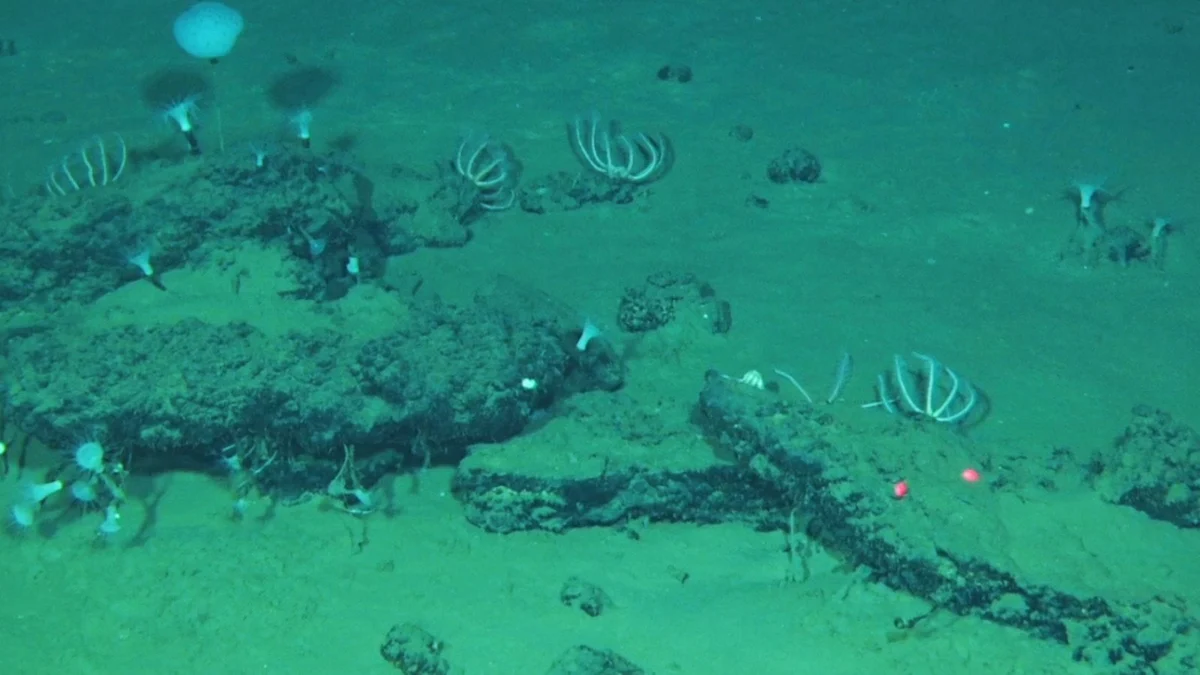
In a landmark discovery that reshapes our understanding of the deep-ocean floor, an international team of researchers led by the Chinese Academy of Sciences (CAS) has identified the most extensive and deepest accumulation of whale fossils and active "whale-fall" ecosystems ever recorded. Located in the southeastern Indian Ocean, specifically within the rugged terrain of the Diamantina Fracture Zone (DFZ), the site has been described as a "whale-fall community supercorridor"—a vast, 1,200-kilometer-long chain of habitats that has sustained specialized deep-sea life for over five million years.
The study, recently published in the prestigious journal Nature, details the identification of hundreds of fossilized remains and several active whale falls at depths previously thought to be largely inhospitable to such concentrated biodiversity. The discovery not only pushes the known boundaries of marine life but also provides a rare "fossil archive" that offers a window into the evolutionary history of cetaceans.
Main Facts: A Record-Breaking Deep-Sea Archive
The expedition, which utilized the state-of-the-art Chinese manned submersible Fendouzhe (Striver), has yielded data that far exceeds previous records in marine biology and paleontology. The primary findings of the study include:
- Extreme Depths: The researchers identified whale-fall sites at depths ranging from 4,200 meters to a staggering 7,002 meters. Prior to this discovery, the deepest recorded whale fall was located at 4,204 meters.
- The Deepest Active Ecosystem: Among the findings was an active whale-fall ecosystem at 6,789 meters—the deepest ever documented. This site serves as a thriving hub for specialized organisms that rely entirely on the nutrients provided by the decomposing carcass.
- Massive Fossil Density: The team documented 485 whale-fossil sites. Statistical modeling based on these findings suggests that more than 10 million whale carcasses could be distributed across the broader region.
- A New Species: Scientists formally identified a previously unknown extinct species of beaked whale, named Pterocetus diamantinae. This discovery adds a significant new branch to the evolutionary tree of deep-diving cetaceans.
- Ancient Origins: Isotopic dating of the remains indicates that the oldest fossils in the graveyard date back approximately 5.3 million years, to the Early Pliocene epoch.
Understanding the ‘Whale Fall’
A "whale fall" occurs when the carcass of a massive cetacean sinks to the bathyal or abyssal zones of the ocean floor. In the nutrient-poor environment of the deep sea, a single whale carcass provides a massive pulse of organic carbon, equivalent to thousands of years of typical "marine snow" (the rain of organic detritus from the surface). These falls create localized hotspots of biodiversity, supporting scavengers, opportunistic bone-eating worms, and chemotrophic bacteria that can thrive for decades on a single skeleton.
Chronology of the Discovery
The revelation of the Indian Ocean’s whale graveyard is the result of a multi-stage deep-sea exploration mission that combined advanced robotics with international expertise.
February – March 2023: The Initial Dives
The discovery began during a scheduled expedition of the Chinese submersible Fendouzhe in the southeastern Indian Ocean. Operated by the Institute of Deep-Sea Science and Engineering (IDSSE) under the Chinese Academy of Sciences, the Fendouzhe is designed to reach the deepest parts of the ocean, including the Challenger Deep. During the initial surveys of the Diamantina Fracture Zone, pilots and scientists noticed an unusual concentration of large biological remains and fossilized bones on the seabed.
April 2023: Mapping the Supercorridor
Recognizing the significance of the initial sightings, the team expanded their mission. Over the following month, researchers conducted 32 additional deep-sea dives. These dives focused on mapping the distribution of the remains along a 1,200-kilometer stretch of the seafloor. Using high-definition cameras and robotic sampling arms, the team collected sediment, bone fragments, and biological specimens from nearly 500 distinct sites.
2023 – 2024: Laboratory Analysis and Species Identification
Following the seafloor operations, the samples were transported to laboratories at the Chinese Academy of Sciences, the University of Pisa in Italy, and Earth Sciences New Zealand. Over the next year, researchers performed isotopic dating to determine the age of the fossils and conducted genetic analysis on tissues recovered from active whale falls. It was during this period that the extinct species Pterocetus diamantinae was identified and the Antarctic minke whale carcass was confirmed through ear-bone analysis.
Supporting Data: Biodiversity and Preservation
The study provides comprehensive data on the biological and geological factors that allowed this "supercorridor" to form and persist over millions of years.
The Biological Community
The researchers identified 35 distinct macrofaunal taxa (groups of organisms) inhabiting the active whale falls. These communities were dominated by:
- Worms and Nematodes: Including specialized bone-eating worms that use acid to dissolve whale bones and extract lipids.
- Crustaceans and Molluscs: Various species of deep-sea crabs and snails that act as scavengers.
- Cnidarians and Echinoderms: Brittle stars and anemones that colonize the periphery of the fall to catch nutrients drifting in the current.
The Guardian reported that many of these organisms are likely new to science, representing highly specialized species that have evolved to move between whale falls across the vast "supercorridor."
Exceptional Fossil Preservation
One of the most striking aspects of the Diamantina Fracture Zone is the pristine condition of the fossils. Researchers attribute this to three main factors:
- Low Sedimentation Rates: The slow accumulation of silt in the deep Indian Ocean prevented the fossils from being buried too quickly, allowing them to remain accessible on the seafloor.
- Mineral Coatings: Many bones were found to be coated in manganese and iron oxides, which acted as a protective shell against chemical erosion.
- Bone Density: The fossils largely belonged to beaked whales (family Ziphiidae), which possess exceptionally dense bone structures designed to withstand the crushing pressures of deep-sea diving.
Case Study: The Antarctic Minke Whale
The largest active whale fall documented was a five-meter-long Antarctic minke whale found at 5,610 meters. Genetic testing and the examination of the whale’s periotic (ear) bones confirmed the species. This find was particularly significant as it demonstrates how migratory species from the Southern Ocean contribute to the nutrient cycles of the deep Indian Ocean.
Official Responses and Scientific Commentary
The discovery has been met with acclaim from the global scientific community, with experts highlighting its implications for both paleontology and marine conservation.
In a commentary accompanying the study in Nature, Stephen J. Godfrey, a curator of paleontology at the Calvert Marine Museum, described the site as "a truly unique discovery." He noted that while whale falls have been studied since the late 1970s, the scale and depth of this site are unprecedented. "This provides a fossil record that is essentially laid out in a line on the seafloor, allowing us to track evolutionary changes in real-time across geological epochs," Godfrey stated.
The authors of the study, writing in Nature, emphasized that the findings "reshape the understanding of the limits and biogeography of whale-fall ecosystems." They argued that the Diamantina Fracture Zone serves as a "natural laboratory" for studying how life survives in the most extreme environments on Earth.
According to a report by the South China Morning Post, the Chinese Academy of Sciences views this discovery as a testament to the country’s growing capabilities in deep-sea research. The use of the Fendouzhe allowed researchers to spend extended periods at depths exceeding 6,000 meters, providing a level of detail that remote-operated vehicles (ROVs) often cannot match.
Implications: Why the Graveyard Exists
The discovery raises a fundamental question: Why is there such a massive concentration of whale remains in this specific part of the Indian Ocean? The researchers proposed a two-fold explanation involving whale physiology and seafloor topography.
The ‘Fatal Dive’ Hypothesis
The majority of the fossils belong to beaked whales, the world’s most accomplished deep-divers. These whales regularly dive to depths of 1,000 to 2,000 meters to hunt for squid. However, the researchers suggest that foraging at the extreme limits of their physiological range—potentially below 3,000 meters—may carry a high risk. The physical demands of these dives could lead to fatal exhaustion, nitrogen narcosis, or decompression sickness (the "bends") if the whale ascends too rapidly or stays down too long. This high-risk, high-reward foraging behavior likely leads to a higher natural mortality rate in the region.
The Topographic Funnel
The Diamantina Fracture Zone is characterized by deep, V-shaped trenches and steep ridges. The study suggests that these geological features act as a "funnel." When a whale dies and begins to sink, the underwater currents and the steep slopes of the fracture zone guide the carcasses toward the bottom of the trenches, concentrating them into a localized "graveyard" rather than allowing them to scatter across the flat abyssal plains.
Climate and Carbon Sequestration
Beyond biology, the discovery has implications for climate science. Whale falls represent a significant "carbon sink." When a whale dies, the carbon stored in its massive body is transported to the deep sea, where it can be sequestered for centuries. Understanding the frequency and distribution of these falls helps scientists more accurately calculate the ocean’s capacity to store carbon and mitigate the effects of climate change.
Conclusion
The discovery of the Indian Ocean’s whale-fall supercorridor is a landmark achievement in deep-sea exploration. It reveals a hidden world where death at the surface fuels a vibrant, ancient, and incredibly deep ecosystem. As scientists continue to analyze the samples from the Fendouzhe mission, they expect to uncover even more species unknown to science and further clarify the mysterious evolutionary path of the world’s largest mammals. The Diamantina Fracture Zone, once a dark and silent abyss, is now recognized as one of the most important biological archives on the planet.
