

BHUBANESWAR — In a landmark achievement for the fields of biomaterials and regenerative medicine, a multidisciplinary consortium of researchers has announced the development of a novel class of hyperbranched polymer scaffolds. These advanced materials, engineered to mimic the intricate signaling environment of the human body, represent a significant leap forward in treating complex wounds and promoting the simultaneous regeneration of skin cells and peripheral nerves.
The study, a collaborative effort involving the University of Calcutta, the National Institute of Science Education and Research (NISER) Bhubaneswar, KIIT Deemed to be University, and industrial partners including Lion Elastomers (USA) and the Hari Shankar Singhania Elastomer and Tyre Research Institute, addresses one of the most persistent challenges in tissue engineering: the restoration of functional communication between diverse cell types.
Main Facts: A New Frontier in Bio-Instructive Materials
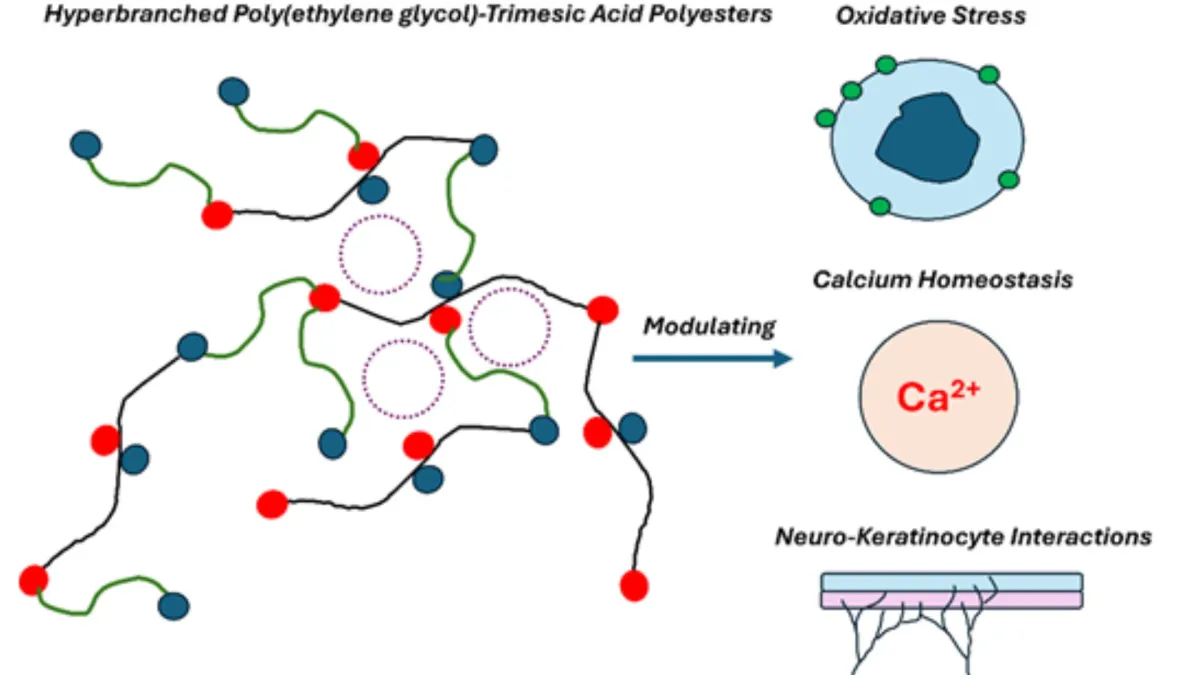
The core of this breakthrough lies in the synthesis of customizable hyperbranched poly(ethylene glycol)–trimesic acid (PEG-TMA) polyesters. Unlike traditional synthetic scaffolds that provide mere structural support, these PEG-TMA polyesters are "bio-instructive." They are designed to actively modulate the cellular microenvironment, specifically targeting oxidative stress and calcium homeostasis—two critical factors that dictate whether a wound heals or remains chronic.
The Biological Challenge
Human skin is not merely a protective barrier; it is a sensory organ densely packed with peripheral nerve endings. For a wound to heal functionally, keratinocytes (the primary cells of the epidermis) must interact seamlessly with these nerve endings. This neuro-keratinocyte communication is vital for sensation, thermoregulation, and the coordinated repair of tissue. Historically, creating a synthetic material that supports both the rigid requirements of skin cells and the delicate, elongated structures of neurons has been an elusive goal.

The Innovation: Hyperbranched Architecture
The research team utilized poly(ethylene glycol) (PEG) as a flexible molecular backbone and trimesic acid (TMA) as a trifunctional monomer to induce "hyperbranching." This chemical architecture creates a dense, three-dimensional network of functional end groups. By adjusting the ratio of PEG to TMA, the researchers can "dial in" specific physical and chemical properties, ranging from soluble, branched components to insoluble, highly crosslinked structures.
Chronology: From Chemical Synthesis to Cellular Synchrony
The development of these scaffolds did not happen in isolation but is the result of a systematic, multi-year research trajectory.
- Initial Synthesis and Safety Validation: Earlier phases of the research focused primarily on the fundamental chemistry of PEG-TMA polyesters. During this stage, the team validated the basic biocompatibility of the materials, ensuring they were non-toxic to human cells and analyzing their surface textures through basic microscopy.
- Structural Customization: The researchers then moved to create a library of five distinct formulations, labeled S1 through S5. By systematically varying the molar ratio of PEG to TMA from 1:0.5 to 1:5, they observed how the material’s porosity, rigidity, and solubility changed.
- The Shift to Cellular Signaling: The most recent breakthrough—and the focus of the current announcement—involved moving beyond physical structure to examine how these materials influence internal cellular "crosstalk." The team investigated how the scaffolds affected mitochondrial health, reactive oxygen species (ROS) production, and calcium ion signaling.
- Co-Culture Success: The final stage of the study involved testing the scaffolds in a complex co-culture environment, simulating the interaction between skin cells and neurons, which led to the identification of the S5 formulation as a superior candidate for clinical application.
Supporting Data: Analyzing the S1–S5 Formulations
The research team’s findings highlight how minute changes in chemical composition lead to vastly different biological outcomes. The five formulations (S1–S5) provided a spectrum of environments for cellular growth.
The Equilibrium of S3 (1:2 Ratio)
The S3 formulation, characterized by a 1:2 PEG:TMA ratio, was found to offer an "optimal equilibrium" for initial cell attachment.

- Physicality: It featured a balanced architecture that allowed for efficient nutrient diffusion.
- Mitochondrial Hyperactivation: Interestingly, S3 induced high levels of mitochondrial membrane potential and mitochondrial ROS. While excessive ROS can be damaging, the researchers noted that in this specific context, the ROS acted as a signaling mechanism that "hyperactivated" cells, leading to robust early-stage adhesion to the scaffold.
The Superiority of S5 (1:5 Ratio) for Complex Repair
While S3 was effective for initial attachment, the S5 formulation (1:5 ratio) emerged as the gold standard for long-term tissue regeneration and nerve integration.
- Chemical Markers: Despite having lower porosity and a denser crosslinked network, S5 possessed a high density of surface carboxyl groups. These groups acted as chemical "anchors" for neurites—the projections of developing neurons.
- Oxidative Stress Mitigation: S5 demonstrated a remarkable ability to lower both intracellular and mitochondrial ROS, creating a "calm" environment conducive to long-term cell viability.
- Calcium Homeostasis: Perhaps the most significant finding was S5’s ability to stabilize basal cytosolic calcium concentrations. Calcium is the primary "messenger" for mechanotransduction (how cells sense physical pressure) and cell-to-cell communication. By stabilizing these levels, the S5 scaffold helps synchronize the behavior of keratinocytes and neurons, effectively acting as a smart platform for tissue harmony.
Official Responses: A Multidisciplinary Triumph
Lead researchers from the participating institutions have emphasized that this study represents a paradigm shift in how we view "bandages" or "grafts."
"We are moving away from the era of passive biomaterials," stated a representative from the research collective. "Our work demonstrates that we can engineer the chemistry of a scaffold to intervene in the very biological pathways that govern repair. By controlling the PEG:TMA ratio, we can tailor a scaffold to the specific needs of a patient’s injury, whether it is a superficial burn or a deep tissue wound involving nerve damage."
Representatives from the National Institute of Science Education and Research (NISER), Bhubaneswar, highlighted the importance of the interdisciplinary nature of the project. "This success was only possible by bridging the gap between polymer chemistry, cell biology, and materials science. The ability to observe real-time calcium signaling on a synthetic polyester surface is a testament to the sophisticated analytical tools and collaborative spirit of this consortium."

Industrial partners from Lion Elastomers and the Hari Shankar Singhania Elastomer and Tyre Research Institute also noted the scalability of the technology. The synthesis of PEG-TMA polyesters is relatively straightforward and uses established chemical processes, making the potential for mass production and clinical adoption highly feasible.
Implications: Addressing a Growing Global Health Crisis
The development of hyperbranched PEG-TMA scaffolds arrives at a critical juncture for global healthcare. The implications of this research extend far beyond the laboratory, offering potential solutions for several pressing medical challenges.
1. Chronic Wound Management
As the global population ages, the prevalence of chronic, non-healing wounds—such as diabetic foot ulcers and venous leg ulcers—is skyrocketing. These wounds are often characterized by high oxidative stress and failed cellular communication. The S5 formulation’s ability to mitigate ROS and stabilize calcium signaling offers a direct therapeutic intervention that could prevent amputations and improve quality of life for millions.
2. Severe Burns and Skin Grafting
Traditional skin grafts often fail to restore full sensation to burn victims because the underlying nerve endings do not integrate with the new tissue. The "neurite anchorage" provided by the high carboxyl density in these new scaffolds could lead to the development of bio-engineered skin that not only covers the wound but restores the patient’s sense of touch.

3. Nerve Regeneration and Grafting
Peripheral nerve injuries are notoriously difficult to treat, often resulting in permanent loss of motor function or chronic pain. The ability of the S5 scaffold to support neurite outgrowth suggests it could be used as a "conduit" to guide regrowing nerves across gaps caused by trauma.
4. Precision Regenerative Medicine
The "tunable" nature of these polyesters paves the way for personalized medicine. In the future, a surgeon could potentially select a specific PEG:TMA ratio based on a patient’s specific biomarker profile—choosing a scaffold that either boosts initial cell activity (like S3) or provides a stabilized, low-stress environment for complex nerve integration (like S5).
Conclusion
The research conducted by this multidisciplinary team in Bhubaneswar and beyond marks a milestone in the evolution of tissue engineering. By shifting the focus from structural mimicry to biochemical synchronization, they have provided a blueprint for the next generation of regenerative therapies. As these hyperbranched polymer scaffolds move toward clinical trials, they carry the promise of faster recovery times, better functional outcomes, and a new lease on life for patients suffering from the most challenging tissue injuries.
