

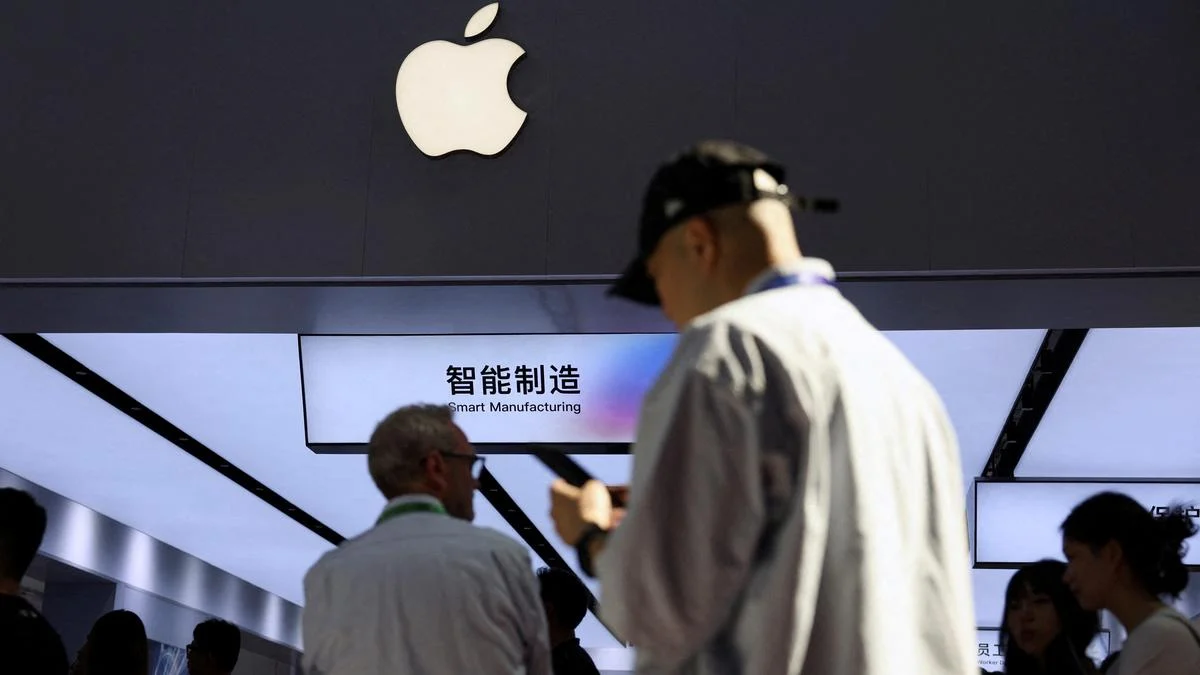
SHANGHAI/CUPERTINO – August 14, 2026 – In a significant strategic pivot, Apple has reportedly developed and trained its own large language model (LLM) specifically tailored for the highly regulated Chinese market. This unprecedented move, confirmed by three individuals familiar with the matter, marks a substantial departure from the iPhone maker’s established strategy of relying exclusively on third-party models to power its artificial intelligence features within the People’s Republic. The development of this proprietary model is understood to have been undertaken in close partnership with Alibaba Group, benefiting from the Chinese tech giant’s extensive support and local expertise.
This revelation, previously unreported, casts new light on Apple’s ambitious plans to deploy its comprehensive suite of AI tools, Apple Intelligence, in China. Unlike its home market where Apple integrates its own on-device AI with leading U.S. models such as OpenAI’s ChatGPT and Anthropic’s Claude, such foreign models are either restricted or outright unavailable in China. The decision to invest in a China-specific LLM underscores Apple’s determination to reclaim market share and navigate the country’s unique regulatory and competitive landscape.
A Strategic Pivot for Apple in China
Apple’s foray into developing its own large language model for the Chinese market represents a critical strategic recalibration. For years, the Cupertino giant has sought to adapt its global products and services to local Chinese preferences and regulatory mandates, often partnering with domestic firms. However, the burgeoning field of generative AI, with its profound implications for data sovereignty, content control, and national security, has presented Apple with its most complex challenge yet.
Beyond Third-Party Reliance
Globally, Apple Intelligence is designed to seamlessly integrate on-device processing with advanced cloud-based capabilities, drawing power from partnerships with generative AI leaders like OpenAI. This hybrid approach aims to deliver a powerful, private, and personalized AI experience. In China, however, the regulatory environment for generative AI is among the world’s strictest, rendering foreign-developed models largely inaccessible or unviable for mass deployment. Previously, Apple had reportedly leaned on agreements with Chinese partners, primarily Alibaba’s Qwen and potentially Baidu’s ERNIE, to bridge this gap. These collaborations were intended to provide the necessary generative AI backbone for iPhones and other Apple devices sold in China, ensuring compliance with local content and data regulations.
The news that Apple has now trained its own China-specific model, albeit with Alibaba’s assistance, signals a deeper commitment and a desire for greater autonomy over the AI experience it offers. This move suggests that Apple views a proprietary LLM as essential for achieving the level of integration, performance, and brand consistency it demands, even in a market as challenging as China. It allows Apple to design the core AI functionalities from the ground up, tailored specifically to the linguistic nuances, cultural contexts, and regulatory frameworks prevalent in mainland China.
The Alibaba Alliance
The partnership with Alibaba Group in training this new China-specific LLM is particularly noteworthy. While Apple has a long history of working with Chinese suppliers and partners, a collaboration of this depth on core AI technology points to a mutual strategic benefit. Alibaba, a pioneer in China’s cloud computing and AI sectors, brings invaluable resources to the table: vast computational infrastructure, extensive data sets relevant to the Chinese language and culture, and deep expertise in navigating local regulations.
For Apple, Alibaba’s support likely accelerated the training process and ensured the model’s adherence to local standards from its inception. For Alibaba, this collaboration solidifies its position as a critical enabler for global tech giants seeking to enter or expand in the Chinese AI market, potentially opening doors for further technological partnerships. It also provides a significant validation of its AI capabilities against a backdrop of intense domestic competition. The nature of this "support" could range from providing cloud computing resources and localized data for training to offering engineering expertise and guidance on regulatory compliance.
Navigating China’s Complex AI Regulatory Landscape
China’s approach to artificial intelligence regulation is comprehensive and rigorously enforced, reflecting the government’s dual objectives of fostering domestic innovation while maintaining strict control over information and data. For any foreign entity operating in this space, understanding and complying with these regulations is paramount.
Beijing’s Stringent Controls
The Cyberspace Administration of China (CAC) stands at the forefront of the country’s internet and AI governance. Its regulations for generative AI services, implemented in 2023, mandate stringent requirements including content censorship, algorithm registration, data localization, and security assessments. These rules effectively create a "walled garden" for AI development and deployment, making it exceedingly difficult for foreign models not explicitly approved by Beijing to operate. Services like OpenAI’s ChatGPT, which generate text and images that may not align with state narratives, are either blocked or face insurmountable hurdles for official release. This regulatory environment is precisely why Apple could not simply port its global AI strategy to China.
A Landmark Approval
Against this backdrop, the recent registration of Apple’s generative AI service by the CAC last month is a monumental achievement. This approval paved the way for Apple Intelligence to finally reach Chinese iPhones, iPads, and Macs. Crucially, the revelation that Apple has its own proprietary model, developed with Alibaba, means that this approval is not just for integrating a third-party Chinese model, but for deploying a service where Apple has a more direct hand in the core AI technology.
This makes Apple the first foreign company to receive Beijing’s approval to offer a proprietary AI model in China. Such an endorsement is not granted lightly and suggests a rare alignment between a major U.S. tech firm’s strategic objectives and Beijing’s regulatory comfort. It underscores the unique "dual-track strategy" Apple has adopted: leveraging its internal AI capabilities while partnering with a trusted local player to ensure regulatory adherence and cultural relevance. This precedent could have far-reaching implications, potentially influencing how other multinational tech companies approach AI deployment in China.
Chronology of a Landmark Collaboration
The path to Apple’s current AI strategy in China has been a multi-year endeavor, marked by early signals, strategic partnerships, and careful navigation of regulatory complexities.
Early Signals and Confirmations
The first public acknowledgment of Apple’s intention to integrate Chinese AI into its devices came in February 2025. During the World Governments Summit in Dubai, Alibaba Chairman Joe Tsai openly confirmed that Apple would be utilizing Alibaba’s AI to power its phones in China. Tsai stated, "They talked to a number of companies in China. In the end they chose to do business with us." At that time, the understanding was that Alibaba’s Qwen model would be directly incorporated into Apple devices. This initial confirmation highlighted Apple’s recognition of the necessity to partner with a local giant to meet China’s unique demands. However, the subsequent rollout of these features faced delays as Apple meticulously worked to adapt its planned AI features to the evolving Chinese regulatory landscape, ensuring full compliance before launch.
Evolving Partnerships and Registrations
As 2026 progressed, further details emerged regarding Apple’s multi-faceted approach. In July, Reuters reported that, in addition to Alibaba, Apple was also set to incorporate technology from Baidu, another leading Chinese AI firm known for its ERNIE Bot. This indicated a potentially complex integration strategy involving multiple domestic partners. The most significant milestone, however, occurred last month, when the Cyberspace Administration of China officially registered Apple’s generative AI service. This critical regulatory clearance removed a major hurdle, officially paving the way for Apple Intelligence to become available on compatible devices in China.
Just last week, Apple briefly published a Chinese-language guide on its official website. The guide detailed how eligible Mac users in mainland China could connect Alibaba’s Qwen model to their Siri digital assistant and Writing Tools feature. While the guide was swiftly deleted without explanation, its momentary appearance offered a tangible glimpse into the technical integration plan, particularly for Apple’s Mac ecosystem, where it aims to compete in the burgeoning AI PC market. The deletion might suggest ongoing refinements or a desire to control the narrative around its comprehensive AI strategy ahead of the official launch.
Anticipated Launch
With the regulatory approvals secured and the internal development of its China-specific model progressing, Apple Intelligence is now expected to launch in China in the coming months. This rollout will occur after a forthcoming update to its iOS operating system, bringing a new era of generative AI capabilities to millions of Chinese users. The full suite of Apple Intelligence features, adapted for the local market, is anticipated to enhance core functionalities across iPhones, iPads, Macs, and potentially even the Vision Pro, offering personalized, contextually aware, and private AI assistance.
The Battle for the Chinese Smartphone Market
China is not merely a critical manufacturing hub for Apple; it is a vital consumer market, accounting for a significant share of the company’s global revenue. However, recent years have seen Apple facing intensifying competition and market share erosion, particularly from aggressive domestic rivals.

Rising Domestic Rivals
The Chinese smartphone market is fiercely competitive, dominated by local players who have rapidly advanced their technological capabilities. Huawei, in particular, has staged a remarkable resurgence, leveraging its deep R&D in AI and chip design to launch a new generation of AI-equipped handsets. These devices have resonated strongly with Chinese consumers, offering sophisticated on-device AI assistants and features that rival or even surpass those available from foreign brands. Other local giants like Xiaomi, Oppo, and Vivo have also been investing heavily in AI, integrating advanced generative AI capabilities into their flagship devices, appealing to a tech-savvy consumer base.
The absence of comparable generative AI features on Chinese iPhones had been cited by analysts as a significant factor weighing on Apple’s sales performance. As domestic brands raced ahead with built-in AI assistants that offered unique local functionalities, many Chinese consumers gravitated towards these offerings, perceiving Apple’s devices as lagging in a crucial area of innovation. This market pressure has undoubtedly been a strong motivator for Apple’s accelerated AI strategy in the region.
Apple’s Competitive Edge
The development of a China-specific, proprietary AI model, combined with strategic partnerships, is designed to give Apple a crucial competitive edge. By having greater control over the AI experience, Apple can ensure deep integration with its hardware and software ecosystem, delivering a seamless and optimized user experience. This approach allows Apple to tailor AI functionalities to specific Chinese user behaviors, language nuances, and digital ecosystems, which differ significantly from Western markets. For instance, features related to local apps, payment systems, and content consumption can be more effectively integrated.
Furthermore, a tailored AI experience helps Apple address the demand for localized, sophisticated AI capabilities that resonate directly with Chinese consumers. It allows the company to compete head-on with Huawei and other domestic players, not just on hardware specifications, but on the intelligence and utility of its devices. This move could revitalize Apple’s brand appeal in China, positioning its products as premium devices that not only offer world-class design and performance but also cutting-edge, culturally relevant AI.
A "Dual-Track Strategy" and its Complexities
Apple’s approach to AI in China can best be described as a unique "dual-track strategy," blending proprietary development with strategic third-party integrations. This complex deployment model is a testament to the intricate challenges of operating in the Chinese tech landscape.
The Interplay of Models
The exact interplay between Apple’s newly revealed self-trained model and the previously reported integrations of Alibaba’s Qwen and potentially Baidu’s ERNIE remains a subject of considerable speculation. One plausible scenario suggests a hybrid architecture. Apple’s proprietary model could handle core, privacy-sensitive on-device tasks, leveraging its efficient neural engines to process user requests locally whenever possible. This aligns with Apple’s global emphasis on user privacy and on-device intelligence.
For more complex or general generative AI queries that require extensive cloud-based processing, Apple could then route these requests to Alibaba’s Qwen or Baidu’s ERNIE, depending on the specific task and context. This would allow Apple to tap into the vast knowledge bases and continuous learning of these leading Chinese LLMs, while ensuring regulatory compliance for cloud-based data processing. The brief appearance of the Mac guide for connecting Qwen to Siri and Writing Tools suggests such a modular or layered approach, where users might have options to utilize different models for different functionalities or preferences. This multi-model strategy could also provide redundancy and flexibility, allowing Apple to adapt to future regulatory changes or technological advancements from its partners.
Implications for Data and Content
This dual-track strategy is not merely about technological optimization; it is profoundly about regulatory compliance. By training its own model with Alibaba’s support and potentially integrating other local LLMs, Apple can more effectively ensure that all AI-generated content and responses adhere to Chinese internet regulations, including content censorship directives. This approach mitigates the risk of non-compliant outputs that could lead to service disruptions or penalties.
Furthermore, the involvement of local partners in the training and operation of these models helps Apple navigate data localization requirements. Data generated and processed by these AI services can be stored and managed within China, satisfying national security and data sovereignty mandates. This careful architectural design is crucial for gaining and maintaining the trust of Chinese regulators, thereby ensuring the long-term viability of Apple’s AI services in the country.
Geopolitical and Economic Ramifications
Apple’s latest move in China transcends mere business strategy; it carries significant geopolitical and economic implications, particularly amidst ongoing U.S.-China trade and technological tensions.
A Rare U.S.-China Tech Rapprochement?
The collaboration between Apple and Alibaba on such a sensitive and strategic technology as generative AI stands out as a rare instance of deep technological cooperation amidst a widening trade and diplomatic rift between the U.S. and China. For years, the two economic superpowers have been engaged in a technology race, particularly in advanced fields like AI and semiconductors, often marked by restrictions, sanctions, and nationalistic rhetoric.
This partnership could be viewed as a pragmatic necessity for both sides. For Apple, it’s about accessing and thriving in a critical market. For China, it demonstrates a willingness to engage with leading foreign tech companies that are prepared to adhere to its unique regulatory framework, potentially showcasing a more nuanced approach to technology governance than often perceived. Whether this collaboration signifies a broader trend towards selective rapprochement in the tech sector, or remains an isolated case driven by specific market dynamics, will be closely watched by analysts and policymakers worldwide. It could, however, set a precedent for other multinational corporations seeking to deploy advanced AI solutions in China.
China’s Critical Role for Apple
Despite the challenges, China remains an indispensable market for Apple. It is not just a major consumer base but also a significant part of its global supply chain. The continued success of Apple in China directly impacts its overall financial performance and global market standing. The absence of competitive AI features on its devices had been contributing to declining sales, making this AI initiative not just an innovation push, but an imperative for business continuity and growth. Reinvigorating its presence in China with cutting-edge, localized AI capabilities is crucial for Apple to maintain its revenue streams and global leadership.
Market Reaction and Future Outlook
The market’s immediate reaction to the initial reports of Apple’s generative AI registration in China was positive, with Alibaba’s U.S.-listed shares climbing by approximately 4% in premarket trading. This surge underscores investor expectations that the tie-up could indeed reshape China’s burgeoning AI ecosystem, benefiting both Apple and its Chinese partners. Investors are betting that a successful rollout of Apple Intelligence, empowered by this unique dual-track strategy, could significantly boost iPhone sales and solidify Apple’s position in one of the world’s most dynamic and competitive tech markets. The long-term impact on global AI development, potentially leading to more localized and culturally adapted AI models across different regions, will be a fascinating area to observe.
Conclusion
Apple’s decision to train its own China-specific large language model, in close partnership with Alibaba, marks a watershed moment in its global strategy and in the broader U.S.-China tech relationship. It is a bold, pragmatic, and complex maneuver designed to navigate the intricate web of regulatory demands, intense domestic competition, and unique consumer preferences within China. By embracing a dual-track strategy that combines proprietary innovation with robust local partnerships, Apple aims to deliver a compelling, compliant, and deeply integrated AI experience to millions of users in its most challenging yet critical overseas market. As Apple Intelligence prepares for its highly anticipated launch in the coming months, the success of this unprecedented approach will not only shape Apple’s future in China but could also offer a blueprint for global tech firms seeking to thrive in fragmented and highly regulated digital landscapes.
Published – August 14, 2026 10:30 am IST
