

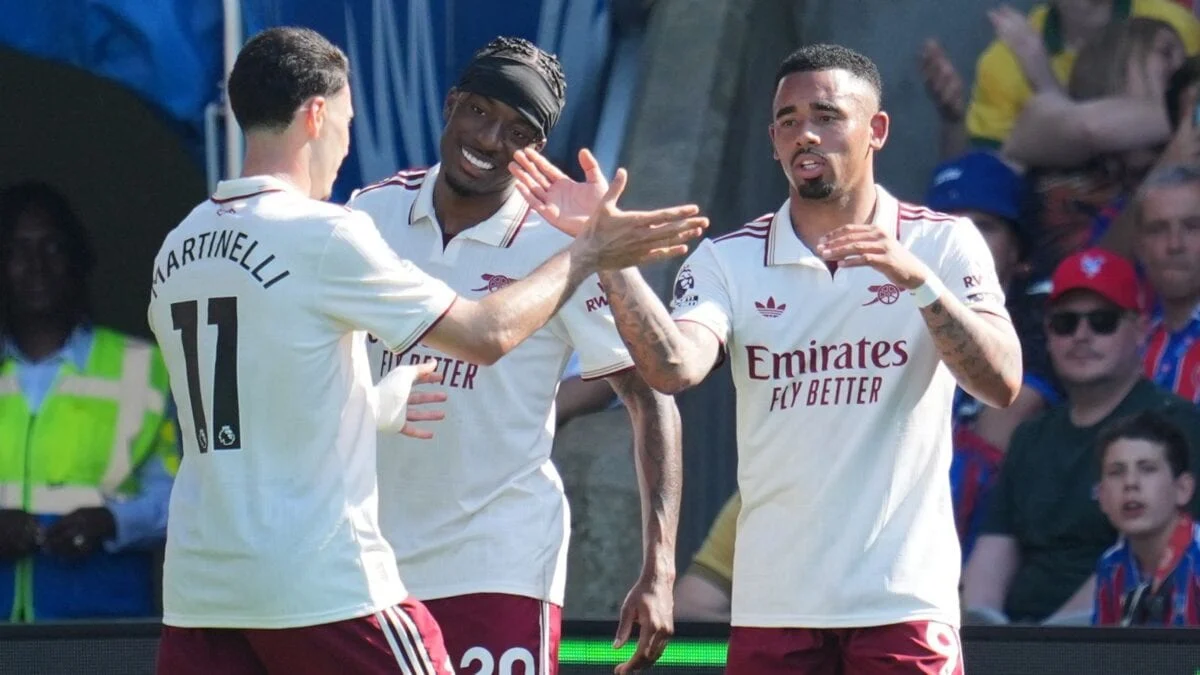
London, United Kingdom – May 24, 2026 – A seismic shift reverberated through English football tonight as Arsenal Football Club ended a torturous 22-year wait, lifting the Premier League trophy to reclaim their status as champions of England. Under the astute guidance of manager Mikel Arteta, the Gunners bookended a truly unforgettable season with a hard-fought 2-1 victory over London rivals Crystal Palace at a jubilant Emirates Stadium. The coronation marked the culmination of years of rebuilding, tactical evolution, and unwavering belief from a squad that has finally delivered on its immense promise.
While North London celebrated wildly, a different kind of drama unfolded at the other end of the capital. Tottenham Hotspur, Arsenal’s fiercest rivals, narrowly avoided the ignominy of relegation to the Championship, securing their Premier League survival with a tense 1-0 win against Everton. Their victory rendered West Ham United’s 2-0 triumph over Leeds United ultimately futile in their desperate bid to avoid the drop, highlighting the cut-throat nature of the league’s final day.
The season also witnessed a significant farewell as Pep Guardiola, widely regarded as one of the greatest managers of all time, bid adieu to English football. His Manchester City side, dethroned by Arsenal, suffered a 1-2 defeat at the hands of Unai Emery’s impressive Aston Villa, a fittingly unpredictable end to an era of unparalleled dominance for the Catalan tactician.
A Historic Triumph: Main Facts of Arsenal’s Coronation
Arsenal’s ascent to the pinnacle of English football marks their first league title since the legendary "Invincibles" season of 2003-04. The 2-1 victory over Crystal Palace, secured by goals from Gabriel Jesus and a late winner from captain Martin Ødegaard, was merely a celebratory formality, as the Gunners had already mathematically clinched the title in the preceding week, pipping Manchester City in a gripping title race that went down to the wire. The final whistle at the Emirates unleashed an outpouring of emotion, a mix of relief, joy, and vindication for a fanbase that has endured much over two decades.
Mikel Arteta, a former Arsenal captain, has meticulously crafted this championship-winning squad, instilling a blend of tactical discipline, attacking flair, and an unyielding winning mentality. His vision, often questioned in earlier stages of his tenure, has now been unequivocally validated. The team’s triumph is built on a foundation of homegrown talent, astute transfer market acquisitions, and a cohesive unit that consistently performed at the highest level.
In other significant developments across the league, Manchester United secured a respectable third-place finish, overcoming a tumultuous start to their campaign. A resounding 3-0 away victory against Brighton & Hove Albion underscored their resurgence under interim manager Michael Carrick, who stepped in mid-season to steady the ship. United’s skipper, Bruno Fernandes, etched his name into Premier League folklore by registering an astounding 21st assist of the season, shattering the previous record held jointly by Gunners legend Thierry Henry and City maestro Kevin De Bruyne. Fernandes’ stellar individual campaign was further recognised with both the Football Writers’ Association (FWA) Player of the Year and the Premier League Player of the Season awards, a testament to his unparalleled creativity and influence.
The race for European qualification also concluded with compelling outcomes. Unai Emery’s Aston Villa, having defeated Pep Guardiola’s City on the final day, finished fourth, securing a coveted spot in the UEFA Champions League. They will be joined by Arne Slot’s Liverpool, who clinched fifth place despite a 1-1 draw with Brentford. Bournemouth and Sunderland defied expectations, finishing sixth and seventh respectively, thereby earning their berths in the UEFA Europa League. Brighton & Hove Albion, despite their heavy defeat to Manchester United, secured eighth place, guaranteeing them a spot in the UEFA Europa Conference League playoffs.
The relegation battle provided the most nail-biting drama. Tottenham Hotspur’s 1-0 win over Everton at Goodison Park, a result secured by a vital second-half goal, was just enough to keep them in the top flight. West Ham United’s 2-0 victory against Leeds United proved insufficient, as Spurs’ result meant the Hammers joined already relegated Wolves and Burnley in dropping to the Championship. Leeds, despite their defeat, finished 14th, safely above the relegation zone.
The season concluded with Brentford in ninth after their draw with Liverpool, followed by Chelsea in a disappointing tenth place after a 1-2 defeat to Sunderland. Fulham finished 11th, besting Newcastle United (12th), while Everton (13th) and Leeds (14th) completed the mid-table. Wolves and Burnley, whose relegation fate was sealed weeks ago, ended their Premier League campaigns with a 1-1 draw.
A Season of Destiny: Chronology of Arsenal’s Unforgettable Journey
The journey to Arsenal’s 2025-26 Premier League title was a meticulously planned and passionately executed campaign, a testament to Mikel Arteta’s long-term vision and the club’s unwavering commitment to his project.
Pre-Season Promise and Early Momentum:
Entering the season, expectations for Arsenal were cautiously optimistic. Following several seasons of incremental improvement, pundits tipped them for a strong challenge, perhaps a top-three finish, but few predicted outright championship glory. The summer transfer window saw strategic acquisitions, notably a dominant defensive midfielder and a versatile forward, complementing a core of existing talent like Bukayo Saka, Martin Ødegaard, and William Saliba.
Arsenal started the season with blistering form, quickly establishing themselves as genuine title contenders. A string of impressive victories, including a dominant opening-day win and crucial early away triumphs, immediately signaled their intent. The team’s high-pressing, fluid attacking style captivated fans and analysts alike, with Gabriel Jesus leading the line with newfound consistency and clinical finishing.
Navigating the Mid-Season Gauntlet:
The autumn months presented Arsenal with their first true tests. A challenging run of fixtures against traditional rivals saw them drop points, leading to familiar whispers of a potential ‘choke’. However, unlike previous seasons, this Arsenal side demonstrated remarkable resilience. Key victories, such as a dramatic comeback win against a resurgent Aston Villa and a hard-fought draw at Anfield, showcased a new mental fortitude. Injuries to key players, including a brief spell on the sidelines for Saka, tested the squad’s depth, but academy graduates and fringe players stepped up admirably, proving the strength in numbers Arteta had cultivated. The January transfer window saw minimal activity, a sign of the manager’s confidence in his existing squad.
The Intensifying Title Race with Manchester City:
The second half of the season transformed into a captivating two-horse race between Arsenal and Pep Guardiola’s Manchester City. The defending champions, initially slow out of the blocks, found their rhythm and began to relentlessly pursue Arsenal. The lead at the top of the table frequently exchanged hands, with each team responding to the other’s victories with their own displays of dominance. A pivotal moment came in late March when Arsenal secured a narrow 1-0 victory over City at the Emirates, a result that not only provided a crucial three points but also a significant psychological boost. The tactical battle between Arteta and Guardiola was lauded as a masterclass, with Arsenal demonstrating a defensive solidity often lacking in previous encounters.
The Business End: Clutch Performances and Coronation:
As the season entered its final stretch, the pressure was immense. Arsenal, however, seemed to thrive on it. A run of consecutive victories in April, including a crucial away win at Old Trafford against Manchester United, created a significant gap. The "mathematically won the league" moment arrived two weeks prior to the final day, after a commanding performance against a relegation-threatened side. The sheer relief and unbridled joy were palpable, even before the final whistle of that game.
The final day’s fixture against Crystal Palace became a celebratory lap of honour. The Emirates Stadium was awash in red and white, an atmosphere charged with emotion and anticipation. The 2-1 victory, though not strictly necessary for the title, was a fitting way to conclude a monumental season, allowing the players to lift the trophy in front of their adoring home support. The scene of Mikel Arteta, hoisted aloft by his players, with tears in his eyes, perfectly encapsulated the journey from doubt to ultimate triumph.
Statistical Dominance and Individual Brilliance
Arsenal’s Premier League title was not merely a result of good fortune but a testament to a season-long exhibition of statistical dominance and exceptional individual performances.
Arsenal’s Commanding Numbers:
The Gunners finished the season with an impressive record of 28 wins, 7 draws, and only 3 losses from their 38 league matches, accumulating a staggering 91 points. Their attacking prowess was evident in their goal tally of 89, making them the league’s highest scorers. Crucially, their defensive solidity was equally remarkable, conceding a league-low of just 32 goals. This robust defensive record, marshalled by the towering William Saliba and the ever-reliable Gabriel Magalhães, with Aaron Ramsdale enjoying a stellar season between the posts, was a cornerstone of their championship success. Bukayo Saka emerged as the team’s top scorer with 18 league goals, adding 12 assists, showcasing his evolution into a truly world-class winger. Captain Martin Ødegaard’s influence was equally profound, with 10 goals and 15 assists, his creative play and leadership central to Arsenal’s attacking fluency.
Bruno Fernandes’ Record-Breaking Season:
While Arsenal celebrated their team triumph, Manchester United’s Bruno Fernandes etched his name into the annals of Premier League history with an individual campaign of extraordinary brilliance. His 21 assists surpassed the previous record of 20, jointly held by two legends of the game, Thierry Henry (2002-03) and Kevin De Bruyne (2019-20). This remarkable feat highlighted Fernandes’ unparalleled vision, passing range, and ability to consistently unlock opposition defences. Beyond his assists, Fernandes also contributed 12 goals, reaffirming his status as one of the league’s most complete and influential midfielders. His Football Writers’ Association Player of the Year and Premier League Player of the Season awards were richly deserved, acknowledging a season where he single-handedly dragged Manchester United back into contention for European places.
Other Notable Contributions:
Aston Villa’s impressive fourth-place finish was underpinned by a strong defensive record and the goal-scoring exploits of their talismanic striker, who netted 16 league goals. Liverpool, securing fifth, showcased their characteristic attacking verve, while the surprise packages of Bournemouth and Sunderland demonstrated remarkable consistency and tactical discipline to secure Europa League berths. Bournemouth’s midfield general and Sunderland’s prolific forward were particularly highlighted for their contributions, embodying the spirit of their overachieving teams. The season also saw a new record for total goals scored across the league, a testament to the attacking talent on display.
Voices of Triumph and Reflection
The final whistle at the Emirates Stadium unleashed an emotional torrent, captured vividly by the reactions of those central to Arsenal’s triumph and the wider football community.
Mikel Arteta, the Architect of Champions:
A visibly emotional Mikel Arteta, teary-eyed as he was embraced by his coaching staff and players, spoke with profound gratitude. "This is for our fans, for everyone who believed in us when many doubted," he began, his voice thick with emotion during his post-match interview. "It has been a long journey, full of challenges, but this group of players, this club, this community – we never stopped believing. The hard work, the sacrifices, the commitment… it has all been worth it. This is not just a trophy; it’s a testament to resilience, to unity, to what we can achieve when we are together. I am immensely proud to be the manager of this football club." Later, in the press conference, Arteta elaborated on his philosophy, crediting the club’s owners for their patience and the players for their unwavering dedication to his demanding tactical system.
Player Euphoria and Captain’s Pride:
Captain Martin Ødegaard, clutching the trophy, echoed his manager’s sentiments. "This feeling is indescribable," he beamed, surrounded by celebrating teammates. "Twenty-two years is a long time for a club like Arsenal. We knew the history, the pressure, but we played for each other, for the badge, for these incredible fans. Every single player contributed, every staff member, every person behind the scenes. This is a dream come true for all of us." Gabriel Jesus, whose early goal set the tone for the final day’s celebration, added, "To score in front of this crowd, on a day like this, is incredible. We fought all season, and now we are champions. It’s truly special." Bukayo Saka, a product of the Arsenal academy, spoke for many young players: "I grew up watching Arsenal, dreaming of this moment. To be a part of it, to deliver this for the fans, it’s the greatest feeling in the world. We’re just getting started."
Pep Guardiola’s Farewell:
In stark contrast to the jubilation at the Emirates, a reflective Pep Guardiola addressed the media after Manchester City’s defeat to Aston Villa, marking his final Premier League game. "It has been an incredible eight years in England," Guardiola stated, maintaining his characteristic calm. "I am immensely proud of what we achieved here at Manchester City. The players, the staff, the fans – they have given me everything. Today was not our day, and Arsenal deserve all the credit for a fantastic season. They were stronger, more consistent. It is time for a new challenge for me, but I will always carry Manchester City in my heart. The Premier League is an incredible competition, and I will miss it." His departure leaves a significant void, closing a chapter of unprecedented success for City.
Bruno Fernandes on his Record-Breaking Season:
Bruno Fernandes, modest despite his historic achievement, focused on team success. "Individual awards are always nice, but for me, it’s about helping the team," he commented after his 21st assist. "To break a record held by legends like Henry and De Bruyne is humbling, but my focus was always on Manchester United finishing as high as possible. We had a difficult start, but we showed great character to finish third. We must build on this for next season."
Tottenham’s Relief:
The mood at Tottenham Hotspur was one of immense relief. Their manager, whose position had been under intense scrutiny, acknowledged the difficulties. "This has been a very challenging season for everyone connected with the club," he admitted. "To secure our Premier League status is the bare minimum, but it’s a crucial step. We know we have a lot of work to do in the summer, but today, we can breathe a sigh of relief and start planning for a much better future." The fans, though relieved, were left with a clear message: significant improvements are required.
Rival Managers and Fan Reactions:
Congratulatory messages poured in from across the league. Jürgen Klopp of Liverpool praised Arsenal’s consistency, while Unai Emery of Aston Villa lauded their tactical prowess. Social media was ablaze with fan reactions, ranging from ecstatic Arsenal supporters celebrating the end of their long wait, to rival fans grudgingly acknowledging the Gunners’ achievement, and Tottenham fans expressing a mixture of relief and frustration at their own club’s struggles. The iconic "North London is Red" chant resonated globally.
The Dawn of a New Era? Implications for English Football
Arsenal’s championship victory and the other significant outcomes of the 2025-26 Premier League season carry profound implications, potentially reshaping the landscape of English football for years to come.
For Arsenal: A New Dynasty or a Solitary Peak?
For Arsenal, the immediate future is bright. Winning the Premier League not only ends a 22-year drought but also firmly re-establishes them among Europe’s elite. The challenge now is to consolidate this success. The UEFA Champions League campaign next season will be a true test of their capabilities against the continent’s best. Retaining key players like Saka, Ødegaard, and Saliba will be paramount, potentially requiring new lucrative contracts. The club’s transfer strategy will shift from acquiring talent to reinforcing a championship-winning squad, aiming for depth and quality to compete on multiple fronts. This title could signify the beginning of a new dynasty under Arteta, or it could be a solitary peak if they fail to build upon this momentum. The ‘banter club’ tag has been definitively shed, replaced by the aura of champions.
For Manchester City: Life After Pep and the Search for Identity:
Pep Guardiola’s departure marks the end of an era for Manchester City. His eight years yielded an unprecedented haul of trophies, fundamentally transforming the club. The immediate implication is the search for a new manager who can maintain City’s high standards and continue their philosophy. Speculation is rife regarding potential successors, with the new manager facing the daunting task of following a legend while simultaneously rejuvenating a squad that has now been dethroned. City’s financial might ensures they will remain formidable, but the psychological impact of losing their talismanic manager and the league title cannot be underestimated. A period of transition, however brief, seems inevitable.
For Manchester United: Building on Carrick’s Momentum:
Manchester United’s third-place finish and Bruno Fernandes’ record-breaking season provide a solid foundation for the future. Michael Carrick, having steered the club through a turbulent period, has a strong claim to the permanent managerial position. The implications for United involve building on the positive momentum, investing wisely in the transfer market to address squad weaknesses, and challenging more consistently for the title next season. Fernandes’ continued brilliance will be crucial, and ensuring he has adequate support around him will be a key task for the management.
European Qualifiers: New Ambitions and Challenges:
Aston Villa’s return to the Champions League under Unai Emery is a remarkable achievement, reflecting the manager’s European pedigree and astute transfer dealings. They will need to strengthen significantly to compete effectively on two fronts. Liverpool, in the Champions League, will look to reassert their dominance. Bournemouth and Sunderland’s qualification for the Europa League is a testament to their exceptional seasons and will bring new financial rewards and prestige, but also the challenge of balancing domestic and European commitments with smaller squads. Brighton’s Conference League playoff spot offers further European exposure, a significant step for the club.
For Tottenham Hotspur: A Wake-Up Call and a Crossroads:
Tottenham’s narrow escape from relegation is a stark warning. The implications are severe: a deep introspection into the club’s direction, managerial stability, and squad composition is urgently needed. This season has highlighted systemic issues that need addressing. A significant squad overhaul, potentially coupled with a change in management, seems inevitable if they are to avoid a repeat of this disastrous campaign. The fear of relegation will undoubtedly fuel a more aggressive approach to the summer transfer window.
Relegated Teams: The Championship Challenge:
For West Ham United, Wolves, and Burnley, the implication is a challenging season in the Championship. The financial impact of relegation is substantial, often leading to player sales and budget cuts. The goal for these clubs will be immediate promotion back to the Premier League, a notoriously difficult feat.
The Premier League Landscape: A Shift in Power?
Arsenal’s triumph, coupled with Guardiola’s departure, could signal a broader shift in the Premier League’s power dynamics. While Manchester City will undoubtedly remain competitive, the emergence of Arsenal and the resurgence of Manchester United suggest a more open and multi-faceted title race in the coming seasons. The league continues to be incredibly competitive from top to bottom, with the drama of European qualification and relegation battles reaching unprecedented levels. Bruno Fernandes’ new assist record sets a new benchmark for playmakers, inspiring a generation.
The 2025-26 Premier League season will be remembered as the year Arsenal finally ended their long wait, reclaiming their rightful place at the summit of English football, and as a season of dramatic twists, historic farewells, and individual brilliance that has once again underscored the league’s unparalleled appeal.
