

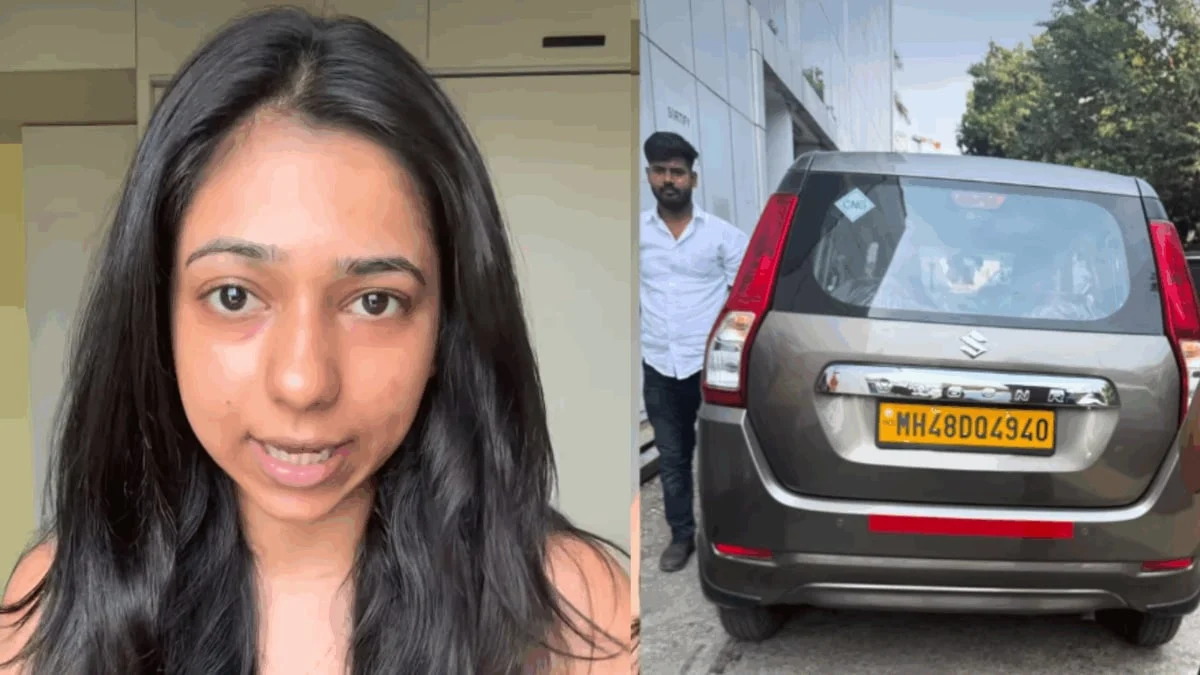
The victim, identified as Shivanii, a resident of Wadala (East) and a well-known digital creator, took to social media to recount the ordeal, which she claims involved physical battery, intimidation, and a chilling verbal threat: "Aur Ek Maar Ke Dikhaun Kya?" (Should I hit you again?).
The Chronology of the Dispute: From Mahalaxmi to Nerul
The incident traces back to the afternoon of April 22, 2026. Shivanii had booked an Uber cab for a cross-city journey from Mahalaxmi in South Mumbai to Nerul in Navi Mumbai—a distance of approximately 30 kilometers that often involves navigating heavy traffic and multiple toll points.
According to Shivanii’s detailed account, the initial fare estimated by the Uber application at the time of booking was ₹460. However, upon reaching her destination at approximately 4:00 PM, the application updated the final fare to ₹501. This adjustment is common in ride-hailing apps, often accounting for real-time traffic delays or slight route deviations. Shivanii proceeded to pay the revised amount of ₹501 through the app’s digital payment interface.
The conflict began the moment the transaction was completed. The driver, whose identity has been withheld by authorities pending further investigation, allegedly demanded an additional ₹40 in cash. He claimed this was to cover toll charges incurred during the trip. Shivanii, familiar with the platform’s interface, refused the demand, asserting that the "Final Fare" displayed on the app—which had already jumped from the estimate—was inclusive of all taxes and tolls, as per Uber’s standard operating procedure for most Mumbai routes.
Escalation and Alleged Physical Assault
The refusal to pay the extra cash reportedly triggered an aggressive response from the driver. According to the victim’s statement to the police and her social media followers, the driver blocked her from exiting the vehicle initially. When she managed to step out of the cab, the driver allegedly pursued her, closing the physical distance in a threatening manner.
Shivanii stated that the driver moved uncomfortably close to her face, prompting her to push him away in what she described as an act of self-defense. It was at this point that the situation turned violent. The driver allegedly retaliated by slapping the 21-year-old across the face and forcefully twisting her hand.
"What started as a disagreement over a relatively small amount of money quickly escalated into a serious safety concern," Shivanii noted in her post. The most haunting part of the encounter, she claims, was the driver’s lack of remorse. Even as she reeled from the assault, he allegedly taunted her, asking if she wanted to be struck a second time.
Intervention and Immediate Aftermath
The altercation occurred in a public space in Nerul, attracting the attention of bystanders and shopkeepers. Recognizing the volatility of the situation, several witnesses reportedly stepped in to mediate and prevent further violence. Shivanii also contacted her colleagues from her nearby workplace, who arrived shortly thereafter to provide support.
Despite the presence of witnesses and the victim’s colleagues, the driver reportedly maintained his aggressive stance, continuing to issue threats before eventually leaving the scene. The delay between the incident (April 22) and its public disclosure (last week) has been attributed by many to the time taken for the victim to process the trauma and for the initial police proceedings to commence.
Official Response: Police Action and Legal Framework
Following the incident, Shivanii approached the Nerul Police Station to lodge a formal complaint. The police have since registered a Non-Cognisable (NC) offence against the driver.
Under the Bharatiya Nyaya Sanhita (BNS)—the new criminal code that replaced the Indian Penal Code (IPC)—the driver has been booked under provisions relating to:
- Voluntarily causing hurt: Pertaining to the physical assault and twisting of the victim’s hand.
- Intentional insult with intent to provoke a breach of peace: Pertaining to the verbal abuse and threats issued during the confrontation.
In Indian law, a Non-Cognisable offence is one in which the police cannot arrest the accused without a warrant and cannot start an investigation without the permission of a court. This classification has often been a point of contention for activists who argue that physical assault against women in the transport sector should warrant more immediate, stringent action.
Supporting Data: The "Toll" Confusion in Ride-Hailing
This incident highlights a recurring systemic issue within the ride-hailing industry in India: the ambiguity of toll payments.
- Uber’s Policy: Generally, Uber’s algorithm is designed to include toll charges automatically in the final fare shown to the rider. However, there are exceptions, such as the "return toll" or specific state-entry taxes that may not always be captured accurately by the GPS.
- Driver Friction: Many drivers in the Mumbai Metropolitan Region (MMR) complain that the app’s toll reimbursement takes days to reflect in their earnings, leading them to demand cash from passengers to cover immediate out-of-pocket expenses at toll plazas like the Vashi Bridge or the Mumbai Trans Harbour Link (MTHL).
- Safety Statistics: According to various urban mobility reports, fare and toll disputes remain the leading cause of verbal and physical altercations between drivers and passengers in India, accounting for nearly 40% of reported "on-trip" conflicts.
Implications for Passenger Safety and Corporate Accountability
The assault on Shivanii raises critical questions about the vetting processes and safety protocols of aggregators like Uber. While Uber provides an "SOS" button and "Share Trip" features, these are often reactive measures that do little to prevent a physical assault once a passenger has exited the vehicle or when a driver turns violent in close quarters.
1. The "Digital Creator" Factor:
As a digital creator, Shivanii’s ability to amplify her story has brought significant attention to the case. However, experts point out that many women without a social media following often face even greater hurdles in getting the police to register an NC, let alone a First Information Report (FIR).
2. Gig Worker Stress and Training:
Industry analysts suggest that the increasing frequency of such incidents may be linked to the high-stress environment of gig work. Long hours, rising fuel costs, and diminishing commissions can create a "pressure cooker" environment. However, this context serves as an explanation for stress, never a justification for violence. The incident underscores a desperate need for mandatory de-escalation training for all commercial drivers.
3. The Legal Hurdle:
The registration of an NC rather than an FIR (First Information Report) often results in such cases hitting a dead end. For a digital creator or any citizen, the path to justice through the court system for an NC offence is long, expensive, and often yields little more than a warning for the perpetrator.
Conclusion: A Call for Systemic Reform
The case of Shivanii vs. the Uber driver is not merely a dispute over ₹40; it is a symptom of a fractured urban transport ecosystem. As Mumbai expands and relies more heavily on app-based transit, the safety of passengers—particularly women—cannot be left to the whims of an algorithm or the temperament of an unvetted driver.
For Uber, the challenge lies in moving beyond "thoughts and prayers" style corporate statements and implementing real-time intervention. For the Mumbai and Navi Mumbai police, the challenge is to treat "minor" disputes with the gravity they deserve before they escalate into life-threatening crimes.
As Shivanii’s story continues to circulate on social media, it serves as a grim reminder to commuters: in the modern city, the distance between a successful digital payment and a physical assault can be as narrow as a forty-rupee disagreement.
Disclaimer: The details in this report are based on the victim’s social media testimony and the police complaint filed at Nerul Police Station. The accused is presumed innocent until proven guilty in a court of law.
