

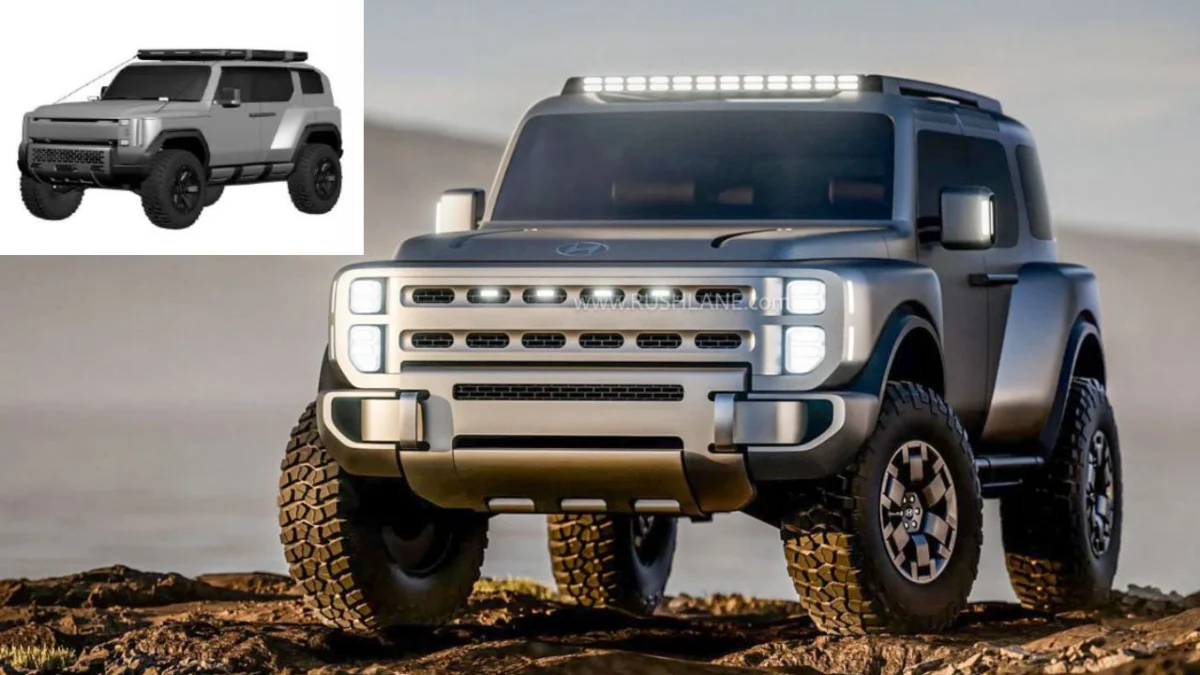
New Delhi, July 2026 – In a move that has sent ripples through the global automotive industry, Hyundai Motor Company has officially filed design patents in India for its highly anticipated Boulder SUV concept. This development follows the vehicle’s high-profile global debut at the New York International Auto Show in April 2026. As India solidifies its position as the world’s third-largest automotive market, the patenting of the Boulder concept highlights a strategic pivot by the South Korean giant to protect its intellectual property in high-growth regions, while simultaneously teasing a potential expansion into the hardcore off-road segment.
The Boulder, a radical departure from Hyundai’s current portfolio of sleek crossovers and urban EVs, represents the company’s first foray into the ladder-frame SUV market specifically designed to challenge established icons like the Jeep Wrangler, Ford Bronco, and Land Rover Defender.
Main Facts: A New Contender in the Off-Road Arena
The Hyundai Boulder is not merely a design study; it is a declaration of intent. Historically known for its dominance in the monocoque SUV segments—with bestsellers like the Creta, Tucson, and Palisade—Hyundai is now looking to capture the "lifestyle off-roader" demographic.
1. The Design Philosophy: "Art of Steel"
The Boulder concept introduces Hyundai’s new "Art of Steel" design language. Unlike the fluidic or "Sensuous Sportiness" themes of the past, this new direction emphasizes raw strength, industrial precision, and geometric rigidity. The patented design reveals a boxy, upright silhouette that prioritizes approach and departure angles, essential for serious off-roading.
2. Dual-Platform Strategy
The Boulder is designed to spawn two distinct body styles: a four-door SUV and a versatile pickup truck. While the pickup version is expected to lead the charge in the North American market to compete with the Ford Ranger and Toyota Tacoma, the SUV version—the one recently patented in India—is aimed at the global enthusiast community.
3. Patent Discrepancies: ICE vs. EV
Interestingly, the design patented in India differs slightly from the concept showcased in New York. The New York debut featured "safari windows" on the roof, auxiliary floodlights integrated into the roofline, and a wrap-around glass element at the rear. These features are notably absent in the Indian patent filings. Furthermore, the patented version features a completely closed-off front grille, leading industry experts to speculate that Hyundai is preparing both Internal Combustion Engine (ICE) and Battery Electric Vehicle (BEV) iterations of the Boulder.

Chronology: The Road to the Boulder
The journey of the Boulder from a boardroom sketch to a patented reality has been swift, reflecting the accelerating pace of Hyundai’s R&D.
- Late 2024 – Early 2025: Rumors begin to circulate regarding Hyundai’s interest in a ladder-frame chassis to rival the Ford Bronco. Internal projects are greenlit under the "Project Boulder" codename.
- April 2026: Hyundai shocks the New York International Auto Show by unveiling the Boulder Concept. It is presented as a rugged, go-anywhere vehicle designed for the "modern adventurer."
- May 2026: Hyundai leadership confirms that the Boulder will utilize a brand-new ladder-frame platform, a first for the brand’s passenger vehicle lineup in North America.
- July 2026: Design patents are filed with the Indian Controller General of Patents, Designs and Trade Marks. This move is seen as a protective measure for Hyundai’s design assets in a market where "lifestyle SUVs" (like the Mahindra Thar and Maruti Jimny) are witnessing unprecedented demand.
- 2027 – 2029 (Projected): Extensive testing is expected to take place across diverse terrains, including the Mojave Desert and the Australian Outback.
- 2030: The projected global commercial launch of the production-spec Hyundai Boulder.
Supporting Data: Engineering and Aesthetics
To compete with the likes of Jeep and Land Rover, Hyundai has integrated several high-tech and "neo-retro" features into the Boulder.
Technical Specifications and Exterior Features
The patented images highlight several key architectural choices:
- Chassis: A traditional body-on-frame (ladder-frame) construction, providing the torsional rigidity required for heavy rock crawling and towing.
- Lighting: Vertically stacked LED headlights and a signature "Pixel" LED light bar across the front, maintaining a familial link to the Ioniq series while looking significantly more rugged.
- Doors: The concept features "suicide doors" (rear-hinged rear doors), reminiscent of luxury vehicles but repurposed here to provide an unobstructed opening to the cabin—a feature highly prized by campers and overlanders.
- Wheel Arches: Massively flared arches designed to accommodate large Mud-Terrain (M/T) tires and long-travel suspension systems.
Interior Innovations
Inside, the Boulder merges utilitarianism with futuristic tech:
- Dashboard: A rugged, flat-top dash featuring four mini-displays that can be customized to show inclinometers, altimeters, GPS data, and vehicle vitals.
- Interface: A "Neo-Retro" steering wheel equipped with tactile rotary dials. Hyundai is intentionally moving away from pure touchscreens in this model, acknowledging that off-roaders require physical controls that can be operated while wearing gloves.
- HUD: A full-width Head-Up Display (HUD) that projects terrain data directly onto the lower portion of the windscreen, helping drivers navigate obstacles without looking down.
Official Context and Market Strategy
While Hyundai India has not officially confirmed the Boulder’s launch for the domestic market, the patent filing serves several strategic purposes.
Intellectual Property Protection
In the global automotive landscape, India has become a critical battleground for IP. By patenting the Boulder here, Hyundai ensures that domestic manufacturers cannot replicate the "Art of Steel" aesthetic or specific functional designs. This is a standard procedure for Global OEMs as they navigate the complexities of the Indian market.

The "Lifestyle SUV" Boom in India
The Indian market has seen a massive shift toward lifestyle 4x4s. The success of the Mahindra Thar, the launch of the 5-door Maruti Suzuki Jimny, and the persistence of the Force Gurkha prove that Indian consumers are willing to pay a premium for vehicles that offer "adventure readiness." If Hyundai were to bring the Boulder to India, it would likely sit as a flagship "Halo" product above the Tucson, catering to a niche but affluent enthusiast base.
Global Manufacturing Hub
There is also speculation that Hyundai might consider India as a peripheral manufacturing or assembly hub for the Boulder’s right-hand-drive (RHD) versions, given Hyundai’s massive manufacturing footprint in Chennai and its recent acquisition of the Talegaon plant.
Implications: What the Boulder Means for the Industry
The emergence of the Hyundai Boulder signifies a broader trend: the "ruggedization" of the global SUV market.
1. Challenging the American Hegemony
For decades, the ladder-frame off-road segment has been dominated by American and Japanese brands. Hyundai’s entry into this space suggests that the South Korean manufacturer believes it has reached a level of brand maturity where it can compete not just on value and features, but on mechanical "toughness" and heritage-style design.
2. The Electric Off-Road Frontier
The "closed grille" design seen in the Indian patent suggests that Hyundai is prioritizing an electric powertrain for the Boulder. An "E-Boulder" would compete directly with the upcoming Jeep Recon and the electric Mercedes-Benz G-Class (EQG). Electric motors provide instantaneous torque, which is an inherent advantage in off-road scenarios like rock crawling.
3. A Shift in Brand Perception
For years, Hyundai was the "safe" choice—reliable, well-equipped, and sensible. The Boulder is anything but sensible. It is a high-risk, high-reward project aimed at changing the brand’s perception from a manufacturer of urban commuters to a creator of lifestyle icons.

4. Impact on Competitors
The patenting of the Boulder will likely force competitors to accelerate their own updates. If Hyundai can offer the Boulder with its industry-leading 10-year warranty and superior infotainment tech, it could steal significant market share from the Ford Bronco and Jeep Wrangler, both of which have faced criticism regarding interior quality and long-term reliability.
Conclusion: A Glimpse into 2030
The Hyundai Boulder is more than just a concept; it is a roadmap for the brand’s future. By patenting the design in India, Hyundai is laying the groundwork for a decade that will be defined by versatility. Whether the Boulder arrives on Indian shores as a premium CBU (Completely Built Unit) or remains a protected design study, its presence in the patent office confirms one thing: Hyundai is no longer content with staying on the pavement.
As we move toward the projected 2030 launch, the industry will be watching closely to see if the production version retains the "Art of Steel" soul of the concept. For now, the Boulder stands as a bold reminder that in the world of automotive design, the next great adventure is always just over the horizon.
