

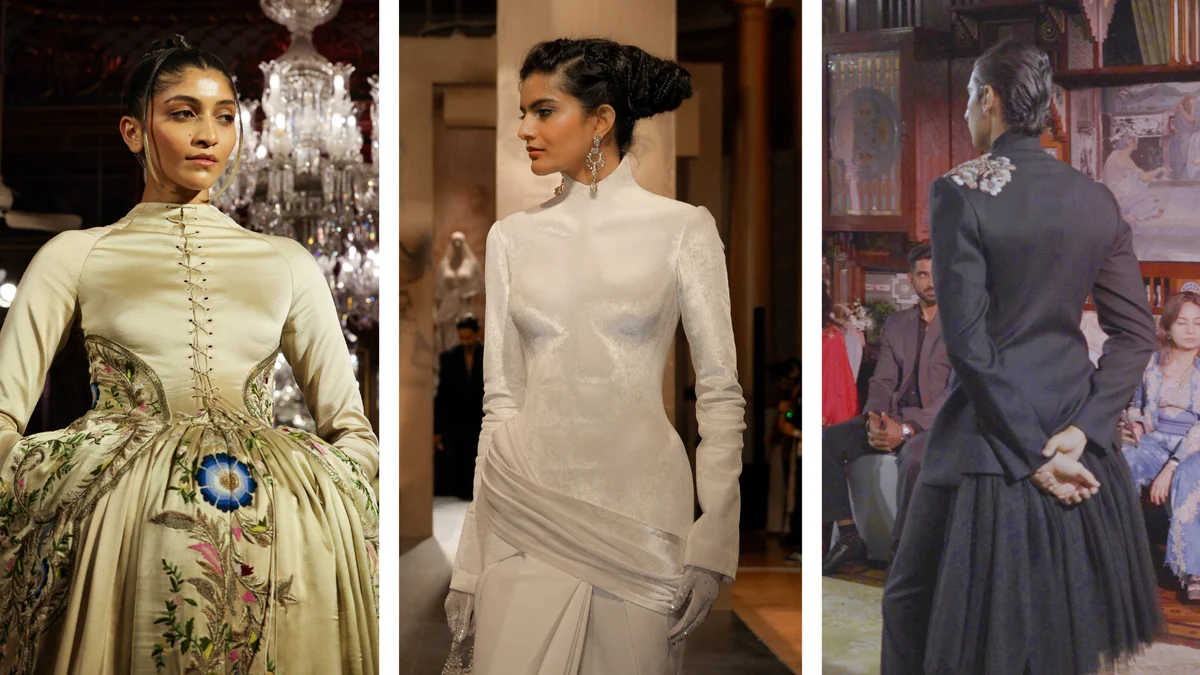
The fashion world, often a mirror reflecting societal shifts, is currently engaged in a profound dialogue about the human form. Recent showcases at the Hyundai India Couture Week have thrust the concept of silhouette manipulation to the forefront, with designers Anamika Khanna and Tarun Tahiliani presenting collections that boldly redefine the body through the art of couture. Far from merely adorning the existing form, these designers are actively constructing new ones, prompting a critical examination of beauty standards, gender fluidity, and the enduring power of fashion to sculpt identity.
Redefining the Form: Khanna’s "Moonlit Palace" and Tahiliani’s "Ang"
At the vanguard of this sartorial revolution is Anamika Khanna, whose collection "Moonlit Palace" opened this year’s Hyundai India Couture Week with a statement that was as audacious as it was thought-provoking. Khanna didn’t just present clothing; she presented a reimagined male physique, a man adorned in a sharply tailored jacket and trousers that were dramatically expanded at the posterior. This was not a subtle suggestion of form, but an emphatic, rounded, and deliberate augmentation of the body’s natural proportions. The effect, achieved through what Khanna described as "bustles, like how the Victorian bustles were created," fundamentally altered the wearer’s silhouette, adding inches of fabric to create a pronounced backside. "Sometimes you use boning, and where required, metal," she explained, hinting at the structural engineering involved. This provocative presentation, she suggested, was an invitation to "open Pandora’s box" of possibilities.

Following closely on Khanna’s heels, Tarun Tahiliani’s collection, "Ang," presented a conceptual exploration of the human form that delved even deeper into sculpted couture. Tahiliani’s intervention was more radical, involving the creation of sculpted abs, an emphatic hip, and a fuller torso. This collection served as a direct response to the prevailing anxieties surrounding the "ideal" body, offering an alternative to the pressure to conform to increasingly narrow physical standards. "Everyone’s become too thin, too fit," Tahiliani remarked. "You can be curvaceous, you can be Indian, you can have abs if you want." His approach involved individually sculpting forms from layers of foam, which were then meticulously dressed in luxurious materials like satin, lace, and even Kanjeevaram silk. The desired effect was "hard and soft, almost like marble or stone," as he described it, positioning himself as a "plastic surgeon through clothes."
A Legacy of Shaping: The Historical Context of Padding and Silhouette Manipulation
The bold gestures of Khanna and Tahiliani are not entirely novel; they tap into a rich and often complex history of silhouette manipulation in fashion. The practice of altering the perceived shape of the body through padding and structural garments has been a consistent element of sartorial evolution across centuries and cultures.

The Victorian Echo: Bustles and the Art of Augmentation
Khanna’s direct reference to Victorian bustles highlights a period where the female form was significantly reshaped to adhere to societal ideals of femininity and status. The bustle, evolving through various iterations in the 19th century, was designed to create a dramatic protrusion at the back, emphasizing the curve of the hips and derrière. These structures, often made of whalebone, steel, or horsehair, fundamentally altered a woman’s posture and movement, dictating a specific way of being in the world. Khanna’s appropriation of this technique for a male silhouette challenges traditional gendered expressions of form and introduces a new dimension to the concept of masculine presentation.
Post-War Abundance: Dior’s Bar Suit and the Return of Curves
The mid-20th century saw a significant shift in silhouette with Christian Dior’s iconic 1947 Bar Suit. Emerging from a period of wartime austerity and fabric rationing, the suit celebrated a return to opulent curves. The padded hip and full skirt were a visible manifestation of renewed abundance and femininity, a stark contrast to the utilitarian styles of the war years. The Metropolitan Museum of Art notes that the haircloth interlining in the original suit was crucial in shaping its contour, demonstrating the sophisticated techniques employed to achieve the desired form. This historical precedent underscores fashion’s ability to respond to socio-economic conditions and redefine desirable aesthetics.

Disrupting the Norm: Kawakubo’s "Lumps and Bumps"
In a more avant-garde approach, Japanese designer Rei Kawakubo, with her groundbreaking 1997 "Body Meets Dress, Dress Meets Body" collection, challenged the very notion of a flattering silhouette. Kawakubo deliberately padded the hip, rear, and belly into strange, lopsided forms, creating "lumps and bumps" that were designed to disrupt and question conventional beauty. The collection famously saw fashion magazines quietly removing the padding for their editorial shoots, a testament to the unsettling yet compelling nature of Kawakubo’s vision. This act of deconstruction and subversion highlights fashion’s potential to provoke and critique established norms.
Indian Traditions of Shaping: The Sari and the "Fake Bottom"
India, too, has its own history of silhouette manipulation, often intertwined with the draping of the sari. Actresses in the 1960s, like Sadhana and Asha Parekh, famously wore what were then known as "fake bottoms" under their saris. These were essentially padding devices designed to create a more voluptuous curve, allowing the sari to drape more elegantly over a fuller shape that the wearer’s body might not naturally possess. This practice reflects a long-standing understanding of how fabric interacts with form and the desire to achieve an aesthetically pleasing silhouette.

Manufacturing a Body: Tahiliani’s Sculptural Approach and Khanna’s Provisional Volume
Both Khanna and Tahiliani’s recent collections can be seen as an escalation of these historical practices, adapted for contemporary discourse. Tahiliani’s meticulous sculpting of foam, described as acting like a "plastic surgeon through clothes," allows for the precise construction of an idealized physique. His intention to alter the silhouette rather than demand bodily change from the wearer is a significant departure, offering a powerful commentary on the pressures of modern beauty standards. He observes, "We’ve always done it in history, with the bust and the farthingales that were in the West. Not so much in India, where the drape expects curves and usually finds them." Tahiliani’s work reintroduces the idea of sculpted curves, even suggesting a return to sensuality with the visible navel in some of his designs, which he calls "such a sexy thing."
Khanna’s approach, while equally impactful, offers a more provisional form of volume. Her use of bustles allows for the addition and subtraction of form, depending on the wearer and the occasion. This flexibility acknowledges the performative aspect of fashion and the diverse ways in which individuals choose to present themselves. She draws inspiration from bridal traditions, where increased volume can signify prominence, and from the broader Victorian silhouette, which historically dictated posture and movement. However, Khanna deliberately detaches the volume from prescribed posture, offering a more fluid and adaptable augmentation.

The Body Under Scrutiny: Societal Anxieties and Shifting Ideals
The prominence of these sculptural silhouettes emerges at a time when the human body is under intense public scrutiny. The pressures to conform to an ever-narrowing ideal of thinness, fitness, and specific facial features are palpable. The rise of "looksmaxxing" in online communities, which encourages extreme measures to enhance physical appearance, reflects a deep-seated societal anxiety about the body. This anxiety, once largely confined to women, is now increasingly affecting men as well, with brands offering padded vests to sculpt chests and biceps.
The cultural conversation around body image has been amplified by public figures like Ariana Grande, who has faced intense scrutiny over her perceived thinness, and Billie Eilish, who has spoken openly about her "toxic relationship" with her body and found solace in oversized clothing. These narratives highlight the emotional toll of constant judgment and the diverse ways individuals seek to reclaim agency over their bodies.

In this context, Khanna’s statement about Ozempic and the body conversation—"I’m letting it go. To each their own"—resonates deeply. Her focus on volume, rather than adherence to a particular body type, offers a refreshing perspective that prioritizes individual expression over prescribed ideals. She also touches upon the historical fluidity of gender presentation, referencing Kalighat paintings with their "sensuous without being afraid" figures and the opening look of her show featuring a model with a moustache, nodding to historical practices of gender play. "Right now, it’s acceptable. So why should I hide it?" she asks, embracing the blurring of boundaries and the bravery inherent in such explorations.
Implications for the Future of Fashion and Identity
The work of designers like Anamika Khanna and Tarun Tahiliani marks a pivotal moment in fashion. It signals a move away from merely dressing the existing body towards actively constructing and deconstructing it. This approach has profound implications for how we understand beauty, identity, and the very definition of the human form.

Firstly, it challenges the notion of a singular, universal ideal of beauty. By offering tools to sculpt and augment, designers empower individuals to create their own ideal, whether that involves enhancing curves, creating defined musculature, or embracing unexpected proportions. This shifts the focus from conformity to customization, allowing for a more diverse and inclusive understanding of aesthetics.
Secondly, these collections contribute to a broader discourse on gender fluidity and identity. Khanna’s playful subversion of masculine norms with her exaggerated bustle, and her nods to historical gender-bending practices, demonstrate how fashion can be a powerful tool for challenging rigid gender binaries. Similarly, Tahiliani’s sculpting of abs and torsos, irrespective of the wearer’s biological sex, opens up possibilities for a more fluid and self-defined expression of physicality.

Thirdly, the emphasis on construction and deconstruction within couture highlights the artistry and engineering involved in garment creation. The intricate use of padding, boning, and structural elements transforms clothing from mere fabric into architectural elements that shape and redefine the wearer. This elevates couture to a form of applied sculpture, where the body itself becomes the canvas.
Finally, these designers are offering an antidote to the anxieties surrounding body image. By providing an alternative to the relentless pursuit of an often unattainable ideal, they are empowering individuals to embrace their own unique forms, whether augmented or natural. The idea that one doesn’t need a "different body" but "different padding" offers a liberating perspective.

As fashion continues to evolve, the contributions of designers like Anamika Khanna and Tarun Tahiliani will undoubtedly be remembered as a crucial turning point. They have not only presented stunning collections but have also ignited a vital conversation about the body, beauty, and the boundless potential of couture to shape our perceptions of ourselves and the world around us. The future of fashion, it seems, lies not just in what we wear, but in how we choose to construct and celebrate the very forms that adorn us.
