

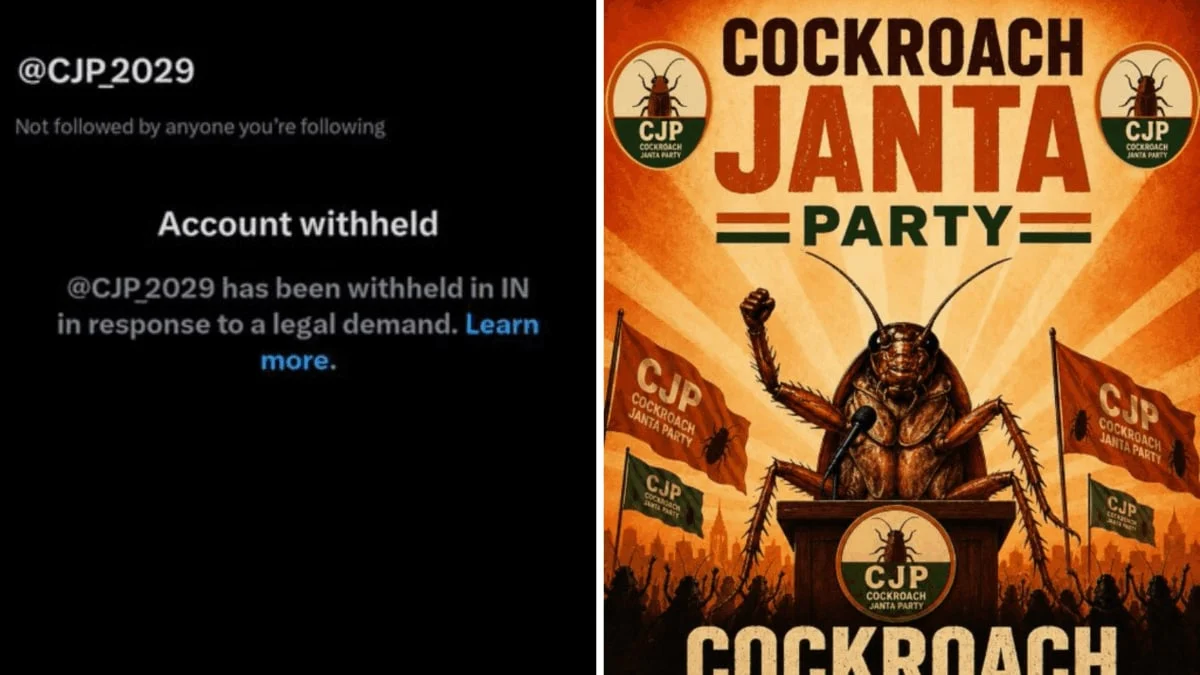
NEW DELHI, India – May 22, 2026 – In a move that has ignited fresh debate on digital freedom and political satire in India, the official X (formerly Twitter) account of the ‘Cockroach Janta Party’ (CJP), a burgeoning satirical political movement, was abruptly withheld in India on Thursday, May 21, 2026. The action came swiftly after the account amassed over 200,000 followers in a mere five days, demonstrating an unprecedented surge in online popularity, particularly among India’s tech-savvy Gen Z demographic. Party founder Abhijeet Dipke swiftly announced the creation of a new handle, underscoring the resilience of digital activism in the face of perceived censorship.
The withholding of the CJP’s primary X account, @CockroachJantaP, has thrust the nascent movement into the national spotlight, highlighting the volatile intersection of digital expression, political dissent, and content moderation in the world’s largest democracy. While the specific reasons for the action remain officially unstated by X or Indian authorities, the move is widely seen as a response to the party’s rapid growth and its provocative, albeit satirical, challenge to the political establishment. This incident not only marks a significant moment for the CJP but also serves as a potent case study on the evolving dynamics of online activism and governmental oversight in the digital age.
The Meteoric Rise and Sudden Halt: A Digital Phenomenon
The Cockroach Janta Party emerged as a powerful, albeit unexpected, voice of discontent, leveraging the pervasive influence of social media to articulate the frustrations of a significant segment of the Indian populace. Its journey from a meme to a major online movement has been nothing short of extraordinary, reflecting a deep-seated desire for alternative political expression.
From Satire to Sensation: The Genesis of CJP
The genesis of the Cockroach Janta Party is rooted in a moment of alleged judicial insensitivity that struck a nerve with millions. The movement originated as a satirical backlash to remarks reportedly made by Chief Justice of India Surya Kant during a recent court hearing. According to widespread online accounts, the CJI had referred to certain unemployed youths and social media activists as "cockroaches" and "parasites." These remarks, perceived as dismissive and derogatory by many, sparked immediate and widespread outrage across social media platforms.
What began as an expression of anger and disillusionment quickly coalesced into a potent, meme-driven protest campaign. The name "Cockroach Janta Party" itself is a defiant reclamation of the alleged slur, transforming a derogatory term into a symbol of collective identity and resistance. The party’s core appeal lies in its ability to tap into the simmering frustrations of young Indians grappling with pressing issues such as widespread unemployment, rampant examination paper leaks, increasingly polarising political rhetoric, and a perceived lack of institutional accountability. Through humour, sharp political commentary, and highly shareable content, the CJP created an accessible and engaging platform for expressing dissent, drawing in a demographic often feeling disenfranchised by traditional political structures.
The X Account’s Short-Lived Triumph
The CJP’s primary X account, launched on May 16, 2026, quickly became a focal point of its digital campaign. Its growth was nothing short of explosive. Within an astonishing five days, the account swelled from obscurity to garnering over 200,000 followers, a testament to its viral appeal and the resonance of its message. This rapid ascent placed it among the fastest-growing political handles in recent Indian social media history, attracting attention from both supporters and critics.
However, this triumph was short-lived. On May 21, 2026, party founder Abhijeet Dipke confirmed via his personal X account that the Cockroach Janta Party’s official handle had been "withheld in India." Dipke posted a screenshot of the account, clearly showing the message indicating the content was restricted within the country. In his announcement, he stated, "As expected, Cockroach Janta Party’s account has been withheld in India," adding, "Cockroach Janta Party’s account was started on 16th May. Within 4 days the account got banned because it got more than 200K following." While Dipke stated "within 4 days," the timeline from May 16 to May 21 actually spans five days, underscoring the swiftness of the platform’s action. The immediate aftermath saw Dipke announce the launch of a new X handle, signalling the movement’s unwavering determination to continue its digital presence despite the setback.
Chronology of a Viral Movement
The rapid trajectory of the Cockroach Janta Party, from its conceptualisation to its account being withheld, provides a compelling timeline of modern digital activism.
May 16, 2026: Birth of a Digital Rebellion
The seeds of the Cockroach Janta Party were sown around May 16, 2026, following the widespread dissemination of news regarding CJI Surya Kant’s alleged remarks. It was on this date that the official X account, along with other social media presences, was established. The initial posts were a blend of pointed satire, humorous memes, and direct calls to action, all framed around the "cockroach" identity. This strategic use of internet culture allowed the CJP to quickly penetrate the youth demographic, who are fluent in the language of memes and online virality. Early traction was observed as the unique name and relatable grievances resonated with a burgeoning online community.
May 16 – May 20, 2026: Unprecedented Growth
The period between May 16 and May 20 witnessed an exponential surge in the CJP’s following across various social media platforms. On X, the follower count skyrocketed, reaching over 200,000. Simultaneously, the movement found immense success on Instagram, where it reportedly garnered over 11 million followers in just five days, even surpassing established political parties like the BJP in terms of digital engagement. This explosive growth was fueled by relentless sharing, trending hashtags, and organic endorsements from numerous online influencers. The CJP’s manifesto, detailing its serious political demands despite its satirical facade, began to gain significant visibility, moving beyond mere meme-sharing to spark genuine discussion about its objectives. The mainstream media also started taking notice, with various outlets covering the phenomenon, further amplifying its reach.
May 21, 2026: The Withholding and Rebirth
The climax of this rapid ascent came on May 21, 2026. Abhijeet Dipke, the founder, announced that the primary X account of the Cockroach Janta Party had been withheld in India. This announcement, made via his personal handle, included a screenshot confirming the restriction. The news immediately sparked a wave of reactions, ranging from outrage among supporters who decried it as an attack on free speech, to discussions among political observers about the implications for online dissent. However, demonstrating the inherent resilience of digital movements, Dipke wasted no time. Within hours of the announcement, he declared the creation of a new X account, signaling the party’s intent to circumvent the restriction and continue its digital campaign. This swift pivot highlighted the adaptive nature of online activism, where platforms may be censored, but the underlying movement often finds new avenues to thrive.
Supporting Data and Underlying Grievances
The Cockroach Janta Party, despite its unconventional name and satirical approach, is more than just an internet joke. It represents a powerful convergence of digital culture and genuine socio-political grievances that resonate deeply with a large segment of India’s population.
Beyond the Memes: CJP’s Serious Agenda
While its viral spread has been largely attributed to its meme-friendly content and satirical tone, the CJP’s manifesto reveals a serious and reform-oriented agenda. Far from being a mere online prank, the party has articulated several concrete political demands that address systemic issues plaguing Indian society. These include:
- Barring former Chief Justices from accepting post-retirement Rajya Sabha positions: This demand targets concerns about judicial independence and the potential for conflicts of interest when former high-ranking judicial officials transition into political roles, particularly legislative ones. It reflects a desire to maintain the sanctity and impartiality of the judiciary.
- Increasing accountability of the Election Commission: The CJP calls for greater transparency and accountability from the Election Commission of India (ECI), a crucial body for upholding democratic processes. This demand likely stems from concerns about the fairness and conduct of elections, particularly in an era of heightened political polarisation.
- Ensuring 50 percent reservation for women in Parliament and ministerial posts: A bold and progressive demand, this highlights the CJP’s commitment to gender equality and equitable representation in India’s political landscape. It seeks to address the long-standing underrepresentation of women in decision-making roles.
- Introducing reforms related to media ownership and employment rights: These demands speak to broader concerns about media independence, the concentration of media ownership, and the rights of workers. In an age where media narratives significantly shape public opinion, ensuring diverse and independent media is seen as crucial. Similarly, advocating for employment rights directly tackles the anxieties of a workforce grappling with job insecurity and inadequate protections.
These demands illustrate that the CJP is not simply a fleeting online trend but a nascent movement with clear political objectives, challenging the status quo on multiple fronts.
The Youth Disenchantment Index
The explosive growth of the Cockroach Janta Party cannot be understood without acknowledging the profound disenchantment prevalent among India’s youth. India, with its vast young population, faces significant challenges in providing adequate employment opportunities. High unemployment rates, coupled with a series of high-profile examination paper leaks that undermine meritocracy and trust in public institutions, have created a fertile ground for frustration and anger.
"The CJP is a symptom, not just a cause," explains Dr. Priya Sharma, a sociologist specialising in digital activism at the University of Delhi. "It’s giving voice to a generation that feels unheard, unseen, and increasingly disillusioned by traditional politics and the promise of a better future. The alleged CJI remarks acted as a powerful trigger, but the underlying issues of unemployment and institutional failures have been festering for years."
The party’s success lies in its ability to articulate these grievances in a relatable and engaging manner. For many young people, satire and memes offer a low-barrier entry point into political discourse, allowing them to express dissent without necessarily engaging in confrontational traditional protests. It’s a manifestation of a "culture jam," where established symbols and narratives are reappropriated to critique power structures.
The Digital Echo Chamber: Social Media’s Role
Social media platforms like X and Instagram have been instrumental in the CJP’s meteoric rise. These platforms serve as powerful digital echo chambers, allowing messages to spread rapidly and resonate within specific communities. India boasts one of the largest internet user bases globally, with millions of young people actively engaged on social media. This digital penetration provides an unparalleled medium for movements to gain traction, bypass traditional media gatekeepers, and directly engage with a mass audience.
The CJP’s strategy of combining humour with sharp political commentary proved incredibly effective in this environment. Memes, by their very nature, are designed for rapid dissemination and emotional impact, making them ideal tools for viral campaigns. The ease of sharing, commenting, and interacting allowed the CJP’s message to permeate various online communities, creating a sense of collective identity and purpose among its followers. The fact that another parody outfit, "Indian National Cockroaches," also emerged online, launched by other social media influencers, further underscores the power of this digital wave and the replicable nature of such movements in the online space.
Official Responses and Regulatory Landscape
The withholding of the Cockroach Janta Party’s X account has brought to the forefront critical questions about official responses, regulatory frameworks, and the delicate balance between free speech and content moderation in India.
Silence from the Authorities
As of the latest reports, there has been a notable lack of official statements regarding the withholding of the CJP’s X account. Neither X India nor any Indian government agency has publicly provided a specific reason for the action. This silence leaves room for speculation, with many observers pointing towards potential government requests to the platform, citing violations of Indian law or public order. Historically, platforms like X have complied with legitimate legal requests from governments to restrict content within specific jurisdictions, a process often referred to as "geo-blocking."
Furthermore, there has been no official comment from the Indian government on the CJP movement itself, nor from Chief Justice of India Surya Kant regarding the alleged remarks that sparked the movement. This lack of official engagement, while perhaps intended to deny the satirical party legitimacy, ironically contributes to the narrative of an establishment out of touch with public sentiment, particularly that of the youth.
India’s Digital Content Regulations
The regulatory environment in India, particularly concerning digital content, has become increasingly stringent. The Information Technology (Intermediary Guidelines and Digital Media Ethics Code) Rules, 2021 (IT Rules, 2021), grant the government significant powers to demand the removal or blocking of content deemed unlawful or prejudicial to the sovereignty and integrity of India, national security, public order, or decency. These rules also mandate due diligence by intermediaries (social media platforms) in moderating content.
The term "withheld in India" specifically indicates that the content remains accessible outside India but is blocked within the country’s geographical boundaries. This is distinct from a global suspension, which would render the account inaccessible worldwide. This geo-blocking mechanism is a common tool used by platforms to comply with local laws without necessarily violating their global free speech principles entirely.
Precedents for such actions are not new. In recent years, several accounts, including those of journalists, activists, and opposition figures, have faced similar restrictions on X and other platforms in India, often following government requests. These incidents have fueled ongoing debates about the scope of free speech online, the power of the state to regulate digital content, and the accountability of social media platforms in balancing user rights with compliance to national laws.
The Platform’s Dilemma: X’s Stance on Local Laws
Social media platforms like X operate under a complex global framework, navigating diverse national laws and cultural norms. X’s policy generally states that it will review valid legal requests from governments to withhold content in specific jurisdictions. While the platform champions free expression, it also acknowledges its obligation to comply with local laws. This often places X in a difficult position, caught between upholding its commitment to free speech and avoiding legal repercussions in countries where it operates.
In the case of the CJP, X’s action, in the absence of a public explanation, suggests either a direct legal directive from the Indian government or an internal decision based on the platform’s interpretation of local regulations concerning content that might be deemed inflammatory, inciteful, or otherwise problematic. This dilemma underscores the precarious tightrope walk platforms must perform, impacting users’ ability to freely express themselves and influencing the landscape of digital activism globally.
Implications and the Future of Digital Activism
The saga of the Cockroach Janta Party carries profound implications for the future of digital activism, free speech, and political engagement in India.
The Resilience of Digital Dissent
The immediate re-launch of the CJP’s X account after its primary handle was withheld is a powerful testament to the resilience and adaptive nature of digital dissent. Far from being silenced, the movement demonstrated an inherent agility, swiftly finding new avenues to continue its message. This incident could, in fact, invoke the "Streisand effect," where attempts to suppress information inadvertently draw more attention to it. The ban has undoubtedly amplified the CJP’s narrative, portraying it as a victim of censorship and thereby potentially increasing its appeal among those who value free speech.
"Digital activists have learned to adapt," notes Dr. Sharma. "A ban on one account doesn’t kill the movement; it often galvanises it. They simply migrate, multiply, and often come back stronger, with a renewed sense of purpose and a larger audience aware of the perceived injustice." This ability to quickly regroup and re-establish a presence underscores the difficulty authorities face in truly "silencing" online movements in the age of pervasive internet access.
A New Paradigm for Political Engagement?
The Cockroach Janta Party serves as a compelling case study for a new paradigm of political engagement, particularly among younger generations. Its success highlights the potential for "parody parties" and meme-driven movements to influence mainstream political discourse. By using humour and satire, the CJP has managed to bypass traditional political gatekeepers and engage a demographic often disengaged from conventional politics.
This approach suggests that future political movements might increasingly originate and thrive online, leveraging digital tools for rapid mobilisation, message dissemination, and community building. The CJP’s ability to translate online virality into a concrete set of political demands, despite its satirical origins, indicates that such movements, even if initially seen as light-hearted, can evolve into serious contenders for public attention and influence. They represent a democratisation of political voice, allowing individuals and groups outside the established political machinery to challenge power structures.
Challenges and Sustenance
Despite its initial success and resilience, the Cockroach Janta Party faces significant challenges in sustaining its momentum and translating online support into tangible, real-world impact. Maintaining virality beyond the initial surge, especially after a high-profile incident like an account withholding, requires continuous innovation in content and strategy.
The movement also needs to navigate the complexities of moving from online protest to more organised, impactful political action. Can it evolve beyond a purely digital phenomenon into a structured organisation that can effectively lobby for its demands or even contest elections? Furthermore, the emergence of other parody outfits like the "Indian National Cockroaches" could either diversify the overall movement or fragment its focus and impact.
Finally, the ongoing threat of further censorship and regulatory scrutiny remains a critical challenge. The incident with X is unlikely to be the last such attempt to curb the CJP’s influence. The movement will need to develop robust strategies to circumvent future restrictions and protect its digital presence, highlighting the continuous cat-and-mouse game between online dissent and state control.
Conclusion
The withholding of the Cockroach Janta Party’s X account in India marks a pivotal moment in the nation’s digital political landscape. It underscores the extraordinary power of social media to catalyse mass movements, even from the most unlikely of origins, and simultaneously highlights the increasing scrutiny and regulatory challenges faced by online dissent.
Born from a satirical response to alleged judicial remarks, the CJP swiftly became a potent symbol of youth discontent, channeling frustrations over unemployment, institutional failures, and political rhetoric into a viral online phenomenon. Its rapid ascent and the subsequent action by X India illuminate the delicate balance between freedom of expression and national regulatory frameworks in the digital age. As the CJP’s founder Abhijeet Dipke defiantly launches a new handle, the movement’s resilience signals a new era for political engagement in India, one where satire, memes, and digital platforms are increasingly becoming battlegrounds for ideas and dissent. The question remains: how will this evolving dynamic shape the future of India’s democracy and the very nature of political participation?
