

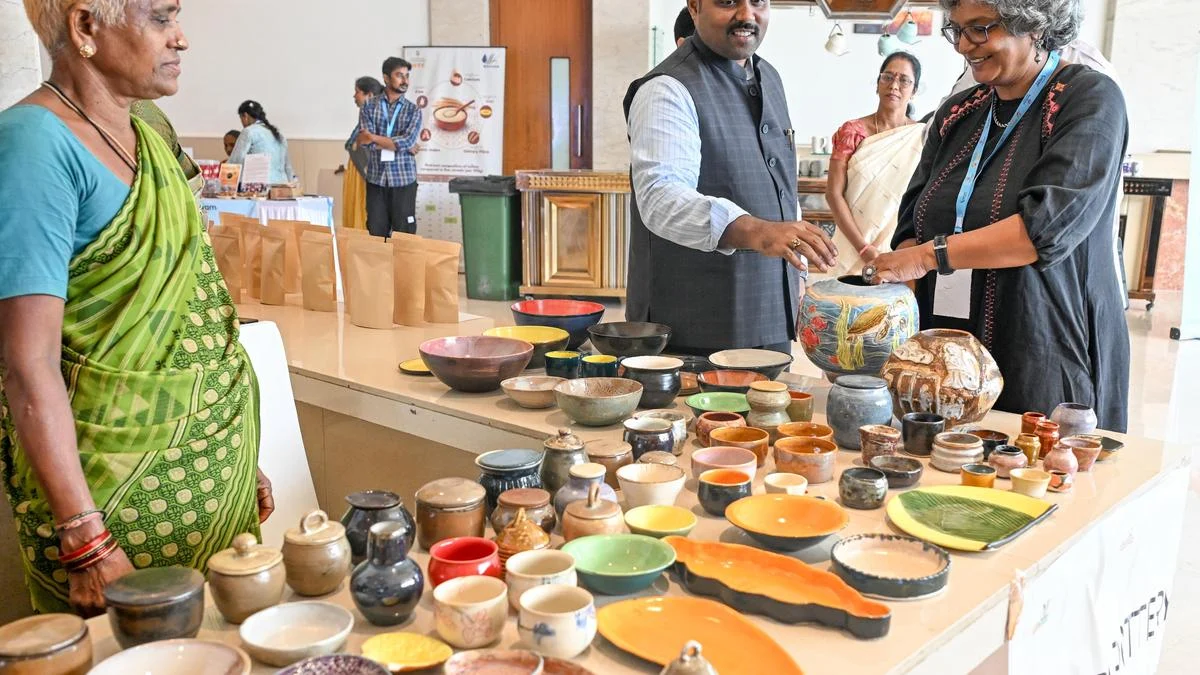
VISAKHAPATNAM – In a significant move to bolster the regional economy and champion gender parity in business, the city of Visakhapatnam recently played host to a high-profile conference and exhibition titled "Celebrating Women Entrepreneurs: Urban Ecosystem and Grassroots Leadership." The event, which took place on Tuesday, served as a vital nexus for innovation, financial discourse, and networking, bringing together a diverse array of stakeholders ranging from local artisans to high-level policy makers.
The summit was jointly organized by the Global Alliance for Mass Entrepreneurship (GAME) and Aspire For Her (AFH), in strategic partnership with the Women’s Wing of the Visakhapatnam Chamber of Commerce and Industry (VCCI). The collaboration highlighted a growing institutional commitment to transforming women-led enterprises from subsistence-level operations into scalable, market-ready businesses.
Main Facts: A Convergence of Policy and Passion
The event was anchored by the presence of prominent figures, including Member of Parliament M. Sribharat and Visakhapatnam Metropolitan Region Development Authority (VMRDA) Commissioner N. Tej Bharath. Their participation underscored the government’s recognition of women entrepreneurs as a primary engine for the region’s "Next-Gen" economic growth.
The conference was structured around three core pillars:
- Market Access: Bridging the gap between local production and global demand.
- Financial Literacy and Inclusion: Navigating the complexities of institutional credit and venture capital.
- Digital Transformation: Leveraging technology to bypass traditional gatekeepers in the supply chain.
A central highlight was the "Exhibition Zone," where the theoretical discussions of the conference hall met the tangible reality of the marketplace. From the sophisticated, minimalist designs of handcrafted ceramics to the traditional, labor-intensive outputs of coastal cooperatives, the expo showcased the sheer breadth of women’s entrepreneurial contributions in Andhra Pradesh.
Chronology: From Vision to Action
The day’s proceedings commenced with an inaugural walkthrough of the exhibition stalls by Commissioner N. Tej Bharath. His visit to the Arra Pottery stall became a symbolic moment for the event, illustrating the bridge between traditional craftsmanship and modern aesthetic markets.
Morning Sessions: The Policy Framework
Following the exhibition tour, the conference moved into its plenary phase. MP M. Sribharat opened the discussions by highlighting the legislative and infrastructural support being funneled into the Visakhapatnam-Kakinada industrial corridor. He emphasized that for Visakhapatnam to truly evolve into a "Global City," its entrepreneurial ecosystem must be inclusive of women at every level—from the boardroom to the village square.
Mid-Day: Spotlight on Resilience
The afternoon was dedicated to "Spotlight Sessions," where individual entrepreneurs shared their "business journeys." These were not merely success stories but candid accounts of the hurdles faced by women in business, including social biases, the "double burden" of domestic and professional roles, and the difficulty of securing collateral-free loans.
Evening: Networking and the "Hamsafal" Initiative
The day concluded with intensive networking sessions designed to facilitate buyer-seller interactions. This period saw the formal introduction of the Hamsafal programme, a collaborative initiative between GAME and Aspire For Her, designed to provide a structured roadmap for women looking to scale their businesses through mentorship and digital tools.
Supporting Data: The Socio-Economic Landscape
The significance of this event is best understood through the lens of current economic data. In India, women-led enterprises account for approximately 13.5 million to 15.7 million of total MSMEs (Micro, Small, and Medium Enterprises). While this number is substantial, the majority are "own-account" enterprises that do not employ others. The Visakhapatnam summit specifically targeted this "missing middle"—the transition from self-employment to job creation.
The Power of Cooperatives
A standout participant at the expo was the Visakhapatnam Town Fisherwomen Dry Fish Cooperative Society. This organization serves as a masterclass in grassroots longevity:
- Established: 1987
- Structure: One of the oldest Fishermen Farmer Producer Organisations (FFPOs) in the region.
- Membership: 164 active women members.
- Scope: Processing, quality control, and direct marketing of dry fish, eliminating predatory middlemen.
The cooperative’s presence highlighted how collective bargaining and formal institutionalization (as an FFPO) can provide a safety net for women in traditional industries while increasing their profit margins.

The Digital Reach
Aspire For Her (AFH) brought the weight of its 1.2 million-strong community to the table. Data shared during the event suggested that women-led businesses that adopt digital payment and marketing tools see a 20-30% faster growth rate compared to those relying solely on offline channels. The Hamsafal programme aims to capitalize on this by providing digital literacy to at least 10,000 women in the initial phase of the regional rollout.
Official Responses: Voices of Leadership
The leadership present at the summit provided a clear roadmap of how the "Urban Ecosystem" and "Grassroots Leadership" can be synthesized.
Subhash Kiran, Programme Director at GAME, spoke to The Hindu regarding the necessity of a holistic ecosystem. "Entrepreneurship does not happen in a vacuum," Kiran noted. "It flourishes when local ecosystems—comprising government, industry, and community—work in tandem. Our goal is to help women move beyond ‘subsistence livelihoods.’ We want to see these women building enterprises that can compete in larger, even international, markets."
Divya Sampath of Aspire For Her emphasized the power of the network. "With a community of 1.2 million women, we have a pulse on what the modern Indian woman entrepreneur needs. Through the Hamsafal programme, we are not just giving advice; we are creating access. Whether it is access to a mentor, a loan, or a new digital marketplace, we are shortening the distance between a woman’s ambition and her achievement."
Commissioner N. Tej Bharath lauded the aesthetic and commercial viability of the products on display. During his interaction at the Arra Pottery stall, he remarked on the importance of "branding and storytelling" in modern commerce, suggesting that the VMRDA would continue to support spaces where such entrepreneurs can interface with the public.
Implications: A New Paradigm for Visakhapatnam
The "Celebrating Women Entrepreneurs" conference is more than just a one-day event; it is an indicator of a shifting economic paradigm in Andhra Pradesh. The implications of this summit are expected to ripple through the regional economy in several ways:
1. Formalization of the Informal Sector
By bringing groups like the Fisherwomen Dry Fish Cooperative into the same room as tech-driven startups and VMRDA officials, the event encourages the formalization of informal labor. Formalization leads to better access to banking, insurance, and government subsidies, which are crucial for long-term stability.
2. The "Multiplier Effect" of Women’s Income
Economic research consistently shows that women reinvest up to 90% of their income back into their families and communities (compared to 30-40% for men). By strengthening women-led enterprises in Visakhapatnam, the city is effectively investing in better health, education, and nutrition for the next generation of its citizens.
3. Visakhapatnam as a Hub for "Mass Entrepreneurship"
The focus on "Mass Entrepreneurship" (as championed by GAME) suggests a move away from the "Unicorn-only" mindset. Instead of focusing solely on high-tech startups that may only employ a few hundred people, the city is looking to support thousands of small and medium businesses that can each employ 5 to 10 people. This is the key to solving the employment challenge in a burgeoning urban center like Vizag.
4. Bridging the Urban-Rural Divide
The dual focus on "Urban Ecosystems" and "Grassroots Leadership" ensures that economic growth is not confined to the city’s IT corridors. By empowering rural and coastal women with the same digital and financial tools available to urban entrepreneurs, the region can achieve a more balanced and equitable development.
Conclusion
The Women Entrepreneurs Expo in Visakhapatnam has set a high benchmark for how regional summits can drive national goals. As the 164 members of the Fisherwomen Cooperative and the artisans of Arra Pottery return to their work, they do so with more than just networking business cards; they carry the momentum of an ecosystem that is finally beginning to recognize their value.
With the continued support of organizations like GAME and Aspire For Her, and the political will demonstrated by leaders like MP M. Sribharat, the path from "grassroots" to "global" is becoming increasingly clear for the women entrepreneurs of Andhra Pradesh. The message from Visakhapatnam is loud and clear: the future of the Indian economy is not just industrial—it is inclusive.
