

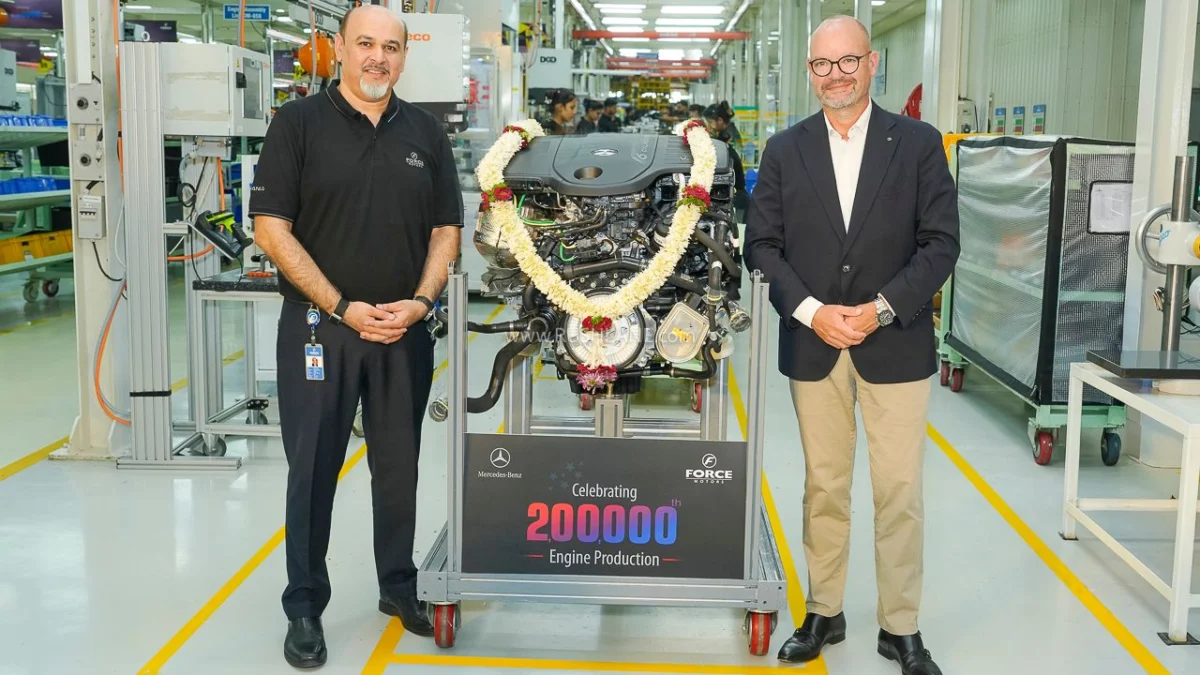
PUNE, INDIA – In a significant affirmation of India’s maturing automotive manufacturing ecosystem, Force Motors has officially rolled out its 200,000th engine for Mercedes-Benz. This milestone, achieved at the company’s state-of-the-art manufacturing facility in Chakan, Pune, marks a defining moment in a partnership that has served as a cornerstone of the Indo-German industrial relationship for nearly three decades.
The landmark unit—a sophisticated 6-cylinder M256 petrol engine—has been designated for installation in the flagship Mercedes-Benz GLS 450 luxury SUV. This achievement is not merely a numerical success but a testament to the precision, technological integration, and high-quality standards maintained by Force Motors in its role as the primary powertrain partner for the world’s most recognized luxury automotive brand in India.
Main Facts: A Milestone of Precision and Scale
The rollout of the 200,000th engine represents the culmination of years of technical synergy. Force Motors operates a dedicated, world-class facility in Chakan that is exclusively tailored to meet the exacting global standards of Mercedes-Benz. This facility is responsible for the assembly of a wide range of engines and axles that power the entire portfolio of Mercedes-Benz cars and SUVs assembled at the German automaker’s own plant nearby.
The 200,000th Unit: The M256 Engine
The engine that claimed the milestone spot, the M256, is a marvel of modern internal combustion technology. It is a 3.0-liter, turbocharged inline-six petrol engine featuring a 48-volt mild-hybrid system. Known for its silky-smooth power delivery and efficiency, the M256 represents the pinnacle of Mercedes-Benz’s current powertrain lineup. Its production in India by Force Motors underscores the capability of the Indian supplier to handle high-complexity, high-tech assemblies that include integrated starter-generators (ISG) and electric auxiliary compressors.
Scope of the Partnership
While the 200,000-engine mark is the headline, the partnership extends far beyond simple assembly. Force Motors produces:
- Four-cylinder and Six-cylinder Diesel Engines: Powering the C-Class, E-Class, and the GLE/GLS ranges.
- Four-cylinder and Six-cylinder Petrol Engines: Powering the premium sedan and SUV segments.
- Front and Rear Axles: Vital drivetrain components for the luxury fleet.
Chronology: Three Decades of Strategic Collaboration
The relationship between Force Motors (formerly known as Bajaj Tempo) and Mercedes-Benz is one of the longest-standing collaborations in the global automotive industry.
1997: The Inception
The partnership began in 1997 when Mercedes-Benz decided to establish a local assembly presence in India. Rather than setting up a captive engine shop immediately, they chose to partner with the Firodia-led Force Motors. This was a strategic move, leveraging Force Motors’ deep understanding of the Indian manufacturing landscape and their existing historical ties to German engineering (via Hanomag and Daimler-Benz).
2005 – 2015: Scaling Up
As the Indian luxury car market began to expand, so did the requirements for localization. In 2005, the collaboration deepened as more models were added to the "Made in India" roster. By the mid-2010s, Force Motors had invested heavily in a dedicated, climate-controlled, and dust-free facility in Chakan to ensure that the engines produced in India were indistinguishable in quality from those produced in Untertürkheim, Germany.
2016: A New Dedicated Plant
In 2016, Force Motors inaugurated a new, dedicated plant for Mercedes-Benz engines. Built with an investment of approximately INR 100 crore, this facility was designed with a "zero-defect" philosophy, utilizing advanced testing rigs and computerized torque-tightening tools synced with global Mercedes-Benz servers.
2024: The 200,000th Milestone
Reaching 200,000 units indicates an accelerating pace of production. While it took over a decade to reach the first 50,000, the leap from 100,000 to 200,000 has occurred in a significantly shorter timeframe, reflecting the booming demand for luxury vehicles in the Indian subcontinent.
Supporting Data: The Industrial Impact
The production of 200,000 engines for a luxury marque in India is a significant data point for several reasons:
- Volume vs. Luxury: In the luxury segment, where annual volumes are much lower than mass-market hatchbacks, 200,000 engines is a staggering figure. It represents the vast majority of all Mercedes-Benz vehicles ever sold on Indian soil.
- Localization Levels: Through this partnership, Mercedes-Benz India has achieved a high level of localization for its powertrain, which has allowed the brand to remain competitive despite India’s high import duties on Completely Built Units (CBUs).
- Employment and Skill Development: The Chakan facility employs hundreds of highly skilled engineers and technicians. The "Force-Mercedes" training protocols have created a specialized workforce in Maharashtra capable of working on Euro 6 (BS6) and upcoming powertrain technologies.
- Quality Consistency: Internal audits from Mercedes-Benz AG have consistently ranked the Force Motors Chakan plant among the top-performing third-party assembly units globally, often matching or exceeding the quality benchmarks of captive plants.
Official Responses: Commemorating the Achievement
The milestone event was attended by the top brass of both organizations, highlighting the mutual respect between the two entities.

Mr. Prasan Firodia, Managing Director of Force Motors, expressed his pride during the ceremony:
"The rollout of the 200,000th engine is a momentous occasion for all of us at Force Motors. It is more than just a production number; it is a symbol of a 27-year-long journey built on the pillars of trust, engineering precision, and a shared commitment to excellence. Our partnership with Mercedes-Benz is a source of immense pride, and it showcases the ability of Indian engineering to meet the most stringent global standards."
Representatives from Mercedes-Benz Group AG and Mercedes-Benz India also lauded the achievement. They noted that Force Motors has been a "reliable and flexible partner" that has adapted quickly to the changing technological landscape, including the transition from BS4 to BS6 emission norms and the introduction of complex mild-hybrid systems.
Industry analysts suggest that the presence of Board Management members from Germany at the event signals that Mercedes-Benz views Force Motors not just as a local vendor, but as a strategic global partner in their supply chain.
Implications: What This Means for the Future
The success of the Force Motors-Mercedes-Benz partnership has several long-term implications for the Indian automotive industry and the global supply chain.
1. India as a Global Sourcing Hub
This milestone reinforces India’s position as a viable hub for high-tech automotive manufacturing. If an Indian company can successfully produce 200,000 engines for a brand as demanding as Mercedes-Benz, it paves the way for other global luxury manufacturers to consider India for more than just low-cost component sourcing. It proves that "Make in India" is applicable to the highest tiers of luxury and technology.
2. The Future of Powertrains (ICE to EV)
As the global automotive industry shifts toward Electric Vehicles (EVs), the partnership is expected to evolve. Force Motors has already demonstrated its ability to handle complex electronics and hybrid systems (as seen in the M256 engine). The next phase of this collaboration could potentially involve the assembly of battery packs or electric drive units (EDUs) as Mercedes-Benz expands its ‘EQ’ portfolio in India.
3. Strengthening Indo-German Ties
The collaboration serves as a "success story" often cited in bilateral trade discussions between India and Germany. It highlights how German technology and Indian manufacturing prowess can create a synergy that benefits both economies—providing jobs and industrial growth in India while allowing German firms to capture market share in one of the world’s fastest-growing economies.
4. Competitive Advantage for Mercedes-Benz
By having a dedicated engine partner like Force Motors, Mercedes-Benz India maintains a logistical and financial advantage over its rivals. The ability to assemble engines locally provides a hedge against currency fluctuations and supply chain disruptions that often plague importers.
Conclusion
The rollout of the 200,000th Mercedes-Benz engine from the Force Motors plant is a landmark event that transcends a simple corporate achievement. It is a celebration of a 27-year legacy that helped put Pune on the global automotive map. As the automotive world stands on the brink of a new era defined by electrification and software-defined vehicles, the robust foundation laid by Force Motors and Mercedes-Benz ensures that they are well-positioned to lead the luxury segment in India for decades to come.
With the M256 engine now powering a GLS 450 somewhere on Indian roads, the message is clear: Indian engineering is no longer just about "frugal innovation"—it is about world-class, uncompromising luxury.
