

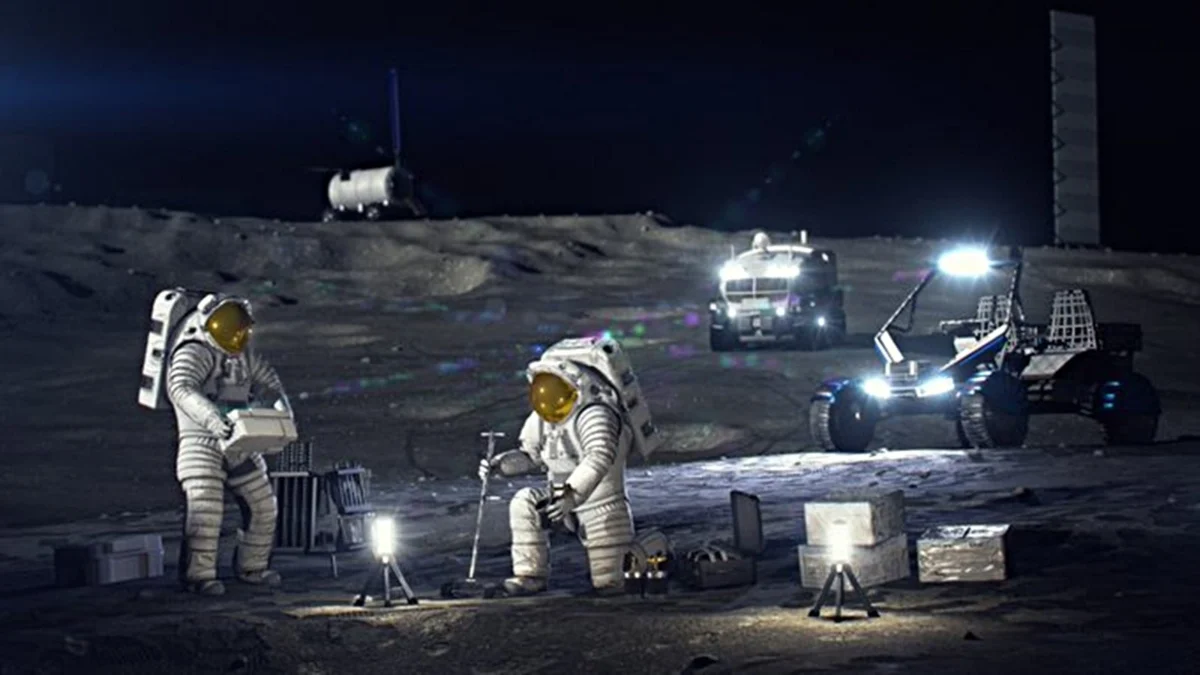
WASHINGTON D.C. — In a move that signals the most significant shift in space policy since the Apollo era, the National Aeronautics and Space Administration (NASA) has officially announced its blueprint for a permanent human settlement on the lunar surface. Moving beyond the "flags and footprints" model of the 20th century, the agency’s "Moon Base" initiative aims to establish a long-term habitat at the lunar South Pole, serving as a crucible for scientific discovery, a hub for commercial activity, and a vital stepping stone for the eventual human exploration of Mars.
The announcement, delivered via a series of official statements and a high-profile social media campaign, marks a paradigm shift in how humanity interacts with its closest celestial neighbor. No longer viewed merely as a destination for short-term sorties, the Moon is being repositioned as the "eighth continent"—a place where humans will live, work, and innovate for generations to come.
Main Facts: The Vision for a Lunar Outpost
NASA has scheduled a comprehensive media briefing for 2:00 PM EDT on May 26, 2026, at its headquarters in Washington to provide the global community with the granular details of the Moon Base program. The event is set to feature a leadership trio that reflects the program’s multidisciplinary nature: NASA Administrator Jared Isaacman, acting associate administrator Lori Glaze, and Moon Base program executive Carlos Garcia-Galan.
The core objective of the initiative is the construction of a sustained lunar habitat at the South Pole. This region was selected not for its ease of access—it is notoriously difficult to navigate—but for its strategic and scientific value. Unlike the equatorial regions visited by Apollo astronauts, the South Pole is believed to harbor vast reservoirs of water ice within its permanently shadowed craters. This ice is the "gold" of the solar system; it can be processed into oxygen for breathing, water for drinking, and liquid hydrogen and oxygen for rocket propellant.
The Moon Base will not be a singular building but a sprawling complex of infrastructure, including power grids, communication arrays, landing pads, and pressurized living quarters. It represents the realization of the Artemis Program’s ultimate goal: establishing a sustainable presence that allows for continuous scientific research and the development of technologies required for the multi-year journey to Mars.
Chronology: A Phased Approach to Colonization
The development of the Moon Base is not an overnight endeavor. NASA has outlined a meticulous, three-phase implementation strategy designed to manage risk, test emerging technologies, and gradually build the logistical muscle required to support human life in a vacuum.
Phase 1: The Technological Foundation
The first phase is characterized by intense robotic activity and technology demonstration. NASA envisions 25 separate launches and 21 lunar landings during this period. The primary goal is to "scout" the terrain and validate the systems needed for survival.
During Phase 1, approximately 4,000 kg of payload will be delivered to the lunar surface. This phase will see the expansion of the Commercial Lunar Payload Services (CLPS) program, with payload capacities increasing to five metric tonnes. These missions will focus on identifying the precise coordinates for the future base, testing autonomous landing systems, and conducting the first crewed mission specifically dedicated to the Moon Base site. It is the era of "site preparation," where the first robots will touch down to ensure the ground is stable and the resources are accessible.
Phase 2: Infrastructure and Expansion
Once the site is secured and the technology proven, Phase 2 shifts toward heavy lifting and initial construction. This stage involves 27 launches and 24 landings, delivering a staggering 60,000 kg of payload.
The hallmark of Phase 2 will be the transition to semi-annual crewed missions. This is the period when "regolith manipulation" begins—using lunar soil to create protective berms or even 3D-printing structures to shield habitats from radiation. This phase will focus on building the initial power infrastructure, likely utilizing a mix of advanced solar arrays and small fission power systems capable of surviving the grueling lunar night.
Phase 3: The Era of Continuous Habitation
The final phase envisions a fully operational Moon Base. With 29 launches and 28 landings scheduled, NASA intends to transport nearly 150,000 kg of equipment and supplies to the surface. By this point, the CLPS program will have matured to deliver eight metric tonnes per mission.
Phase 3 introduces uncrewed cargo return systems, allowing scientific samples and potentially manufactured goods to be sent back to Earth. Most importantly, this phase marks the beginning of a continuous human presence. The Moon Base will no longer be a place astronauts "visit"; it will be a place where they reside in shifts, maintaining a 360-day-a-year operation that mirrors the presence of scientists at research stations in Antarctica.
Supporting Data: Overcoming the Environmental Gauntlet
The logistical data provided by NASA highlights the sheer scale of the engineering challenge. The South Pole of the Moon is one of the most hostile environments in the known solar system.
The Lighting and Power Crisis
One of the primary challenges detailed by the agency involves the unique lighting conditions at the South Pole. Because the Sun remains low on the horizon, it casts incredibly long shadows. While "peaks of eternal light" offer near-constant solar energy, the adjacent craters remain in "permanent shadow."
NASA’s data suggests that systems must be designed to withstand temperatures that can swing from 120°C in the sun to -230°C in the shade. Furthermore, any solar-dependent infrastructure must be strategically placed on high ridges, while the habitats themselves might be nestled in valleys for radiation protection, necessitating a complex, wide-area power grid.
Mobility and Terrain
The topography of the South Pole is a jagged nightmare of steep crater walls and uneven regolith. NASA’s roadmap emphasizes the need for a new generation of lunar vehicles. These are not the simple "moon buggies" of the 1970s. The agency is calling for advanced mobility systems capable of descending into deep, pitch-black craters to prospect for frozen water. These robotic and crewed rovers must possess high levels of autonomy and the ability to navigate without the aid of GPS, using instead "terrain-relative navigation" and LIDAR.
Official Responses: A "Golden Age" of Innovation
The leadership at NASA has framed this initiative as the dawn of a "New Golden Age." Administrator Jared Isaacman, a figure known for his advocacy of commercial-government synergy in space, has emphasized that the Moon Base is not a solo act by the U.S. government.
"We’re building a Moon Base," Isaacman stated in a recent post on X (formerly Twitter). "It will serve as a habitat where astronauts live and work during long-term science missions." His rhetoric suggests a heavy reliance on industry partnerships, moving away from the traditional "cost-plus" contracts of the past toward a more agile, service-based model where companies like SpaceX, Blue Origin, and smaller tech startups provide the "trucking" and "housing" services for NASA’s "tenants."
Lori Glaze, acting associate administrator, has highlighted the scientific windfall expected from the project. "The South Pole is a time capsule of the early solar system," she noted. "By establishing a permanent base, we can conduct geology, astronomy, and biology experiments that are impossible to perform from Earth or even from a short-term lunar stay."
Carlos Garcia-Galan, the Moon Base program executive, focused on the engineering roadmap, stating that the phased implementation is designed to be "iterative and sustainable," ensuring that the mission doesn’t suffer from the budgetary "stop-and-start" cycles that have plagued previous lunar return plans.
Implications: The Moon as a Gateway to the Cosmos
The implications of a successful Moon Base extend far beyond the lunar surface. Strategically, this project cements the United States’ leadership in space at a time when other nations, most notably China and its partners, are also eyeing the lunar South Pole. The establishment of "norms of behavior" and international lunar law will likely be dictated by those who establish the first functional infrastructure.
The Mars Connection
NASA has been transparent about the fact that the Moon Base is a "testbed" for Mars. The life support systems, radiation shielding, and psychological impacts of long-term isolation studied on the Moon will be directly applicable to the first crewed missions to the Red Planet. If humans cannot survive three months on the Moon, they cannot survive three years on a trip to Mars.
Economic and Scientific Expansion
Economically, the Moon Base could catalyze a "Lunar Economy." From mining rare minerals to manufacturing in low gravity, the presence of a permanent human outpost provides the stability needed for private investment.
Scientifically, a base on the Moon—particularly if it extends to the far side—would allow for the construction of radio telescopes shielded from the electronic noise of Earth. This could allow astronomers to peer back to the "Dark Ages" of the universe, seeing the first stars ignite.
As the May 26 briefing approaches, the world watches with a mixture of skepticism and awe. The roadmap is ambitious, the costs are certain to be astronomical, and the risks are life-threatening. However, as NASA’s recent communications suggest, the agency believes that the era of "visiting" space is over. The era of "inhabiting" it has begun.
The media briefing, to be streamed live on NASA+ and YouTube, will likely be the moment when the abstract dream of a lunar colony finally transforms into a concrete, funded, and scheduled reality. For the first time in history, the "Man in the Moon" may soon have company that is there to stay.
