

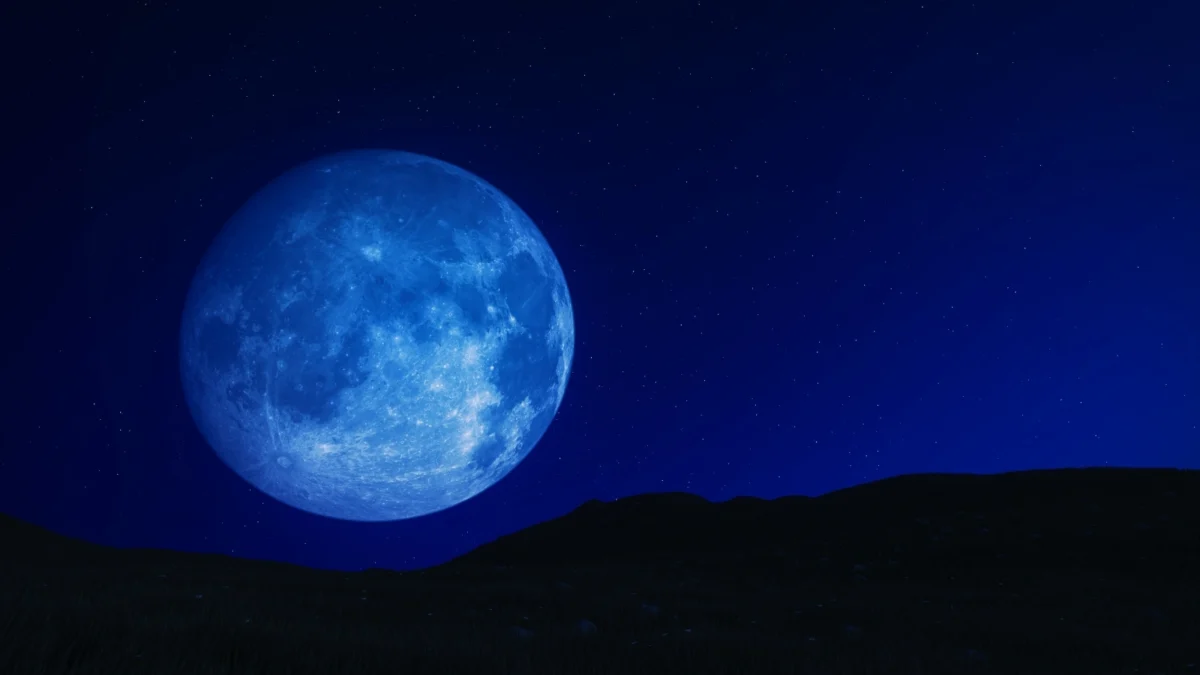
The night sky has long served as a canvas for both scientific inquiry and cultural myth. Among the various lunar phenomena that capture the public imagination, few carry as much linguistic weight as the "Blue Moon." While the idiom "once in a blue moon" implies an event of extreme rarity, the astronomical reality is far more rhythmic and predictable. As May 2026 approaches, astronomers and skywatchers are preparing for a month that will feature two full moons—the second of which, occurring on May 31, will officially earn the title of a "Blue Moon."
This upcoming celestial event offers a unique opportunity to explore the intersection of orbital mechanics, atmospheric physics, and the historical evolution of how we track time.
1. Main Facts: The Double Lunar Display of May 2026
The primary event defining the astronomical calendar for early 2026 is the occurrence of two full moons within the span of a single month. The first full moon will grace the sky on May 1, 2026. Because the lunar cycle—the time it takes for the Moon to return to the same phase—lasts approximately 29.5 days, a second full moon is scheduled to appear on May 31, 2026.
Under the most widely accepted modern definition, this second full moon is classified as a Blue Moon. It is important to clarify that, despite the name, the Moon will not physically change its hue to blue. To the naked eye, it will appear as the familiar pearly-white or golden orb that observers have seen for millennia. The term "Blue Moon" is a calendrical designation rather than a description of optical color.
For observers in India and across the Eastern Hemisphere, the May 31 Blue Moon will be particularly striking. It is expected to rise in the eastern sky shortly after sunset. Given the timing, the "moon illusion"—an optical trick where the moon looks larger near the horizon—will likely provide a spectacular view for those watching from urban centers like Delhi, Kolkata, and Mumbai, as well as rural regions with lower light pollution.
2. Chronology: The Evolution of a Celestial Term
The history of the term "Blue Moon" is a fascinating study in how scientific definitions can be shaped by human error and cultural shifts. The chronology of the term can be divided into three distinct eras:
The Traditional Seasonal Definition (Pre-1946)
Originally, the term "Blue Moon" was used by the Maine Farmers’ Almanac to describe a specific occurrence within an astronomical season. A typical season (Spring, Summer, Fall, or Winter) usually contains three full moons. However, because the solar year and lunar cycles are not perfectly aligned, some seasons end up with four full moons. In these instances, the third full moon of that season was dubbed the "Blue Moon." This ensured that the names of the other moons (such as the Harvest Moon or the Hunter’s Moon) remained aligned with their proper seasonal activities.
The Modern Misinterpretation (1946)
The definition most people use today—the second full moon in a single calendar month—actually stems from a mistake. In the March 1946 issue of Sky & Telescope magazine, an author named James Hugh Pruett misinterpreted the Maine Farmers’ Almanac. He incorrectly wrote that the "Blue Moon" was the second full moon in a month. This simpler, albeit "incorrect" definition, was picked up by popular media and eventually became the standard global understanding of the term.
The Era of Global Connectivity (2023–Present)
In recent years, the Blue Moon has become a viral sensation, often overlapping with other lunar events. In August 2023, the world witnessed a "Blue Supermoon," where the second moon of the month coincided with perigee (the Moon’s closest approach to Earth). This event was documented extensively by photographers like Soumyadeep Mukherjee in Kolkata and Taranjot Singh in Sydney, bringing high-definition lunar photography to the forefront of social media and reigniting public interest in the May 2026 event.
3. Supporting Data: The Mechanics of the Lunar Cycle
To understand why a Blue Moon occurs, one must look at the mathematical discrepancy between the solar year and the lunar month.
The Synodic Month vs. The Calendar Month
The Moon takes 27.3 days to orbit the Earth (the sidereal month), but because the Earth is also moving around the Sun, it takes 29.53 days for the Moon to return to the same phase as seen from Earth (the synodic month). Our Gregorian calendar months, however, range from 28 to 31 days.
The Accumulation of Days
A standard solar year consists of 365.24 days. Twelve lunar cycles (12 x 29.53) total approximately 354 days. This leaves an 11-day gap every year. Over the course of roughly two to three years, these "extra" days accumulate to the point where an additional full moon is squeezed into the calendar. This is why Blue Moons occur approximately every 30 months.
Statistical Frequency
- Monthly Blue Moons: Occur roughly once every 2.7 years.
- Double Blue Moon Years: Occasionally, a year will have two Blue Moons (one in January and one in March, with February having no full moon at all). This is much rarer, occurring about four times every century.
- Seasonal Blue Moons: The "old" definition remains in use by astronomers. The next seasonal Blue Moon (the 3rd of 4 in a season) is projected for May 20, 2027.
4. Official Responses and Scientific Perspectives
National space agencies and astronomical societies often use these events as "teachable moments" to explain atmospheric optics and orbital mechanics to the public.
NASA’s Perspective on Color
NASA scientists frequently clarify that while a "Blue Moon" is a calendar event, the Moon can actually turn blue under specific, extreme atmospheric conditions. This is known as "Mie scattering." For the Moon to appear blue, the Earth’s atmosphere must be filled with particles that are slightly wider than the wavelength of red light (about 0.7 microns) but not so large that they scatter all light equally.
The Krakatoa Precedent
The most famous instance of a literal blue moon occurred in 1883 following the eruption of the Krakatoa volcano in Indonesia. The eruption was so powerful that it injected massive amounts of ash into the stratosphere. These particles were the perfect size to scatter red light while allowing blue light to pass through. For nearly two years, people across the globe reported seeing the Moon with a distinct blue or lavender tint. Similar effects have been noted after major forest fires or smaller volcanic events, such as the 1980 eruption of Mount St. Helens.
Astronomical Societies
Groups like the Royal Astronomical Society (RAS) and the Astronomical Society of India (ASI) emphasize that the Blue Moon is an excellent entry point for amateur astronomers. Because the event requires no specialized equipment, it serves as a "gateway" phenomenon that encourages the public to look up and engage with the night sky.
5. Implications: Cultural, Scientific, and Photographic
The occurrence of a Blue Moon in May 2026 carries implications that extend beyond mere dates on a calendar.
The "Moon Illusion" and Public Engagement
Because the May 31 Blue Moon will be visible shortly after sunset, it will be subject to the "moon illusion." When the Moon is near the horizon, the human brain perceives it as much larger than when it is high in the sky. This psychological phenomenon, combined with the "Blue Moon" branding, typically leads to a massive surge in public interest, outdoor gatherings, and educational webinars hosted by planetariums.
Advancements in Astrophotography
The 2026 event will likely see a record number of high-resolution images captured by both professionals and enthusiasts. With the advent of smartphone sensors capable of 100x zoom and sophisticated post-processing AI, the "Blue Moon" has become a major event for digital content creators. Photographers use these nights to capture "forced perspective" shots—aligning the Moon with iconic landmarks such as the India Gate in Delhi or the Sydney Opera House—to highlight the scale and beauty of our natural satellite.
Cultural Symbolism
Culturally, the Blue Moon remains a symbol of the unexpected. In folklore, full moons are often associated with shifts in behavior or "lunacy," and a double full moon month is frequently viewed as a period of heightened emotional or spiritual energy. While these beliefs are not supported by scientific data, they contribute to the festive atmosphere that surrounds the event.
Looking Ahead to 2027
The May 2026 event serves as a precursor to the seasonal Blue Moon of May 2027. For those who follow the "older" definition of the term, 2027 will be the year of the "true" Blue Moon. By comparing the two events—the monthly Blue Moon of 2026 and the seasonal one of 2027—astronomers can help the public understand the different ways we measure and categorize the movements of the heavens.
Conclusion
The Blue Moon of May 31, 2026, is a reminder of the elegant, if slightly messy, clockwork of our solar system. It is a product of the human desire to fit the circular cycles of the Moon into the square boxes of a calendar. While the Moon will not turn a shade of azure, the event remains a rare opportunity for global connection, scientific education, and a simple, profound moment of looking upward. Whether viewed through a professional telescope or from a balcony in a crowded city, the May 2026 Blue Moon will undoubtedly "steal the night sky," proving that even a "misinterpreted" definition can lead to a deeper appreciation of the cosmos.
