

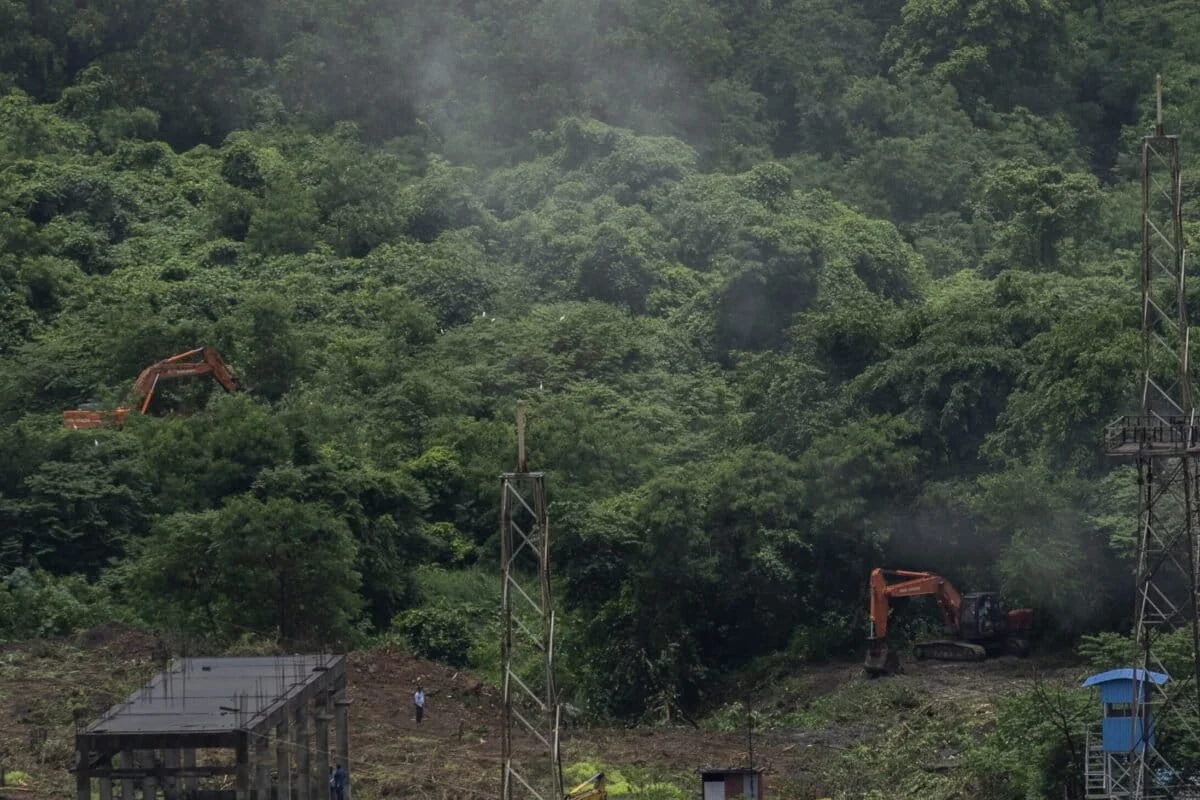
NEW DELHI — In a legal challenge that strikes at the heart of India’s environmental governance, a group of the nation’s most distinguished former forest officials and conservationists has moved the Delhi High Court. The Public Interest Litigation (PIL) levels a scathing indictment against the National Board for Wildlife (NBWL) and its Standing Committee (SC-NBWL), accusing them of abdicating their statutory duties to protect the country’s most fragile ecosystems.
The petitioners—including four retired Indian Forest Service (IFS) officers and the primary architect of India’s wildlife laws—allege that these bodies have transformed from protectors of biodiversity into a "rubber-stamp" agency for industrial and infrastructure projects. The core of their argument rests on a staggering statistic: between 2014 and 2026, the Standing Committee approved 97% of all project proposals brought before it, leading to the diversion of nearly 96,000 hectares of protected forest land.
The Core Allegations: A Failure of Oversight
The petition, led by former senior IFS officer Prakriti Srivastava and the eminent conservationist M.K. Ranjitsinh—who was instrumental in drafting the Wildlife Protection Act of 1972—paints a picture of systemic institutional decay. The group alleges that the NBWL and its Standing Committee have acted with "scant ecological and scientific evidence" and a "total disregard" for the constitutional duties they were created to uphold.
At the center of the dispute is the National Board for Wildlife, a statutory body chaired by the Prime Minister of India. Created under the 2003 amendment to the Wildlife Protection Act, the NBWL is mandated to advise the Central and State governments on wildlife conservation, impact assessments, and the management of national parks and sanctuaries. However, the petitioners argue that the Board has effectively ceased to function as a deliberative body.
According to the PIL, the full NBWL met only once between 2012 and 2025. In its absence, the Standing Committee (SC-NBWL), chaired by the Union Environment Minister, has assumed all decision-making powers. This smaller body, the petitioners argue, lacks the necessary oversight and "processual rigour" required to sanction the destruction of protected habitats.

Chronology of a Regulatory Shift
To understand the gravity of the current legal battle, one must look at the evolution of environmental clearances over the last decade.
- 2003: The NBWL is formally established to provide high-level expertise on wildlife matters.
- 2012-2013: A sub-committee drafts specific rules and protocols to govern the Standing Committee’s functioning, aiming for transparency and scientific rigor. These rules are later rejected, leaving the committee to function in what the petition calls an "arbitrary and ad hoc manner."
- 2014-Present: The incumbent government prioritizes the "ease of doing business." National environmental norms undergo a series of changes to facilitate faster clearances for infrastructure.
- 2014-2026: The Standing Committee meets 55 times, considering 2,186 project proposals. It maintains a 97% approval rate.
- March 2025: India’s protected area network reaches 1,014 sites, covering 5.32% of the country’s geography—areas now under intense pressure from the very body meant to guard them.
- July 9, 2024: The SC-NBWL holds its 91st meeting, clearing over 100 projects in a single session.
- Current Status: The Delhi High Court has issued a notice to the Union Environment Ministry, seeking a response within four weeks. The next hearing is scheduled for September 18.
Supporting Data: The High Cost of "Ease of Doing Business"
The quantitative evidence presented in the PIL is corroborated by independent researchers. Mridhu Tandon, a consultant and member of the IUCN’s World Commission on Protected Areas, tracked the committee’s approvals for the Legal Initiative for Forests and Environment (LIFE).
Her findings suggest that the vast majority of clearances pertain to "linear infrastructure"—roads, railways, and power transmission lines. These projects are particularly damaging because they fragment habitats, leading to increased human-wildlife conflict and "roadkill" incidents.
"The deliberations recorded for linear infrastructure proposals are strikingly similar across projects," Tandon noted. "There is little discussion of the biodiversity values of the protected area or of the specific impacts that the project is likely to have. Discussions on alternative alignments or designs that could avoid the forest altogether are largely absent."
The petition highlights two high-profile cases as evidence of this "shoddy assessment":
- The Ken-Betwa River Linking Project: Approved despite warnings that it would submerge 10% of the Panna Tiger Reserve. The project was cleared even though the Park’s own director had formally opposed it, citing the hard-won recovery of the local tiger population.
- Great Nicobar Island Development: The committee approved the denotification of Galathea Bay, a critical nesting site for the giant leatherback sea turtle, to make way for a transshipment port. The petition argues the SC-NBWL lacks the statutory power to denotify protected areas, a move that has drawn international condemnation for threatening endemic tribes and unique biodiversity.
The Question of Legality and Conflict of Interest
A significant portion of the PIL focuses on the "illegal" constitution of the current Standing Committee. Under the Wildlife Protection Act, the Standing Committee is supposed to be constituted by the NBWL itself. However, the petition alleges that the Union Environment Ministry has bypassed this by nominating members directly.

"This shift to nomination by the Central Government is not only illegal but also shows that the SC-NBWL lacks autonomy," the petition states.
Furthermore, the composition of the committee has come under fire. While the parent NBWL is supposed to include five non-governmental organizations (NGOs) and ten conservation experts, the Standing Committee—the actual decision-maker—includes only one NGO: WWF-India. The rest of the body is dominated by government officials and representatives from state-linked institutes.
The petitioners allege that this creates a massive conflict of interest where the government acts as both the project proponent and the environmental judge. "There is no voting on matters, and often the chairperson makes unilateral decisions, rendering the expertise and diversity of views within the committee redundant," the petition says.
Official Responses: Sustainable Development vs. Conservation
The Union Environment Ministry has consistently defended its record. Following the 91st meeting of the Standing Committee in July, the Ministry issued a press release stating that proposals are appraised based on their "ecological impacts, importance for public welfare, and national development."
The statement reiterated the government’s commitment to "facilitating sustainable development" while ensuring the conservation of habitats through mitigation measures. However, when reached for comment regarding the specific allegations in the PIL, a representative for Union Environment Minister Bhupender Yadav declined to provide a statement.
The Ministry’s stance reflects a broader policy shift in New Delhi, where environmental clearances are often framed as bureaucratic hurdles to be "streamlined" rather than essential safeguards for the nation’s natural capital.

Implications: Seeking a New Framework for Accountability
The petitioners are not merely seeking the cancellation of specific project clearances; they are demanding a fundamental overhaul of how India’s wildlife is managed. They are calling for:
- Mandatory Written Justifications: Any decision to divert or denotify forest land must be justified in writing, explaining how the move improves the management of wildlife.
- Independent Impact Assessments: Moving away from "desk-based" clearances toward rigorous, site-specific scientific studies conducted by independent experts.
- Adherence to International Obligations: Ensuring that decisions regarding internationally recognized sites (such as Ramsar sites or World Heritage sites) comply with India’s global commitments.
- Restoration of Autonomy: Returning the power of nomination to the NBWL to ensure the Standing Committee is not a mere extension of the Ministry.
The outcome of this case could redefine the boundaries of executive power in India. If the Delhi High Court rules in favor of the petitioners, it could force a slowdown in the government’s infrastructure blitz, requiring a much higher threshold of scientific proof before a single tree is felled in a protected area.
As India grapples with the dual crises of climate change and rapid biodiversity loss, the legal battle over the NBWL serves as a litmus test for the country’s environmental future. For the petitioners—veterans who have spent decades in the service of India’s forests—the goal is simple: to ensure that the laws they helped write are not sacrificed at the altar of short-term economic gain.
The eyes of the conservation world will be on the Delhi High Court this September. At stake is not just 95,000 hectares of forest, but the very integrity of the legal framework that protects India’s wild heritage.
