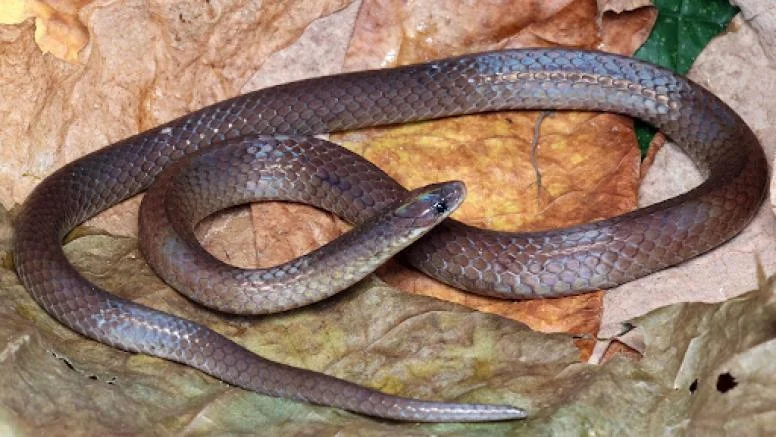
MIZORAM — In the damp, high-altitude forests of Northeast India, where the clouds often sit heavy upon the canopy, a team of international researchers has uncovered a secret hidden beneath the soil. A new species of fossorial (burrowing) snake, characterized by its iridescent sheen and unique abdominal patterns, has been officially described, marking a significant milestone for herpetology in the Indo-Burma biodiversity hotspot.
The species, named Trachischium lalremsangai, was identified through a collaborative effort involving Mizoram University and the Max Planck Institute for Biology in Germany. This discovery not only adds a new member to the genus Trachischium—commonly known as slender snakes—but also highlights the immense, yet often overlooked, biological richness of the India-Myanmar border regions.
Main Facts: The Anatomy of a Cryptic Discovery
The newly identified Trachischium lalremsangai is a non-venomous, small-bodied reptile specifically adapted for a life spent almost entirely underground. While many snakes are celebrated for their vibrant colors or intimidating size, this species finds its beauty in the subtle details of its morphology.
Physical Characteristics
The snake is distinguished by several key taxonomic features that separate it from its closest relatives:
- Dorsal Scales: It possesses exactly 13 rows of smooth, imbricate scales running down the length of its body.
- Iridescence: The back of the snake is a deep, chocolatey brown that exhibits a striking iridescence when caught in the light, a common trait among fossorial species that helps them navigate the friction of soil.
- Unique Ventral Patterning: Perhaps its most defining visual trait is its belly. The anterior (front) quarter is a clean, creamy white, which gradually transitions into a dark brown speckled with delicate white spots toward the tail.
- Ocular Structure: The species has two distinct postocular scales (scales located directly behind the eye), a feature that helped researchers differentiate it from the closely related Trachischium reticulata.
Habitat and Ecology
The species was found in the montane forests of Mizoram, specifically near Murlen National Park. These snakes are specialized for high-altitude environments, typically ranging between 800 and 2,500 meters above sea level. As a fossorial species, T. lalremsangai plays a crucial role in the local ecosystem, likely feeding on soft-bodied invertebrates like earthworms and insect larvae, thereby contributing to the nutrient cycling of the forest floor.

Chronology: From a Muddy Road to a Scientific Breakthrough
The journey to identifying Trachischium lalremsangai was a blend of serendipitous field observation and meticulous laboratory investigation.
The Initial Encounter
The story began on a humid night in the highlands of Mizoram. A research team from Mizoram University was conducting a nocturnal survey near the India-Myanmar border, close to Murlen National Park. Following a brief but intense rain shower—conditions that often coax burrowing animals to the surface—the scientists spotted a small, dark serpent on a muddy mountain road.
The snake was noted for its unusually calm temperament. Unlike many wild serpents that display defensive posturing or attempt rapid flight, this specimen remained remarkably placid, allowing the researchers to collect it for further study.
The Laboratory Phase
Initial visual inspections suggested the snake belonged to the genus Trachischium, but certain anomalies in its scale count and coloration prompted a deeper dive. The team partnered with experts at the Max Planck Institute for Biology in Tübingen, Germany.
Over the following months, the researchers employed a dual-pronged approach:

- Morphological Comparison: Measuring every scale and body proportion against existing records of known slender snakes.
- Molecular Phylogenetics: Extracting DNA to sequence specific mitochondrial genes. The genetic data confirmed that the specimen was evolutionarily distinct from Trachischium reticulata and other known congeners.
The Museum "Re-discovery"
In a classic twist of biological detective work, the researchers extended their search to historical archives. They discovered a second specimen, collected decades ago and stored in a museum in Myanmar, that had been misidentified or left unclassified. This "hidden" specimen matched the physical description of the Mizoram find perfectly, providing the necessary evidence to confirm that this was a wide-ranging, albeit secretive, new species rather than a localized mutation.
Supporting Data: Taxonomic Precision
To the untrained eye, many slender snakes look identical. However, the scientific description of Trachischium lalremsangai rests on precise data points that satisfy the rigorous requirements of the International Code of Zoological Nomenclature (ICZN).
Comparative Analysis Table
| Feature | T. lalremsangai | T. reticulata (Closest Relative) |
|---|---|---|
| Dorsal Scale Rows | 13 | 15 (typically) |
| Postocular Scales | 2 | 1 |
| Ventral Color | White transitioning to speckled brown | Uniformly yellowish or light brown |
| Head Shape | Narrower, adapted for harder soils | Slightly broader |
The genetic distance between T. lalremsangai and its relatives further solidified its status. The DNA sequencing revealed a divergence rate significant enough to indicate that the species had been evolutionarily isolated for millions of years, likely separated by the complex topography of the Indo-Burmese mountain ranges.
Official Responses: Honoring a Legacy in Conservation
The naming of a new species is often an opportunity to honor those who have dedicated their lives to the natural world. The researchers chose to name the snake Trachischium lalremsangai as a tribute to Professor Hmar Tlawmte Lalremsanga.
A Tribute to Mentorship
Professor Lalremsanga, a faculty member at Mizoram University, is a towering figure in North Indian herpetology. For decades, he has spearheaded efforts to document the reptiles and amphibians of the Northeast, a region that remains one of the most under-studied "hotspots" on Earth.

"Naming this species after Professor Lalremsanga is not merely a formality," stated one of the study’s co-authors. "It is a recognition of his role in fostering a new generation of Indian scientists. His work has bridged the gap between local field knowledge and international academic research."
Institutional Collaboration
Representatives from Mizoram University emphasized that this discovery is a testament to the power of international collaboration. By combining the local ecological expertise of Indian researchers with the advanced genomic sequencing capabilities of the Max Planck Institute, the team was able to move from discovery to description with unprecedented accuracy.
Implications: Why a Small Snake Matters for Global Biodiversity
The discovery of Trachischium lalremsangai carries weight far beyond the world of herpetology. It serves as a stark reminder of the "Wallacean Deficit"—the gap between what we know about a species and its actual distribution in the wild.
The Importance of the Indo-Burma Hotspot
The Indo-Burma region is one of the most biologically diverse places on the planet, but it is also one of the most threatened. Rapid infrastructure development, shifting cultivation patterns, and climate change pose significant risks to species that have evolved in very specific, high-altitude niches.
Because T. lalremsangai is a fossorial species, it is particularly sensitive to changes in soil quality and moisture levels. Its presence serves as a bio-indicator for the health of the montane forest floor. If the soil becomes too compacted or dry due to deforestation, these specialized snakes may be among the first to vanish.

A Call for Conservation Funding
The research team has used this discovery to advocate for increased conservation focus on the "cryptic" fauna of the Northeast. While "charismatic megafauna" like tigers and elephants receive the lion’s share of funding, small reptiles and amphibians are often the backbone of the ecosystem.
"Every time we find a new species like this, it tells us that we have only scratched the surface," the researchers noted in their concluding remarks. "There are likely dozens of other reptiles living right beneath our feet in Mizoram and Myanmar that remain unknown to science. We cannot protect what we do not know exists."
Future Research Directions
The discovery opens new doors for ecological study. Scientists now aim to investigate the diet, reproductive habits, and exact population range of T. lalremsangai. Furthermore, the team hopes that this success will inspire the Indian government and international bodies to provide more robust support for biodiversity surveys in border regions, where the terrain is difficult but the scientific rewards are immense.
In the quiet, misty heights of Murlen National Park, Trachischium lalremsangai continues its silent existence beneath the mud. Thanks to a chance encounter on a rainy night and the dedication of a global team of scientists, it is no longer invisible to the world. It stands as a symbol of the mystery that remains in the natural world and a reminder of the urgent need to preserve the wild, hidden corners of our planet.