

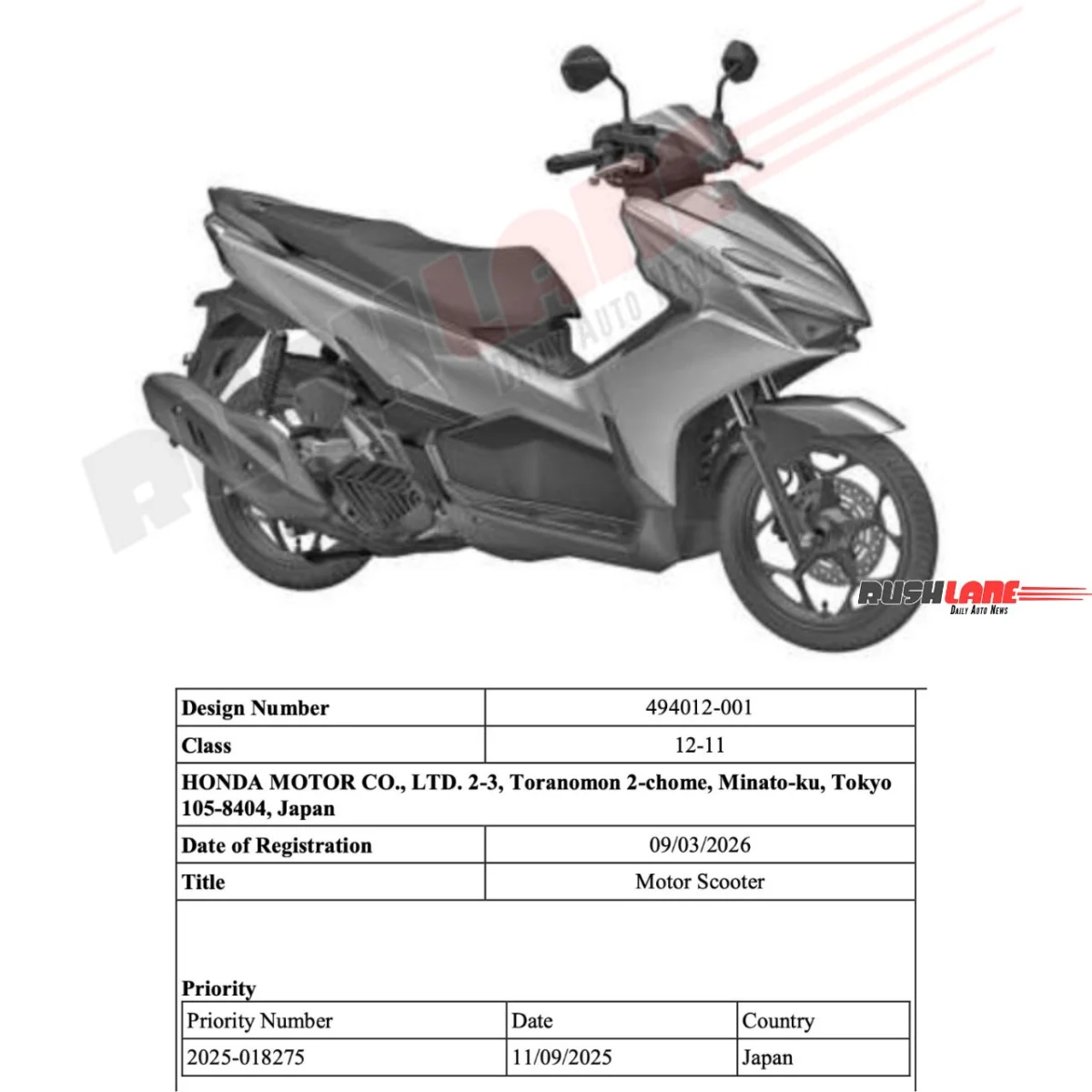
The Indian two-wheeler landscape is currently undergoing a seismic shift. While the segment was once dominated by utilitarian "family" scooters prioritized for fuel efficiency and floorboard space, a new era of performance-oriented, "maxi-style" scooters is taking hold. Leading this charge is Honda Motorcycles and Scooters India (HMSI), a company that has long held a near-monopoly on the commuter segment via the venerable Activa. However, recent developments indicate that Honda is no longer content with just the "safe" choice. The Japanese giant has officially patented the latest generation of the Honda Airblade in India, signaling a major strategic pivot toward the premium performance scooter market.
Main Facts: The Entry of a Global Heavyweight
The Honda Airblade is a renowned name in Southeast Asian markets, particularly in Vietnam and Thailand, where it has served as a benchmark for sporty, mid-capacity scooters for over a decade. The patenting of the Airblade in India suggests that HMSI is preparing to challenge the dominance of the Yamaha Aerox 155 and the upcoming Hero Xoom 160.
The Airblade is not a traditional "step-through" scooter. It features a central spine that houses the fuel tank, a design choice that prioritizes chassis rigidity and handling over flat-floorboard utility. Globally, the Airblade is offered in two liquid-cooled engine configurations: a 125cc variant and a more potent 160cc version. While the patent drawings do not explicitly confirm which displacement will grace Indian shores, industry analysts suggest that the 160cc model is the most likely candidate to compete in India’s burgeoning "super-scooter" category.
Key technical highlights of the Airblade include:
- Engine: 156.93cc, single-cylinder, liquid-cooled, 4-valve engine.
- Performance: Approximately 15 bhp and 14.8 Nm of torque.
- Weight: A remarkably low curb weight of 113 kg (for the 160cc version).
- Technology: "Crystal Light" LED projector headlamps, Honda Smart Key, and a fully digital LCD instrument cluster.
Chronology: From Utility to Performance
The journey of Honda scooters in India began in 2001 with the launch of the first-generation Activa. For over two decades, the Activa has been the default choice for millions, effectively defining the "scooter" for the Indian public. However, the market began to diversify around 2018–2019, as younger buyers sought more than just a commute; they wanted an identity.

2018–2021: The Rise of the Sporty Scooter
During this period, the Suzuki Burgman Street 125 introduced Indian riders to the "maxi-scooter" aesthetic, though it remained a 125cc commuter under the skin. Meanwhile, the TVS NTORQ 125 proved that performance and technology could drive high sales volumes in the youth demographic.
2022: The Yamaha Aerox 155 Disruptor
The arrival of the Yamaha Aerox 155 changed the rules of the game. By transplanting the R15’s liquid-cooled engine into a scooter chassis, Yamaha proved there was a hungry market for high-performance scooters priced above ₹1.40 lakh.
2024–2025: Honda’s Strategic Move
Recognizing the gap in its portfolio—where it only offered the Activa (commuter) and the Dio (sporty commuter)—HMSI began evaluating its global portfolio. The decision to patent the Airblade follows a record-breaking April 2026 performance, where HMSI saw a 15% year-on-year growth, selling 4.84 lakh units. With the "mass market" secured, the company is now focusing on "premiumization."
Supporting Data: Engineering and Competitive Benchmarking
To understand the potential impact of the Airblade, one must look at the specifications in comparison to its primary rivals. The Airblade 160’s greatest strength lies in its power-to-weight ratio.
Technical Specification Comparison
| Feature | Honda Airblade 160 | Yamaha Aerox 155 | Hero Xoom 160 |
|---|---|---|---|
| Engine | 156.93cc, Liquid-Cooled | 155cc, Liquid-Cooled (VVA) | 156cc, Liquid-Cooled |
| Power | 15 bhp | 14.8 bhp | 14 bhp (Est.) |
| Torque | 14.8 Nm | 13.9 Nm | 13.7 Nm (Est.) |
| Curb Weight | 113 kg | 126 kg | 142 kg |
| Fuel Tank | 4.4 Liters | 5.5 Liters | ~7 Liters |
| Wheel Size | 14-inch (Front/Rear) | 14-inch (Front/Rear) | 14-inch (Front/Rear) |
The data reveals that the Honda Airblade 160 is significantly lighter than its competitors. At 113 kg, it is 13 kg lighter than the Aerox and a staggering 29 kg lighter than the Hero Xoom 160. This weight advantage translates to superior agility in urban traffic and potentially quicker off-the-line acceleration, despite having similar power figures.

Efficiency and Range
Honda claims a mileage of 44.8 km/l for the 160cc variant. While the 4.4-liter fuel tank is smaller than that of its rivals, the efficiency ensures a theoretical range of nearly 200 km. The scooter also features a 23.2-liter under-seat storage compartment, facilitated by the relocation of the fuel tank to the central spine, allowing it to hold a full-face helmet and additional gear.
Official Responses and Market Positioning
While HMSI has not yet released an official launch date, the patent filing is a standard precursor to either local manufacturing or R&D testing for the Indian environment. In recent press interactions regarding their sales growth, HMSI leadership has emphasized a "multi-pronged approach" to the Indian market.
A spokesperson for HMSI recently noted, "Our focus remains on delivering products that resonate with the evolving aspirations of Indian riders. While the Activa remains our cornerstone, we are actively exploring the premium and performance segments to cater to the growing demand for sophisticated technology and sporty design."
Industry insiders suggest that if the Airblade is greenlit for production, it will likely be sold through Honda’s premium "BigWing" dealerships or a specialized section of their standard showrooms to differentiate it from the mass-market Activa. This positioning would allow Honda to command a premium price point, likely ranging between ₹1.45 lakh and ₹1.60 lakh (ex-showroom).
Implications: A New Era for the Indian Scooterist
The patenting of the Honda Airblade carries significant implications for the Indian automotive industry and the consumer alike.

1. The End of the "One-Size-Fits-All" Scooter
For decades, the Indian scooter was a compromise—a vehicle for the father to buy groceries, the mother to commute to work, and the son to go to college. The Airblade represents the "individualization" of the scooter. Its lack of a flat floorboard makes it impractical for carrying heavy grocery bags, but its 14-inch wheels and liquid-cooled engine make it a legitimate tool for weekend touring and spirited riding.
2. Intensifying the "Tech War"
The Airblade brings features usually reserved for premium motorcycles. The "Crystal Light" technology is not just a marketing term; it refers to a specific lens geometry designed to provide a wider and deeper throw of light, improving safety during night rides. The inclusion of a USB charging port, keyless go (Smart Key), and single-channel ABS as standard will force other manufacturers to upgrade their existing 125cc and 150cc offerings.
3. Impact on Local Manufacturing
If Honda decides to manufacture the Airblade in India rather than importing it as a CKD (Completely Knocked Down) unit, it could lead to the localization of high-end components like liquid-cooling systems and advanced fuel injection modules. This would benefit the wider Indian component ecosystem and potentially lower costs for future performance models.
4. Competitive Pressure on Hero and Yamaha
Hero MotoCorp is currently betting big on the Xoom 160, which features a more rugged, adventure-focused design. Yamaha has enjoyed a virtual monopoly in the performance scooter space with the Aerox. The entry of Honda—with its massive service network and brand trust—could disrupt the status quo. Honda’s reputation for refinement and engine longevity (the "H-ness" factor) will be a significant draw for buyers who find the Aerox too aggressive or the Xoom too unproven.
Conclusion
The Honda Airblade patent is more than just a legal filing; it is a statement of intent. It signifies that the world’s largest two-wheeler manufacturer recognizes that India is ready for "lifestyle" scooters. While the Activa will continue to provide the volume, the Airblade is poised to provide the "soul" of Honda’s scooter lineup in India. Whether it arrives in its 125cc or 160cc avatar, the Airblade is set to redefine what an Indian rider can expect from a twist-and-go machine: a blend of surgical precision, modern aesthetics, and the reliability that has become synonymous with the Honda wing badge.
