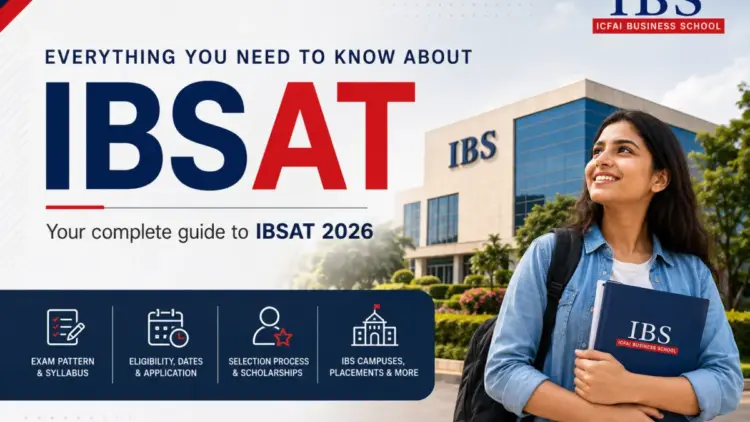
Hyderabad, India – [Current Date] – For aspiring management professionals aiming to secure a coveted MBA or PGPM degree from the esteemed ICFAI Business School (IBS) network, the IBSAT 2026 examination stands as the primary gateway. This national-level aptitude test, conducted by the ICFAI Foundation for Higher Education (IFHE), offers a singular application route to nine IBS campuses across India. With applications now open, IBSAT 2026 presents a compelling opportunity, further bolstered by a significant Rs. 10 crore merit scholarship pool for the 2027-29 intake and the continued option to leverage scores from other leading management entrance examinations.
IBSAT 2026: Key Facts at a Glance
IBSAT 2026 is more than just an entrance exam; it’s a strategic pathway designed to identify and nurture future business leaders. The test will be held in December 2026, with applications open from July 1st until the third week of December. The application fee remains an accessible ₹1,800. The examination comprises 140 multiple-choice questions spread across 120 minutes, with no negative marking. Notably, there are no sectional time limits, granting candidates the flexibility to allocate their time strategically across the four distinct sections: Verbal Ability, Reading Comprehension, Quantitative Aptitude, and Data Adequacy & Interpretation. The results are anticipated in the first week of January 2027, followed by selection briefings and the final selection process in the subsequent months.
| Particulars | Details |
|---|---|
| Full Form | ICFAI Business School Aptitude Test |
| Conducting Body | ICFAI Foundation for Higher Education (IFHE) |
| Exam Level | National |
| Frequency | Once a year |
| Exam Month | December 2026 |
| Mode | Online |
| Duration | 120 minutes |
| Total Questions | 140 |
| Total Marks | 140 |
| Sections | 4 (Verbal Ability, Reading Comprehension, Quant, DI/DA) |
| Question Type | Multiple Choice Questions (MCQs) |
| Marking Scheme | +1 for each correct answer |
| Negative Marking | No |
| Application Fee | ₹1,800 |
| Application Window | July 1 – Third week of December 2026 |
| Result Declaration | First week of January 2027 (Tentative) |
| Selection Briefings | January 2027 (Tentative) |
| Selection Process | February 2027 (Tentative) |
Note: Dates marked as tentative are subject to change by IBS.
A Streamlined Path to Nine Prestigious Campuses
One of the most significant advantages of IBSAT is its unified application system. Aspirants can apply to all nine IBS campuses—Ahmedabad, Bengaluru, Dehradun, Gurgaon, Hyderabad, Jaipur, Kolkata, Mumbai, and Pune—with a single application. This model significantly simplifies the admission process, eliminating the need for multiple applications and reducing administrative burdens. The campuses offer a mix of MBA and PGPM programs, with IBS Hyderabad, Bengaluru, Dehradun, and Jaipur historically offering MBA degrees, while Ahmedabad, Gurgaon, Kolkata, Mumbai, and Pune have focused on the two-year PGPM. Candidates are advised to verify the specific program offerings for the 2027-29 intake at each campus before finalizing their preferences.
IBSAT 2026 Eligibility Criteria: An Inclusive Approach
IBSAT maintains an inclusive eligibility framework, welcoming a diverse pool of candidates. To be eligible for the two-year MBA/PGPM programs, candidates must have secured at least 50% marks in their graduation from a recognized university. This requirement extends to final-year undergraduate students as well, provided they complete their degree within the stipulated timeline. For candidates whose undergraduate education was not conducted in English, submission of a TOEFL, NELT, or IELTS score by the specified deadline may be necessary. Importantly, IBSAT does not impose an age limit, ensuring that experience and ambition, rather than age, are the primary considerations.
Understanding the IBSAT Examination Structure and Syllabus
The IBSAT exam is meticulously designed to assess a candidate’s aptitude and potential for management studies. The structure, with its 140 questions within a 120-minute timeframe and no negative marking, emphasizes speed, accuracy, and strategic question selection.
IBSAT 2026 Sectional Breakdown:
| Section | Number of Questions |
|---|---|
| Verbal Ability | 50 |
| Reading Comprehension | 30 |
| Quantitative Aptitude | 30 |
| Data Adequacy & Interpretation | 30 |
| Total | 140 |
The absence of sectional time limits is a crucial tactical advantage, allowing candidates to navigate the exam based on their strengths and weaknesses. This necessitates a preparation strategy that prioritizes not just conceptual understanding but also efficient problem-solving and time management.
Detailed Syllabus Breakdown:
-
Verbal Ability (50 Questions): This section is the largest component of the exam and requires a strong command of English grammar, vocabulary, and sentence construction. Key areas include:
- Grammar (Parts of Speech, Tenses, Voice, Narration, Articles, Prepositions, Conjunctions, Subject-Verb Agreement, etc.)
- Vocabulary (Synonyms, Antonyms, Analogies, Idioms & Phrases, Word Roots, etc.)
- Sentence Correction and Improvement
- Verbal Reasoning (Logical sequencing of sentences, Syllogisms, etc.)
- Fill in the Blanks
-
Reading Comprehension (30 Questions): This section evaluates a candidate’s ability to comprehend and analyze written passages effectively. Preparation should focus on:
- Identifying the main idea and central theme of a passage.
- Inferring meanings and drawing conclusions.
- Understanding the author’s tone and purpose.
- Answering questions based on explicit and implicit information.
- Developing speed in reading and comprehension.
-
Quantitative Aptitude (30 Questions): This segment tests fundamental mathematical concepts commonly found in management entrance exams. Key areas include:
- Arithmetic (Number System, Percentages, Profit & Loss, Ratio & Proportion, Time & Work, Time Speed & Distance, etc.)
- Algebra (Linear & Quadratic Equations, Progressions, etc.)
- Geometry (Mensuration, Coordinate Geometry, etc.)
- Modern Maths (Permutations & Combinations, Probability, Set Theory, etc.)
- Number Theory
-
Data Adequacy & Interpretation (30 Questions): This section assesses the ability to interpret data presented in various formats and determine the sufficiency of information to answer questions. Focus areas include:
- Data Interpretation (Tables, Bar Graphs, Pie Charts, Line Graphs, Caselets)
- Data Sufficiency (Determining if given data is sufficient to answer a question)
- Logical Reasoning related to data analysis.
IBSAT vs. CAT: A Strategic Distinction
The perennial question for many MBA aspirants is whether IBSAT is easier than CAT. The answer is nuanced. While both are management entrance exams, they possess distinct testing dynamics. IBSAT’s 140 questions in 120 minutes, coupled with no negative marking, create a high-stakes environment where speed and strategic selection are paramount. Unlike CAT, where negative marking often discourages random guessing, IBSAT encourages a more aggressive approach to maximizing scores by attempting all questions. This doesn’t imply random marking, but rather a calculated effort to convert every opportunity into a point. Preparing for CAT provides a strong conceptual foundation for IBSAT, but specific practice focusing on the IBSAT format is crucial for success.
The IBSAT Strategy: Mastering the Art of Speed and Selection
The core of a winning IBSAT strategy lies in mastering speed and selection. With an average of approximately 51 seconds per question (140 questions / 120 minutes), efficient time management is non-negotiable. A robust strategy involves three layers:
- Accuracy: Building a solid conceptual foundation ensures that easy and moderate questions are answered correctly, providing a reliable scoring base.
- Speed: Practicing to solve familiar question types quickly, minimizing unnecessary calculations, is vital.
- Selection: Developing the crucial skill of knowing when to move on from a difficult question is often underestimated. Spending excessive time on a single challenging problem can cost the opportunity to solve multiple easier ones.
Preparing for IBSAT 2026: A Phased Approach
Candidates already preparing for other management entrance exams like CAT, XAT, NMAT, or GMAT will find significant overlap in the core syllabus for IBSAT. However, IBSAT-specific mocks are indispensable due to its unique format. A practical preparation framework includes:
- Phase 1: Build the Base: Strengthen fundamentals in arithmetic, algebra, grammar, vocabulary, and reading comprehension.
- Phase 2: Introduce Timed Practice: Begin solving mixed sets under timed conditions to acclimatize to time pressure.
- Phase 3: IBSAT-Specific Mocks: Take full-length mock tests designed around the 140-question/120-minute format to simulate the actual exam experience.
- Phase 4: Analyze, Don’t Just Attempt: Thoroughly analyze mock test performance, identifying strengths, weaknesses, question accuracy, time spent per question, and areas for improvement.
- Phase 5: Develop Personal Exam Order: Experiment with different section sequences in mocks to determine the order that maximizes your score per minute.
The Application Process: A Seamless Journey
IBS has designed a straightforward application process for IBSAT 2026:
- Online Registration: Visit the official IBSAT website and create your profile by providing essential personal and contact details.
- Application Fee Payment: Pay the non-refundable application fee of ₹1,800.
- Confirmation: Receive confirmation of your application submission along with login credentials.
- Profile Completion: Log in to complete the detailed application form.
- Score Route Selection: Indicate whether you will be appearing for IBSAT or submitting scores from CAT, XAT, NMAT by GMAC, or GMAT.
- Await Selection Call: Candidates meeting the qualifying criteria will be invited for the subsequent selection stages.
IBSAT 2026: Crucial Dates to Remember
Aspirants must remain vigilant regarding the official dates, as many are marked as tentative:
| Event | Timeline |
|---|---|
| Application Begins | July 1, 2026 |
| Application Deadline | Third week of December 2026 |
| IBSAT 2026 Exam | December 2026 |
| Result Declaration | First week of January 2027 (Tentative) |
| Selection Briefings | January 2027 (Tentative) |
| Selection Process | February 2027 (Tentative) |
Candidates are strongly advised to verify specific exam dates and guidelines on the official IBSAT website, as unofficial information circulating on coaching platforms or social media may not be accurate.
Beyond the Exam: The IBS Selection Process
Clearing IBSAT is the first step in a multi-stage admission process. Shortlisted candidates will be invited for the IBS selection process, which typically includes:
- Micro Presentation (MP): This segment assesses a candidate’s ability to articulate thoughts clearly and concisely within a limited timeframe. Candidates may be given a topic and a short preparation window to present their ideas, demonstrating structure, clarity, and confidence.
- Personal Interview (PI): The interview aims to evaluate a candidate’s communication skills, motivation, career aspirations, and overall suitability for the program.
Crucially, IBS considers past academic performance alongside performance in the Micro Presentation and Personal Interview. This underscores the importance of maintaining a strong academic record throughout one’s educational journey.
A Significant Boost: IBSAT 2026 Scholarships
A major development for the 2027-29 intake is the introduction of a substantial Rs. 10 crore merit scholarship pool. This initiative aims to support deserving students and reduce the financial burden of pursuing an MBA/PGPM. The scholarship structure is designed to reward academic merit:
- Top 100 Ranks in IBSAT: Full tuition fee waiver.
- Next 200 Ranks in IBSAT: 50% tuition fee waiver.
This scholarship opportunity is available to candidates applying through IBSAT as well as those using CAT, XAT, NMAT by GMAC, or GMAT scores, subject to fulfilling the applicable conditions. This initiative significantly enhances the attractiveness of IBS as a preferred destination for management education.
National Mock Test: Benchmarking Your Preparation
IBS is actively promoting candidate preparedness through a National Mock Test initiative for IBSAT 2026. Scheduled across multiple months leading up to the examination, these online proctored mock tests offer participants valuable benchmarking opportunities. Prizes for the top 100 performers, including cash awards and scholarships, add an extra layer of motivation. Furthermore, the official IBSAT platform provides a free mock test, mirroring the 140-question, four-section format, which is an invaluable tool for aspirants to assess their readiness against the actual exam structure.
Understanding IBSAT Cut-Offs: A Holistic View
IBS does not publish a single, universal cut-off score for IBSAT applicable to all its campuses. Instead, invitations for the selection process are based on qualifying performance, and campus allotment is determined by a combination of the candidate’s score, campus preferences, and the specific cut-off for each campus, which can vary annually. Aspirants are best advised to focus on maximizing their IBSAT score rather than aiming for a predicted cut-off, as a higher score invariably strengthens their chances across all preferred campuses.
Choosing Your Campus: A Strategic Decision
Selecting the right IBS campus is a critical decision that should extend beyond solely relying on IBSAT scores. Aspirants should conduct thorough research across several parameters:
- Programme Offered: MBA vs. PGPM.
- Location: Proximity to desired industry hubs and lifestyle preferences.
- Placements: Detailed analysis of average and median salaries, recruiter diversity, sector-wise placements, and role profiles.
- Fees and ROI: Comprehensive evaluation of the program cost against projected career earnings.
- Specializations and Career Goals: Alignment of campus offerings with individual career aspirations (e.g., Finance, Marketing, Consulting).
- Student Experience: Infrastructure, extracurricular activities, industry exposure, and alumni network.
IBS Placements: A Track Record of Success
IBS consistently reports high placement rates across its campuses, with over 90% of students securing positions in leading organizations. For the IBS Hyderabad Class of 2026, notable statistics include an average CTC of ₹14.06 LPA and a highest CTC of ₹26.12 LPA. The extensive network of over 1,000 corporate partners across diverse sectors—including finance, banking, consulting, IT/ITES, FMCG, and e-commerce—provides a broad spectrum of opportunities for graduating students. Aspirants are encouraged to look beyond the highest package and analyze median/average outcomes, role diversity, and the total cost of the program for a realistic assessment of return on investment.
IBSAT vs. CAT: A Complementary Approach
For aspirants targeting a wide range of B-schools, CAT remains the foundational examination due to its acceptance by the IIMs and numerous other top-tier institutions. IBSAT, conversely, is specifically relevant for those with IBS in their sights. The good news is that robust CAT preparation naturally covers a significant portion of the IBSAT syllabus. The key is to adapt by practicing the IBSAT format, emphasizing speed, accuracy, and strategic question selection within its unique structure.
Leveraging Existing Scores: An Alternative Pathway
IBS offers a significant advantage by allowing candidates to use valid CAT, XAT, NMAT by GMAC, or GMAT scores as an alternative to IBSAT. This provides flexibility for candidates who have already achieved competitive scores in these exams, potentially streamlining their admission process. For those without such scores, or who wish to enhance their application with an IBSAT performance, the exam remains a vital entry point.
Frequently Asked Questions About IBSAT 2026
Is IBSAT 2026 difficult?
IBSAT’s difficulty lies in its unique format – 140 questions in 120 minutes with no negative marking, demanding high speed and strategic question selection.
How many questions are in IBSAT?
There are 140 questions.
What is the duration of IBSAT?
The exam duration is 120 minutes (2 hours).
Is there negative marking?
No, there is no negative marking.
Are there sectional time limits?
No, candidates can move freely between sections.
What is the cost of IBSAT 2026?
The application fee is ₹1,800.
When will IBSAT 2026 be conducted?
The exam is scheduled for December 2026.
When will the IBSAT 2026 result be announced?
The result is tentatively scheduled for the first week of January 2027.
Can final-year students apply?
Yes, provided they meet graduation requirements within the stipulated time.
What is the minimum graduation percentage?
A minimum of 50% in graduation is required.
Which exams can be used instead of IBSAT?
CAT, XAT, NMAT by GMAC, and GMAT scores are accepted.
How many IBS campuses are there?
There are nine IBS campuses across India.
What happens after IBSAT?
Shortlisted candidates proceed to the Micro Presentation and Personal Interview rounds.
The Bottom Line: IBSAT – A Strategic Opportunity
IBSAT 2026 is an exam that rewards strategic thinking, efficiency, and a deep understanding of one’s strengths. The combination of a high question count, a generous time limit, no negative marking, and no sectional constraints presents a unique challenge that can be mastered with focused preparation. The opportunity to apply to nine campuses with a single application, coupled with the flexibility of using other accepted scores and the significant new scholarship pool, makes IBSAT a compelling pathway for aspiring MBA candidates.
For those targeting IBS, the time to act is now. Understand the exam pattern, build a strong conceptual foundation, engage in timed practice, and meticulously track official announcements. Treat IBSAT not merely as another entrance test, but as a strategic component of your B-school admission plan. Success in IBSAT, and subsequently at IBS, hinges on how effectively you leverage your 120 minutes – a deceptively simple yet profoundly impactful determinant of your future in management education.
[Link to IBSAT 2026 Application Page]
[Link to PaGaLGuY Forum for IBSAT Aspirants]