

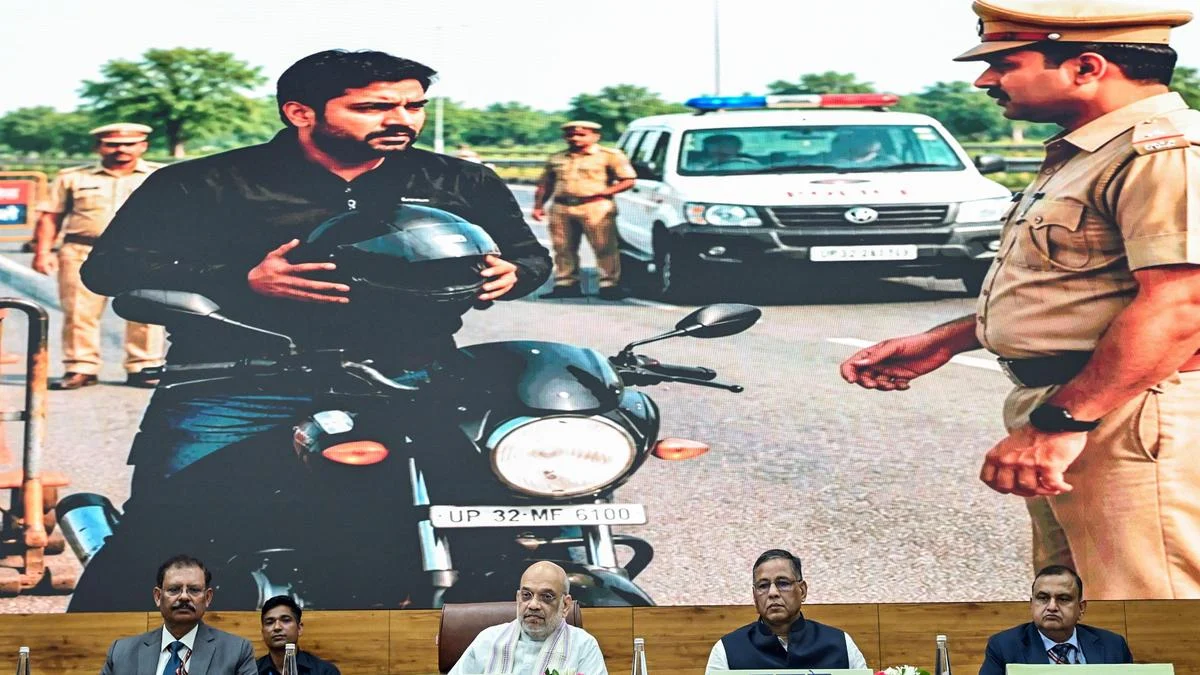
New Delhi, June 19, 2026 – In a landmark move poised to revolutionize crime detection and investigation across India, Union Home Minister Amit Shah today launched "Abhigyan," a groundbreaking mobile application that will equip police and investigating agencies nationwide with portable fingerprint scanners linked to a vast national database of criminal records. The initiative, unveiled at the 26th All India Fingerprint Conference 2026 held at the Sardar Vallabhbhai Patel Auditorium in New Delhi, promises to usher in an era of real-time, on-the-spot identification of criminal suspects, fundamentally altering policing methodologies.
The launch, attended by key figures including Director of the National Crime Records Bureau (NCRB) Alok Ranjan and Director of the Intelligence Bureau of India Tapan Deka, marks a significant leap towards smart policing, leveraging advanced biometric technology to enhance law enforcement capabilities. While hailed as a powerful tool for bolstering national security and expediting justice, the system’s inherent ability to conduct random checks on individuals raises critical questions regarding privacy, civil liberties, and the legal framework governing such pervasive surveillance.
The Technological Leap: Abhigyan and NAFIS
At the heart of this transformative initiative is "Abhigyan," an application meticulously developed by the National Crime Records Bureau (NCRB). This innovative app serves as the crucial interface, linking portable fingerprint scanners directly to the National Automated Fingerprint Identification System (NAFIS). NAFIS, a centralized digital repository, currently houses fingerprint scans of an astounding 1.3 crore (13 million) criminal suspects and convicts, including those presently incarcerated in prisons across the country.
The demonstration of Abhigyan during the conference showcased its remarkable efficiency. Field officers, equipped with these portable scanners and smartphones, will be able to collect thumb impressions from individuals anywhere – even during routine vehicle checks or on the streets – and instantly cross-reference them with the NAFIS database. The system boasts an impressive response time, capable of matching prints with the national database in a mere 35 seconds. This rapid identification capability stands in stark contrast to the previous, more cumbersome process, which required bringing individuals to one of the 1,556 static workstations deployed at police stations and district headquarters for fingerprint verification.

Union Home Minister Amit Shah underscored the app’s potential, stating, "Secured with two-step authentication, it allows real-time fingerprint identification within seconds, strengthening ground-level policing. Equipped with features such as fast identification, portability, and access to millions of records, ‘Abhigyan’ is a highly powerful tool." He highlighted that the NAFIS database is already a rich reservoir of information, containing records of approximately 9.91 lakh narcotics offenders and 3.65 lakh human trafficking cases, among other extensive prison databases.
Empowering Field Policing: A Paradigm Shift
The introduction of Abhigyan represents a significant paradigm shift in how law enforcement operates at the ground level. The immediate implications for policing are profound:
- Real-time Intelligence: Police personnel will no longer need to rely solely on visual identification or verbal information. They can quickly ascertain if an individual has a criminal record, is wanted in connection with crimes, or has a history of serious offenses.
- Enhanced Officer Safety: As the demonstration highlighted, "Field officers can get the criminal history of the suspect in a few seconds. This will provide protection to the police officials, as they will be alerted of the presence of a hardened criminal." This immediate intelligence can significantly reduce risks for officers confronting potentially dangerous individuals.
- Increased Efficiency in Routine Checks: Vehicle checks, patrolling, and other routine law enforcement activities will become more effective. Suspicious individuals can be quickly identified and their backgrounds checked, allowing police to focus resources where they are most needed.
- Proactive Crime Prevention: By enabling faster identification of known offenders, Abhigyan could deter potential criminals and aid in apprehending those attempting to evade justice.
- Streamlined Investigations: The ability to instantly identify suspects at crime scenes or during initial questioning can accelerate investigations, leading to quicker arrests and resolution of cases.
This move aligns with the government’s broader vision of ‘smart policing,’ which emphasizes the integration of technology, data analytics, and modern techniques to improve law enforcement efficiency and responsiveness. The shift from static fingerprint workstations to mobile units fundamentally decentralizes a critical investigative tool, placing it directly in the hands of frontline officers.
Legal Ambiguity and Privacy Concerns: A Looming Debate
While the operational benefits of Abhigyan are clear, its proposed implementation, particularly the provision for stopping individuals "anywhere, even on the streets" for fingerprint collection, immediately brings to the forefront significant legal and ethical considerations. The core of this debate revolves around the interpretation and application of the Criminal Procedure Identification Act, 2022.

An NCRB official cited the Act as providing the legal basis for such checks. However, a closer examination of Section 3 of the Criminal Procedure Identification Act, 2022, reveals a potential area of contention. This section primarily limits the mandatory recording of "measurements" – which include fingerprints – to specific categories of individuals:
- Those who have been convicted of an offense punishable under any law.
- Those who have been arrested in connection with an offense punishable under any law.
- Those who have been ordered by a court to give security for good behaviour or maintaining peace under the Code of Criminal Procedure, 1973.
Crucially, the Act does not explicitly mention the possibility of random testing of individuals without any prior evidence linking them to a punishable offense or without them falling into one of the aforementioned categories. The phrase "suspicious individual" used in the Abhigyan demonstration appears to exist in a legal grey area, potentially allowing for broader collection of biometric data than the Act, in its current interpretation, might permit.
This discrepancy raises several critical questions and concerns:
- Right to Privacy: India’s Supreme Court, in the landmark Puttaswamy judgment, affirmed the right to privacy as a fundamental right. The ability of law enforcement to collect biometric data from citizens without clear grounds or judicial oversight could be challenged as an infringement on this right.
- Potential for Misuse and Harassment: Critics argue that such a powerful tool, without stringent safeguards, could be susceptible to misuse, leading to arbitrary detention, harassment, or profiling of specific communities or individuals. The definition of "suspicious" could be subjective and open to abuse.
- Lack of Explicit Consent: If individuals are compelled to provide fingerprints during routine checks without being arrested or having committed a crime, the element of consent becomes a complex issue.
- Data Security and Integrity: With such a massive and sensitive database, concerns about data breaches, unauthorized access, and the potential for identity theft become paramount. Robust cybersecurity measures and continuous auditing will be essential.
- Scope Creep: There are fears that a system designed for specific law enforcement purposes could gradually expand its scope, leading to a de facto national biometric registry for all citizens, blurring the lines between criminal identification and general surveillance.
- Judicial Oversight and Accountability: Clear guidelines on when and how these portable scanners can be used, along with mechanisms for accountability and redressal for individuals whose rights may be violated, are crucial. The absence of judicial pre-authorization for such checks in non-arrest situations is a significant concern.
Legal experts are likely to scrutinize these provisions closely, potentially leading to public interest litigations challenging the scope of Abhigyan’s application in situations not explicitly covered by the existing legal framework. The government may need to issue clear Standard Operating Procedures (SOPs) or even consider amendments to the Act to explicitly define the circumstances under which such random biometric checks are permissible and to establish robust safeguards.

Beyond Identification: A Holistic Approach to Justice
Home Minister Amit Shah’s address transcended the immediate operational benefits of Abhigyan, articulating a broader vision for criminal justice reform in India. He emphasized that the effectiveness of NAFIS and similar technologies hinges on more than just identification; it requires a holistic approach encompassing data enrichment, forensic science integration, time-bound prosecution, and enhanced training.
Shah stressed that NAFIS should not be used merely to identify offenders but must be continuously enriched by uploading fingerprints collected from every crime scene. This highlights the crucial link between forensic evidence collection and the efficacy of biometric databases. He also noted the importance of properly preserving DNA samples, emphasizing that they "can also be used in the investigation of other crimes," underscoring that this is primarily the responsibility of the States.
A significant portion of the Minister’s speech focused on the need for systemic improvements in prosecution and conviction rates. He asserted that continued emphasis must be placed not only on apprehending offenders but also on ensuring that crimes are proven in a time-bound manner. "The focus should not be limited merely to the arrest of criminals but on time-bound justice," he reiterated, signaling a shift in priority towards securing convictions rather than just making arrests.
To achieve this, Shah called for a radical overhaul of police training. He stated that training must be made more practical, incorporating the "art of drafting concise chargesheets, along with the precise processes of collecting, preserving, and uploading scientific evidence." He urged that such modules should be developed by experienced prosecutors, ensuring that officers are equipped with the skills necessary to build strong, evidence-based cases.

Shah critically observed, "If courts are still presented with 250 pieces of evidence, even after matching fingerprints, telephone tower data, facial recognition, iris scans, and DNA, then the technology serves no real purpose." This statement underscores his belief that advanced technology must translate into efficient, conclusive prosecution, rather than merely adding to an overwhelming volume of unprocessed data. It’s a clear directive to focus on quality over quantity in evidence presentation and legal arguments.
Challenges and the Road Ahead
The successful pan-India implementation of Abhigyan and the realization of the Home Minister’s vision face several formidable challenges:
- Training and Capacity Building: Equipping over two million police personnel across various state forces with the necessary skills to effectively use the portable scanners and Abhigyan app, while adhering to legal and ethical guidelines, will be a monumental task. Comprehensive and continuous training programs will be essential.
- Infrastructure and Connectivity: While urban areas may have robust internet connectivity, ensuring seamless, real-time access to the NAFIS database in remote and rural areas, where network infrastructure might be patchy, will be critical.
- Data Accuracy and Maintenance: The integrity of the 1.3 crore-strong database is paramount. Regular auditing, updating, and error correction mechanisms will be needed to prevent false positives or negatives, which could have severe consequences for individuals.
- Public Acceptance and Trust: Building public trust in a system that allows for on-the-spot biometric collection will require transparency, clear communication, and demonstrated commitment to upholding individual rights. Addressing fears of surveillance and potential harassment will be crucial for widespread acceptance.
- Inter-Agency Coordination: Effective utilization of NAFIS and Abhigyan requires seamless coordination between central agencies like the NCRB, state police forces, and other investigative bodies. Standardized protocols for data collection, sharing, and usage will be necessary.
- Technological Evolution: The field of biometrics is constantly evolving. Ensuring that NAFIS and Abhigyan remain technologically advanced, secure, and compatible with future innovations will require continuous investment and upgrades.
- Integration with Other Biometrics: The Home Minister’s mention of DNA, facial recognition, and iris scans hints at a future where these systems might be integrated into a comprehensive national biometric identification network. Such integration would bring further efficiencies but also amplify privacy and security concerns, demanding even more robust legal and ethical frameworks.
The launch of Abhigyan represents a bold step towards modernizing India’s criminal justice system. It offers unparalleled potential to enhance law enforcement efficiency, improve officer safety, and accelerate investigations. However, the true success of this initiative will not only be measured by its technological prowess but also by its ability to navigate the complex legal and ethical landscape, ensuring that the pursuit of security does not come at the expense of fundamental rights and democratic values. The coming months and years will be crucial in defining how India balances these competing demands as it embraces a new era of mobile biometric policing.
