

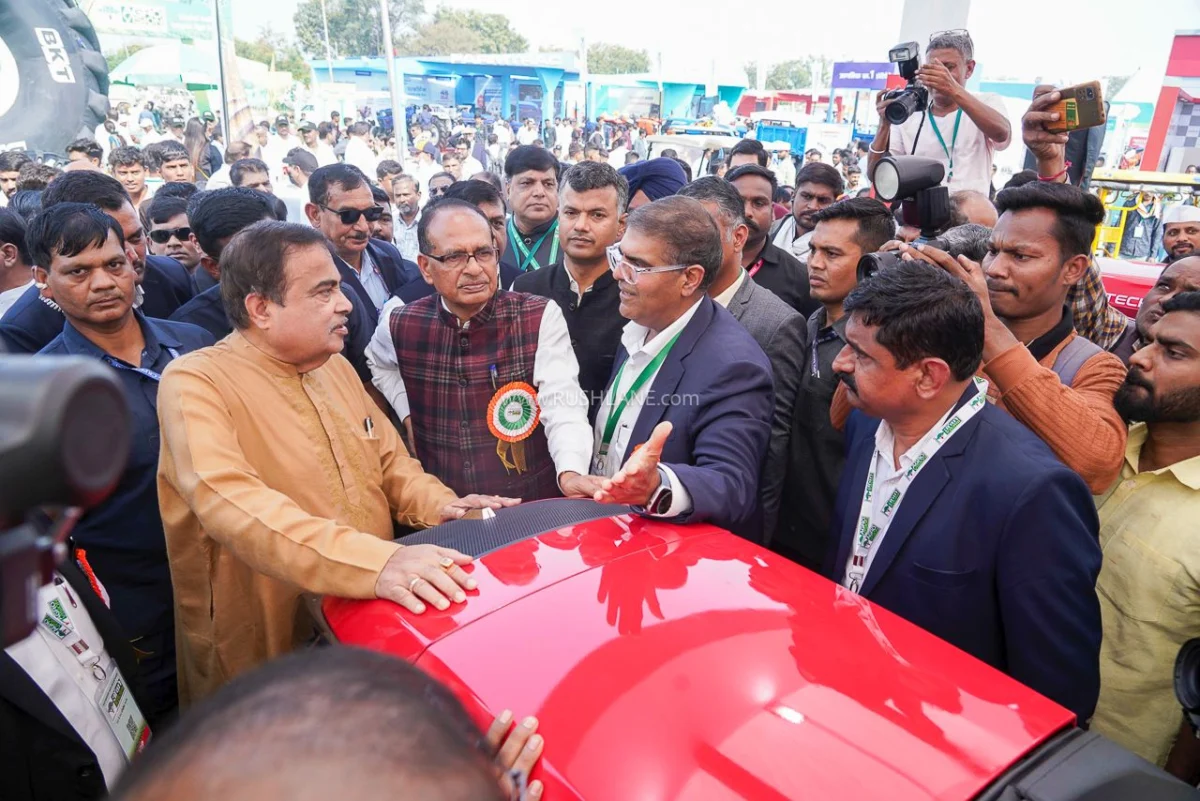
In a landmark move that signals a paradigm shift in India’s energy and automotive landscape, Union Minister for Road Transport and Highways, Nitin Gadkari, has officially signed the regulatory framework authorizing the use of 100% ethanol (E100) as a standalone automotive fuel. This legislative milestone, announced during the Agrovision 2025 event in Nagpur, marks the culmination of years of policy advocacy and technological preparation, positioning India as a global leader in the adoption of biofuels.
The approval of E100 is not merely a technical update to the Central Motor Vehicles Rules (CMVR); it is a strategic maneuver designed to decouple the Indian economy from its heavy reliance on volatile global crude oil markets while simultaneously fortifying the domestic agricultural sector. With this signature, the government has cleared the path for a new generation of Flex-Fuel Vehicles (FFVs) and dedicated ethanol-powered engines to hit Indian roads.
1. Main Facts: The Legal and Regulatory Framework
The formalization of E100 regulations represents the highest tier of the Ethanol Blended Petrol (EBP) program. While the government has aggressively pushed for E20 (20% ethanol blend) across the country over the last two years, E100 represents a "pure-play" alternative where the internal combustion engine (ICE) operates entirely on ethanol produced from renewable biomass.
Key Regulatory Highlights:
- CMVR Amendments: The Ministry of Road Transport and Highways (MoRTH) has amended the Central Motor Vehicles Rules to include E100, E85, and even B100 (100% Biodiesel) as legally recognized fuels.
- Safety and Standards: The new regulations provide the Bureau of Indian Standards (BIS) and the Automotive Research Association of India (ARAI) with the mandate to set specific safety and performance benchmarks for vehicles utilizing these high-concentration biofuels.
- Inter-Ministerial Synergy: The move was a coordinated effort between Gadkari’s ministry and the Ministry of Petroleum and Natural Gas, led by Hardeep Singh Puri. This ensures that as the transport ministry approves the vehicles, the petroleum ministry facilitates the retail infrastructure.
According to Minister Gadkari, the "skepticism" that once surrounded the feasibility of 100% ethanol has been dismantled by successful pilot projects and the willingness of global automakers to adapt their technology for the Indian market.
2. Chronology: The Journey from E5 to E100
India’s transition to high-blend biofuels has been an accelerated journey, moving significantly faster than many global counterparts.
- 2014–2018: The Foundation: India struggled with low blending rates, often hovering around 1.5% to 2%. The government introduced the National Policy on Biofuels in 2018 to incentivize production from various feedstocks beyond just sugarcane molasses.
- 2019–2022: The E10 Milestone: India achieved its target of 10% ethanol blending ahead of schedule. During this period, the Prime Minister moved the target for E20 blending from 2030 to 2025.
- 2023: The E20 Launch: E20 fuel was rolled out at select petrol pumps, and automakers began making all new engines "E20 material-compliant."
- Late 2024 – Early 2025: The Flex-Fuel Offensive: Hero MotoCorp launched the flex-fuel variants of the Splendor+ and HF Deluxe, capable of running on E85. Toyota and Maruti Suzuki showcased prototypes of flex-fuel cars (Innova Hycross and WagonR).
- June 2026 (Current Milestone): Minister Gadkari officially signs the file at 8:00 PM on a Friday evening, legalizing E100 and setting a 45-day countdown for major manufacturer launches.
3. Supporting Data: The Economic and Environmental Rationale
The push for E100 is rooted in cold, hard economics. India is the world’s third-largest consumer of crude oil, importing over 85% of its requirements.
The Import Bill
India spends approximately ₹16 lakh crore (roughly $200 billion) annually on crude oil imports. By transitioning to a higher ethanol mix, the government aims to retain a significant portion of this capital within the domestic economy. Even a 20% reduction in oil imports could save the national exchequer over ₹3 lakh crore annually.
The Agricultural Surplus
India often faces a "problem of plenty" with sugarcane and food grains. Converting surplus sugar, corn, and damaged food grains into ethanol solves two problems: it prevents market price crashes for farmers and provides a sustainable source of fuel.
- Sugar Industry: Ethanol has become a lifeline for sugar mills, helping them clear "Fair and Remunerative Price" (FRP) dues to farmers on time.
- Grain Diversification: The shift toward using maize (corn) for ethanol production provides an alternative crop for farmers in states like Punjab and Haryana, potentially aiding in crop diversification away from water-intensive paddy.
Environmental Impact
Ethanol is a cleaner-burning fuel compared to gasoline. It contains oxygen, which allows the engine to more completely combust the fuel, resulting in lower emissions of carbon monoxide (CO), nitrogen oxides (NOx), and particulate matter. As a plant-based fuel, the carbon dioxide (CO2) released during combustion is largely offset by the CO2 absorbed by the plants during their growth, making it a "well-to-wheel" carbon-neutral cycle in ideal conditions.
4. Official Responses: The Voice of Leadership
Minister Nitin Gadkari has been the most vocal proponent of this transition. At the Nagpur event, his rhetoric focused on the concept of "Atmanirbhar Bharat" (Self-reliant India).

"I am delighted to share that the regulations to legally authorize the use of 100% ethanol are now finalized," Gadkari stated. "Initially, when I proposed this, people were doubtful. They asked how a car could run on the same alcohol people drink or that comes from sugarcane. But today, technology has proven them wrong."
He further emphasized the role of the petroleum ministry: "I, along with Hardeep Singh Puri, have been working to ensure that the ethanol supply chain is robust. We are moving from being a consumer of imported energy to a producer of indigenous green fuel."
Industry leaders have also responded. Representatives from Toyota Kirloskar Motor and Maruti Suzuki have noted that while the technology exists globally (particularly in Brazil), the Indian context requires specific tuning for local climatic conditions and fuel quality. The consensus among the "Big Four" mentioned by Gadkari—Toyota, Suzuki, Hyundai, and MG—is that the regulatory clarity provided by this signature is the "green light" they needed for mass production.
5. Implications: Challenges and the Road Ahead
While the legal path is clear, the practical implementation of E100 faces several "speed bumps" that require careful navigation.
The Infrastructure Hurdle
Ethanol is fundamentally different from petrol. It is hygroscopic, meaning it attracts water from the atmosphere. This poses a challenge for storage tanks and transport tankers, which must be moisture-sealed to prevent fuel degradation. Furthermore, ethanol is corrosive to certain types of rubber and plastic used in older fuel systems. Oil Marketing Companies (OMCs) like IOCL, BPCL, and HPCL will need to invest billions in dedicated E100 dispensing units, separate from existing petrol and diesel pumps.
The Legacy Fleet Dilemma
Perhaps the most significant challenge lies in the millions of vehicles already on Indian roads. As highlighted by recent social media reports—such as a 2022 Kia Sonet owner pointing out a manual warning against fuel with more than 10% ethanol—most existing cars are not designed for high ethanol concentrations.
- Warranty Risks: Using E20 or E100 in a vehicle designed for E10 can void warranties and lead to engine damage, specifically to fuel pumps, gaskets, and fuel lines.
- The Retrofit Question: There is currently no government-approved "kit" to convert older cars to flex-fuel, leaving a large portion of the population tethered to dwindling supplies of low-blend petrol.
Technical Calibration
E100 has a lower energy density than petrol, meaning a car will typically achieve lower mileage (kilometers per liter) on pure ethanol. To compensate, manufacturers must develop high-compression engines and sophisticated Electronic Control Units (ECUs) that can adjust fuel injection timing in real-time based on the ethanol-to-petrol ratio.
6. A Multi-Fuel Future
The approval of E100 is one piece of a much larger puzzle. The Indian government is not betting on a single "silver bullet" for green mobility. Instead, it is fostering a multi-fuel ecosystem:
- Electric Vehicles (EVs): Continued subsidies via FAME schemes for urban and short-distance commuting.
- Hydrogen: Gadkari announced a pilot project in Nagpur for hydrogen-powered buses, aiming to tap into the "Green Hydrogen Mission."
- CNG/LNG: Expanding the city gas distribution network for heavy-duty long-haul transport.
- Bio-CNG: Converting municipal solid waste and agricultural residue (parali) into gas, solving the air pollution crisis caused by stubble burning.
Conclusion
The formal authorization of E100 is a historic turning point. It transforms the Indian farmer from an "Annadata" (food provider) to an "Urjadata" (energy provider). While the transition will take years to reach every corner of the country, the message to the global automotive industry is clear: India’s future is green, indigenous, and powered by ethanol. As Toyota, Suzuki, Hyundai, and MG prepare to roll out their first E100-compatible models in the coming weeks, the Indian consumer stands on the brink of a new era in sustainable mobility.
