

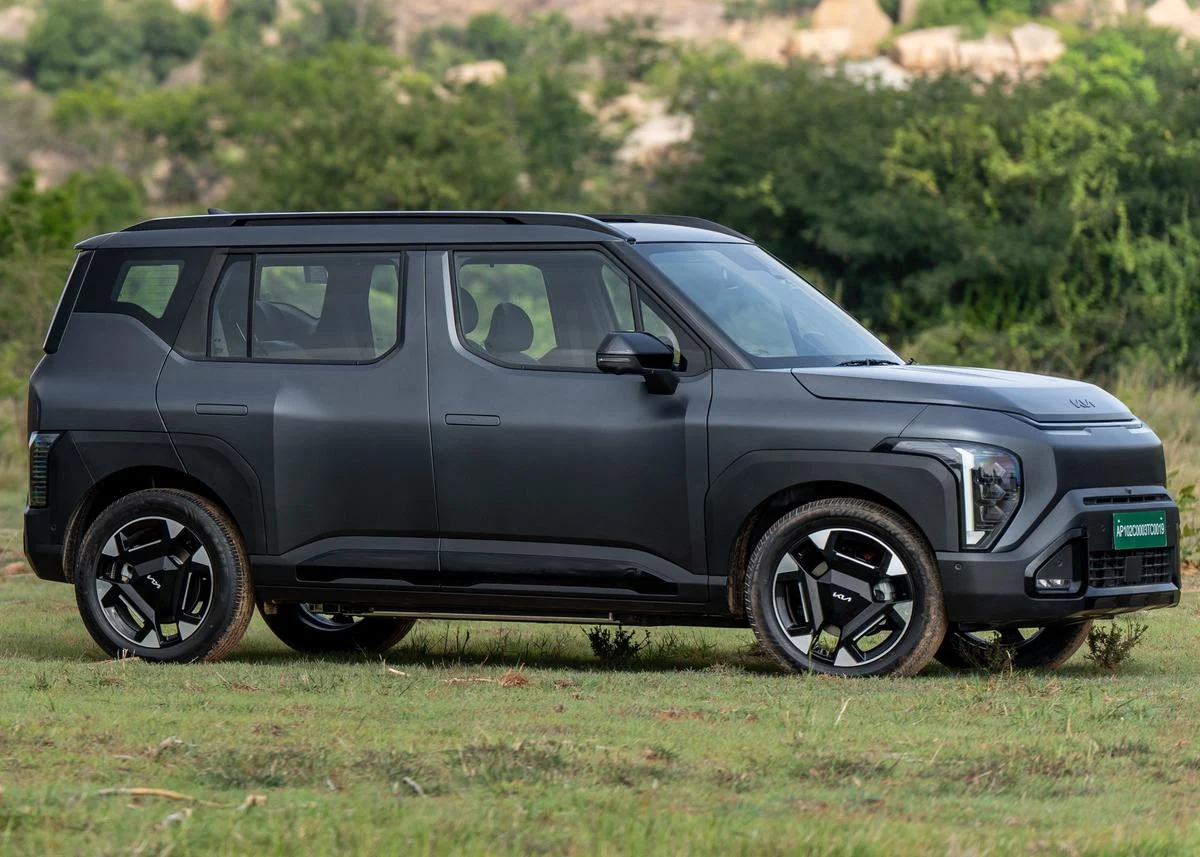
The Indian automotive landscape is witnessing a decisive shift toward electrification, but the transition has often been hampered by a perceived trade-off between size, range, and price. With the official unveiling and drive of the Kia Syros EV, the South Korean automaker appears to have cracked the code for the "Goldilocks" zone of electric mobility. Positioned strategically between ₹13.50 lakh and ₹20.00 lakh (ex-showroom), the Syros EV is not merely an electric version of a combustion vehicle; it is a calculated attempt to redefine what an urban family should expect from a sub-four-meter SUV.
Main Facts: Breaking Down the Syros EV Proposition
The Kia Syros EV enters a hyper-competitive segment, yet it distinguishes itself through a "packaging-first" philosophy. While many manufacturers prioritize aerodynamic silhouettes that often compromise interior headroom, Kia has opted for a tall-boy stance that maximizes every millimeter of its 3,995 mm length.
Key Specifications at a Glance:
- Dimensions: Length of 3,995 mm with a generous 2,550 mm wheelbase.
- Battery Options: 42 kWh (Standard Range) and 51.4 kWh (Long Range).
- Performance: 171 PS of power and 255 Nm of torque (Long Range variant).
- Range: 526 km (MIDC) for the 51.4 kWh pack; 443 km (MIDC) for the 42 kWh pack.
- Acceleration: 0 to 100 km/h in a brisk 8.1 seconds.
- Practicality: Up to 465 liters of boot space with a sliding and reclining rear seat.
- Price Range: ₹13.50 lakh to ₹20.00 lakh.
What makes these numbers significant is the context of the Indian market. The sub-four-meter category is the "bread and butter" of Indian automotive sales due to tax incentives. By hitting the upper limit of this category while offering a wheelbase usually reserved for larger vehicles, Kia has created a car that feels "larger on the inside" than it appears on the outside.
Chronology: From Concept to the Electric Frontier
The journey of the Syros nameplate began with the development of a versatile platform capable of housing both Internal Combustion Engines (ICE) and Battery Electric Vehicle (BEV) powertrains. Kia’s strategy in India has evolved from being a premium newcomer with the Seltos in 2019 to a dominant force in the SUV space.

The Syros EV represents the third phase of Kia’s "Plan S" strategy in India. The first phase established the brand’s ICE credentials; the second phase introduced luxury EVs like the EV6 and EV9 to act as "halo" products; and this third phase aims for volume.
During its development, Kia focused on "India-centric" engineering. This included testing the suspension for varied road qualities—from the smooth highways of the Golden Quadrilateral to the monsoon-ravaged streets of urban centers. The Syros EV was designed to retain the familiar aesthetic of its ICE sibling to ensure a sense of continuity for traditional buyers, while subtly introducing EV-specific elements like the closed-off grille and aero-optimized wheels to signal its futuristic powertrain.
Supporting Data: Engineering and Technology Deep Dive
The Syros EV is a masterclass in utilizing the inherent advantages of an electric architecture within a compact footprint.
Powertrain and Dynamics
The heart of the Syros EV is its Permanent Magnet Synchronous Motor. The 171 PS output is particularly noteworthy because it places the Syros EV ahead of many entry-level luxury sedans in terms of raw power. In an electric vehicle, this power is accessible instantaneously. Unlike a turbocharged petrol engine that requires a build-up of exhaust pressure, the Syros EV delivers its 255 Nm of torque from zero RPM.

This responsiveness is complemented by a sophisticated regenerative braking system. Drivers can use steering-mounted paddles to toggle between different levels of energy recuperation. The "i-Pedal" mode is particularly effective for urban commutes, allowing for "one-pedal driving" where the car slows down significantly just by lifting off the accelerator, simultaneously feeding energy back into the battery.
Battery and Charging Infrastructure
Kia offers two distinct battery chemistries tailored for different usage patterns:
- The 42 kWh Pack: Ideal for city dwellers whose primary usage is daily commuting with occasional weekend trips.
- The 51.4 kWh Pack: Targeted at the "one-car family" who requires the confidence to undertake inter-city travel.
The charging capabilities are equally robust. Utilizing a 100 kW DC fast charger, the Syros EV can replenish its battery from 10% to 80% in just 39 minutes. For home charging, the support for 11 kW AC charging ensures that even the larger battery can be fully topped up overnight, a critical factor for EV adoption in the residential sector.
Interior Versatility: The 465-Liter Breakthrough
Perhaps the most impressive data point is the 465-liter boot capacity. In the sub-four-meter segment, boot space is usually the first casualty of passenger comfort. Kia’s solution—a sliding and reclining rear bench—allows the owner to prioritize either luggage or legroom. When the seats are moved forward, the Syros EV offers cargo capacity that rivals SUVs from the segment above, making it a viable tool for family vacations.

Official Responses and Market Positioning
Kia’s leadership has been vocal about the Syros EV not being a "niche" product. The company’s positioning targets the "tech-savvy Indian family" that values premium features but is conscious of value for money.
The Maruti Suzuki e Vitara Factor
The elephant in the room is the upcoming Maruti Suzuki e Vitara. While the e Vitara is technically a larger vehicle, Kia’s official stance and the Syros’s design suggest a "quality over quantity" approach. Kia representatives have highlighted that while the e Vitara may have a larger footprint, the Syros EV’s clever packaging and superior equipment list—including the dual 12.3-inch screens and Level 2 ADAS—provide a more modern ownership experience.
The Syros EV’s interior is a significant part of this positioning. By including ventilated seats, a panoramic sunroof, and a separate physical interface for climate control, Kia is responding to customer feedback that "all-touch" interiors can be distracting and impractical in the dusty, high-temperature environment of India.
Safety as a Standard
Kia has also doubled down on safety to address historical criticisms of the segment. The Syros EV comes standard with:

- Six airbags.
- Electronic Stability Control (ESC).
- Disc brakes on all four wheels (to manage the additional weight of the batteries).
- Level 2 ADAS (Advanced Driver Assistance Systems).
The ADAS suite, which includes Forward Collision-Avoidance Assist and Adaptive Cruise Control, has been calibrated specifically for Indian road conditions, where the software must account for "unstructured" traffic such as cyclists and pedestrians.
Implications: What the Syros EV Means for the Industry
The arrival of the Kia Syros EV has three major implications for the Indian automotive industry and the broader push toward sustainability.
1. The Death of the "EV Sacrifice"
Historically, buying a compact EV meant sacrificing either performance or interior space. The Syros EV proves that an electric powertrain can actually enhance these aspects. The 171 PS motor provides a level of refinement and punch that no 1.0-liter or 1.2-liter ICE engine in this segment can match. This will likely force competitors to upgrade their powertrain offerings to remain relevant.
2. Price Normalization
With a starting price of ₹13.50 lakh, the Syros EV is narrowing the price gap between high-end petrol compact SUVs and electric ones. When considering the lower cost of "fuel" (electricity) and reduced maintenance schedules, the Total Cost of Ownership (TCO) for the Syros EV could reach parity with ICE vehicles much faster than previously estimated. This could trigger a mass-market pivot toward EVs in the ₹15–20 lakh bracket.

3. Pressure on Charging Infrastructure
As Kia aims for high volumes with the Syros, the demand for reliable DC fast charging will skyrocket. Kia’s commitment to an "EV ecosystem," including battery warranties and integrated charging apps, sets a benchmark for other OEMs. It shifts the responsibility of charging from the "early adopter enthusiast" to the manufacturer, making EV ownership a "plug-and-play" experience for the average buyer.
Verdict: A Benchmark in the Making
The Kia Syros EV is a rare example of a vehicle that understands the specific nuances of its target market. It doesn’t try to be a "miniature Tesla" or a budget "compliance car." Instead, it is a well-built, high-performance SUV that happens to be electric.
By balancing the pragmatic needs of space and range with the emotional desires for technology and status, Kia has created a package that is difficult to ignore. As the 526 km range (MIDC) and the 171 PS motor meet the reality of Indian roads, the Syros EV stands as a compelling argument that the future of the Indian family car is not just electric—it is exceptionally well-judged.
