

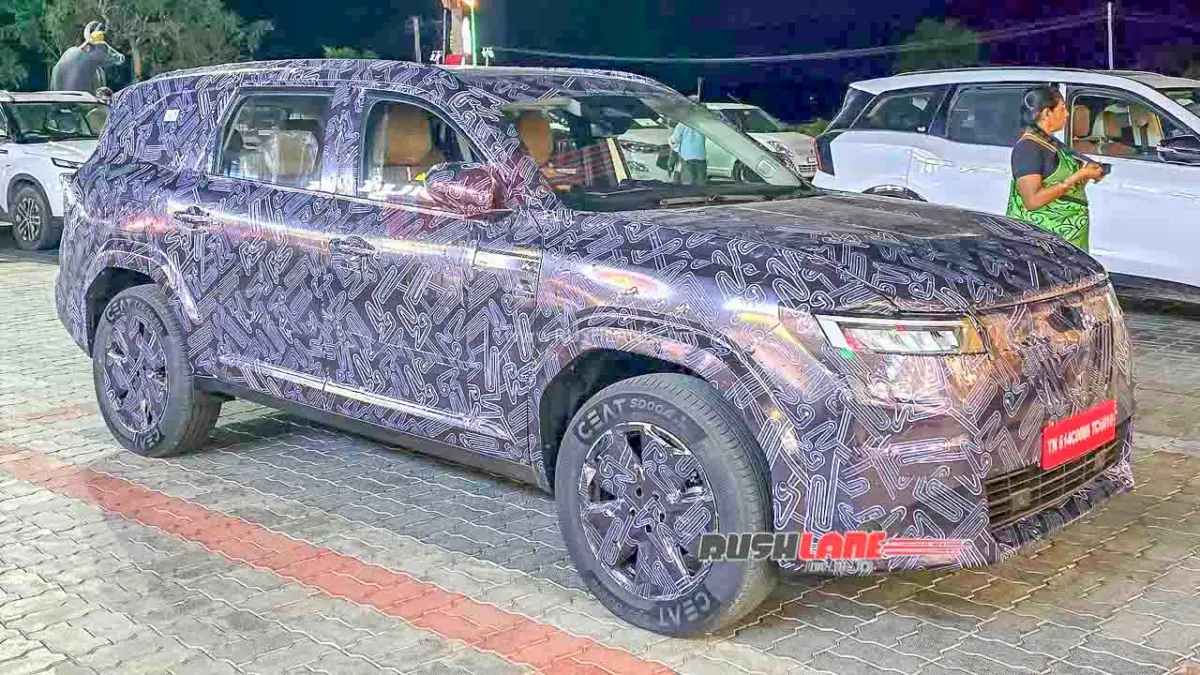
The Indian automotive landscape is currently witnessing a significant strategic pivot by Nissan Motor India Pvt Ltd. After years of relying heavily on the Magnite compact SUV to sustain its market presence, the Japanese automaker is aggressively expanding its portfolio to capture the lucrative mid-size and premium segments. The most recent and significant development in this roadmap is the commencement of real-world testing for the Nissan Tekton 7S—a three-row, seven-seater flagship SUV designed to challenge the established players in the C-SUV segment.
Recent spy shots captured by automotive enthusiasts have provided an unprecedented look at the vehicle’s design, proportions, and technological upgrades. As Nissan prepares for a projected 2027 launch, the Tekton 7S represents more than just a larger vehicle; it is a statement of intent regarding Nissan’s long-term viability in the Indian subcontinent.
Main Facts: What We Know About the Nissan Tekton 7S
The Nissan Tekton 7S is the elongated, three-row sibling of the recently introduced five-seater Tekton. While the five-seater variant allowed Nissan to re-enter the Mid-Size C-SUV space, the 7S is aimed at the "plus-sized" family SUV market, a segment currently dominated by the Hyundai Alcazar, Mahindra XUV700, and the Tata Safari.

Key Visual and Mechanical Indicators
The latest spy images reveal several critical deviations from the standard Tekton:
- Enhanced Footprint: The test mule was spotted wearing 18-inch alloy wheels with a distinct design. More importantly, the rubber has been beefed up. While the width remains at 225mm, the aspect ratio has increased from 55 to 60 (225/60 R18). This change is likely intended to improve ride quality and load-bearing capacity for the additional passengers.
- Dimensional Adjustments: Interestingly, the 2,657 mm wheelbase appears to be carried over from the five-seater model. To accommodate the third row, Nissan engineers have significantly stretched the rear overhang. This "extended tail" approach is a common engineering tactic to maximize cabin volume without re-engineering the entire platform chassis.
- Advanced Safety Hardware: A closer inspection of the front bumper reveals the presence of two millimeter-wave radar sensors. This confirms that the Tekton 7S will feature a more comprehensive Advanced Driver Assistance System (ADAS) suite than its five-seater counterpart, potentially offering Level 2 autonomy.
- Revised Aesthetics: The fascia features a redesigned bumper with vertical slits that converge toward the bottom, giving the SUV a more aggressive and wider stance. At the rear, a new connected LED tail-light signature replaces the standard Tekton units, providing a premium visual identity.
Chronology of Development: Nissan’s Path to the 7-Seater
The journey toward the Tekton 7S began as part of the renewed Renault-Nissan Alliance investment strategy for India, announced in early 2023.
- Phase 1: The Survival Era (2020–2023): Nissan focused almost exclusively on the Magnite. While successful, the lack of a broader portfolio led to a gradual decline in overall market share.
- Phase 2: The C-SUV Re-entry (Late 2024–2025): Nissan introduced the Tekton (5-seater) to compete with the Hyundai Creta and Kia Seltos. This was a critical step in moving the brand upmarket.
- Phase 3: The Flagship Testing (Late 2025–2026): Recognizing that Indian buyers in the ₹18 lakh to ₹28 lakh bracket often prefer the flexibility of seven seats, development shifted toward the "7S" variant.
- Phase 4: Current Testing (Late 2026): The vehicle has moved from closed-circuit testing to public road trials. The current spy shots represent the "production-ready" testing phase, where real-world road conditions are used to calibrate suspension and ADAS sensors.
- Phase 5: Projected Launch (2027): Industry analysts expect a commercial debut in the first half of 2027, following a series of global and local showcase events.
Supporting Data: Specifications and Features
To compete in the premium C-segment, the Tekton 7S must balance performance with an exhaustive feature list. Based on the test mules and shared platform architecture, the following data points emerge:

Powertrain and Performance
The Tekton 7S is expected to utilize the high-performance 1.3L Turbo Petrol engine, a unit co-developed by the Alliance and Mercedes-Benz.
- Engine Type: 1.3-litre Four-Cylinder Turbocharged Petrol.
- Power Output: 163 bhp.
- Peak Torque: 280 Nm.
- Transmission Options: A 6-speed Manual for enthusiasts and a 6-speed Wet-Clutch Dual-Clutch Transmission (DCT) for the premium buyer.
- The Hybrid Question: While the 1.8L Strong Hybrid engine found in international models (like the Dacia Duster/Bigster) is a possibility, current indicators suggest Nissan may stick to turbo-petrol to keep price points competitive against Mahindra’s mStallion engines.
Cabin and Technology
The 7-seater variant will inherit the "tech-forward" interior of the Tekton but will add several "class-above" features to justify its flagship status:
- Infotainment: A 12.3-inch touchscreen featuring Google Built-in (Maps, Assistant, and Play Store integrated directly into the OS).
- Driver Display: A 10.25-inch fully digital TFT instrument cluster with navigation mirroring.
- Comfort: Dual-zone automatic climate control, panoramic sunroof, and ventilated front seats.
- Exclusive 7S Additions: To cater to the second and third rows, the 7S is expected to feature rear ventilated seats (a rarity in this segment), manual sunshades for the rear windows, and a dedicated wireless charging pad for middle-row passengers.
Official Responses and Strategic Context
While Nissan Motor India has not released a specific "spec sheet" for the Tekton 7S, their corporate communications have consistently highlighted India as a "key export and domestic hub."

In previous briefings, Nissan executives have emphasized the "Nissan Ambition 2030" plan, which involves localizing high-value components to ensure that premium SUVs like the Tekton can be priced aggressively. The company’s plant in Oragadam, Chennai, is currently being upgraded to handle the more complex assembly requirements of radar-integrated bumpers and three-row seating configurations.
The Renault-Nissan Alliance’s $600 million investment in India is the backbone of this project. By sharing platforms (CMF-B) and engines, Nissan can achieve economies of scale that would be impossible as a standalone entity. This allows them to offer the Tekton 7S with a level of build quality and electronic sophistication usually reserved for European-market vehicles.
Market Implications: Can the Tekton 7S Change the Game?
The introduction of the Tekton 7S carries heavy implications for both Nissan and the Indian SUV market at large.

1. Brand Perception Shift
For the past half-decade, Nissan has been viewed as a "budget-friendly" brand due to the Magnite. The Tekton 7S, with its 18-inch wheels, ADAS tech, and Google-integrated cabin, is designed to pivot the brand toward a "Premium Japanese" identity. This is essential for long-term survival as the Indian market matures and buyers move away from entry-level hatchbacks toward sophisticated SUVs.
2. Addressing the "Space" Criticism
The five-seater Tekton faced minor criticism regarding its rear-seat legroom compared to some rivals. By stretching the rear overhang for the 7S, Nissan is directly addressing the need for more cabin volume. Even if the third row is used primarily for children, the increased luggage space (with the third row folded) will appeal to the "touring" demographic that Nissan wants to capture.
3. The ADAS Arms Race
By equipping the 7S with dual-radar setups, Nissan is entering the safety "arms race." Indian consumers are increasingly prioritizing safety ratings and active safety features. A robust ADAS suite will allow Nissan to market the Tekton 7S as one of the safest vehicles in its class, potentially aiming for a 5-star BNCAP (Bharat New Car Assessment Program) rating.

4. Competitive Pressure
The Tekton 7S will enter a crowded field. Its success will depend on its ability to offer a more "refined" driving experience than the rugged Mahindra XUV700 and a more "modern" tech suite than the Hyundai Alcazar. The 1.3L Turbo engine’s 280 Nm of torque will be a key selling point, offering a punchy alternative to the naturally aspirated engines found in some competitors.
Conclusion: A High-Stakes Gamble
The Nissan Tekton 7S is more than just another SUV; it is the culmination of Nissan’s "India 2.0" strategy. The spy shots reveal a vehicle that is physically larger, technologically superior, and aesthetically more modern than anything Nissan has offered in India for over a decade.
While the 2027 launch date seems distant, the level of detail seen in the current test mules suggests that the engineering is largely finalized. Nissan is now in the "polishing" phase—tuning the suspension for Indian potholes, calibrating the ADAS for chaotic traffic, and ensuring the 1.3L engine can handle the heat of Indian summers with a full load of seven passengers.

If Nissan can price the Tekton 7S competitively—likely in the ₹20-26 lakh range—they may finally see the "drastic jump" in sales charts that has eluded them. For now, the automotive world watches the Chennai-based testing with bated breath, as Nissan prepares to unleash its most ambitious Indian product yet.
