

The Indian automotive landscape has undergone a seismic shift over the last decade. Once a market dominated purely by fuel efficiency and resale value, it has evolved into a space where safety, technology, and design maturity take center stage. At the heart of this transformation is Tata Motors, a manufacturer that has successfully pivoted from being a utility-focused brand to a leader in design and safety. The latest iteration of the Tata Tiago—spanning petrol, CNG, and electric powertrains—serves as a testament to this evolution.
With the introduction of the new Tiago range, Tata Motors is not merely updating a product; it is attempting to redefine what a "small car" can be. By integrating features typically reserved for premium sedans and SUVs, the new Tiago challenges the notion that entry-level buyers must compromise on luxury or safety.
Main Facts: The Evolution of a Segment Leader
The new Tata Tiago arrives with a refreshed visual identity and a significantly bolstered feature list. The core of the update lies in its "mature presence," moving away from the playful aesthetics of its predecessor toward a more sophisticated, premium look.
Key Highlights of the Update:
- Exterior Enhancements: The introduction of Lux Beam LED headlamps and a "Halo" connected lightbar at the rear provides a modern light signature.
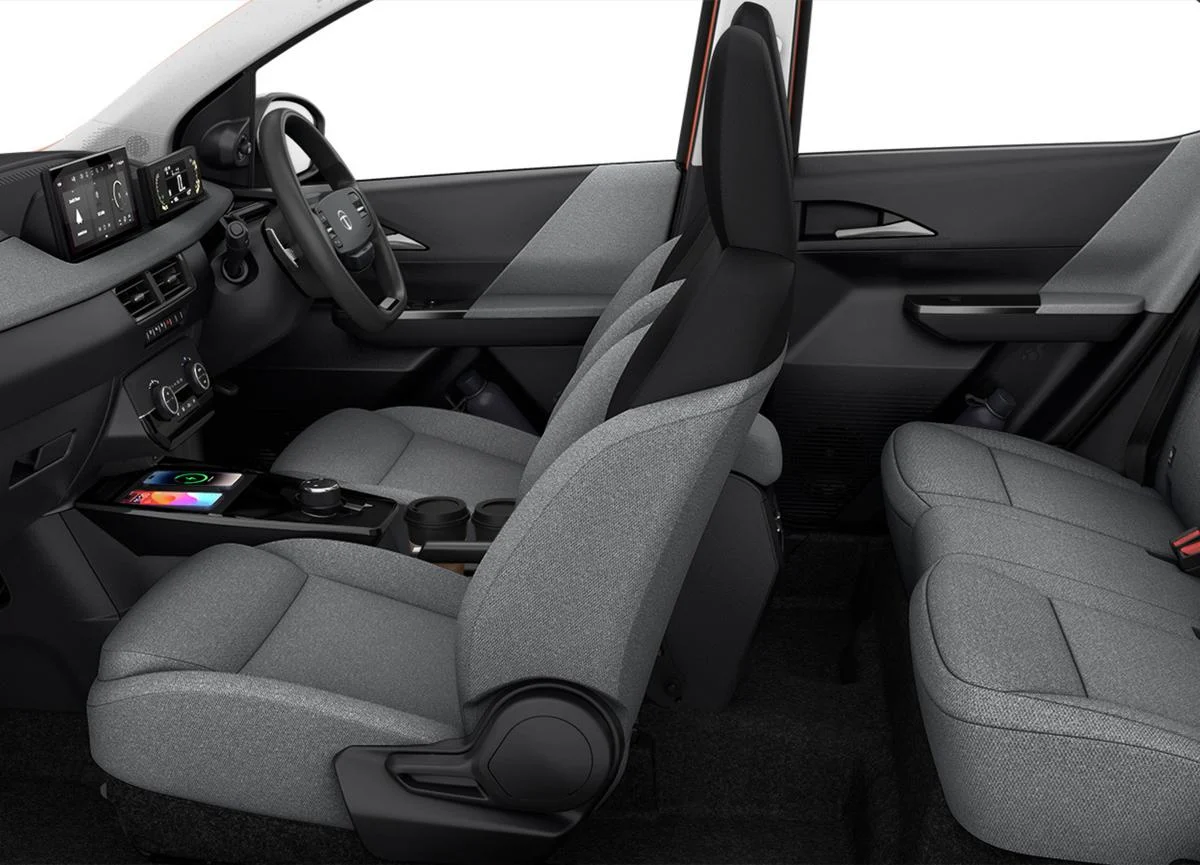
- Interior Overhaul: A new "Fabricia Luxe" dashboard and a 26.03 cm (10.25-inch) HD touchscreen infotainment system elevate the cabin’s perceived quality.
- Powertrain Diversity: The Tiago remains one of the few vehicles in India to offer three distinct fuel options—Petrol, CNG, and Electric—catering to a wide spectrum of consumer needs.
- Safety Standard: In a significant move for the segment, six airbags are now standard across the entire range.
- Technological Firsts: The inclusion of a 360-degree High-Definition Surround View Camera and a Blind View Monitor marks a first for the hatchback segment in this price bracket.
The pricing, ranging from INR 4.69 lakh to 8.55 lakh, positions the Tiago as a high-value proposition, competing directly with established rivals like the Maruti Suzuki Swift and the Hyundai Grand i10 Nios.
Chronology: From Impact Design to Digital Sophistication
To understand the significance of the new Tiago, one must look at its trajectory. Launched originally in 2016, the Tiago was the first product to showcase Tata’s "Impact Design" philosophy. It was the car that arguably saved Tata Motors’ passenger vehicle division, providing a stylish, robust alternative to the then-ubiquitous offerings from competitors.

In 2020, the Tiago received a mid-life facelift that aligned it with the "Impact 2.0" design language, introducing a sharper "Humanity Line" and a more angular front fascia. This update also saw the transition to BS6 emission standards.
The current 2024-2025 update represents the third major chapter in the Tiago story. This phase is defined by "Digital Sophistication." As the Indian consumer becomes more tech-savvy, Tata has shifted focus toward connectivity, high-definition displays, and advanced driver assistance features like the Blind View Monitor. This chronology shows a clear path from a brand focusing on survival to a brand setting the benchmark for the segment.
Deep Dive: Design and the "Segment-Above" Cabin
A Mature Exterior Aesthetic
The Tiago has always been lauded for its proportions. The latest update maintains the compact dimensions—essential for navigating the congested streets of cities like Bengaluru or Mumbai—but adds a layer of "gravitas." The revised grille, featuring a more intricate tri-arrow pattern, and the textured wheel-arch cladding give the car a more substantial, crossover-like stance.
The "Halo" lightbar at the rear is perhaps the most striking change. By connecting the tail lamps with a light strip, Tata has adopted a design trend usually found in luxury European marques. This visual width makes the Tiago look more planted on the road.
The "Fabricia Luxe" Interior
Step inside, and the "entry-level" tag feels misplaced. The dashboard uses a layered approach with varying textures that catch the light, reducing the "plastic-heavy" feel common in this segment. The "Digital Island" cluster—a fully digital instrument console—replaces the older semi-digital units, providing the driver with a wealth of information in a crisp, legible format.

Connectivity is handled by a 26.03 cm HD touchscreen. During testing, the interface proved responsive, with minimal lag between menu transitions. The inclusion of wireless Android Auto and Apple CarPlay removes cable clutter, a small but significant luxury in daily commutes.
Supporting Data: One Car, Three Distinct Personalities
The Tiago’s greatest strength is its versatility. Tata Motors has engineered the chassis to handle three very different powertrain weights and characteristics.
1. The Petrol Powerhouse: Refinement and Pep
The 1.2-litre Revotron petrol engine remains the backbone of the range.
- Power: 86 PS @ 6000 rpm
- Torque: 113 Nm @ 3300 rpm
- Transmission: 5-speed Manual / 5-speed AMT
This engine is tuned for urban drivability. The torque delivery is linear, making it easy to close gaps in traffic without constant downshifting.
2. The CNG Revolution: Twin-Cylinder Innovation
Historically, CNG buyers had to sacrifice their entire boot space to accommodate a large fuel tank. Tata’s "Twin-Cylinder" technology solves this by using two smaller tanks tucked under the luggage floor.
- Performance in CNG Mode: 73.5 PS and 95 Nm.
- USP: Usable boot space and the ability to start the car directly in CNG mode, a feature many competitors lack.
- Convenience: The Tiago remains the only CNG hatchback in its class to offer an Automated Manual Transmission (AMT), bringing ease of use to the budget-conscious commuter.
3. The Tiago.ev: The Electric Pioneer
The Tiago.ev has become a catalyst for EV adoption in India. It offers two battery options:

- Medium Range: 19.2 kWh (Estimated real-world range: 160-170 km)
- Long Range: 24 kWh (Estimated real-world range: 205-215 km)
- Performance: 0-60 km/h in 5.7 seconds (24 kWh version).
The EV variant benefits from a near-silent cabin and instant torque (114 Nm), making it the most effortless version to drive in stop-and-go traffic. Furthermore, the IP67-rated battery pack ensures that the vehicle remains resilient against India’s monsoon floods and dust.
Safety Standards: The New Non-Negotiable
Tata Motors has built its modern reputation on safety, and the Tiago range is no exception. While the previous version held a 4-star Global NCAP rating (under older protocols), the new range pushes the envelope further.
Standard Safety Kit:
- Six Airbags (Front, Side, and Curtain)
- Electronic Stability Program (ESP)
- Hill Hold Control
- ABS with EBD
- ISOFIX child seat anchors
The inclusion of the 360-degree HD Surround View Camera is a significant technological leap. In tight parking spots or narrow lanes, this system provides a bird’s-eye view, reducing the risk of minor scrapes. Coupled with the Blind View Monitor, which activates a camera feed on the infotainment screen when the turn signal is engaged, the Tiago offers a level of situational awareness previously unseen in the A-segment.
Official Responses and Expert Perspectives
While Tata Motors executives emphasize "democratizing technology," industry analysts point to a broader strategy. "Tata is no longer competing on price alone," says an automotive industry consultant. "They are competing on ‘value-per-feature.’ By offering six airbags and a 360-degree camera, they are forcing competitors to either upgrade their products or risk appearing obsolete."
Expert testers have noted that the Tiago’s ride quality remains its "secret weapon." The suspension is tuned with a slightly longer travel and softer damping than its European-style rivals, allowing it to "round off" sharp bumps and potholes with a level of composure that mimics larger sedans.
Implications: What This Means for the Indian Consumer
The launch of the enriched Tiago range has several long-term implications for the Indian automotive market:

- The End of the "Basic" Hatchback: As entry-level cars begin to feature high-definition screens and advanced safety suites, the "bare-bones" hatchback is likely to disappear. Consumers now expect a premium experience regardless of the vehicle’s size.
- Normalization of EVs: By keeping the Tiago.ev’s design understated and similar to the petrol version, Tata is helping "normalize" electric vehicles. It’s no longer a futuristic experiment but a practical daily driver.
- Safety as a Sales Driver: With six airbags becoming standard, safety is transitioning from a "premium add-on" to a fundamental right for the Indian car buyer. This shift will likely lead to a reduction in road fatalities as these features trickle down to the highest-volume segments.
Verdict: Small Cars No Longer Need to Feel Small
The new Tata Tiago range is a sophisticated response to the changing desires of the Indian middle class. It acknowledges that while a buyer might need a compact footprint for practical reasons, their aspirations for luxury, connectivity, and safety are as high as those of a luxury car owner.
Whether it is the frugal efficiency of the Twin-Cylinder CNG, the zippy and silent performance of the EV, or the dependable refinement of the petrol engine, the Tiago offers a polished experience. It is a car that punches well above its weight, proving that in the modern era, "entry-level" can still mean "first-class."
Price Range: INR 4.69 lakh – 8.55 lakh (Ex-showroom)
Review conducted in association with Motorscribes and The Hindu.
