

The Indian automotive landscape is standing on the precipice of a significant technological shift, and at the center of this transformation is Maruti Suzuki. As the nation’s largest carmaker, Maruti Suzuki has long been the barometer for consumer sentiment and market trends. Recent sightings of the 2026 Maruti Baleno facelift undergoing rigorous testing have sent ripples through the industry. Slated for a high-profile launch in the first week of September 2026, this update represents more than just a cosmetic refresh; it marks the debut of Maruti’s highly anticipated "affordable hybrid" technology.
By timing the launch just ahead of the festive season—a period that traditionally accounts for a massive chunk of annual automotive sales—Maruti Suzuki is positioning the Baleno to reclaim its undisputed crown in the premium hatchback segment.
1. Main Facts: A Mid-Cycle Refresh with High-Stakes Technology
The 2026 Maruti Baleno facelift is a strategic response to a changing market. While the "SUV craze" has dominated headlines, the premium hatchback segment remains a vital volume driver for manufacturers who can offer the right mix of prestige, efficiency, and technology.
The Exterior Overhaul
Based on recent spy shots, the 2026 Baleno will maintain its "Liquid Flow" design philosophy but with a sharper, more aggressive execution. The front fascia is expected to feature a wider, more intricate grille pattern, flanked by slimmer LED projector headlamps. The signature three-element DRLs (Daytime Running Lamps), which have become a hallmark of the Nexa brand, are likely to be evolved into a more integrated light bar or a more complex geometric pattern.
The side profile remains familiar, preserving the Baleno’s aerodynamic silhouette, but it will be punctuated by new 16-inch precision-cut alloy wheels. At the rear, the LED tail lamps will receive a new internal signature, likely adopting a "connected" look to align with modern design trends seen in the Grand Vitara and Fronx.
The Interior and Feature Set
Maruti Suzuki is moving toward "premiumization." The 2026 cabin is expected to ditch the hard plastics of yesteryear in favor of soft-touch materials on the dashboard and door pads. Key updates include:

- Infotainment: An upgraded 9-inch SmartPlay Pro+ touchscreen with a more intuitive UI and wireless smartphone integration.
- Comfort: Ventilated front seats, a feature increasingly demanded by Indian buyers, and potentially a wireless charging pad.
- Safety: To align with Bharat NCAP aspirations, the facelift is expected to standardize six airbags across more variants and potentially introduce Electronic Stability Program (ESP) and Hill Hold Assist as standard features.
The "Affordable Hybrid" Engine
The most critical fact regarding the 2026 update is the powertrain. Maruti is expected to introduce its internally developed series-parallel hybrid system. Unlike the expensive strong-hybrid tech sourced from Toyota (used in the Grand Vitara), this "Affordable Hybrid" is designed to be cost-effective while delivering a staggering fuel efficiency figure, rumored to be in the range of 30–35 kmpl.
2. Chronology: The Evolution of a Segment Leader
To understand the significance of the 2026 facelift, one must look at the Baleno’s journey from a niche sedan to a mass-market powerhouse.
- 1999–2007: The Sedan Era: The Baleno nameplate first appeared in India as a premium sedan. While appreciated by enthusiasts for its performance, it struggled against the Honda City.
- 2015: The Rebirth: Maruti Suzuki resurrected the name for a global premium hatchback, launched exclusively through the then-new Nexa dealership network. It was a runaway success, offering space that rivaled mid-size sedans.
- 2019: The First Facelift: A minor mid-cycle update introduced the DualJet engine and subtle cosmetic tweaks, reinforcing its lead over the Hyundai i20.
- 2022: The Tech Leap: Maruti launched a heavily updated Baleno featuring a Head-Up Display (HUD), 360-degree camera, and a significantly reinforced chassis. This version moved the Baleno from "budget premium" to "tech-loaded premium."
- September 2026 (Projected): The Hybrid Revolution: The upcoming facelift represents the fifth major milestone, transitioning the model into the electrified era.
3. Supporting Data: Market Dynamics and Sales Performance
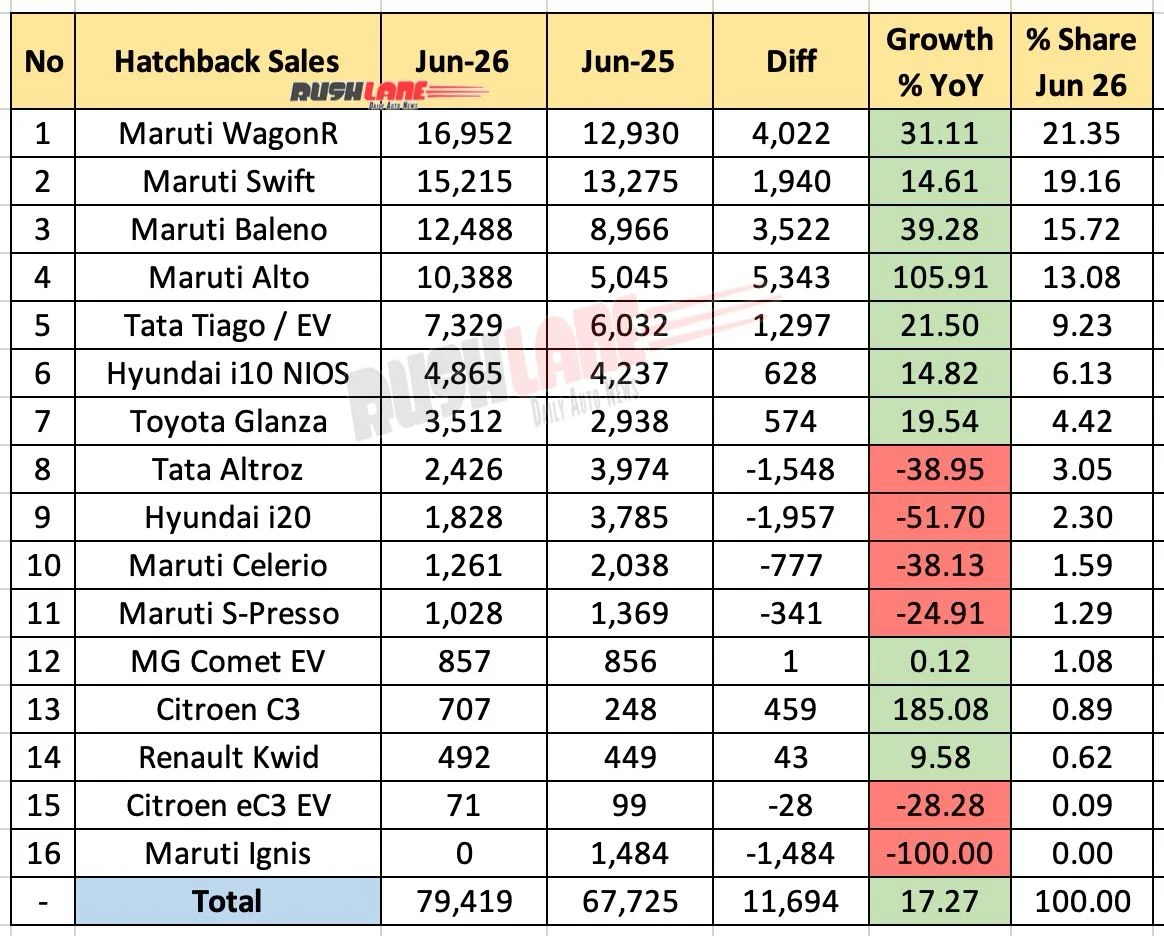
Despite the onslaught of sub-compact SUVs like the Tata Punch and Maruti’s own Fronx, the Baleno has maintained a formidable presence in the sales charts.
Sales Performance (June 2026 Context)
According to recent industry data, the Baleno consistently clocks between 12,000 and 17,000 units per month. Even as the overall hatchback segment saw a minor year-on-year (YoY) decline of roughly 5-7% in early 2026, the Baleno managed to grow its market share within the segment.
| Feature | Maruti Baleno (Current) | Hyundai i20 | Tata Altroz |
|---|---|---|---|
| Engine | 1.2L NA Petrol | 1.2L NA / 1.0L Turbo | 1.2L NA / 1.2L Turbo / 1.5L Diesel |
| Max Mileage | 22.94 kmpl (AGS) | 20.0 kmpl | 23.64 kmpl (Diesel) |
| Safety Rating | Not Rated (New Gen) | 3-Star (Global NCAP) | 5-Star (Global NCAP) |
| Hybrid Option | Mild Hybrid | None | None |
The introduction of the 2026 Hybrid system is expected to create a massive delta in the "Max Mileage" column, potentially widening the gap between Maruti and its rivals by over 10 kmpl.
The Competition Gap
While the Hyundai i20 focuses on European styling and turbocharged performance, and the Tata Altroz leans on its 5-star safety rating and diesel torque, the Baleno has carved a niche for "Rational Premiumization." Data suggests that 65% of Baleno buyers cite "Fuel Efficiency" and "Resale Value" as their primary purchase drivers. The 2026 facelift doubles down on these strengths.

4. Official Responses and Industry Insights
While Maruti Suzuki officials remain tight-lipped about specific torque figures or pricing for the 2026 model, the company’s leadership has been vocal about their "Multi-Path Strategy."
In recent investor calls, Maruti Suzuki executives emphasized that while Electric Vehicles (EVs) are the future, "Hybrids are the bridge for the next decade." The company believes that until charging infrastructure matures in Tier-2 and Tier-3 cities, a high-efficiency hybrid that doesn’t require external charging is the most practical solution for the Indian masses.
Industry Analysts’ Take
Automotive analysts suggest that Maruti’s move to develop an in-house hybrid system is a defensive maneuver against rising input costs. "By not relying on Toyota for the hybrid transaxle in smaller cars, Maruti can price the Baleno Hybrid just ₹1 lakh to ₹1.5 lakh above the standard petrol variant," says a senior analyst at a leading firm. "This makes the payback period for the consumer much shorter than a traditional strong hybrid."
Furthermore, the collaboration with Toyota will continue via the Toyota Glanza, which will receive these updates shortly after the Baleno launch, ensuring that the economies of scale benefit both manufacturers.
5. Implications: What the 2026 Baleno Means for the Industry
The launch of the 2026 Baleno facelift is likely to trigger a domino effect across the Indian automotive sector.
1. The Survival of the Hatchback
Many critics have predicted the death of the hatchback in India. However, a 30+ kmpl Baleno could prove that there is still a massive appetite for low-slung, aerodynamic cars that offer superior handling and efficiency compared to top-heavy SUVs. If the Baleno succeeds, expect Hyundai and Tata to accelerate their own electrification or hybrid plans for the i20 and Altroz.

2. Redefining "Premium"
With the inclusion of more sophisticated materials and potentially Level 1 ADAS (Advanced Driver Assistance Systems) in the top-tier Alpha trim, Maruti is redefining what a "budget" premium car looks like. This puts pressure on the entry-level SUV segment (the sub-4-meter category), which often sacrifices interior quality for ground clearance.
3. Fuel Economy as the New Battleground
For years, the industry shifted toward performance. The 2026 Baleno facelift signals a return to fuel economy as the primary battleground, but with a modern twist. This isn’t just about small engines; it’s about smart energy management.
4. Impact on the Used Car Market
The arrival of a highly efficient hybrid Baleno may impact the resale value of existing petrol-only premium hatchbacks. Buyers in the second-hand market may soon prioritize hybrid tech, forcing a correction in the pricing of older internal combustion engine (ICE) models.
Conclusion
The 2026 Maruti Baleno facelift is not merely a stop-gap measure to keep a model fresh. It is a calculated, high-stakes gambit by Maruti Suzuki to dominate the "Green Mobility" transition without forcing consumers into the still-expensive EV ecosystem. With its refreshed aesthetics, upgraded cabin, and a revolutionary hybrid heart, the new Baleno is poised to remain the gold standard of the Indian premium hatchback segment for years to come. As the first week of September 2026 approaches, all eyes will be on the Nexa showrooms to see if Maruti can once again capture lightning in a bottle.
