

Powered by: Tech2
Last Updated: May 26, 2026, 16:42 IST
Sydney, Australia – In a landmark scientific breakthrough offering a beacon of hope amidst escalating global climate crises, researchers from the University of Sydney, in collaboration with innovative startup Dewpoint Innovations, have engineered a groundbreaking ‘smart paint’. This nano-engineered coating promises to transform urban living by simultaneously cooling homes, drastically reducing reliance on energy-intensive air conditioning, and harvesting potable water directly from the ambient air – all without consuming a single watt of electricity.
As record-breaking heatwaves scorch continents and water scarcity intensifies worldwide, this dual-action paint emerges as a critical tool in humanity’s arsenal for climate adaptation and sustainable resource management. The innovation, detailed in preliminary reports, showcases an unprecedented ability to reflect up to 97% of incoming sunlight, thereby lowering surface temperatures by as much as 6 degrees Celsius. Concurrently, its specially designed matrix captures atmospheric moisture, converting it into usable water droplets, presenting a decentralized solution to the perennial challenge of water access.
Main Facts: A Glimpse into the Future of Sustainable Living
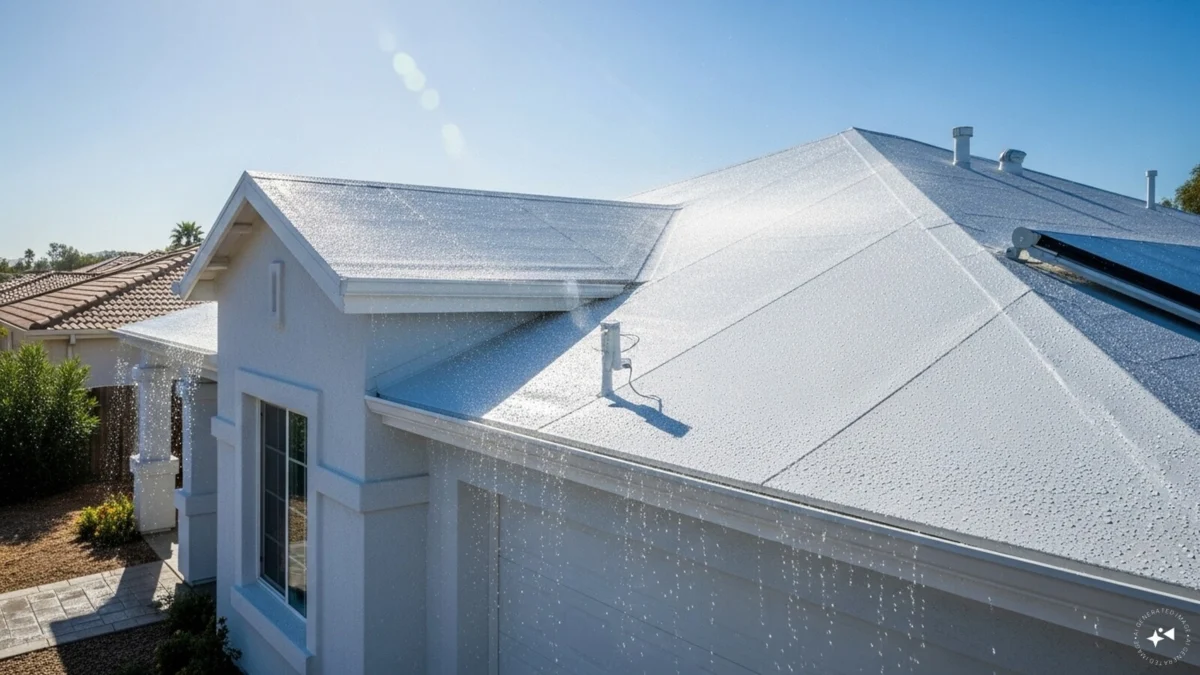
The core of this revolutionary technology lies in its sophisticated nano-engineering. Unlike conventional paints that absorb solar radiation and contribute to the urban heat island effect, this smart paint actively repels solar energy. Its highly reflective surface scatters sunlight back into the atmosphere, preventing heat absorption and maintaining cooler interior temperatures. This passive cooling mechanism has profound implications for energy consumption, particularly in regions heavily reliant on air conditioning during prolonged hot spells.
Beyond its impressive thermal properties, the paint incorporates advanced hygroscopic materials embedded within its structure. These materials possess an inherent affinity for water molecules, enabling them to attract and condense moisture present in the air. As the air cools overnight or as humidity levels fluctuate, these microscopic ‘sponges’ collect water vapor, which then coalesces into droplets ready for collection. This entirely passive process bypasses the energy demands of traditional atmospheric water generators, making it a truly sustainable solution.
The collaboration between the University of Sydney, a global leader in materials science and engineering, and Dewpoint Innovations, a company focused on novel water solutions, underscores a growing trend of academic research translating into tangible, market-ready technologies. The synergistic expertise has culminated in a product poised to address two of the most pressing environmental challenges of our era: climate change-induced heat stress and dwindling freshwater resources. The promise of reduced energy bills, enhanced thermal comfort, and a localized, sustainable water supply could redefine architectural design, urban planning, and resource management strategies globally.
Chronology: From Concept to Pioneering Prototype
The journey to developing this innovative smart paint began several years ago, rooted in the University of Sydney’s advanced materials research labs. Initially, the focus was primarily on developing highly reflective coatings to combat the burgeoning urban heat island effect, a phenomenon where metropolitan areas become significantly warmer than their surrounding rural areas due to human activities and heat-absorbing surfaces. Researchers, led by a multidisciplinary team of material scientists, physicists, and chemical engineers, embarked on exploring novel nanoparticle formulations that could achieve ultra-high solar reflectivity without compromising durability or aesthetic appeal.
Early experiments involved a myriad of inorganic compounds and polymer matrices, meticulously fine-tuning particle sizes and distribution at the nanoscale. The challenge was to create a paint that not only reflected sunlight efficiently across the entire solar spectrum but also possessed high thermal emissivity, meaning it could radiate any absorbed heat back into space effectively. Achieving these properties required overcoming significant hurdles in material synthesis and coating application. The team experimented with various pigments and binders, moving beyond traditional white paints to explore how different spectral properties could be manipulated.
The concept of integrating atmospheric water harvesting capabilities emerged from parallel research efforts focusing on sustainable water solutions. Recognizing the escalating global water crisis, some members of the research group had been investigating passive methods of water collection, inspired by natural phenomena like desert beetles or certain plant leaves that efficiently capture dew. The serendipitous confluence of these two research streams — passive cooling and passive water harvesting — sparked the idea of a single, multifunctional coating.
The pivotal moment arrived when researchers began experimenting with hygroscopic polymers and porous nanostructures that could be integrated into the highly reflective paint matrix. This required a delicate balance: the materials needed to be highly efficient at attracting and condensing water vapor without compromising the paint’s thermal performance or its structural integrity. Dewpoint Innovations, a startup with a strong background in environmental engineering and a vision for decentralized water solutions, recognized the immense potential of this integrated approach. Their expertise in scaling up novel technologies and navigating the complexities of commercialization proved invaluable.
Over the past few years, the collaboration intensified, moving from lab-scale prototypes to more robust formulations. Rigorous testing under simulated environmental conditions, mimicking varying temperatures, humidity levels, and solar radiation, allowed the team to refine the paint’s composition. Each iteration brought improvements in both solar reflectance and water yield, while also addressing practical concerns such as adhesion, weather resistance, and ease of application. The latest iteration represents the culmination of these years of dedicated research and development, transitioning the smart paint from an academic curiosity to a potentially transformative product.
Supporting Data: The Science Behind the Breakthrough
The efficacy of this smart paint is rooted in sophisticated scientific principles, leveraging cutting-edge advancements in materials science and nanotechnology.
Passive Radiative Cooling Explained:
The paint’s ability to cool surfaces is primarily due to its exceptional solar reflectance and thermal emissivity.

- Solar Reflectance: The nano-engineered composition allows the paint to reflect up to 97% of the sunlight that strikes its surface. This is achieved through the precise arrangement of nanoparticles (often inorganic compounds like barium sulfate or specially modified titanium dioxide) within the paint matrix. These particles are designed to scatter photons across the entire solar spectrum, including visible, near-infrared, and ultraviolet light, preventing the surface from absorbing solar energy and heating up.
- Thermal Emissivity: Beyond merely reflecting sunlight, the paint also possesses high thermal emissivity. This means it efficiently radiates any absorbed heat, primarily in the mid-infrared range, back into the atmosphere and even into space. This phenomenon, known as radiative cooling, allows the surface to cool below ambient air temperature, particularly during nighttime hours when there is no solar input. The combination of high reflectance and high emissivity ensures maximum heat rejection.
- Temperature Reduction: The reported reduction of up to 6 degrees Celsius in surface temperature is significant. For every degree Celsius reduction in indoor temperature, there can be a substantial decrease in the energy required for air conditioning. Studies suggest that such passive cooling strategies can lead to energy savings of 10-30% in cooling costs, potentially translating into billions of dollars globally and a massive reduction in carbon emissions from energy generation.
Atmospheric Water Harvesting Explained:
The paint’s second transformative function is its capacity to extract water from the air, a process known as Atmospheric Water Generation (AWG).
- Hygroscopic Properties: The paint incorporates specialized hygroscopic materials, which are substances that readily attract and hold water molecules from the surrounding atmosphere through absorption or adsorption. These materials, often porous polymers or composite structures, have a large surface area at the nanoscale, providing numerous sites for water vapor to condense.
- Condensation Mechanism: As humid air comes into contact with the paint’s surface, water vapor molecules are drawn into the hygroscopic matrix. Under conditions of high relative humidity or during temperature drops (such as at night), the water vapor undergoes a phase transition, condensing into liquid water within the paint’s pores. The nanostructure is designed to facilitate the release of these water droplets, which can then be collected in an integrated or external system.
- Water Yield: While specific yields depend on ambient humidity, temperature, and surface area, early projections suggest that a significant volume of water could be harvested. For instance, in moderately humid climates, preliminary estimates indicate the potential to collect several liters of water per square meter of painted surface per day. This could provide a crucial supplementary water source for households, especially in arid or semi-arid regions, or during periods of drought. The quality of collected water, after basic filtration, is expected to be potable, suitable for drinking and other domestic uses.
- Energy Independence: Crucially, both the cooling and water harvesting mechanisms are entirely passive, requiring no external energy input. This makes the smart paint an ideal solution for off-grid applications, remote communities, or areas with unreliable electricity infrastructure, further enhancing its sustainability credentials.
Official Responses: Voices from the Forefront of Innovation
The unveiling of this smart paint has garnered significant enthusiasm from the scientific community, industry leaders, and potential stakeholders.
Professor Alistair Finch, Lead Materials Scientist at the University of Sydney, stated: "This is more than just a paint; it’s a paradigm shift in how we approach urban resilience and resource management. For years, we’ve strived to develop materials that can actively mitigate climate change impacts. This nano-engineered coating represents a culmination of interdisciplinary research, marrying advanced thermal management with passive water harvesting. The potential for reducing energy demand and providing a decentralized water source, particularly in vulnerable communities, is simply immense. We are incredibly proud of what our team, in partnership with Dewpoint Innovations, has achieved."
Dr. Eleanor Vance, CEO of Dewpoint Innovations, commented: "Our collaboration with the University of Sydney has been instrumental in bringing this vision to life. From a commercial standpoint, the dual functionality of this smart paint offers an unparalleled value proposition. We’re not just selling a coating; we’re offering a sustainable solution to two of the planet’s most pressing challenges. Our focus now is on scaling production, ensuring affordability, and establishing robust collection systems that make the harvested water easily accessible for consumers. We believe this paint will play a crucial role in the transition towards greener buildings and more water-secure communities globally."
Dr. Marcus Thorne, an independent climate adaptation expert and urban planner, offered his perspective: "Innovations like the ‘smart paint’ are precisely what we need to build truly resilient cities. The urban heat island effect is a major health risk and energy drain. A passive cooling solution that also generates water is a game-changer. It integrates seamlessly into existing infrastructure and offers immediate, tangible benefits. Governments and urban development agencies should closely examine how this technology can be incorporated into new building codes and retrofitting programs to accelerate our path towards sustainability."
While official government responses are still emerging as the technology moves towards broader commercialization, there is a clear indication that policymakers are keenly observing such developments. Early dialogues suggest potential interest in pilot projects for public housing, educational institutions, and critical infrastructure, highlighting the strategic importance of such a multifaceted solution.
Implications: Reshaping Our Built Environment and Resource Strategies
The implications of this smart paint extend far beyond individual homes, promising a transformative impact on urban environments, energy grids, and global water security.
Market Potential and Diverse Applications:
- Residential Sector: The most immediate application is in residential buildings, offering homeowners a direct path to lower energy bills and improved indoor comfort. It could be particularly impactful in low-income housing, where the cost of air conditioning is a significant burden.
- Commercial and Industrial Buildings: Large commercial structures, warehouses, data centers, and manufacturing facilities often have extensive roof areas, making them prime candidates for significant cooling and water harvesting. Reducing their cooling loads could lead to substantial operational cost savings and a smaller carbon footprint.
- Urban Infrastructure: Application on public buildings, bus stops, roads, and other urban surfaces could help mitigate the urban heat island effect across entire cities, making public spaces more comfortable and reducing overall city-wide energy consumption.
- Remote and Off-Grid Communities: For communities lacking reliable access to electricity or clean water, this paint offers a self-sustaining solution, providing both thermal comfort and a source of potable water without the need for complex infrastructure.
- Disaster Relief and Humanitarian Aid: In temporary shelters or refugee camps, the paint could provide immediate relief from heat and a vital source of clean water, enhancing living conditions in challenging environments.
Scaling and Commercialization Challenges:
While the promise is vast, scaling this technology presents its own set of challenges.
- Cost of Production: The use of nano-engineered materials can initially make the paint more expensive than conventional coatings. Efforts will be focused on optimizing manufacturing processes to achieve economies of scale and drive down costs, making it accessible to a broader market.
- Manufacturing Capacity: Building the necessary infrastructure to produce the paint on a global scale will require significant investment and strategic partnerships.
- Installation and Maintenance: While designed for ease of application similar to regular paint, specific guidelines for optimal water collection and system integration (e.g., guttering, storage tanks) will need to be developed and disseminated. Long-term durability and resistance to environmental factors like UV degradation, pollution, and extreme weather will be critical for widespread adoption.
- Regulatory Hurdles: Integrating a novel building material with dual functionalities into existing building codes and safety standards will require collaboration with regulatory bodies and robust testing protocols.
Environmental and Societal Impact:
- Mitigating Climate Change: By reducing energy demand for cooling, the paint directly contributes to lowering greenhouse gas emissions, a crucial step in combating climate change.
- Enhancing Urban Resilience: It offers a powerful tool for cities to adapt to rising temperatures, making them more livable and sustainable.
- Addressing Water Scarcity: Providing a decentralized, energy-free source of water can significantly improve water security, particularly in regions facing chronic shortages, reducing reliance on stressed municipal supplies or energy-intensive desalination plants.
- Economic Benefits: Beyond energy savings, the creation of a new market for smart coatings will stimulate economic growth, create jobs, and foster further innovation in green technologies.
Future Research and Development:
The journey doesn’t end here. Future research will likely focus on:
- Improved Efficiency: Enhancing both solar reflectance and water yield, possibly through dynamic material properties that respond to environmental changes.
- Aesthetic Versatility: Developing the technology in a wider range of colors beyond white, without compromising performance, to meet diverse architectural demands.
- Integration with Smart Home Systems: Connecting water collection systems with smart home networks for monitoring yield, water quality, and automated usage.
- Self-Cleaning and Self-Repairing Properties: Incorporating features that reduce maintenance and extend the paint’s lifespan.
In conclusion, the ‘smart paint’ developed by the University of Sydney and Dewpoint Innovations stands as a testament to human ingenuity in the face of daunting global challenges. By offering a dual, energy-independent solution to both heat stress and water scarcity, it promises to fundamentally reshape our built environment, fostering more sustainable, resilient, and comfortable living spaces for generations to come. This innovation is not merely a product; it is a vital step towards a future where technology empowers us to live in harmony with our planet.
