

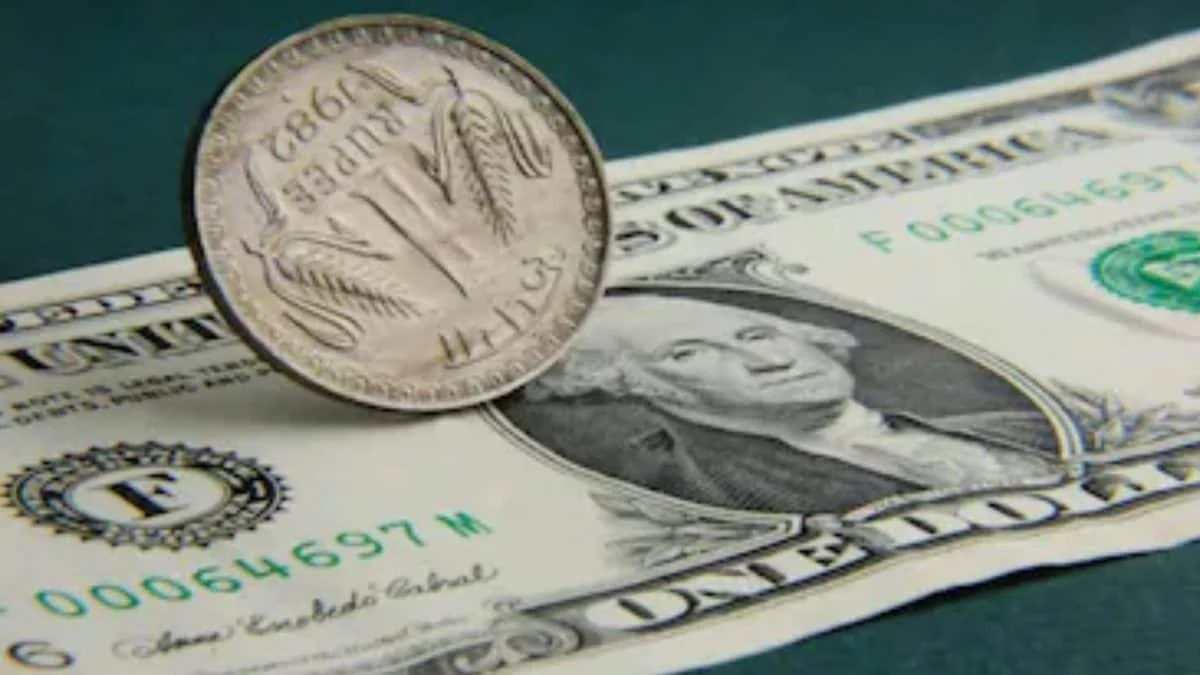
NEW DELHI, India – May 27, 2026 – The Indian Rupee on Wednesday extended its depreciation against the US Dollar, falling by 8 paise to trade at 95.78 in early interbank foreign exchange market transactions. This renewed weakness in the local currency is primarily attributed to a sharp increase in safe-haven demand for the greenback, fueled by escalating geopolitical tensions between the United States and Iran, which have simultaneously propelled global crude oil prices higher.
The rupee, which had initially shown a glimmer of strength by opening 10 paise higher at 95.60, quickly ceded its gains as market sentiment turned cautious. This marks a continuation of a trend seen on Tuesday, when the currency depreciated by a significant 44 paise to close at 95.70, underscoring the profound impact of the volatile West Asian geopolitical landscape and its ripple effects on global commodity markets.
Forex market participants are closely monitoring developments in the Strait of Hormuz, a critical chokepoint for global oil supplies, as reports of renewed US military actions against Iranian assets have intensified concerns. This has pushed Brent crude oil futures to a robust $98 per barrel, a level that poses considerable challenges for India, a major net importer of crude.
Geopolitical Storm Brews in West Asia
The latest episode of rupee depreciation is inextricably linked to the deteriorating security situation in West Asia. For weeks, tensions between Washington and Tehran have been simmering, but recent days have witnessed a worrying escalation. Reports indicate that the United States has conducted targeted strikes against Iranian-backed militia positions in the region, citing threats to its personnel and interests. These actions, reportedly in response to a series of drone and missile attacks attributed to Iran or its proxies, have significantly ratcheted up the risk premium across global markets.
The Strait of Hormuz, through which a substantial portion of the world’s seaborne oil passes, has once again become a focal point of anxiety. Any disruption or perceived threat to navigation in this vital waterway sends immediate shockwaves through oil markets, driving prices upwards. The current environment of heightened military posturing and a visible breakdown in diplomatic efforts has ignited fears of a broader regional conflict, compelling investors to seek refuge in traditionally safer assets like the US dollar.
A Detailed Chronology of the Rupee’s Slide
The Indian Rupee’s recent trajectory illustrates a direct correlation with the evolving geopolitical and economic landscape:
- Tuesday, May 26, 2026: The rupee experienced a significant downturn, depreciating by 44 paise to close at 95.70 against the US dollar. This sharp decline was triggered by initial reports of renewed geopolitical tensions in West Asia and an immediate surge in crude oil prices, which breached the critical $97 mark. Foreign institutional investors (FIIs) simultaneously withdrew a substantial Rs 2,407.87 crore from Indian equities, signaling a clear risk-off sentiment among global investors.
- Wednesday, May 27, 2026 (Morning Trade):
- Opening: The rupee opened on a positive note, stronger by 10 paise at 95.60 against the American currency. This initial buoyancy was likely a residual effect of some overnight optimism or profit-booking in the dollar.
- Mid-morning: However, this early strength proved fleeting. As news reports detailing the extent of the US-Iran conflict escalation and the subsequent jump in Brent crude prices became more pronounced, market sentiment quickly soured. The rupee rapidly pared its gains.
- Current Trading: By mid-morning, the rupee had fallen to 95.78 against the US dollar, registering a net fall of 8 paise from its previous day’s close and a significant decline from its opening level. This rapid reversal underscored the fragility of the market and the overwhelming influence of external factors.
This sequence of events highlights how quickly global developments, particularly those involving major oil-producing regions and global superpowers, can impact emerging market currencies. The swift shift from a positive opening to a depreciated state within hours reflects the heightened sensitivity of the forex market to breaking geopolitical news.
Supporting Data and Market Indicators
Several key financial indicators reinforce the narrative of a market under stress:
- Exchange Rate: The rupee is currently trading at 95.78 against the US dollar. This level represents a significant depreciation compared to its recent past and raises concerns about its potential to breach further psychological barriers.
- Crude Oil Prices: Brent crude, the international benchmark, was trading at $98.09 per barrel in futures trade. While it showed a marginal dip of 1.50 per cent from its intra-day high after initial reports of fresh US attacks against Iran, its sustained position at these elevated levels remains a critical concern for India. The $98 mark is historically high and puts immense pressure on India’s import bill and domestic inflation.
- Dollar Index: The dollar index (DXY), which measures the greenback’s strength against a basket of six major currencies, was trading at 99.09, down 0.07 per cent. Despite this slight dip, the dollar’s overall strength is sustained by its safe-haven appeal and expectations of continued hawkish monetary policy from the US Federal Reserve. The index has been hovering near multi-year highs, reflecting global uncertainty and robust US economic data.
- Domestic Equities: In contrast to the currency market, the domestic equity market showed resilience in early trade. The Sensex climbed 127.83 points to 76,137.53, while the Nifty was up 36.45 points to 23,950.15. This divergence often occurs when FIIs pull out, but domestic institutional investors (DIIs) and retail investors step in, absorbing some of the selling pressure. However, sustained FII outflows could eventually weigh on the equity markets as well.
- Foreign Institutional Investor (FII) Activity: On Tuesday, foreign institutional investors offloaded equities worth a substantial Rs 2,407.87 crore. This capital flight is a clear indicator of risk aversion among global investors, who tend to move their funds from emerging markets to safer assets like US treasuries or the dollar during periods of heightened uncertainty. Persistent FII outflows can put further downward pressure on the rupee and domestic asset prices.
The confluence of these factors paints a challenging picture for the Indian currency. While domestic equities show some fortitude, the overarching global sentiment, driven by geopolitical fears and commodity price surges, dictates the rupee’s near-term fate.
Official Responses and Expert Outlook
The current situation has prompted various reactions and analyses from market experts and signals potential policy considerations.
Amit Pabari, MD of CR Forex Advisors, articulated the immediate drivers behind the rupee’s recent slide. "The rupee slipped after crude oil prices rebounded as hopes of an immediate US-Iran peace deal faded slightly. Reports of renewed US strikes on Iran and delays in negotiations kept markets cautious, even though investors still believe a broader resolution remains possible," Pabari stated. His assessment underscores the delicate balance between geopolitical developments and market reactions, where even a slight shift in diplomatic prospects can have a profound impact.
Looking ahead, Pabari highlighted the critical importance of the upcoming Reserve Bank of India (RBI) Monetary Policy Committee (MPC) meeting, scheduled for June 3-5. "Now, attention shifts toward the upcoming RBI Monetary Policy Committee meeting scheduled for June 3-5. Markets remain divided between a possible rate hike and a status quo decision," he observed.
The RBI faces a complex dilemma. Traditionally, its primary mandates have been price stability (inflation management) and supporting economic growth. However, persistent rupee depreciation adds a third, increasingly urgent dimension: currency stability. A weakening rupee exacerbates imported inflation, making crude oil, essential commodities, and various manufactured goods more expensive. This directly impacts the RBI’s ability to control inflation, which has already been a concern.
Pabari further elaborated on the potential strategic shift within the RBI: "The larger question, however, is whether RBI may choose to prioritise currency stability alongside inflation management. With the central bank already using several measures to manage rupee volatility, interest rates could also become part of the broader strategy to attract inflows back into the system."
This suggests that the RBI might consider a hawkish stance, potentially hiking interest rates, not just to curb domestic inflation but also to make Indian assets more attractive to foreign investors. Higher interest rates could draw FIIs back, bolstering the rupee and mitigating some of the depreciation pressure. However, a rate hike could also dampen domestic economic growth, creating a tightrope walk for policymakers. The market will be scrutinizing the MPC’s statements for any hints of a shift in policy priorities or a more aggressive approach to managing currency volatility.
Other market analysts echo similar sentiments. Dr. Priya Sharma, a Senior Economist at a leading financial institution, noted, "The RBI has historically intervened in the forex market to smooth out excessive volatility. However, persistent and significant depreciation stemming from global factors like oil price surges and geopolitical risks requires a more structural response. A rate hike, even a modest one, could signal the RBI’s commitment to defending the rupee and managing imported inflation, thereby instilling confidence."
However, not all experts advocate for a rate hike. Mr. Rajesh Gupta, a veteran forex strategist, cautioned, "While a rate hike might temporarily prop up the rupee, it comes with the risk of stifling domestic demand and investment. The current depreciation is largely externally driven. The RBI should focus on managing liquidity and targeted interventions, while the government works on fiscal measures to mitigate the impact of high oil prices on consumers." This highlights the ongoing debate within economic circles about the most effective tools to combat externally induced currency weakness without harming the domestic economy.
Broader Implications for the Indian Economy
The persistent depreciation of the Indian Rupee, especially when driven by factors like surging crude oil prices and global risk aversion, carries significant implications for various sectors of the Indian economy:
- Inflationary Pressure: India imports over 80% of its crude oil requirements. A stronger dollar and higher global oil prices mean a significantly increased import bill. This translates directly into higher domestic fuel prices (petrol, diesel), which, in turn, fuels inflation across the economy by increasing transportation costs for goods and services. Imported inflation can erode purchasing power and complicate the RBI’s efforts to maintain price stability.
- Current Account Deficit (CAD): A larger oil import bill, coupled with potential FII outflows, can widen India’s Current Account Deficit. A widening CAD puts further pressure on the rupee and makes the economy more vulnerable to external shocks.
- Importers: Businesses that rely heavily on imported raw materials, components, or finished goods will face higher costs. Sectors like electronics, automobiles, and pharmaceuticals, which have significant import dependencies, will see their input costs rise, potentially leading to higher consumer prices or reduced profit margins.
- Exporters: While a weaker rupee generally makes Indian exports more competitive in global markets, the current global economic slowdown and the specific nature of the geopolitical risks (which could impact global trade volumes) might offset some of these benefits. Furthermore, exporters also face higher costs for imported inputs.
- Foreign Debt: Indian companies and the government with unhedged foreign currency debt will find their repayment obligations increase in rupee terms. This can strain corporate balance sheets and potentially lead to defaults if not managed effectively.
- Foreign Investment: Sustained rupee weakness and FII outflows can make India a less attractive destination for foreign direct investment (FDI) and portfolio investment, impacting capital formation and economic growth prospects.
- Government Finances: The government might face pressure to absorb some of the higher crude oil costs through tax cuts or subsidies, which could strain its fiscal deficit targets.
The combined effect of these implications suggests a challenging period ahead for India’s economic policymakers. The delicate balance between managing inflation, ensuring currency stability, and fostering economic growth will be tested. The upcoming RBI MPC meeting will be crucial in setting the tone for the nation’s monetary policy response to these evolving global headwinds.
The global economic landscape remains fraught with uncertainty. The US-Iran conflict’s trajectory, the volatility of crude oil markets, and the monetary policy decisions of major central banks will all play a pivotal role in determining the rupee’s path in the coming weeks and months. Indian markets will remain highly sensitive to any further geopolitical developments and the signals from the RBI’s policy pronouncements.
(With PTI Inputs)
