

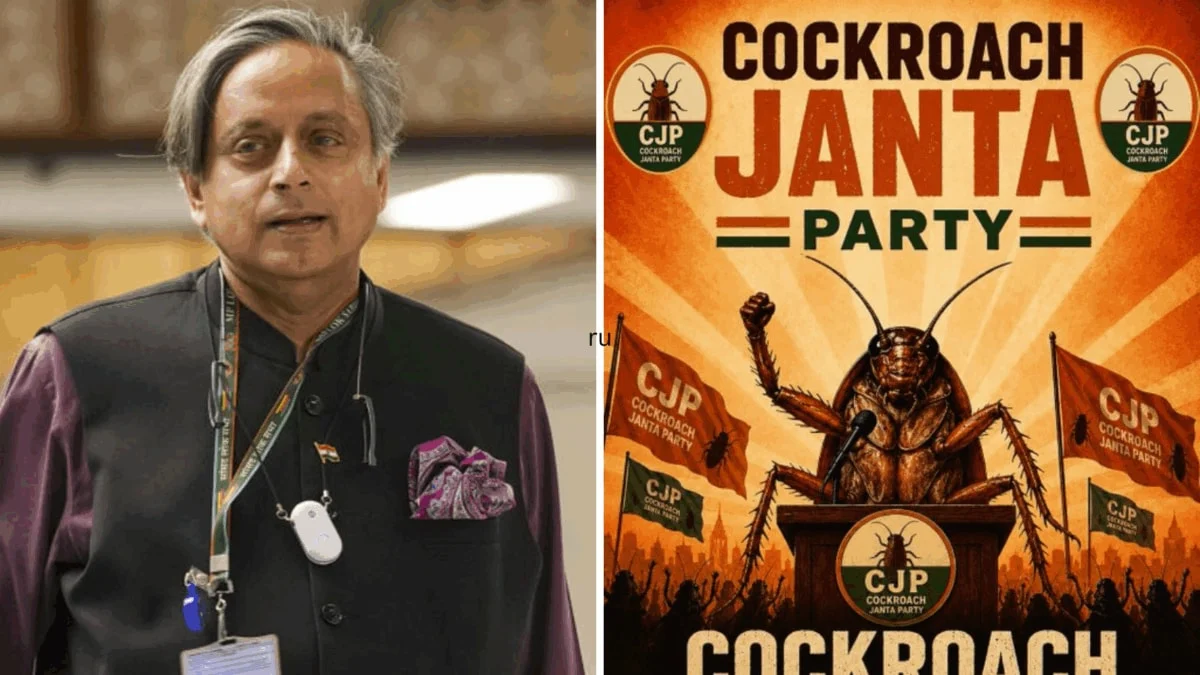
New Delhi, India – May 22, 2026 – In a rapidly evolving digital political landscape, Congress MP Shashi Tharoor has issued a compelling call to India’s opposition parties, urging them to "seize the opportunity" presented by the meteoric rise of the satirical ‘Cockroach Janta Party’ (CJP). Tharoor’s remarks, made on Friday, highlight the profound intrigue surrounding the CJP’s unprecedented viral success on Instagram and simultaneously condemn the "disastrous and deeply unwise" blocking of its X (formerly Twitter) account. His intervention underscores a growing recognition within established political circles of the potent, albeit unconventional, force of youth-driven online movements.
The CJP, a self-proclaimed "political front of the youth, by the youth, for the youth" and the "Voice of the Lazy & Unemployed," has captivated millions with its sardonic commentary and unconventional manifesto. Its sudden emergence and overwhelming popularity have sparked a crucial debate about the avenues of dissent in a democracy, the role of social media in political mobilization, and the potential for satirical movements to challenge traditional power structures. Tharoor’s commentary, delivered amidst this digital frenzy, positions the CJP not merely as a fleeting internet trend but as a significant indicator of widespread youth frustration and a potential catalyst for political realignment.
The Unprecedented Rise of the ‘Cockroach Janta Party’
The ‘Cockroach Janta Party’ burst onto the Indian digital scene just days ago, quickly morphing from an obscure online initiative into a national talking point. Founded by Abhijeet Dipke, who proudly identifies as its "Founding President," the CJP’s meteoric ascent has been nothing short of astonishing. Within a mere five days, its Instagram account amassed over 15 million followers, a figure that has since surged past 19 million, dwarfing the digital footprints of many established political entities. This rapid accumulation of followers signals a profound resonance with a demographic often perceived as disengaged from mainstream politics.
The party’s name itself, ‘Cockroach Janta Party,’ is imbued with satirical intent, likely alluding to resilience, ubiquity, and perhaps a perceived ‘nuisance’ factor to the established order. The CJP’s website explicitly states its satirical nature in the footer, yet its message and unconventional demands have clearly struck a chord beyond mere humor. It positions itself as a voice for the marginalized and the disenchanted, particularly the youth grappling with unemployment and a sense of political voicelessness.
The mock manifesto released by the CJP offers a glimpse into the issues animating its nascent support base. Among its most striking demands are:
- Prohibiting retired chief justices from being nominated to the Rajya Sabha: A direct jab at the practice of post-retirement appointments to legislative bodies, often viewed as compromising judicial independence.
- Introducing 50 per cent reservation for women in Parliament without expanding the total number of seats: A bold proposal that challenges the status quo of parliamentary representation and implicitly calls for a redistribution of existing power.
- Imposing a 20-year political ban on elected representatives who switch parties: A clear expression of frustration with political opportunism and the erosion of ideological loyalty in Indian politics.
These demands, while framed within a satirical context, touch upon deeply felt public grievances regarding governance, integrity, and representation. The CJP, through its digital prowess and pointed satire, has managed to articulate a collective sentiment of dissatisfaction, turning online virality into a significant socio-political phenomenon.
Shashi Tharoor’s Strategic Counsel: Seize the Digital Wave
Congress MP Shashi Tharoor, known for his articulate commentary and keen understanding of modern communication, was quick to acknowledge and analyze the CJP’s unexpected rise. "I’m incredibly intrigued by the rise of #CockroachJantaParty," Tharoor posted on X, recognizing the movement’s rapid growth and the underlying frustrations driving its popularity. His intrigue quickly transitioned into a strategic counsel for the opposition, seeing in the CJP’s success a powerful, untapped reservoir of youth energy and dissent.
Tharoor did not merely praise the movement; he passionately defended its right to exist and thrive in the digital public square. The blocking of the CJP’s X account, which had garnered over two lakh followers before its suspension, drew sharp criticism from the Congress MP. He lambasted the takedown as "disastrous and deeply unwise," emphasizing that such actions stifle legitimate avenues for expression. "I understand the frustrations of the youth and see why they are resonating with it. This is precisely why the account being withheld on X is disastrous and deeply unwise – there should be an outlet for the youth to express their feelings and so, let CJP’s account function instead of shutting it down!" Tharoor asserted, highlighting the necessity of digital platforms as spaces for open dialogue and critique.
His argument extended beyond mere defense of free speech, evolving into a broader philosophical point about the health of democratic societies. "Democracies need outlets for dissent, humour, satire and even frustration," he stated, underlining that suppressing such expressions only exacerbates underlying discontent and pushes it into less visible, potentially more volatile, channels. Tharoor’s perspective suggests that a mature democracy must accommodate and even embrace diverse forms of political expression, including the satirical and the unconventional.
Crucially, Tharoor framed the CJP phenomenon as a significant "opportunity that the Opposition must seize." While acknowledging uncertainty about the movement’s future, he expressed hope that its proponents would "find a way to bring this energy into mainstream politics or perhaps express it through their vote to be a voice of change and in doing so, become impossible to ignore." This advice is a direct challenge to established opposition parties, urging them to look beyond traditional campaign methods and actively engage with the digital zeitgeist. It calls for a strategic recalibration, encouraging them to understand the language and concerns of the youth, and to channel this nascent energy onto their own political platforms, rather than allowing it to remain fragmented or dissipate. Tharoor’s insight points towards a future where political relevance is increasingly tied to the ability to connect with, and represent, the digitally native generation.
A Timeline of Viral Ascent and Digital Suppression
The saga of the ‘Cockroach Janta Party’ has unfolded with remarkable speed, characteristic of digital phenomena in the age of instant communication.
- Days Prior to May 22, 2026: The ‘Cockroach Janta Party’ (CJP) emerges on social media platforms, particularly Instagram, spearheaded by its founder, Abhijeet Dipke. Its satirical content and unique branding quickly begin to gain traction among Indian youth.
- Rapid Growth Phase: Within an astonishingly short span of approximately five days, the CJP’s Instagram account witnesses an exponential surge in followers, reaching over 15 million, and subsequently surpassing 19 million by the time of news reports on May 22. Its X account also rapidly accumulates over two lakh followers, indicating broad cross-platform appeal.
- May 21, 2026 (Wednesday): The CJP’s X account, which had become a significant hub for its satirical commentary and engagement, is "withheld in India." The reasons for this specific action remain officially unstated, but such moves are often associated with requests from government authorities citing various regulations or concerns. This act of digital suppression sparks immediate controversy and draws attention to the CJP’s growing influence. Following the takedown, the founder reportedly launches a new handle to continue the online presence, showcasing the resilience and adaptability inherent in digital activism.
- May 22, 2026 (Friday): Congress MP Shashi Tharoor issues his detailed statement on X, expressing intrigue at the CJP’s viral success and condemning the blocking of its X account. His comments elevate the discussion around the CJP from a mere internet trend to a significant political talking point.
- Ongoing Developments: Amidst the unfolding narrative, reports emerge of multiple trademark applications being filed for the "Cockroach Janata Party" name. Interestingly, Abhijeet Dipke, the self-proclaimed founder, is not listed among the applicants, raising questions about potential attempts to capitalize on the movement’s popularity or even appropriate its identity. This development highlights the complexities and potential commercialization inherent in successful online movements.
This compressed timeline demonstrates the swift and often unpredictable nature of digital political activism. It underscores how rapidly an online phenomenon can gain momentum, attract both widespread support and official scrutiny, and trigger broader discussions about free speech, political opportunity, and the very definition of political engagement in contemporary India.
Underlying Currents: Youth Discontent and the Power of Satire
The meteoric rise of the ‘Cockroach Janta Party’ is not an isolated incident but a potent symptom of deeper socio-political currents flowing through India. At its heart lies a pervasive sense of youth discontent, fueled by economic anxieties, particularly unemployment, and a perceived lack of meaningful avenues for political participation. India, with its vast youth demographic, faces the dual challenge of providing adequate employment opportunities and fostering an environment where young voices feel heard and valued within the democratic framework. When traditional channels appear unresponsive or inaccessible, digital platforms become fertile ground for alternative forms of expression and mobilization.
Youth unemployment remains a critical issue, contributing to widespread frustration among educated young Indians who feel their aspirations are not being met by the existing economic and political systems. This disillusionment often translates into apathy towards conventional politics or, as seen with the CJP, a gravitation towards unconventional, often irreverent, movements that speak to their frustrations in a relatable language.
Furthermore, the CJP’s success underscores the enduring power of satire in political discourse. Throughout history, satire has served as a critical tool for challenging authority, exposing hypocrisy, and articulating grievances in a manner that is both engaging and disarming. From ancient Greek comedies to modern political cartoons and internet memes, satire bypasses formal political rhetoric to tap into public sentiment, often making uncomfortable truths palatable through humor. In the Indian context, where political discourse can sometimes be polarized and rigid, satire offers a refreshing and often more accessible way for citizens to engage with complex issues and critique power without directly facing the repercussions often associated with overt political dissent.
The digital landscape, particularly social media, amplifies this power exponentially. Platforms like Instagram and X provide immediate, widespread reach, allowing satirical content to go viral within hours. They also offer a sense of community and collective identity for those who feel marginalized or unheard. The CJP’s ability to use these platforms to build a massive following in such a short period reflects not just the ingenuity of its creators but also the profound yearning among a segment of the population for a voice that resonates with their lived experiences and frustrations. This phenomenon points to a significant shift in how political messaging is consumed and how collective sentiment is formed and expressed, moving beyond traditional media and party structures.
Official Silence and Broader Implications
The withholding of the ‘Cockroach Janta Party’s’ X account in India, without explicit official explanation, casts a long shadow over the broader implications of such digital movements. While X’s policy allows for content to be withheld in specific countries based on legal requests, the lack of transparency surrounding the CJP’s case raises concerns about digital censorship and the shrinking space for dissent online. This incident is not isolated; India has seen a growing trend of government requests to social media platforms to block content or accounts, often citing national security, public order, or IT Act provisions. Critics argue that such actions can stifle legitimate criticism and humorous dissent, blurring the lines between genuine threats and inconvenient narratives.
The official silence surrounding the X account’s blocking, juxtaposed with Tharoor’s vocal condemnation, highlights a critical tension between state control and freedom of expression in the digital age. It underscores the challenges faced by platforms like X in navigating complex legal frameworks and government pressures in diverse democracies. For the CJP itself, the blocking tests its resilience and adaptability. While its Instagram presence remains robust, the incident signals the precariousness of operating in a highly regulated digital environment, potentially pushing its creators to innovate new strategies for outreach and engagement.
The rise of the CJP, and the subsequent reaction to it, carries significant implications for various stakeholders:
- For the ‘Cockroach Janta Party’: Can a satirical online movement sustain its momentum and translate digital virality into tangible political influence? The challenge lies in converting online engagement into real-world action, whether through voter mobilization, policy advocacy, or the emergence of new political leadership. The CJP’s journey will be a test case for the limits and possibilities of digital-first political outfits.
- For the Opposition Parties: Tharoor’s advice to "seize the opportunity" presents both a strategic imperative and a complex challenge. Opposition parties must demonstrate an authentic understanding of the youth’s frustrations and articulate policy solutions that resonate with their aspirations. This requires moving beyond traditional campaign rhetoric and embracing the digital language and platforms where young people congregate. The risk, however, is that an attempt to co-opt such a movement might be perceived as inauthentic, alienating the very demographic they seek to attract. The true opportunity lies in genuinely reflecting the spirit of dissent rather than merely adopting its symbols.
- For Indian Democracy: The CJP phenomenon underscores the evolving nature of political participation. It suggests that traditional political structures may be struggling to accommodate the diverse and often informal ways in which citizens, particularly the youth, wish to engage. The need for "outlets for dissent, humour, satire and even frustration," as Tharoor articulated, is paramount for the health of a vibrant democracy. Suppressing such outlets risks alienating a crucial segment of the population and fostering deeper disaffection. The CJP’s narrative serves as a stark reminder that when formal channels appear insufficient, citizens will innovate new ways to make their voices heard, often through the powerful and unpredictable medium of the internet.
Conclusion
The ‘Cockroach Janta Party’ has undeniably carved out a unique space in India’s political discourse, transforming from an internet curiosity into a symbol of youth-driven digital dissent. Shashi Tharoor’s astute observations and strategic counsel serve as a crucial commentary on the evolving dynamics of power, protest, and political engagement in the 21st century. His call for the opposition to leverage this movement is not merely about electoral gain but about acknowledging and integrating the voices of a generation that feels increasingly marginalized.
As the CJP continues its unpredictable journey, navigating the complexities of digital virality and potential censorship, its impact extends far beyond its satirical origins. It forces a critical re-evaluation of how political movements emerge, how dissent is expressed, and how traditional political actors respond to the shifting tides of public sentiment. Whether the ‘Cockroach Janta Party’ ultimately evolves into a lasting political force, or remains a powerful, albeit fleeting, expression of discontent, its story will undoubtedly serve as a significant chapter in the ongoing narrative of digital activism and democratic evolution in India. The message is clear: the youth are speaking, and their collective voice, even when cloaked in satire, is becoming increasingly impossible to ignore.
