

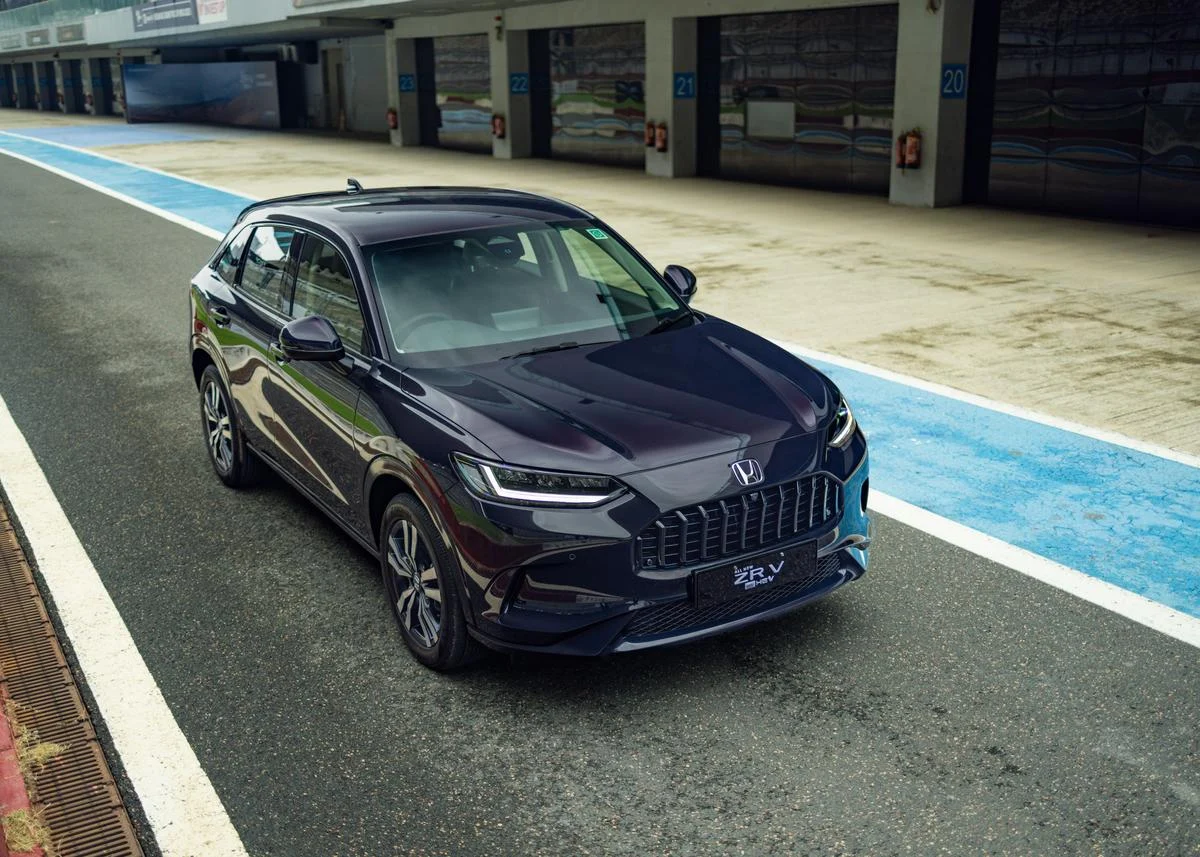
The Indian automotive landscape, particularly the premium SUV sector, has recently devolved into what industry observers call a "battle of excess." As manufacturers compete for a shrinking slice of the affluent middle-class pie, the focus has shifted toward aggressive aesthetic treatments, oversized infotainment displays, and exhaustive feature lists that often prioritize marketing "wow-factor" over long-term mechanical integrity. In this climate of sensory overload, Honda has introduced the ZR-V—a vehicle that deliberately pivots away from the industry’s current trajectory.
Positioned as a bridge between the mass-market Elevate and the luxury offerings of European marques, the ZR-V arrives in India via the Completely Built Unit (CBU) route. With a price tag of ₹47.99 lakh (ex-showroom), it challenges the conventional wisdom of "more is better," betting instead on the enduring value of superior engineering, hybrid efficiency, and a refined ownership experience.
Main Facts: The ZR-V Proposition
The Honda ZR-V enters a market where the ₹40–50 lakh price bracket is dominated by vehicles offering three-row seating, rugged all-wheel-drive systems, or panoramic glass roofs. On paper, the ZR-V appears to be an underdog: it is a five-seater, front-wheel-drive crossover with a minimalist interior. However, its value proposition lies beneath the surface.

Key Specifications and Pricing
- Price: ₹47.99 Lakh (Ex-showroom, India).
- Powertrain: 2.0-litre i-VTEC Atkinson-cycle petrol engine paired with Honda’s e:HEV strong hybrid system.
- Performance: Combined output of 181 bhp and 315 Nm of torque.
- Acceleration: 0 to 100 km/h in a claimed 7.9 seconds.
- Efficiency: ARAI-certified 22+ kmpl; real-world estimates hovering around 17–19 kmpl.
- Safety: 8 Airbags, Honda SENSING (ADAS), and a 4-star Euro NCAP rating.
The ZR-V is built on the same global platform as the legendary Civic, which explains its sophisticated road manners. By importing the vehicle as a CBU, Honda ensures that the Indian consumer receives the exact same build quality, material selection, and tolerances as buyers in Europe or Japan. This "global standard" is the cornerstone of the ZR-V’s identity in India.
Chronology: From Concept to Indian Tarmac
The journey of the ZR-V began as a strategic move by Honda to fill the "Goldilocks" gap in its global lineup—larger than the HR-V but more compact and car-like than the CR-V.
- Global Debut (2022): The ZR-V was first introduced in North America (as the HR-V) and subsequently in Japan and China. It was designed to appeal to a younger, more driving-focused demographic that found traditional SUVs too cumbersome.
- The Hybrid Pivot: As global emissions norms tightened, Honda prioritized the e:HEV powertrain for the ZR-V, making it the flagship technology for the model in mature markets.
- The Indian Entry (Current): Following the successful reception of the City e:HEV and the launch of the Elevate, Honda identified a niche for a premium, high-quality hybrid SUV in India. The decision to bring the ZR-V as a CBU serves as a litmus test for the brand’s premium aspirations in a market that has recently seen the exit of several high-end sedan models.
- Track Validation: To prove its engineering mettle, Honda recently showcased the ZR-V at the Buddh International Circuit (BIC). This move was intended to demonstrate that while the ZR-V is an efficient hybrid, it possesses the chassis dynamics to handle high-speed maneuvers—a rarity in the family SUV segment.
Supporting Data: Engineering and Performance Dynamics
The heart of the ZR-V is the latest generation of Honda’s e:HEV (strong hybrid) system. Unlike "mild hybrids" that merely assist the engine, or "parallel hybrids" that use a complex gearbox to blend power, Honda’s system operates more like an Electric Vehicle with a built-in generator.

The e:HEV Mechanism
The system utilizes two electric motors and a 2.0-litre engine. In most urban driving scenarios, the petrol engine does not drive the wheels at all; it acts as a generator to provide power to the electric propulsion motor.
- EV Drive Mode: Ideal for stop-and-go traffic, providing silent, instantaneous torque.
- Hybrid Drive Mode: The engine generates electricity while the motor drives the wheels, offering a blend of power and efficiency.
- Engine Drive Mode: At sustained highway speeds, a lock-up clutch connects the engine directly to the front wheels via a single-speed transmission, where the internal combustion engine is at its most efficient.
Performance Testing at BIC
During testing at the Buddh International Circuit, the ZR-V demonstrated a level of composure usually reserved for European luxury crossovers.
- High-Speed Stability: The vehicle reached an indicated 150 km/h on the back straight without the "floaty" sensation common in many high-riding SUVs.
- Lateral Dynamics: In the 80 km/h slalom test, the ZR-V showed minimal body roll. The steering rack, derived from Honda’s performance heritage, builds weight progressively, allowing for precise placement of the vehicle through tight corners.
- NVH Levels: The use of acoustic glass and extensive sound dampening ensures that even under hard acceleration, the transition between electric and petrol power is nearly imperceptible to the occupants.
Official Responses and Market Positioning
Honda’s official stance on the ZR-V emphasizes "Substance over Gimmicks." While critics point out the lack of certain features common in the ₹40 lakh+ segment—such as ventilated seats or a panoramic sunroof—Honda executives argue that these omissions are a conscious choice to prioritize mechanical longevity and structural integrity.

Addressing the "Feature Gap"
Honda’s design philosophy for the ZR-V centers on "Man Maximum, Machine Minimum." The brand maintains that:
- Visibility and Ergonomics: The thin A-pillars and cowl-mounted wipers provide a field of vision that reduces driver fatigue, a "feature" that isn’t listed on a spec sheet but impacts safety daily.
- Build Quality: The CBU status ensures a level of "heft" and tactile quality in the switchgear that mass-produced local rivals often struggle to match.
- The "Invisible" Innovations: Features like the wiper-integrated washer jets (which use 40% less fluid and improve visibility during cleaning) and the "Walk Away Close" tailgate demonstrate a focus on user-centric engineering rather than flashy tech.
However, the market reality remains: Indian buyers in this price bracket have grown accustomed to "theatre." The 9-inch infotainment screen, while functional, feels dated compared to the 12- or 14-inch screens found in rivals. The absence of rear-seat reclining functions is another point of contention for a market where chauffeur-driven usage is common.
Implications: The Future of the Premium SUV Market
The introduction of the Honda ZR-V carries significant implications for the Indian automotive industry, signaling a potential shift in how "luxury" is defined in the post-diesel era.

1. The Hybrid vs. Diesel Debate
As diesel engines face increasing regulatory scrutiny and shrinking lifespans in NCR and other regions, strong hybrids like the ZR-V offer a compelling alternative. The ZR-V provides the low-end torque and highway efficiency of a diesel without the associated NVH (Noise, Vibration, Harshness) issues or environmental stigma.
2. CBU as a Quality Benchmark
By positioning a CBU product at this price point, Honda is testing whether Indian consumers are willing to pay a premium for "global build quality." If the ZR-V finds success, it may encourage other manufacturers to bring in high-quality global models in limited volumes rather than diluting products for local manufacturing.
3. The "Slow Burn" Ownership Model
The ZR-V is not designed for the buyer who wants to impress neighbors on day one with a massive sunroof. It is designed for the buyer who wants the car to feel exactly the same on day 1,000 as it did on day one. This focus on reliability and "solidarity" is a gamble in a market currently obsessed with "newness."

4. Safety as a Standard
With a 4-star Euro NCAP rating and a comprehensive ADAS suite, the ZR-V reinforces the trend that safety is no longer an optional luxury but a baseline requirement for the premium segment.
Conclusion
The Honda ZR-V is a paradoxical entry in the Indian market. It is an expensive five-seater that lacks the "glitter" of its competitors, yet it offers a driving experience and mechanical depth that few in its price range can replicate. It is a car for the connoisseur—the individual who understands the difference between a high-resolution screen and a well-tuned suspension.
While it may remain a niche player due to its CBU pricing and conservative feature list, the ZR-V serves as a vital reminder that at its core, a car is a piece of engineering. In the race to turn SUVs into rolling smartphones, Honda has chosen to keep the "car" at the center of the equation. Whether the Indian consumer values this substance over the prevailing spectacle will be the ultimate test for the ZR-V.
