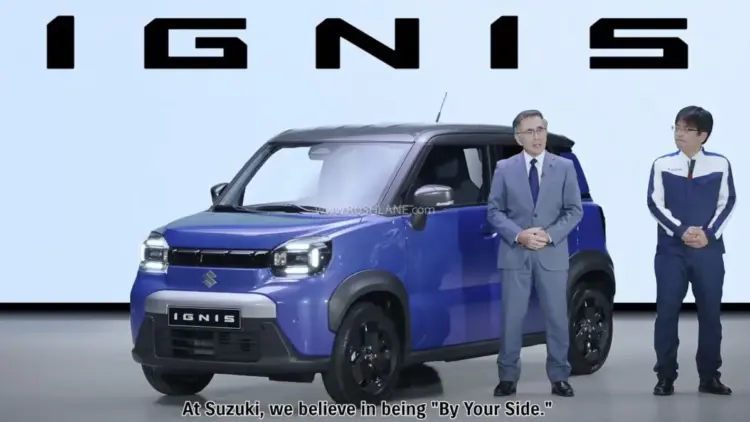
The global automotive landscape is currently undergoing a seismic shift toward electrification, and Suzuki, a stalwart in the compact car segment, has officially announced its latest contribution to this transition. By reviving the "Ignis" moniker—a nameplate that has long been synonymous with quirky, capable, and ultra-compact urban motoring—Suzuki is positioning itself to capture the burgeoning market for affordable, city-centric electric vehicles (EVs).
The new Suzuki Ignis Electric, recently unveiled with a focus on the European market, represents a strategic evolution of the brand’s design philosophy. Built upon the specialized HEARTECT-e architecture, the Ignis EV is designed to balance efficiency, affordability, and the nimble handling characteristics that have defined Suzuki’s small cars for decades. With a European launch slated for the summer of 2027, this vehicle serves as a cornerstone of Suzuki’s "Growth Strategy" to achieve carbon neutrality in key markets.
Main Facts: The Technical Blueprint of the Ignis EV
The Suzuki Ignis EV is not merely a conversion of an internal combustion engine (ICE) vehicle; it is a purpose-built electric city car. At its core lies a 26 kWh Lithium Iron Phosphate (LFP) battery pack. The choice of LFP chemistry is significant, as it typically offers greater thermal stability and a longer lifecycle compared to traditional Nickel Manganese Cobalt (NMC) batteries, while also being more cost-effective—a crucial factor for a car aimed at the entry-level EV segment.
Powering the front wheels is a compact electric motor producing 90 bhp (approximately 67 kW) and 133 Nm of peak torque. While these figures may appear modest in the context of high-performance EVs, they are perfectly tailored for a vehicle with a curb weight of just 1,080 kg. This lightweight construction ensures that the Ignis EV remains sprightly in stop-and-go city traffic.

Key Specifications at a Glance:
- Battery: 26 kWh LFP (Lithium Iron Phosphate).
- Power Output: 90 bhp / 133 Nm torque.
- Architecture: HEARTECT-e (EV-specific platform).
- Dimensions: 3,570 mm (L) x 1,565 mm (W) x 1,635 mm (H).
- Wheelbase: 2,460 mm.
- Turning Radius: 4.5 meters (9-meter turning circle).
- Charging: 7.4 kW AC; 50 kW DC Fast Charging (0-80% in under 30 minutes).
- Seating Capacity: 4-passenger layout.
Chronology: From Petrol Icon to Electric Pioneer
The journey of the Ignis nameplate has been one of constant adaptation. The original Ignis, and its subsequent generations, carved a niche as a "Compact High-Rider" or "Micro-SUV." However, the timeline leading to the new EV version reflects the broader industry’s pivot away from fossil fuels.
- The ICE Legacy (2016–2024): The second-generation petrol Ignis became a global success, particularly in India and Europe, praised for its lightweight "HEARTECT" platform and distinctive "Coke-bottle" styling.
- The Transition Phase (Early 2026): In April 2026, Suzuki made the difficult decision to discontinue the petrol-powered Ignis in several major markets, including India. This move signaled the end of an era but cleared the production and marketing "lane" for an electric successor.
- The Japanese Prelude (Late 2026): Suzuki launched the "e-Sky" in Japan, a dedicated electric kei car. While the e-Sky was confined to the strict dimensional regulations of the Japanese domestic market, it served as the mechanical and aesthetic prototype for what would become the global Ignis EV.
- The Global Debut (Late 2026/Early 2027): Suzuki officially unveiled the European-spec Ignis EV. Unlike the e-Sky, the Ignis was widened and lengthened to meet international safety standards and consumer preferences for more cabin room.
- Future Market Entry (Summer 2027): The Ignis EV is scheduled to hit European showrooms, marking Suzuki’s aggressive push into the affordable EV sector, currently dominated by brands like Dacia and Stellantis’s entry-level offerings.
Supporting Data: Engineering for the Urban Jungle
To understand the Ignis EV’s potential impact, one must look at the data regarding its physical footprint and charging capabilities. Suzuki has prioritized "right-sizing" over "over-specifying."
Dimensions and Maneuverability
The Ignis EV measures 3,570 mm in length, which is significantly shorter than most B-segment hatchbacks, yet it is 175 mm longer than its Japanese sibling, the e-Sky. This extra length, combined with a 2,460 mm wheelbase, allows for a more comfortable four-seat arrangement and improved crash structures.
The most impressive data point for city dwellers is the 4.5-meter turning radius. In densely populated European and Asian cities, this maneuverability is a primary selling point, allowing the vehicle to navigate narrow alleys and U-turns that would challenge larger EVs like the Tesla Model 3 or even the Volkswagen ID.3.

Charging Infrastructure Compatibility
Suzuki has equipped the Ignis EV with a versatile charging system:
- 3.7 kW Home AC Charging: A full charge from empty takes approximately 8 hours, making it ideal for overnight charging via a standard domestic socket.
- 7.4 kW Wallbox AC Charging: Reduces the full charge time to 4 hours.
- 50 kW CCS DC Fast Charging: For those on the move, the Ignis can replenish its battery to 80% in less than 30 minutes.
While 50 kW is not "ultra-fast" by modern standards, it is perfectly adequate for a 26 kWh battery. Faster charging rates often lead to higher heat generation and faster battery degradation, so this choice reflects Suzuki’s commitment to longevity and cost-control.
Official Responses: A Tailored Development Strategy
Suzuki’s leadership has been vocal about the fact that the Ignis EV is not a mere "copy-paste" of the Japanese e-Sky. Chief Engineer Tomoyuki Tsubata emphasized that while the two vehicles share a common DNA, they were developed with distinct market requirements in mind from the earliest stages of the project.
"The Ignis name, derived from the Latin word for ‘fire,’ reflects our intention to bring a fresh, energetic spark to the compact EV segment," Tsubata noted during the reveal. He further explained that the European version required a wider track and a more robust suspension tune to handle higher average speeds and varied road surfaces compared to the low-speed urban environments of Tokyo or Osaka.

The company’s official stance highlights a focus on "Usability over Complexity." Instead of massive touchscreens and gesture controls, the Ignis EV features a straightforward, ergonomic interior. This is a deliberate move to attract traditional car buyers who may feel alienated by the overly digital interfaces found in many modern electric vehicles.
Implications: What the Ignis EV Means for the Global Market
The introduction of the Ignis EV carries heavy implications for several key markets, most notably Europe and India.
The European "Price War"
In Europe, the Ignis EV will enter a fray where the Dacia Spring currently reigns as the king of affordable EVs. By offering a 90 bhp motor—significantly more powerful than the base Spring—Suzuki is positioning the Ignis as a more "complete" car capable of short highway stints, rather than just a neighborhood electric vehicle (NEV). If Suzuki can maintain a competitive price point, the Ignis EV could become a volume driver in markets like Italy, France, and the UK.
The Indian Question: Maruti Suzuki’s Strategy
For the Indian market, the implications are even more intriguing. Maruti Suzuki, which held a dominant position with the petrol Ignis, has yet to confirm the EV’s arrival in the subcontinent. However, the data from Japan provides a compelling case. The e-Sky (the Ignis’s smaller sibling) is priced at approximately JPY 1.55 million (roughly Rs 9.50 lakh) after subsidies.

If Maruti Suzuki can localize the HEARTECT-e platform and the 26 kWh LFP battery production in India, the Ignis EV could directly challenge the Tata Tiago EV and the MG Comet EV. Given the "Ignis" brand’s existing equity in India as a "cool" and "premium" offering through the Nexa dealership network, an electric return would likely be met with significant consumer interest.
Environmental and Urban Impact
Beyond sales figures, the Ignis EV represents a shift toward "sustainable minimalism." Large-battery SUVs often consume vast amounts of resources during production and energy during operation. The Ignis EV, with its 1,080 kg weight and modest battery, has a much smaller manufacturing carbon footprint. It addresses the "last-mile" and "urban commute" problems without the excess of a 2.5-ton luxury EV.
Conclusion
The 2027 Suzuki Ignis EV is a testament to the philosophy that "less is more." By focusing on lightweight construction, efficient LFP battery technology, and class-leading maneuverability, Suzuki is not just replacing an old model; it is redefining what a modern city car should be. While enthusiasts must wait until the summer of 2027 to see the Ignis on European roads, the ripple effects of its debut are already being felt across the global automotive industry. Whether it arrives in India or remains a European and Japanese exclusive, the Ignis EV has successfully reignited the "fire" of one of Suzuki’s most beloved nameplates.