The Indian automotive landscape is currently witnessing a significant shift toward premiumization within the sub-four-meter segment. Leading this charge is India’s largest automaker, Maruti Suzuki, which is currently deep in the development cycle of the 2027 Fronx Facelift. While the current Fronx has been a resounding success since its 2023 debut, the upcoming iteration—codenamed and spied extensively over recent months—aims to bridge the gap between mass-market utility and luxury-oriented features.
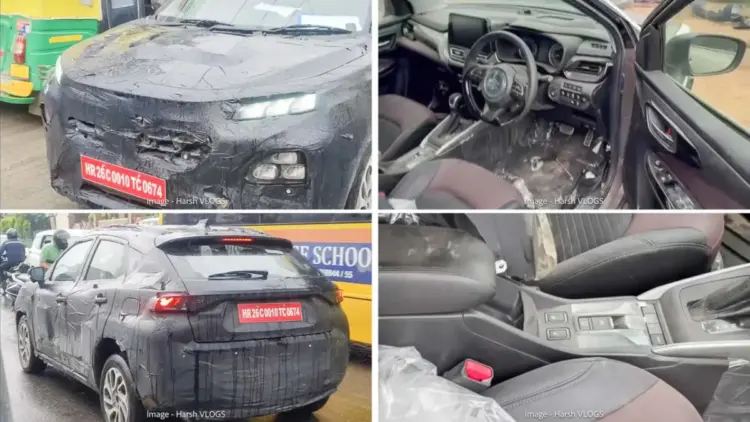
Recent spy shots, sourced from a detailed video by Harsh Vlogs, have provided the most intimate look yet at the vehicle’s interior and technological suite. These revelations suggest that Maruti Suzuki is not merely performing a cosmetic "plastic surgery" but is instead fundamentally upgrading the Fronx to compete with increasingly sophisticated rivals like the Tata Nexon, Kia Sonet, and the Mahindra XUV 3XO.
Main Facts: The Tech-Heavy Evolution
The latest leaks confirm several "first-in-segment" or "first-for-Maruti" features that signal a departure from the brand’s traditionally conservative approach to equipment levels.
1. Cabin Sophistication and Feature Load
The most striking revelation from the interior spy shots is the inclusion of ventilated front seats. This feature, once reserved for luxury sedans and mid-sized SUVs, is becoming a non-negotiable for Indian consumers facing harsh tropical summers. The controls for these seats are visibly integrated into the lower center console.

Furthermore, the 2027 Fronx Facelift will ditch the traditional mechanical handbrake in favor of an Electronic Parking Brake (EPB) with an Auto-Hold function. This move not only cleans up the ergonomics of the center console but also aligns the Fronx with global Suzuki models.
2. Infotainment and Connectivity
The central nervous system of the cabin—the infotainment system—is growing. The current 9-inch SmartPlay Pro+ unit is expected to be replaced by a 10.1-inch touchscreen. This new unit likely features improved resolution, a faster processor, and enhanced wireless connectivity for Apple CarPlay and Android Auto. To complement this, the spy shots suggest an upgraded Qi-certified fast wireless charging pad, addressing a common pain point regarding the slow charging speeds of current automotive wireless pads.
3. Level 2 ADAS Implementation
Perhaps the most significant safety upgrade is the confirmed presence of a radar module at the front of the test mule. This confirms that the 2027 Fronx will feature a Level 2 Advanced Driver Assistance System (ADAS) suite. Expected features include Autonomous Emergency Braking (AEB), Lane Keep Assist, Adaptive Cruise Control, and High Beam Assist. This move is crucial as competitors like the Hyundai Venue and Kia Sonet already offer ADAS, and Maruti cannot afford to lag in the safety technology race.
Chronology: The Journey of the Fronx
To understand the importance of the 2027 facelift, one must look at the timeline of the vehicle’s evolution:

- January 2023: Maruti Suzuki unveils the Fronx at the Auto Expo. It is positioned as a "Sub-4m SUV-Coupe" based on the Baleno’s HEARTECT platform, reviving the 1.0L Boosterjet engine.
- April 2023: The Fronx is officially launched in the Indian market, quickly becoming one of the fastest models to reach the 1,00,000-unit sales milestone.
- Mid-2024: First rumors of a mid-cycle refresh surface as Maruti begins testing its new Z-Series engine in various platforms.
- Late 2024: Spy shots of heavily camouflaged test mules appear on the outskirts of Gurugram and in high-altitude testing zones. These early mules hint at revised lighting signatures and ADAS sensors.
- November 2024: Detailed interior spy shots emerge, confirming the EPB, ventilated seats, and the larger infotainment screen.
- Projected Early 2027: The official market launch of the Fronx Facelift, likely coinciding with the implementation of stricter emission and safety norms in India.
Supporting Data: Mechanical and Aesthetic Transitions
The 2027 facelift isn’t just about screens and sensors; it involves a major powertrain transition and mechanical hardening.
The Engine Swap: K-Series to Z-Series
The current 1.2L 4-cylinder K-Series DualJet engine, known for its refinement and linear power delivery, is expected to be phased out in favor of the new 1.2L 3-cylinder Z-Series engine.
- Why the change? The Z-Series engine is designed with a focus on thermal efficiency and low-end torque, making it more suitable for stop-and-go city traffic. While 3-cylinder engines inherently have more vibrations than 4-cylinder units, Maruti has utilized advanced counter-balancing technology to maintain refinement levels.
- Efficiency: The Z-Series is expected to push fuel efficiency figures even higher, potentially crossing the 25 km/l mark in real-world highway conditions.
The Boosterjet Factor
For enthusiasts, the 1.0L 3-cylinder Boosterjet Turbo Petrol engine will remain. However, industry insiders suggest a re-tuning of the ECU. Currently producing 100 PS and 147 Nm, the 2027 version could see a bump to 110 PS, allowing it to better compete with the high-output turbo engines found in the Tata Nexon and Mahindra XUV 3XO.
Braking and Dynamics
A "noteworthy" addition spotted on the test mules is the inclusion of rear disc brakes. In the sub-4m segment, Maruti has traditionally used rear drum brakes to save costs and weight (even the heavier Brezza uses drums). The last time a Maruti in this segment featured four-wheel disc brakes was the Baleno RS (2017–2019). The addition of rear discs is likely a necessity to handle the increased weight of the ADAS hardware and the potential power bump of the turbo engine.

| Feature | Current Fronx (2024) | Fronx Facelift (2027) |
|---|---|---|
| Infotainment | 9-inch SmartPlay Pro+ | 10.1-inch Upgraded Unit |
| Parking Brake | Manual Lever | Electronic (EPB) with Auto-Hold |
| Front Seats | Standard Fabric/Leatherette | Ventilated Seats |
| Rear Brakes | Drum | Disc (on higher trims) |
| Safety | 6 Airbags, ESP | 6 Airbags + Level 2 ADAS |
| Base Engine | 1.2L K-Series (4-cyl) | 1.2L Z-Series (3-cyl) |
Official Responses and Strategic Context
While Maruti Suzuki India Limited (MSIL) has not officially commented on the specific features of the leaked test mules, their broader corporate strategy provides clear context.
During recent investor calls, Maruti Suzuki executives have emphasized "Vision 3.0," a strategy aimed at doubling production capacity and significantly enhancing the "premium quotient" of their NEXA lineup. The Fronx is a pillar of the NEXA brand, which targets younger, tech-savvy urban buyers.
Furthermore, Maruti’s partnership with Toyota has influenced their safety and feature trajectory. With the Toyota Taisor (a rebadged Fronx) also slated for these updates, the development costs are shared, allowing Maruti to offer high-end features like ADAS and EPB while maintaining competitive pricing—a hallmark of the brand.
Implications: A Shift in Market Dynamics
The arrival of the 2027 Fronx Facelift will have far-reaching implications for the Indian automotive market.

1. The End of the "Budget" Tag
For decades, Maruti was seen as the "value-for-money" brand that skimped on high-end features. The 2027 Fronx challenges this perception. By offering Level 2 ADAS and ventilated seats, Maruti is signaling that it no longer wants to compete solely on price, but on technology and lifestyle appeal.
2. Competitive Pressure
The sub-compact SUV segment is the most profitable and crowded in India. When the market leader introduces ADAS and rear disc brakes, it forces other manufacturers to follow suit or lower their prices. The Fronx Facelift will likely put immense pressure on the Hyundai Venue and Kia Sonet, which have traditionally used "features" as their primary USP over Maruti.
3. Resale Value and Longevity
By upgrading to the Z-Series engine and adding ADAS, Maruti is future-proofing the Fronx against upcoming regulations. This ensures that the vehicle remains relevant in the used car market five to seven years down the line, maintaining Maruti’s legendary resale value.
4. The "Turbo" Resurgence
By potentially bumping the Boosterjet’s output and adding rear disc brakes, Maruti is courting the "enthusiast" demographic that previously looked toward the Volkswagen Taigun or the Mahindra XUV 3XO. This broadens the Fronx’s appeal from a "stylish commuter" to a "performance-oriented crossover."

Conclusion
The 2027 Maruti Suzuki Fronx Facelift represents a pivotal moment for the brand. It is a calculated move to dominate the premium sub-4m space by combining Maruti’s traditional strengths—reliability, service network, and fuel efficiency—with modern necessities like ADAS, enhanced braking systems, and cabin luxury. While the launch is still roughly two years away, the testing phase confirms that the next generation of Maruti vehicles will be safer, smarter, and significantly more sophisticated than ever before.