

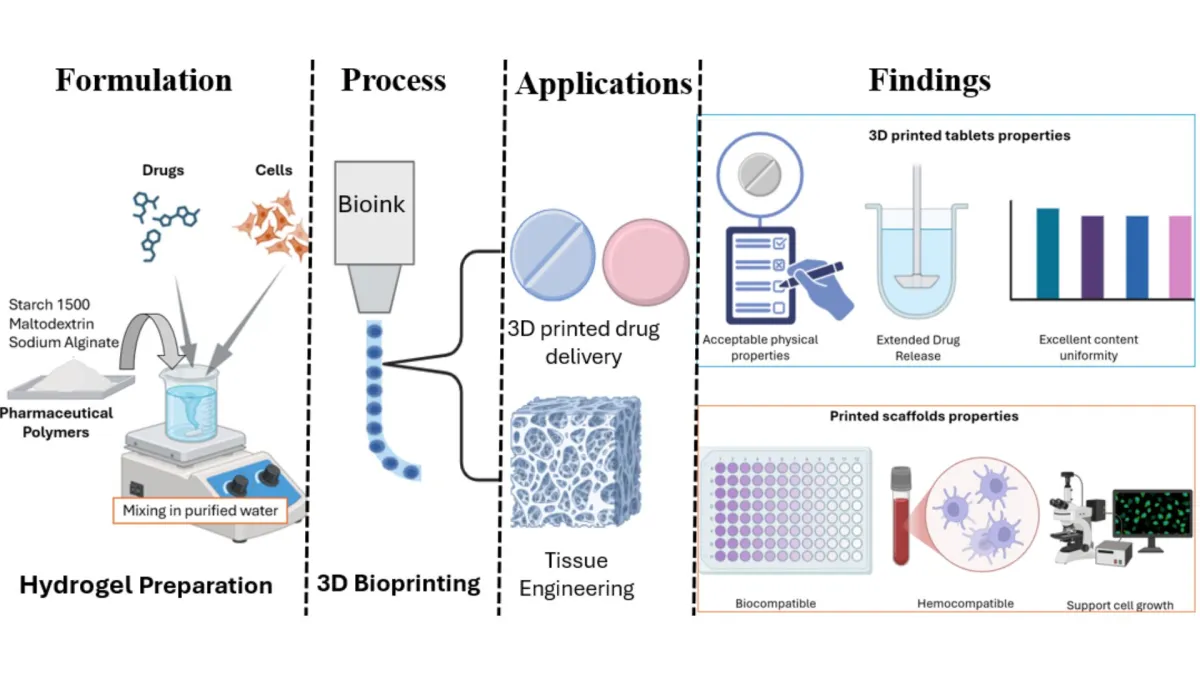
GOA, INDIA — In a quiet laboratory at the Birla Institute of Technology and Science (BITS) Pilani, Goa Campus, a team of researchers has unveiled a technological breakthrough that could bridge the gap between high-end regenerative medicine and everyday clinical practice. By utilizing low-cost, regulatory-approved pharmaceutical polymers, the scientists have developed a novel "bioink" capable of 3D-printing both complex skin scaffolds for wound healing and customized, chewable medication for chronic conditions.
This dual-purpose innovation addresses two of the most significant hurdles in modern biomedical engineering: the prohibitive cost of specialized materials and the rigorous safety standards required for human application. By moving away from expensive, animal-derived substances and toward common ingredients like maize starch and alginate, the BITS Pilani team is paving the way for a future where personalized healthcare is not just a luxury, but a standard of care.
Main Facts: A New Formula for Life and Longevity
The core of the research lies in the development of a proprietary bioink—a substance used to create three-dimensional structures in a bioprinter, much like traditional ink is used in a paper printer. However, unlike traditional bioinks that often rely on expensive synthetic proteins or animal-derived collagen, the BITS Pilani formula is remarkably grounded in everyday pharmaceutical science.
The ink is composed of a synergistic blend of three primary components:

- Maize Starch: A widely available carbohydrate that provides structural integrity.
- Maltodextrin: A common food additive and pharmaceutical excipient that aids in texture and flow.
- Sodium Alginate: A natural polysaccharide derived from brown algae, known for its ability to form gels.
The significance of this choice cannot be overstated. All three materials are already approved by global health regulators (such as the FDA and India’s CDSCO) and are "animal-free," which eliminates the risk of zoonotic disease transmission and circumvents the ethical concerns associated with animal-sourced collagen.
By utilizing semisolid extrusion (SSE) 3D bioprinting—a process akin to a highly precise, computer-controlled glue gun—the researchers successfully printed two distinct medical products: porous scaffolds designed to help regrow human skin and "smart" chewable tablets loaded with Glimepiride, a common medication for Type 2 diabetes.
Chronology: From Concept to Clinical Potential
The journey of this research began with the identification of a "bottleneck" in the 3D bioprinting industry. While the technology to print tissues has existed for years, it has largely remained confined to high-budget research institutions. The BITS Pilani team sought to "democratize" this technology by focusing on material science.
Phase 1: Material Selection and Rheological Engineering
The researchers spent the initial phase of the study perfecting the "rheology" or flow characteristics of their ink. A bioink must be fluid enough to pass through a fine nozzle but sturdy enough to maintain its shape once deposited. The team discovered that their starch-alginate-maltodextrin blend possessed "shear-thinning" properties. When pressure was applied in the printer, the ink thinned out to flow; the moment the pressure was removed, it regained 87% of its original thickness almost instantly.

Phase 2: The "Egg-Box" Transformation
Once the designs were printed, the structures needed to be stabilized. The team employed a chemical process known as ionic crosslinking. By exposing the printed structures to calcium chloride, they triggered the formation of "egg-box junctions"—a molecular arrangement where calcium ions nestle between polymer chains, locking them into a stable, water-rich hydrogel.
Phase 3: Biological and Pharmaceutical Validation
With the structures finalized, the team moved to testing. The skin scaffolds were seeded with mouse fibroblasts and human keratinocytes (the primary cells found in the outer layer of the skin). Simultaneously, the pharmaceutical team tested the 3D-printed tablets for dosage accuracy and drug release rates.
Supporting Data: Precision at the Micrometer Scale
The success of the BITS Pilani study is backed by rigorous quantitative data that underscores the viability of their bioink for medical use.
Skin Scaffold Performance:
- Porosity: The scaffolds were engineered with microscopic pores measuring approximately 39 micrometers in width. This specific size is crucial; it is large enough to allow oxygen and nutrients to diffuse through the tissue but small enough to provide a stable "ladder" for cells to climb and multiply.
- Cell Viability: In biological assays, more than 70% of cells survived and thrived on the scaffolds over a 48-hour period. This confirms the material is "cytocompatible," meaning it does not poison or inhibit living tissue.
- Hemocompatibility: Tests involving red blood cells showed minimal damage (hemolysis), indicating that the material is safe for use in wound dressings or implants that come into contact with the bloodstream.
Pharmaceutical Tablet Performance:
- Content Uniformity: The 3D-printed chewable tablets were loaded with a 2mg dose of Glimepiride. Traditional manufacturing often struggles with "low-dose" uniformity, but the BITS Pilani method achieved near-perfect distribution of the drug across all printed samples.
- Sustained Release: Rather than a sudden "dump" of medication into the system, the tablets demonstrated a controlled release profile, gradually dispensing the drug over a four-hour window.
Official Responses and Scientific Significance
While the team at BITS Pilani continues to refine the technology, the scientific community has noted the study’s potential to disrupt the current manufacturing paradigm. The researchers emphasized that the move toward regulatory-approved, off-the-shelf polymers is a deliberate strategy to bypass the "valley of death"—the gap where most medical innovations fail because they are too expensive or difficult to clear through regulatory bodies.

According to the study’s findings, the use of animal-free components also addresses a growing demand in the global market for vegan and "halal" or "kosher" medical products, ensuring that the benefits of 3D bioprinting can be extended to all patient populations regardless of ethical or religious dietary restrictions.
The team noted that the ability of the ink to recover its shape (the 87% thickness recovery) is a "gold standard" for extrusion-based printing, ensuring that complex, multi-layered structures—such as the valves of a heart or the layers of the dermis—can be printed with high fidelity without the structure collapsing under its own weight.
Implications: A Hospital-Side Revolution
The implications of this research extend far beyond the laboratory, suggesting a fundamental shift in how hospitals and pharmacies operate.
1. On-Demand Tissue Engineering
Currently, burn victims or patients with chronic ulcers often rely on skin grafts from other parts of their bodies or from donors. With BITS Pilani’s low-cost bioink, a future is visible where a hospital could "print" a custom skin graft tailored to the exact dimensions of a patient’s wound, using the patient’s own cells to minimize the risk of organ rejection.

2. The End of "One Size Fits All" Medication
The pharmaceutical application of this bioink is equally transformative. Traditional mass production creates pills in fixed dosages (e.g., 5mg, 10mg, 20mg). However, a child or an elderly patient might require a highly specific dose like 2.7mg.
- Customization: Pharmacies could print tablets in specific shapes, colors, or flavors to improve "patient compliance" (the likelihood that a patient will take their medicine).
- Polypills: The technology allows for the printing of multiple drugs into a single tablet, each with its own release rate, potentially reducing "pill burden" for patients who currently take a dozen different medications a day.
3. Economic Accessibility
By utilizing maize starch and alginate—materials that cost pennies compared to the thousands of dollars charged for specialized bioinks—this technology is uniquely suited for developing nations. It offers a path to advanced healthcare that does not require the massive infrastructure of traditional pharmaceutical factories.
Conclusion
The work at BITS Pilani represents a pivotal moment in the evolution of 3D bioprinting. By proving that high-tech medical solutions can be built from low-cost, safe, and widely available materials, the researchers have brought the dream of "personalized medicine for the masses" one step closer to reality. As this technology moves toward clinical trials, the medical community watches closely, anticipating a world where the printer in the local pharmacy is just as vital as the surgeon’s scalpel.
