

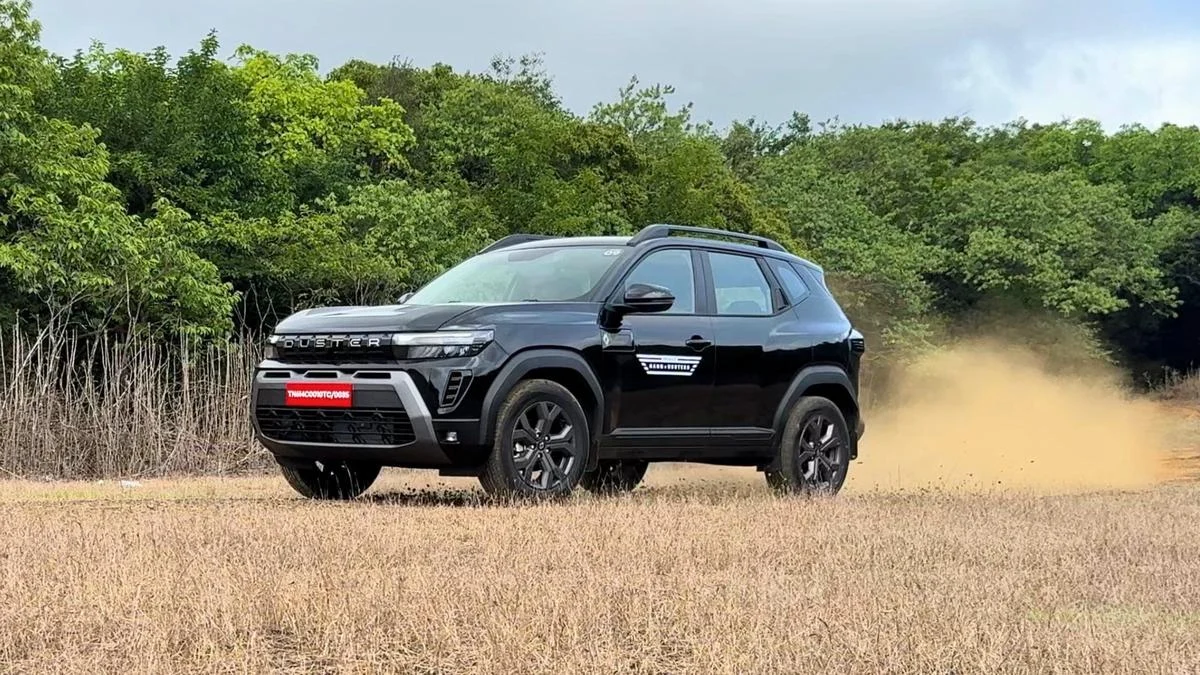
Main Facts: Challenging the "Bigger is Better" Dogma
In the competitive landscape of the Indian automotive market, a long-standing prejudice has dictated consumer behavior: the belief that a large SUV requires a large engine. For years, buyers have equated displacement with capability, often dismissing sub-1.2-liter engines as "underpowered" for anything larger than a hatchback. However, the Renault Duster TCe 100 is systematically dismantling this narrative.
Equipped with a modest 999cc, three-cylinder turbocharged petrol engine, the Duster TCe 100 produces 100 PS of power and 166 Nm of torque. While these figures might seem conservative on a spec sheet dominated by 1.5-liter rivals, the real-world application tells a vastly different story. The vehicle positions itself not as a budget compromise, but as a precision-engineered "sweet spot" within the Duster lineup, retailing between ₹10.49 lakh and ₹13.49 lakh.
The core of the Duster TCe 100’s appeal lies in its mechanical synergy. By pairing a highly responsive turbocharger with a specifically calibrated six-speed manual transmission, Renault has created a powertrain that punches significantly above its weight class. It offers a blend of European driving dynamics, rugged chassis composure, and a sophisticated interior that challenges the dominance of established players like the Volkswagen Taigun and Skoda Kushaq.
Chronology: The Evolution of a Legend and its Downsized Heart
The journey of the Renault Duster in the Indian market has been one of pioneering success followed by a period of strategic reinvention. To understand the significance of the TCe 100, one must look at the timeline of its development:

- The Monocoque Revolution (2012): Renault launched the original Duster, effectively creating the compact SUV segment in India. It was lauded for its ride quality and car-like handling paired with SUV ruggedness.
- The Era of Turbocharging (2020-Present): As global emission norms tightened and the industry pivoted away from diesel, Renault began focusing on its "TCe" (Turbo Control efficiency) family of engines.
- The Kiger Foundation: Renault introduced the 1.0-liter turbo engine in the Kiger compact SUV. While successful, critics wondered if the same block could handle the larger footprint and heavier mass of a Duster.
- The Re-engineering Phase: Recognizing that the Duster serves a different demographic—one that prioritizes highway stability and occasional off-roading—Renault engineers did not simply "drop in" the Kiger’s motor. They undertook a substantial re-calibration of the engine mapping and the transmission ratios to suit the Duster’s heavier duty-cycle.
- The Current Iteration: The TCe 100 launched as a strategic entry and mid-range option, designed to offer a "European" driving feel at a price point that undercuts the premium German and Czech rivals.
Supporting Data: Engineering the 1.0-Litre "Giant Killer"
To understand why the Duster TCe 100 performs better than expected, we must look at the technical data and the specific tuning of its powertrain.
The Power-to-Weight Equilibrium
While 100 PS sounds modest, the Duster’s monocoque construction keeps the kerb weight optimized. The more critical figure is the 166 Nm of torque, which peaks at just 2,000 rpm. This low-end grunt is what allows the vehicle to feel "effortless" in city traffic.
Transmission Calibration
Renault has opted for a six-speed manual gearbox rather than a five-speed unit. The additional gear allows for:
- Shorter lower ratios: For better acceleration and "crawling" ability in traffic.
- Taller sixth gear: For relaxed highway cruising. At 100 km/h, the engine remains in a refined rev band, optimizing fuel efficiency and reducing Noise, Vibration, and Harshness (NVH) levels.
Chassis and Suspension Metrics
The Duster maintains its reputation for class-leading ride quality. The suspension setup, while leaning toward the firmer side to handle the turbo’s mid-range surge, utilizes high-quality dampers that absorb sharp ruts without upsetting the cabin’s composure. The inclusion of all-wheel disc brakes in the Techno variant is a significant safety and performance data point, offering superior stopping power compared to the rear-drum setups found in many competitors.

Official Responses: Renault’s Strategic Positioning
While official press releases often focus on marketing jargon, Renault’s engineering choices provide a clear "response" to market demands. The company has communicated through its product design that it prioritizes mechanical integrity over digital gimmicks.
Industry analysts note that Renault’s decision to use fabric trims, dual-tone finishes, and brown accents in the cabin is a deliberate attempt to move the Duster upmarket. "The goal was to create a ‘sophisticated’ environment that feels mature," says a source close to the design team. By using soft-touch fabrics on the center console and door trims, Renault is addressing previous criticisms of "budget" plastics in older models.
Furthermore, the integration of technology—such as the responsive touchscreen with Apple CarPlay and Android Auto—serves as Renault’s response to the tech-savvy Indian buyer. However, the brand has remained firm on its "driver-first" philosophy, choosing to invest in communicative steering and chassis balance rather than "superfluous" features like ventilated seats, which were omitted to maintain a competitive price bracket.
Implications: A Shift in the Compact SUV Hierarchy
The success of the Duster TCe 100 has several long-term implications for the Indian automotive sector and potential buyers.

1. The Normalization of Downsizing
The Duster proves that "right-sizing" is more important than "downsizing." If a 1.0-liter engine can confidently climb mountain gradients and overtake on highways without "feeling short of breath," it paves the way for other manufacturers to introduce smaller, high-efficiency turbocharged engines in larger vehicle segments. This leads to better fleet emissions and lower running costs for consumers.
2. A Challenge to the "German" Monopoly
For years, the Volkswagen Taigun and Skoda Kushaq were the default choices for buyers seeking a "European" driving experience. The Duster TCe 100, priced at ₹13.49 lakh for the top-end variant, offers a similar—and in some cases, more spacious—alternative. This increased competition is likely to force rivals to reconsider their pricing strategies or equipment levels.
3. The Value vs. Feature Conflict
The Duster highlights a growing divide in the SUV market: Features vs. Fundamentals. While rivals offer panoramic sunroofs and ventilated seats, the Duster focuses on steering feel, suspension composure, and tactile cabin materials. The market’s reception of the TCe 100 will indicate whether Indian buyers are shifting their priorities back toward the "driving experience" over a "gadget-heavy" interior.
4. Practicality for the Modern Family
With its ample boot space, generous rear-seat accommodation, and rugged capability on dirt tracks, the Duster TCe 100 reinforces its role as a versatile family tool. It suggests that a single vehicle can indeed handle the daily office commute, the school run, and the weekend mountain getaway without requiring a massive engine or a premium luxury price tag.

Conclusion: The Triumph of Engineering over Specifications
The Renault Duster TCe 100 is a reminder that a car is the sum of its parts, not just the size of its pistons. By focusing on torque delivery, gearbox calibration, and a communicative chassis, Renault has delivered a vehicle that defies the limitations of its 999cc displacement.
It is a vehicle that rewards the driver who looks beyond the brochure. While the 1.3-liter turbo variant remains the choice for the outright speed enthusiast, the TCe 100 emerges as the pragmatic hero. It offers a sophisticated, engaging, and remarkably capable SUV experience that proves, once and for all, that efficiency and character can coexist in a single, well-engineered package. For the Indian buyer navigating a market of rising costs, the Duster TCe 100 isn’t just a car; it’s a compelling argument for a smarter way to drive.
Technical Specifications at a Glance:
- Engine: 1.0L TCe Turbocharged Petrol
- Power: 100 PS
- Torque: 166 Nm @ 2,000 rpm
- Transmission: 6-Speed Manual
- Price Range: ₹10.49 lakh – ₹13.49 lakh (Ex-showroom)
- Key Features: All-wheel disc brakes, 17-inch alloys, Wireless charging, Android Auto/Apple CarPlay.
This report was compiled in association with Motorscribes and The Hindu.
